Arizona Autism Charter School's Path to the Yass Prize
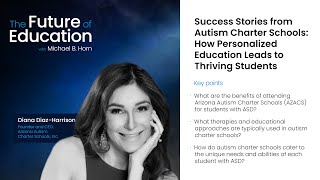
Diana Diaz Harrison founded Arizona Autism Charter Schools after her own child's autism diagnosis revealed gaps in K-12 education. The network won a $1 million YASS Prize and uses applied behavioral analysis with project-based learning, maintaining a 3:1 student-to-staff ratio. The funding will expand to Tucson, partner with Apple co-founder Wazen on STEAM, and launch a national accelerator for tuition-free autism charter schools.
Chapters
Welcome to the future of education. And now here's your host, Michael Horne.
Welcome, welcome. Welcome to the future of education, where we are obsessed with helping all individuals build their passions and fulfill their human potential. And today, we get to talk to someone who is helping do just that. She's Diana Diaz Harrison, founder and CEO of Arizona Autism Charter Schools, which won this year's Yass Prize, which awards $1 million to the country's education provider that best exemplifies what they call the STOP Principles. That stands for sustainable, transformational, outstanding, and permissionless. Diana, first, welcome. Congratulations on winning the YASS Prize. There were, I mean, frankly, many inspirational and incredible educators competing this year. Many of them won awards. You won the top prize. I happened to be a judge, actually, in one of the rounds and got to read your application. I was just blown away and so excited by what you have created and the vision. And we'll get to the prize and more toward the end of our conversation. But I just want to start with, you know, grounding our audience at a high level with what are the Arizona autism charter schools?
So we are an autism focused charter school. So we implement best practices for children with autism, and we are the first and only autism focused charter network in the state and in the southwest. So we feel that what we do is very unique in kind of marrying best clinical practices for kids with autism along with best instructional and educational practices. So the best of both worlds in a school setting for kids with autism.
Very neat. So tell us. We're going to get more into the instructional model and unpack all that, but go back a little bit. Tell us the founding story. What was that problem that you experienced that led you to say we need to create something that does not exist?
Yes. So I am an autism mom. I have my son Sammy, who is 20 years old and in our transition academy now. But when he was little and we found out that he had an autism diagnosis, we immersed ourselves in best clinical practices to get him up to speed on all of those foundational skills like communication, shaping behavior, and just more social interaction, tolerating sensory differences and the like. And luckily, here in Phoenix, there are wonderful early intervention programs that are a model for other states. But sadly, when he became school age, all of the work that we had done in early intervention wasn't available or to be continued. When the rest of his next chapter came to be kindergarten and then K12 school, all of the great work that I learned about in clinical practice was just not a part of his schooling. So it became very challenging to watch him regress and just kind of go through school and go to school, but not becoming his best self during school, which is what school is supposed to do. So, you know, I was one of those moms that advocated heavily for, you know, bringing the embedded supports that needed. But I quickly realized that I just didn't want to be that mom that was fighting all the time and then have these forced situations and then feeling like people were doing me a favor when there were more and more kids with autism coming up in school. And, you know, we parents just had to settle or, you know, pay 40 to 50,000 a year for private school. So I knew there had to be a better way. And luckily, I did learn about other autism charters in the country. Florida was a wonderful state to look at as a model, and I pitched the idea to people in Arizona. But, you know, special education comes with a lot of, you know, litigiousness around it, and there were no takers. So after a while of knocking on doors, I realized that if I really wanted this to happen, I would have to be the one to do.
Wow. And so all of a sudden, you're an education entrepreneur, you. And I think. I mean, it makes sense. We had a former school head for our kids who used to say, we get the best and you get the rest. It sounds like that was the opposite of what you were having for your son. Sammy. I'm curious, like, you build this model and as I understand, you've used applied behavioral analysis sort of on the clinical side, and then you're really deeply personalizing the learning itself. What does that look like for students in your schools?
What's really great about our school is that when people come in tour and see what we're doing with kids, they'll tell me this looks more like a program for gifted kids. You know, there's so much theme project based learning. We've adopted the was Ed curriculum, which is developed by Steve Wozniak, which is typically, you know, those kinds of innovative programs are reserved for the highly gifted kids. But at our school, we really see all the kids as gifted in their own way. You know, we really celebrate their neurodiversity. Obviously, these autism and other special needs come with challenges, but the neurodiversity is also very much celebrated here in that we allow kids to engage their find foundational skills into projects that are of high interest to them. So we developed a model that really addresses the needs of the entire spectrum, because it is a spectrum condition that manifests in many different ways. You know, you could have kids that have intensive needs and need a functional form of communication because they're non verbal, you know, to very verbal kids who have a peak skill, say in tech or math, but need more support with language. So the class sizes are very small. We have an average 3 to 1 student to staff ratio across the board. And that really helps make the program more personalized for, for each student that is a part of our community.
That's amazing. So the three to one student to staff ratio, like how do you afford that? Because Arizona is not known for high per pupil funding per se. What goes into supporting a model like that so you can provide that kind of personalization?
Well, I think the main, the main thing that happens is that the resources that do come from the state and federal funding go into the classroom versus top heavy special ed departments, you know, that hire a lot of extraneous legal staff or you know, others. Our executive team is super small and all of the funding goes into the classroom. Then I think that that's a choice. You know, anybody can make that choice, but very few schools do. I think the other area is all the private grants and fundraising that are a core part of my job telling our story and convincing grant funders to invest in our kids because they can do great things given the opportunity in our model. So both of those things, I think make a huge difference in putting the resources where the kids are.
No, that makes a ton of sense. And I think that focus on the classroom spend as opposed to the administration is something other schools would do well to model. Sometimes when you see these big price tags on the east coast where I am, you sort of say, where are all the money? Where's all the money going? And it's sadly not into the classroom in many cases. I'm curious, you talk about on the website in sort of the. About, you know what you do, that every student at every single grade level and ability level is going to make progress in your model. You're realizing the high state standards. You've talked about it here. It doesn't look like a program for special ed students. It looks like a program for gifted students. This is a school frankly that has high expectations for its students. It's clear what are the outcomes? What do you see from the students?
Every day we really measure and celebrate engagement. So you know, with our students, oftentimes especially highly impacted students, you know, if they're kind of there and not causing any trouble, you know, they can really slide by with doing the minimal and you know, people that are in charge of the Kids can also get by with doing the minimal. But we have high engagement expectations for our, you know, students and staff that are measurable. We've got a lot of data driven instructions. We check our data very frequently. We have the kids see the owners of their data as well. So that, you know, it's not an external force watching their growth, it's themselves. And then, you know, we have a lot of a very competitive spirit at our school that is healthy, I think, because our students, if given the opportunity, do love to compete. You know, one example is our great special Olympic program and tournaments and our kids are coming back with first place medals. Internally, we like to post our data, celebrate our data, and also come together as a community for students who need help in any area. And part of the learning that takes place here is being okay with asking for help, learning how to advocate for yourself if you need support in different areas, and celebrating that as well. So it's all about what the kids can do and kind of reframing how they feel about themselves. Yes, they have learning differences, but that is not what's going to define them. It's their latest research, their latest group based project, or how they help somebody else in the community that really defines them. And so now kids will come and say to me, Ms. Diana, autism is my superpower. Look at what I figured out. And that's exactly what we want, what we want them to feel here.
I love that asset based framing. I suspect the parents also love that asset based framing. Dig into the personalization a little bit more because it sounds like you have a real model of empowerment where the students, as you said, are owning their data. It sounds like they're setting goals. How does technology play into that learning? How does the projects work? What does that look like in the mixing of those different elements?
Yeah, so I think it starts by having a menu of assessments that is developmentally appropriate for each student. So we don't just have one assessment and then everybody has to fit into that. That doesn't work for our kids. We have research based assessments that are proven to deliver best outcomes for autism and we use those for students who don't have intellectual disability. We use more standardized assessments. But you know, having just one assessment that is the state based assessment for all kids is really detrimental for kids who can't access that. And so then you end up measuring nothing because the test is not appropriate for them. So it starts by, you know, really doing a deep evaluation of each child and putting them in the right assessment, evaluating the efficiency of the strategies Used to help them grow and then helping them on their data. Another exciting thing about our school is that we have student digital portfolios. So parents are seeing the students data in real time and can see data, work samples, videos of projects. Kind of a nice, well rounded portfolio base which is light years ahead of most because, you know, kids that have special needs typically have an IEP that gets reviewed annually. And oftentimes parents will go to that meeting and find out after a year that their kid made minimal progress. So that just parents feel like they're in the dark. You know, if there are skill acquisition issues, they should know earlier so that they can help be part of the team that figures out a solution. So we really love the data transparency at our schools or our digital portfolios. And it really is game changing for parents who are often fold over and over what their kids can't do, their kids disability and this, that and the other. Yes, we address that as well. But from there it's all about what the kids learn and do.
That's awesome. And so then it sounded like you all have an online school as well, if I'm not mistaken. So this is not just a brick and mortar school experience. What does that look like?
Yes. So we did dive into virtual programming when everybody had to during COVID and the way we ran our online school, which was not part of the original, but we didn't hesitate to pivot. We really took cues from telehealth teletherapy and developed a protocol called telelessons where it was still very much small group or even one on one so that we could still run drills and get data on the kids. We still did our project based showcases even though the kids were online and in person and there was a variety of modalities. But back to our project based learning. Every quarter the kids collaborate to develop a project with peers, which is huge. And they presented either in person or virtually if they're in the online school. Our online program had so much success that we decided to keep it as part of the menu of options for families. And yeah, more than 100 families have selected that now. We spiraled into a hybrid model as well as, you know, one of the menu options. And so it's all about just giving parents choice who typically don't have a lot of choice.
Wow. So I mean that's powerful. And so it sounds like, I mean students have a lot of choice at the classroom level. The parents are having choice of different models here. Just take us one more step into the, into the learning experience. Student Shows up. It sounds like we're not talking about block periods or a seven period day or something like that. It sounds like they're really deep with a, you know, fellow teacher, with fellow peers, figuring out which projects they're working on, which content they're going to learn. And it's much more self driven. Is there what's the rhythm, if you will, of the day? How do you use time?
So in our K5 program, the kiddos are in a group of about eight detentions. They have a lead teacher and support staff and then they go through, you know, their regular daily schedule that is very much visually driven. There's visual schedules all over and that's as they work through their day. Students are kind of marking, you know, what they have completed and then moving on to a different station. It's a three station rotation model which helps keep the teaching and learning small. Three kids to a staff member and rotations throughout the day. And it really helps students, you know, not have to be seated in one spot, you know, for, you know, several hours a day. They're moving about and navigating an instructional program that in large part is self driven so that they can apply their skills into ideas and creativity that is of importance to them. And you know, kids on the spectrum have very defined interests. So this really helps leverage, you know, learning foundational skills and then as a reward, applying it to their preferred project.
Gotcha. Super interesting. Okay, so let's pivot now. You win the YASS prize a few months ago, $1 million. What are you going to use the funds for? You already have several schools up and running. I think you're serving something like 700, 800 students at the moment. What's next on the horizon?
So we're really excited, excited to be adding a campus in Tucson, Arizona. We're using the YAS prize fund to continue to have more and more project based learning through Wazen. We're thrilled about this partnership because the co founder of Apple developed the awesome theme and project based kits that include everything from coding, robotics, drone flying with the culminating activity of getting an FAA license, for example, you know, very cool stuff. And so we are going to expand our STEAM programming across all our sites and including for our online students. And that's a very exciting experience expansion that we're having internally. And then the other portion of the prize is going to be used to develop the national accelerator of Autism Charter schools. I know firsthand how hard it is not to have a viable school choice for my child with autism. And we know there are only a few autism focused charter school tuition free around the nation. So part of the YADA prize will be used to accelerate the creation and the founding of nonprofit tuition free autism charters in other states.
That's powerful. So. And it goes to the next question I want to ask, and I'm curious, frankly, if you agree with the statement I'm about to make, which is it feels like right now there's a movement of entrepreneurs in education that feels much bigger than it was when you got started, say in 2016. I think it was. And I'm curious quickly, I guess, does that feel right to you that we're in this moment of time right now where there's a lot of education entrepreneurship going on?
Absolutely. There are charter schools, there are more niche specialty charter schools which we're excited about. And then all of the micro schools that are emerging and yesa scholarships that are available are, are great for education options, innovation and choice. I We've seen a little bit of a pendulum when here in Arizona. And we're watching because we think the more choice, the better. You know, it's hard enough to navigate, you know, the school setting with a child with special needs, you know, having limited choices or just one choice is insufficient and outdated. And now that parents have experienced choice, you know, they don't want to give that up. So we are very protective, you know, of, you know, the ability to start charters if that's what a founding team wants to do, or to start private or micro schools that benefit from GSA funding because, you know, we shouldn't be limited by prescribed, you know, by an extensive program.
Yeah, that makes sense. And obviously we're all watching Arizona right now to see what happens. But I guess as you turn and you're supporting these entrepreneurs in, in starting, you know, autism based programs specifically, but more generally as well, what, what are the lessons from your own experience that you would offer or teach these entrepreneurs as they jump into this world?
I think it's very important to know that it's very consuming work. You know, starting a school is not for the faint of heart. So you really have to go into it knowing that, you know, you're starting a business and many businesses don't make it in the first few years because of all the barriers that come into play. But if you have a committed founding board that's willing to help navigate all kinds of obstacles and a leader with a purpose first and foremost, and you know, you're doing this because you're going to do it no matter what it takes, then you know that that is the level of commitment that's required for something like this. But once you know, you, you get all of those pivotal processes in place, the reward that you get from serving kids who otherwise wouldn't have a quality option is really priceless. And then to see those kids flourish into high school students that are starting entrepreneurial endeavors and making friends for the first time and presenting a project to their parents, you know, who previously, you know, they thought they wouldn't be able to present anything, is really game changing. And I think it's really changing the narrative about what it is to be a person with autism and how that doesn't need to have all the limitations that have been previously associated with it.
It's powerful stuff. So last question as we wrap up here, which is what are the lessons that maybe your experience holds for us as a nation, you know, not just for the education entrepreneurs, but for educators, parents, policymakers, and society more broadly?
I would say we should not lower the bar. You know, we should not make do because of, you know, whatever the talent pipeline or resources shift up and down. I think keeping the bar high for our kids, we should be unapologetic about that because the kids deserve everything that is the most fruitful and exceptional and exciting at school. So we fight hard to keep the bar high and to troubleshoot any barriers that get in the way of that. But I think what's going to bring America back is not lowering the bar for kids and fighting to keep it high no matter what.
Terrific stuff. Diana, congratulations again. More importantly, congrats for what you're doing for students not just in Arizona, but increasingly across the country. Really appreciate the work you're doing.
Thank you so much. Thank you for the support and helping us share our story.
Yeah, you bet. And we'll be back next time on the FUTURE of education.
Sam.










