Arizona State University's Julie Young on How K–12 Schools Can Meet the Current Moment
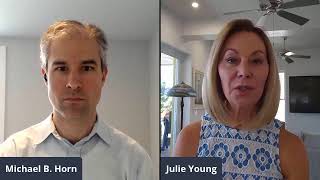
In this live interview, Michael Horn talks with Julie Young, founder of Florida Virtual School and managing director of Arizona State University’s Prep Academy and Prep Digital. Young explains how ASU Prep Academy—a network of 12 charter schools, 11 brick‑and‑mortar and one digital high school—pivoted to fully blended, personalized learning and then, when COVID‑19 forced school closures, moved the entire network online in just 48 hours. She details the logistical effort: device and hotspot distribution, creation of multiple Zoom support rooms for parents, students, teachers, and IT, and intensive professional development for staff. The conversation expands to ASU’s broader role, including the free ASU4U resource hub and partnerships with 68 Arizona districts, offering training, content, and guidance to schools worldwide. Young offers concrete recommendations for districts: conduct an inventory of devices and broadband access, assess teacher readiness, understand special‑needs populations, and use diagnostic tools (NWEA, DreamBox, IXL, ALEKS, Lexia) to personalize instruction. She discusses social‑emotional support, the need for virtual recess and learning‑success coaches, and the importance of caring for parents as well as students. Looking ahead, she emphasizes flexible schooling models—hybrid, full‑remote, or choice‑based—based on family preferences, and stresses that future instruction must be student‑centered, using diagnostic data to meet learners wherever they are. The interview closes with reflections on lessons from Florida Virtual School’s individualized design and a call for educators to adopt robust, personalized digital curricula.
Chapters
Welcome, everyone, viewing on YouTube Live and Facebook Live. I'm Michael Horne. Really excited by my guest today. Longtime friend, longtime innovator in the K12 education world. We have Julie Young, who many of you will know her. She founded the Florida Virtual School. Famous scene in my mind of her putting a student in the center and saying, what if we actually built a school that put students in the center of their learning and drove all, all the decisions around that as the primary concern. I grew that to significant success. And now serving as the managing director of Arizona State University's Prep Academy and Arizona State University Prep Digital, which Julie, I'll let you tell us about in just a moment. But first, welcome and thanks for joining me.
Thanks for having me.
Appreciate it so much amidst these crazy times. But before we get into sort of the crazy times that education's in right now and the impact on broader society, I'd love you just to tell folks, what is ASU Prep Academy and what is ASU Prep Digital and what do you all do in this space? I think a lot of people know Arizona State, very robust higher ed innovator. They're probably less familiar with the K12 work you do.
Sure. Actually, it's a really unique opportunity. And ASU Prep Academy is a network of charter schools in the state of Arizona that was authorized by ASU about 10 years ago, very specifically to create new education models for success and to improve educational outcomes for all students. If you listen to our president, President Michael Crow, he will say, we didn't get into the charter business to get into the charter business. We got into the charter business because it was a vehicle to get into the K12 business. And his whole goal is to create this continuum of learning from really birth through, you know, through life. And so it is a group of 12 schools within the network, 11 of which are brick and mortar, which we call immersion at asu, and one of which is our digital program, our digital high school. And those, those 12 or those 11 other schools sit on seven sites in the central Phoenix area.
Perfect. And then. So as you all have been innovating, can you give us a sense, you know, COVID 19 hit schools shuttered across America. First of all, what happened to the brick and mortar charter schools that you were operating? But secondly, and more nationally and internationally, I suspect would love to hear more from ASU Prep Digital's perspective. The online learning that you've been doing for K12. What have you all been doing to help schools around the world actually sort of deal with this shift to remote learning that they're all struggling with right now.
Sure. Well, I'll start with ASU Prep Academy. We're incredibly proud of how the teams, how the. How the leadership and the families transitioned. We. I've been at ASU now for three years, and two years ago, we really started down the pathway of preparing our schools to all become blended, personalized learning institutions. And so we have been gradually preparing our teachers and our students with tools and pedagogy to make that shift. So then you add in ASU Prep Digital as a component and a support organization to the entire network, and we really made the transition in about 48 hours. Now, I will give that credit to President Crow, who started very early, once this kind of hit the airwaves, that this was coming, preparing our entire institution to move online seamlessly. And for those of you that don't know a great deal about ASU, it's the largest university in the country, has about 75,000 immersion on ground students and over 45,000 online students under normal circumstances. So very, very deliberate and dedicated to what? Distance to distance education, digital learning. And so we started to prep and prepare as a team for what this transition would look like. Made a decision on a Friday that our students would not be coming back on Monday, Notified our teachers because everybody was on spring break, which was convenient. Notified our teachers that they could either come into the building on Monday, or they could train from home on Monday and set up a full day of training on Monday and a full day of training on Tuesday, simultaneously set up stations by which parents could come and pick up devices. Did the research 2, 3 weeks previous as to who would need those devices at home and also who would need support with broadband. And so we ordered a set of hotspots that we could easily deploy. And so all that was kind of taking place simultaneous on that Monday and Tuesday after spring break. And then on Wednesday, our students went live. And we've done a tremendous amount of work on support. And so, you know, our digital team did a tremendous amount of training for our immersion teachers. We set up what we call zoom rooms, where parents can come into the zoom room and ask questions and get support. We set them up for students for tutoring purposes. We've had people come, you know, students come in from other programs, from, you know, other parts of the world to those tutoring rooms. We set up an IT zoom room. And so we just made sure that there was somebody always there for an extended period of time to support whatever the teachers, parents and students. Students needed at the moment. And it's been really remarkable. We've continued to do some type of professional development almost every day, if not every day, about three times a week. That's optional for our teachers, so they can opt in based on what they need at the moment. And then we continue to do some that are full, you know, that are, that are required based on what we're seeing, you know, across the network in terms of needs, et cetera. And then we've trained our students as well. So we've, you know, and it's changed. Every day is a different day. Started out with a very strict schedule, you know, wanting kids to show up at 8 o' clock and high school students to show up on the hour. And as I said yesterday to somebody that lasted about a minute, you know, that was like parents were about to pull their hair out because they were trying to get online for work and get into zoom for work. And, you know, all of that that we know by now, but all in all, we've had a really, really nice level of success. We're experiencing anywhere from 85 to 95% attendance on a regular basis. Parents seem happy and students seem to be engaged.
So, I mean, that's incredible. And it's an incredible amount of logistics you just described to move all of that that rapidly and have that many students, how many are served across the network?
So the network serves about 3,000 students. And yeah, it was just so much fun to watch the immersion team, leadership team and our digital team come together, put their heads together and just create the plan. And then we've met every. Well, for probably the first three weeks, we met every day, twice a day with leadership and support groups. And then now we're doing principal briefings every other day.
That's phenomenal. So shifting a little bit because the online learning vehicle, specifically ASU Prep Digital, you all have conceptualized it not just as a school unto itself or a school to serve the charters that ASU operates, but also to support schools and districts, not just nationwide, but worldwide. What sort of role are you playing as they've been shifted into very unfamiliar ground for many educators, students and parents across the world.
Right. Well, asu, the institution, is taking a very active role in terms of, you know, being available and a support organization to anyone who needs that kind of support. So we've created a website called ASU4U, which is a growing, evolving website of resources that are mostly free, some reduced cost, recovery type pricing, but mostly free that's available to educators, to parents, to students, and there are resources there for all ages. For again, k. Through life that keeps growing and evolving as a commitment from Arizona State University, really, to the community at large, which we see as the world, that's number one, first and foremost. But in terms of the work that ASU Prep and ASU Prep Digital is doing in this particular space, based on your question about the world, you know, we have a group of about 68 Arizona districts that we have a collaborative partnership with already. And so we've reached out to all of them to, you know, just offer our help. How can we help? And we're, you know, able. Stand ready and able to serve them either with instruction or. Or to help train their teachers on how to make this transition. What does that look like? Or provide content and then support with using that content. Initially, I think that educators across the country we are seeing just kind of froze. It was like everybody was paralyzed and did not know what to do next. I think it's completely clear that we were not prepared as a nation. We were prepared as an institution and a school, which was a pretty phenomenal experience to be part of. But I think everybody just kind of, kind of froze. And so. And it also seemed like, okay, we're going to be out of school for two weeks and then we're going to be back in school. And then it was, oh, maybe another two weeks, and then we might be back in school. And I think at this point, everybody's realized that we're not going back to school this year. And so what we're seeing is that right now they're doing the best that they can and they're trying to not introduce too many new things right now because our teachers are also in the same situation as our students parents, which they are in that they're trying to teach our students and they have their own children at home as well, and they're trying to work and figure all that out. So with that said, what we are seeing emerge across the country is a strong desire for summer opportunities for whether it be summer school or summer training. As we look at the fact that we don't know what August is going to look like. I don't know about you, but I heard on the news this morning that the CDC announced that what we may experience in the winter could actually be worse than what we're experiencing now.
Yeah, I just saw that.
Yeah. And so I think what we are trying to do is be available to really anyone in the country that would like us to be helpful in helping us take what we did to transition our schools so smoothly and help them Create continuity plans and a smooth transition plan and provide training to their teachers, to their leaders, to their parents, and student readiness as well. So that's kind of. Kind of the landscape.
No, it's phenomenally helpful, I think, to start thinking about this. Want to get in questions sort of as you start to think about, independent of what you all have done to support schools and districts worldwide. What do you think? You know, districts right now are going through this moment where it's really been. As you said, they froze in many cases, did not offer instruction or learning whatsoever, in some cases have started to triage the situation. Our friend Governor Bob Wise last week with me said, you know, moving from triage to then transitioning to a posture of transformation is what's key. What are the steps that you would recommend that states and districts ought to be doing? I know you've thought a lot about that. You have a paper that I believe just came out from the Pioneer Institute on the topic. Walk us through sort of the major things that you think states and districts ought to be doing as they walk into this world and for the foreseeable future, frankly, as you just laid out.
Right. I mean, I think we're all kind of, look, I think we're all kind of going, you know, wow, this really caught us off guard. It shouldn't have. It's the year 2020. How do we correct this moving forward so that we're never in this situation again? And every leader that I have spoken to across the country has had that type of opinion and feeling about how they move forward. You know, my. I think for, you know, kind of tips on what to do next or what to do now is first and foremost to kind of survey the scene. You know, find out what you have and what you don't have. You know, every leader, every district, every principal should know, you know, you know, who has a device. They should recognize the fact that just because someone has a cell phone that it may not work for what we are doing. If indeed we are going to provide distance, virtual digital learning, they may have a very old cell phone. So. So find out, you know, first and foremost, you know, who has advice. Be very careful of the fact that a parent may say, yes, we have a computer, but they might have three children. So be specific about gaining that information. I would say, you know, find out which of your families are not in a zone with broadband and whether they're even in an area where a hotspot will work. And then I would say work with your providers, your Internet and cable providers to See, you know, what can be done in the immediate to prepare for August and beyond, we need to know what our teachers know. So our teachers are all at different levels. We give our teachers across the country a lot of autonomy. And so many teachers use a lot of technology in their classrooms, and some choose to use very little, if any at all. And so really being able to do a deep dive into determining what your readiness is for virtual distance type of learning scenarios moving forward. So those are just kind of the fundamentals that I think are really important. And then also to really understand your. Your students with special needs and which of those students will actually benefit from online learning. Because we know that online learning actually can be incredibly beneficial and productive for many students who have special learning needs.
I just want to pause on that just for a moment, just because I've seen so many people push back on that and say, oh, gosh, this just won't work. And it flies in the face of the evidence that for some students with special needs, it actually can be a much more productive environment. It's certainly not built for all students with special needs. And so sort of parsing that is important. If I could just have you say maybe a little bit more how you would think about who it's works well for and how, you know, versus who maybe is you're gonna have to do something else for.
Yeah, over. You know, we've been at this for a very long time. This is said yesterday. Whenever I say it out loud, it frightens me. But this is my 40th year as an educator, in my 25th year as a digital educator. And over the years, I think what has been so rewarding is how many students who have struggled in our traditional environments due to learning differences or challenges that come into an online environment where all of a sudden pace becomes a little bit less relevant, and they are actually able to focus on mastery and working with a teacher one on one, as opposed to being in a room full of peers and feeling like they're the only one that doesn't know how to do whatever it is we're doing today or that they are in a separate classroom. Name the scenario. And so we have seen students with learning differ over the years, absolutely blossom, and have the time to actually really hone and focus on their, you know, growing their skill sets. So there's a whole host of students that have processing difficulties, Asperger's, autistic students, ADHD students, dyslexic students. I mean, students that have, you know, named that label, that do incredibly well in an online environment that has some flexibility and pace, when you get into the more severe disabilities that parents may be dealing with and teachers may be dealing with, whether those be physical, emotional, or mental, then that's a different scenario. And not always is this the best solution. Although I will say there are some good, really good online programs that are starting to materialize for speech therapy and occupational therapy that parents and teachers can avail themselves to under these circumstances. So I think what's really important about this conversation, we could do a whole, whole session on this. Yeah, that just like you can't lump, you know, that we should not be saying that online learning is for everyone or online learning is not for anyone. You can't lump these things into one, just one little pot of students and say, it doesn't work for these kids, and it does work for these kids, because that is not the case.
Makes a lot of sense. I'm going to deviate a little bit from my plan questions just because we're actually getting a lot of audience questions right now. So one that came in is how to best incorporate social and emotional development in distance learning. As schools are moving to these formats for the first time, how should they think about that side of the equation for their learners? And frankly, another question was saying, are the parents and families at home prepared for this moment? Those sort of go together, I think, in some ways. So how would you encourage people to think about those two questions?
Yeah, so when I think about the social and emotional element of what we're going through right now, I kind of think about parents and students together. So, I mean, I think we're in a situation where we have to take as much care of the parents as we do the students in this environment. And if we think about what they're dealing with, and we've all seen the funny memes that have been coming across our email where parents are just like, oh, my gosh, and, you know, I didn't sign up to be a homeschool teacher. And so recognizing what the scenario is today, as opposed to a traditional online model that we are all accustomed to, so many different factors to take into account. Number one, first and foremost, teachers have to recognize that right now it's about the fundamentals. And anything that is remotely filler needs to go away. It is about what are the standards that these students need to meet to actually feel as though we've accomplished what we need to accomplish for this school year. And let's look really closely at that and work our plans around that. One of the things that we should really recognize is that, you know, when, when over the years when you'd ask a student who maybe came into a virtual environment and then went back to a traditional environment and that you'd ask the question why? And a lot of times they'd say, I miss my friends. And so we try to build in a lot of collaboration and interactivity with our students in our full time program. And so I would encourage all of our teachers now to just give kids time to gather. They need time to gather. They need to come into Zoom and act silly and have the opportunity to play. We are doing virtual recess with our kids and so they have an opportunity to come into Zoom rooms and they play pictionary and charades and tic tac toe and other things like that trivia. But we need to create spaces for them to come together and be with other, with their peers, be with other students. I also do think that that one on one we have what we call a learning success coach that's part of our team. That learning success coach works alongside of our teachers and they really work to, you know, as a consistent figure with the students across all of their subject areas. Which would translate really nicely into what we are doing right now because we've sent these kids home and they have all subject. They're basically in a full time online program that has been being created on the fly. And so possibly having someone that can work with the families across all of the subject areas, not even about the subject areas, but just about how are you doing? How can I be helpful and really understanding the needs of that particular family and being like an outreach resource for them. And then we're doing workshops. We'll provide online workshops that kids can come into, parents can come into, teachers can come into that are really just helpful and providing places where parents can come together and talk. That goes back to that Zoom room idea. Where's a safe place that I as a parent can come in and ask other parents for advice or tips on how they're handling certain, certain situations. I think above all is we want to avoid this at home. And you know, you see the stories and, and you get it. And you know, you. We really want to help families avoid the tension as much as possible.
Yeah, as much as possible is the operative, I guess, phrase. So getting more questions in there. But I want to let you tackle where I think you were moving toward is you had done sort of the short term here and now needs that schools and states ought to be thinking about right now. As you think more broadly, you know, return in the fall, or frankly, not a return in the fall, and some sort of intermittent schooling or different blocks of schooling and so forth. How do we, how do you start thinking about what schools ought to be moving toward, I guess, and the systems that they put in place? Well, I guess perhaps you're covering for them in the summer as they have some time to plan and get on more solid footing. What are the major considerations in your mind that they should be putting forward? Whether it's remote or frankly, we go back to school.
So I think whether we go back to school or not, in theory, there will be those who do not come back to school. School. There will be parents who do not want to send their children back to school. There will be teachers that do not want to come back into the same environment. And so what we're doing is we're planning for a variety of scenarios, which I would encourage everyone to do. If we magically all got to go back into school on August, I think we should also be thinking about what should look different. What have we learned from this scenario? And even if we had the ideal situation, situation, how would it look differently in August than it did two months ago? With that said, I doubt that's what's going to happen. And so I think we've got to be prepared for a variety of scenarios. Number one, you know, when the schools open, there are going to be families that want their kids to be there every day. That's where their children eat, that's where they get their support and stability, and we have to be ready for that. We've already heard from families who are really enjoying this community kind of learning experience and are saying, wow, I'm actually really loving having some involvement in, you know, a heavier level of involvement in my child's education. I'd like to see some kind of situation in the fall where maybe my child could come to, come to school two or three days a week and I could have them at home another two days a week. We're looking at that scenario. We're also looking at providing a full time remote scenario for our families as well as part of what we do, you know, across, across our network. So we're looking at all those kinds of things. What we want to do ASU Prep Digital and ASU Prep, ASU in general wants to do is, is help districts ready themselves for those different scenarios. Because what you and I know, Michael, over the years, if we think about students who have exited the public sector schools or they've chosen a different public route, such as a charter school, or they've gone to a full, full time online program, or they've gone to being full time homeschooled. They've left that school because they've wanted something different that the school was unable to give them. Right now we have parents who are hating this and we have parents that are loving this. Same with teachers. And so if they see this new way of learning and they want to have this kind of flexibility, especially under the circumstances of the unknown of the virus, if the school doesn't offer them choices, they'll go somewhere else to get that choice and they'll have that option. And they'll also be much more ready to make the leap because what they have just experienced. So I think what we have to do as schools, regardless of where we are in the world, is we have to think of the fact that our families all in this scenario, they all have different circumstances and they're going to bring those circumstances to us in August and we need to be ready for that. So how can your school create different types of programs and have readiness for the different scenarios that your families are going to bring?
Super important point. The other piece of personalization that seems to matter from my perspective, but I'm curious to get yours about how you would actually implement this is that students, to your point that you've made a few times, have a huge variation in terms of where they are in their learning, learning differences, different learning needs and so forth, different mastery of content skills, et cetera. We've historically treated them as much the same in the existing system. Outside of maybe some tracking that goes on that has its own set of problems on the other end. But I think that spread, my own take is that spread is going to be even bigger when students come back because some students aren't even going to school right now. Some will probably do a bunch of enrichment and accelerate actually. And what's different, it seems to me, is that whereas before that probably was also happening, but as a teacher, you had some confidence that most of the students at least had been exposed to prior concepts. That exposure is not a guarantee anymore, particularly since some schools are refusing to introduce new concepts in this new world, what would you do? I mean, it seems to me to like give parents and teachers a very frank assessment of where all their children are and then personalize accordingly would be important. But what's realistic and how would you implement something like that?
So nwea just I don't know if you saw that this morning, but they just released a report indicating that as of Today their projections are that for math, students will enter or, you know, come upon August a half to a full year behind. So take the summer slide and magnify that significantly. It's a little bit less than that for reading, but still about a 70% deficiency. So what we are looking at in terms of learning loss from now until August is extreme in our particular vernacular and circumstances. So what's interesting about your question, if we go back, I'll take us back to the design of Florida Virtual School, mid-90s.
Yeah, let's do it.
The entire premise, and you mentioned it, was put the student at the center and build a program around that individual student. And so every student was taught as an individual. So students, so wherever, wherever they came to us, we took them from that point to where they needed to go. So a teacher would have potentially anywhere from 100 to 150 students. So, you know, the load looks like a regular school load. But in that group of 100 to 150 students, students could be in a hundred different places. And so utilizing the instructional tools, the online classes that were pre prepared, we were able to guide the student and facilitate those students and teach those students in all different places. And as opposed to you have to show up on this day and every student's getting the same assignments today and turning them in tomorrow, my hunch is that right now 99% of what's going on for those who are actively doing remote teaching and learning is that the students are being given the same assignments on the same day, asking to turn them in the next day or at least within the same week when our students show back up for August in whatever format that they show up in. To your point, they're going to be all over the map. And so I believe that we are going to have to put some diagnostic tools in place to really look at what that student knows at the moment and you know, where their gaps are. And then we're going to have to have instructional tools that allow teachers to teach kids that are all over the map. And so it's going to take traditional education to a, to a level that we've been striving for in online learning to personalize the instruction, instruction to a whole new level.
If your school sort of. I've gotten a couple questions of outside of zoom, what are tools you'd be using? I guess I'm curious from an assessment perspective in particular, maybe, you know, what are the diagnostic assessments that you'd be putting in place? Are there systems that you'd say, you know, every School ought to be looking at these three set of assessments or this personalized learning, you know, program or digital learning program, you know, even outside of ASU Prep. Digital, obviously. Are there certain ones that come to mind that for the educators tuning in right now, you'd say make sure this is on your radar screen because this is going to be the. I mean, I think this is so needed and yet I'm very worried that it's not going to happen lots of places. And I don't know what that looks like, but it'll be bad. So I'm just curious, what are the off the shelf ways to make this happen more seamlessly perhaps than it probably will?
Right. Well, I think NWEA is a diagnostic that is certainly available that I just mentioned that I know that our curriculum team certainly likes for that type of work. We also use a California Achievement test to actually diagnose kids that are coming in that may be ready for college work. I also think that many of the applications, and there are others too, but I think the applications also have diagnostics within them. So for example, whether you are using, you know, Dreambox Learning or IXL or we use Alex Math and Dreambox, all of those have diagnostic tools that allow you to place the student in the, in the appropriate place within that system. And what I kind of feel like we should be thinking about is what we've traditionally done as educators is we've used those types of tools as the afterthought. In other words, you know, okay, you finished your math, go in the back of the room and go on Dreambox and you know, self instruct. Whereas now I really think we're going to have to think about flipping that scenario and using the online, the online courses, you know, whether those are created by ASU Prep or Florida Virtual School or Name that Provider or these types of applications that I've just met. You know, there's lots of people using Dreambox and I ready and Alex and IXL and Lexia. Those are, you know, some of the, some of the tools that we're hearing repeatedly that are being used out there. We may want to take and use that as the base of the curriculum and then wrap the other instruction around it so that we know exactly where those students are and we can get them caught up and without the teacher losing their minds. I mean, I, I met with one of my friends who is one of the best teachers I've ever known through the course of my career the other day and social distance, and she's a phenomenal fifth grade teacher. Loves teaching, will probably never quit until she dies. And she's miserable. And one of the reasons she's miserable right now is she doesn't feel like she's teaching. She feels like all she's doing is creating materials. And so she said, I'm working 12 to 13 hours a day. I don't feel the reward of, like, I'm really connecting with the kids. And, you know, my first reaction is, you know, why are you creating all these materials yourself? You live in Florida. You have access to ready made, proven curriculum. Think about that.
Yeah. Yeah, well. And it goes to actually a question that someone asked also earlier, which was, how are you ensuring the teachers in the ASU system create materials that are consistent and so forth? And the answer is you have a sound curriculum across the grade spans and subject areas. Right. So that they get to use that and teach with it, as opposed to, to your point, trying to replicate what a lot of people have already done very, very well. And for those of you that haven't seen, as we sort of wrap up this conversation, if you haven't seen, say, the biology course, for example, that ASU Prep Digital has, it's the most phenomenal learning experience you can imagine and sort of what you would hope these online learning experiences would ultimately look like in terms of a deep, robust simulation, in essence, where you're actually, I mean, it feels like virtual reality. You're actually going through the systems of cells and so forth to see up close how these different parts work and function in ways that you just wish biology got taught that way worldwide, frankly, I don't think I'm exaggerating, Julie.
Right.
But so it's, you know, I think that's good advice. And I won't put you on the hotspot with a prediction of what will actually happen, I guess, in the fall. But instead, I'll just say I hope the great advice that you've given here, that there's a lot of educators out there who take that up and move with it. But deep appreciation for your leadership and the work you continue to do to like.
Thank you. Thank you so much, Michael. And I wish everybody out there the best and feel free to tap into those of us that have been doing this for a while. We're here to help.
Yeah, that's terrific. Thank you so much. And thanks to everyone for watching and engaging. We'll be back in a week with more.
Thank you.










