Behind National University's New Pricing Model
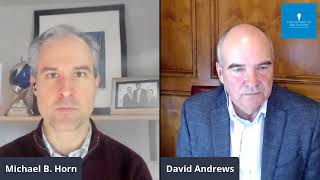
David Andrews, president of National University, discusses the school's 2021 affordability overhaul: a 25% tuition reduction delivered through Opportunity Scholarships, including a near-free option for Pell-eligible students. The university uses predictive analytics and behavioral nudges to personalize support for working adults, and is building industry partnerships to cut costs and align learning with workforce needs.
Chapters
Welcome to the Future of Education. I'm Michael Horne, joined today by the president of National University, David Andrews. David, first, good to see you. Thanks for being here.
That's great. Thanks for having me.
Yeah, no, I appreciate it. We've had conversations over the years more when you were at Johns Hopkins than when you've since you've been at national. But I'd love to start for those tuning in who don't know your background, frankly, a question that I love to ask in my other podcast, Future you, which is how did you get into higher education originally because you have a wealth of experience across a few different institutions in that realm?
I do have a lot of experience across different types of institutions. And I got into higher education because I just love school so much. I literally went from high school to undergrad, stayed through graduate school and liked it so much that I became a student of higher education and stayed into it and made a career out of it. So I've just been fascinated with higher education since the time I walked onto a college campus. And now that our college campuses are very different in shape, it's even kind of more exciting to see where the future takes us.
Yeah, so take us into that a little bit actually, because National University looks very different from traditional colleges and universities that a lot of folks who tune in and watch this later on will have in their mind. So I think it'd be great if you could give folks an overview of what is National University and we can get into the future direction in a moment. So let's start what it is today.
Yeah. And it's actually what brought me here to National University is that it's an open access, adult serving institution with an incredibly heterogeneous set of students, both in diversity of all types. But the pathways that they got here in an open access institution and the one thing they have in common is they're working adults, all looking for advancement, mostly career related advancement. And I had spent most of my career in very traditional institutions. And actually looking back on it, institutions, as I moved from institution to institution, they became more selective. Ended up at Johns Hopkins University, a highly traditional, selective institution. And the more selective you get, the more homogeneous the student population gets. And you know, I'm fascinated with the ability to meet the needs, the diverse needs of such a broad audience. And I've spent most of my career, I'm a developmental psychologist by training and most of my career has been trying to reach hard to reach populations of students and individuals. And this is a hard to reach population. These are busy Busy people who are trying to put an advancement agenda on the table along with work and family and other things that are going on with them and open access. We're not hand picking them to be successful in this environment. So it's a great challenge and a great opportunity for us.
It's interesting you mentioned that path that you yourself took, right from I think you were at the Ohio State University before Johns Hopkins, then to Johns Hopkins and then sort of widen the aperture to National. I'm just curious, where does that focus? You know, loving school. School doesn't work, as we know in its current incarnation for so many individuals, not just in higher education. K12 also where you have roots that we'll get into later in the conversation. But where does that passion and desire to help many more students than higher ed has traditionally served come from within? Because it's not something that a lot of folks in higher ed come by naturally.
I think it's just part of what's motivated me from the beginning. I started, I tell a funny story. I started as a developmental psychologist working with young children, actually infants, and then I like to say I tried to stay ahead of my own kids in their development. So I ended up working with teenagers. And then as it progressed, now I've gone back to working adults and developmentally trying to reach populations that haven't benefited from traditional pathways. And our students are in that category. And it's not because they're not capable, it's because their opportunities have been different than the opportunities of others. When we were at Johns Hopkins, we built the first new school in East Baltimore in 25 years in the K12 space. Again trying to personalize that experience and create a new set of opportunities for that hard to reach population. And I, to be perfectly honest, before coming to National University, had not framed open access adult serving institutions in the same way as we framed harder to reach populations in the K12 space. But the strategies and the models that we need to create for the future are the same. When we personalize, we personalize to the individual needs of students. It doesn't matter if they're in K12 or the higher education space.
It makes a lot of sense and I'm glad you brought it up. I want to dig into the K12 piece of this toward the end of the conversation, but my observation generally has been that there's been a lot of learning model innovation within K12 focused on marginalized student populations and students for whom schooling hasn't worked. Higher ed, while there's been a lot of decentralization and what I would call business model innovation. There hasn't been that same learning model innovation to serve those populations well. So bringing people who have that perspective that you do from the K12 world into higher ed is an interesting opportunity. And I'm curious, you know, at national, what are the sorts of initiatives you all have going on right now to bring those insights into the student population that you serve to serve them better?
So it's a systemic change for the institution to think about. How do we become the most student centric? We can come at a price point that allows people to participate and to access, which means thinking about efficiencies in the delivery model, but also being very precise and on demand in the way we support students. And so we've created a precision education initiative. People want to know, is that a technology move? Is it a business model move? It's an ecosystem that really allows us to respond to the individual needs of, of our students. And going back to the K12 space, we've talked about differentiated instruction, we've talked about response intervention. For years we've had IEPs for students that are struggling. And we haven't really created a foundational set of data systems that allow us to integrate support for students in a very holistic way and make that affordable. And that's the initiative that we are moving forward with.
So let's talk about that initiative now because in I think it was August, you made a big announcement to. It wasn't a tuition reset as other institutions have done, but it was a series of steps to lower the cost, particularly for low income students. Can you talk about that initiative and dig into it so people understand exactly what you're now offering?
Yeah, so we, our aspirations were to serve more students at a lower price point and to take our current price point and reduce it by 25%. But not to do that as an across the board tuition cut, but to align those benefits to students, the cost benefits to students with things that would motivate them to make progress and to focus on students who need it the most. So we put together Opportunity Scholarships. We put about $30 million into scholarship new scholarships on top of what we were already offering, which is nearly a tenfold increase in the scholarship program directly to students. And on the Opportunity Scholarships, we basically took our Pell eligible students and tried to make it where there's very little out of pocket cost for Pell eligible. So essentially free if you're full time Pell eligible. We had a big initiative on textbooks and digital open educational resources as well as Us absorbing the cost of content to move it down. And then I think the most clever is a set of scholarships, we call them fast track scholarships but that actually reward consumption, reward progress towards your degree. Because at the same time we're trying to make the cost, the tuition affordable. We're also trying to increase student success rates by rewarding and getting students into a pattern of course consumption that's going to allow them to be successful. Our undergraduates are 31 years of age on average when they come to us they have three to five transcripts on average they have up to an average of 100 credit hours. So they've been to college, we want to make sure they get out of college. And so we've already in predictive analytics we clearly understand that the more progress they're making, it's not rocket science, but the more progress they're making, the more they get into the rhythm and the motivation of continuing to make progress, the higher the likelihood that they will complete. And so you know, in the model it's important and this is one of the things we don't think about in higher ed the same way we think about in the K12 space. But we have to think about the non academic behavioral barriers to completion and success as much as we think about instruction. We tend to think about innovation around instruction and learning models. But if you're a working adult, you have a full time job and, and you have three children and you're trying to go back to school and now with the pandemic you've got those three children fighting for the computer. It's really not about the quality of instruction that a professor gives you at that point. It's about how do we create engagement models with those students that are more on demand, flexible to fit their schedule, allows us to engage with them in modalities that they are able to take advantage of. I taught a course here last year. One of the best students I've ever had in any institution I've been at was doing her work at 2:00 in the morning. She had a full time early head start. Teacher was going to lose her job if she didn't finish her bachelor's degree. And she had several children and a disabled husband. She's doing her work at 2:00 in the morning. I felt compelled to give responses to her at least when I get up early in the morning. Rather than waiting the mandatory 24 hours to give know a response to a student we get, we put her on scholarship because just the incredible effort that goes into Making progress. So if we're not focusing on helping with both the motivation, the scheduling, the on demand aspects of how people can take advantage of the, of what we're offering, it's not just throwing out content and assessments and crossing our fingers. If we do that, we're going to have a, you know, 20, 30% completion rate. We have to have these nudging strategies, strategies to engage on demand, integrating support from faculty with non faculty, getting a view into the classroom so that we can have a comprehensive, integrated view. And all of that requires technology and data systems, but it also requires a culture that sees your responsibility as serving students rather than sorting students. And fundamentally, higher education has leaned towards sorting rather than serving. And it's open access institutions like this, I think that are going to lead to some innovations in thinking about a more collective and holistic way of serving students by focusing on barriers to success as much as we focus on instructional quality.
I couldn't agree more with that sentiment. And I'm curious if we dig into it a little bit more deeply because you said a number of things that are interesting there. Uh, let's start with the w. With the sense of progress for students and the flexibility that you were talking about in the different modalities that you offer up for students to learn. It seems to me, at least in higher ed, that there's a bit of a narrative has developed in online education that if you make things more flexible and asynchronous, you're going to be able to widen the net and serve more students. But they don't necessarily complete. And then sort of the counter push has been synchronous. More deadlines closes the net. But you know, there's more likelihood that they're going to complete, me cynically say, because. Well, yeah, because they sort of have to, because they just march along regardless of how they do. But put that aside for a moment. How are you thinking about that? Because it sounds like you're threading an interesting needle there with trying to be able to serve up both, if I'm. If I'm understanding correctly.
Yeah, that's a great observation. And asynchronous doesn't mean just throwing out content and assessments and crossing your fingers. So as we unbundle, another part of the initiative is creating micro credentials, which we all know is moving toward relevance in the workforce and the ability to actually stand behind what people know and can do. But when you unbundle that, you let people move at their own pace. And I do believe that pace is kind of the final frontier that we're trying to tackle. And pace is part of the solution to better rates. Tuition rates are reducing the tuition rates. If you have all you can eat or all you can learn models where people are paying less as they can consume more, you have to have a flexible pace model. But we've learned a lot of things about just opening up that pace completely and crossing your fingers. You have to think about how do we use some of the behavioral strategies, A lot of it coming from cognitive behavioral interventions, other areas like weight loss and substance abuse prevention, or interventions to actually set goals, break those goals down into manageable pieces, and then put learning plans together to try to keep you on track towards your individual goal. And then using technology to surface. It's a Google Maps analogy. At this pace, this is when you're going to arrive. And if you take a detour, it's going to add this much to your time to completion. But giving that feedback to students so that they can actually make wise decisions about their time allocation. And using nudging to actually show them what other successful students are doing, because that's all mapping systems do. They show you how successful people got where they wanted to go. And if you can give that feedback based on very specific behaviors. For example, we did a number of pilots with nudging, and we found out that generic nudging, like cheerleading, I call it, good job, keep it up, you're making progress, does nothing to lift academic performance. But if you give nudges to certain students, not all students, again, we're trying to figure out not what works, but what works for certain types of students. If you give me 10 more minutes, the rest of your colleagues, the rest of your students in these courses have spent 10 more minutes on this type of assignment than you're spending and gotten two letter grades higher in their outcome. Can you give us 10 more minutes? And if that lift, if that nudge provides a lift, then the analytics make it more likely to be served up to the next person who finds themselves in that situation. But these are in their nascent form. We've gone beyond piloting. We're scaling across large numbers. I was shocked at how many institutions don't have an explicit understanding of the goals of their students coming in. I think small liberal arts institutions do because they've got someone assigned on a personal basis to try to understand what the end result is going to be for every student. That's positive. But in larger scale institutions, we have people talking to our students or had people talking to our students who had very little understanding of what their specific goal is. And they're such a diverse group. We have some students who want to finish their college degree because they have teenagers who are getting college age and they are emphasizing the importance of college and they didn't finish themselves. They want a path of least resistance. They're not going to change their jobs, they just want a degree. So we put them on a path that is fastest for them to meet their goals. We have others that come in. They want to be a Qualcomm engineer number four. That's not an engineering degree by itself. It's not going to get you to that. We need to stack additional micro credentials on top of that scraping LinkedIn and other sources to say this is what's really going to put you in a position to be successful with your individual goals. And part of the culture shift is having an integrated view of that and a commitment across the institution that we are here to the value proposition is in fulfilling student goals, not getting a certain degree or certain certificate. But to understand that and that everyone who talks to student needs to be adhering to that philosophy.
I want to geek out on a couple of things there with you a little bit further because the nudging piece, I think it's fair to say across higher ed, across the research literature, it hasn't produced what it has in other fields. It seems like one of your assertions is it's working for you all because you're not trying to make it do things that a it wasn't designed for or students for whom perhaps it wasn't designed, if I'm understanding it correctly, but the other thing it seems that you're doing is somehow avoiding the detriment of using the average to decide when to apply those nudges. If I'm understanding you correctly, that you're basically saying, and this seems to me frankly that the downside of nudging and behavioral science writ large, which is that it takes a population as a monolithic group and says on average if we do this nudge, 70% more will do this behavior. We don't know what happened to the other 30%, but we're willing to live with that result because it's better than what we currently did and it's sort of a low cost way to get behavior improvement. It sounds like what you're saying though is we actually are starting to know for this set of students with this set of goals, with this working condition, this sort of a nudge is not the way to go. So we're never going to show it to them. How do you start to. You must be doing a lot of information intake on the front end to start to be able to parse that out. How do you.
That's what we, you know, that's what you come to the conclusion very quickly, that you have to know a lot about students in order to be able to partition and deliver these types of interventions. And you know, it's also been the, the set of variables that have slowed down, that have hampered precision medicine is that you have to have, and you have to have it all in one place. I mean, you can't have half of it in the student information system and other halves in your learning management system that only the professor can get to. I mean, you have to have integrated data systems and that's a monumental investment to make those things happen and know about your students before you can match. It's a two sided market match. So before you can match to fulfill their needs, you have to understand what those needs are and the characteristics of students. And then you also have to have a variety of interventions. I mean, you can't have just one intervention. So it's not one nudge. It's not one type of nudging. It's nudging combined with reminding people where they are in their personalized learning plan, with reaching out seeking. Half the time. It's not half the time, but a good 25% of the time. It's a financial barrier. They don't need to be talking to a student support person at all. They need to be talking to somebody in financial aid because. But getting to those kind of root causes and then being able to deliver those. I think we've always done it in education, but we've done it through one on one counseling and a deeper understanding of a connection with an advisor, sometimes a faculty advisor, sometimes an advisor from a student services group. But doing that on demand in real time with adult students is fundamentally more challenging. And we don't pretend to have all the answers, but we certainly know what the questions are and it's taking the next steps become more and more student centric every day. How do we make sure that every student has a very well articulated set of goals that we can refer back to to make sure that just a simple move like that has, you know, has changed the culture and the way we think about a student centric organization?
Just to make sure people understand the scale that you're operating at. How many students does national have at the moment?
Roughly 30,000. Right. So graduate students and the graduate students are you know, from, from all types of institutions, mostly Cal State system and the University of California system. Again, what they have in common is they're working, they're not going to quit their job to come back and finish a master's degree or they're changing a career or they're trying to create advance within their own organization. And the final thing I would say on the, on the cost, on the tuition model is that we have to do a lot more partnerships with industry in order to reduce the acquisition cost for students. So we're spending way too much across the entire sector on getting students in the door. We have to reduce those costs and align it with their specific goals so that we're working in partnership with job opportunities, workforce relevant opportunities. So we put together a workforce education solutions group that does nothing but help us partner with industry. And the reason is twofold. One is to make sure that we're able to place students, but more importantly is it reduces our acquisition cost dramatically. So it's a B2B wholesale model that has to be part of this movement, at least in the open access space to acquire students, serve them and, and do it at a lower cost.
Makes a lot of sense. Last editorial on this and then I want to flip to K12 realm.
But.
My other observation is the language you're using about the progress that individuals are trying to make and tying the supports and the services and the classes and the entire student experience to that notion of progress and then that also driving the financial model. In many ways it frankly harkens back to a lot of the jobs to be done research that we've done, which is that you know, individuals, you don't treat them as an individual based on their demographics, you treat them as an individual based on the progress they're trying to make and understanding of that struggling circumstance that they're situated in. And if you can understand that, you go way deeper than oh, this person wants a promotion, you understand, oh, they want a promotion because you know, they just had a kid and they need to be able to pay this mortgage. And Right. You get a sense of the complexity in the lives as opposed to these simplistic sort of categorization schemes.
Yeah, we have to ask the why as much as you know, you know, what they're aspiring to why and their, the context of their situation. And then it's not helpful though, unless you are at the same time building multiple types of learning experiences and interventions, both instructional and non instructional interventions, because you only have one. You don't need a map if you only have one road. If you only have one road, you don't need it. I mean, you can figure out what your destination is and what your starting point is, but if you only have one way to get there, you're wasting your time. So you have to figure out multiple pathways of supporting students and that brings in faculty and faculty both in higher ed and teachers in K12 have had a lot of control over how they address these issues. And so it takes working very closely with the folks faculty to change mindset about multiple ways of reaching students.
Makes a ton of sense as we start to wrap up our time together. And frankly, I think we could go for a while longer on this, but we're trying not to go till it's dark on the west coast. You obviously have a significant background which you've alluded to many times in K12 education. You were the dean at Johns Hopkins Education School. You all started a school there. You have pioneered a lot of the personalized learning and techniques that have gained attention. I'm curious, as you look at this moment that we've experienced over the last almost year now in K12 education, with the pandemic shuttering so many schools, creating various hybrid learning arrangements for students and so forth, what are your observations about how the system has responded and what are your thoughts about what we need to do from a K12 perspective going forward to get to a better place for individuals?
Yeah, well, obviously we need to get as many kids back into face to face environments, not just with teachers, but with other kids. Because in the K12 space, social emotional learning is just as important as the academic learning and that's where it happens. So. But I don't think we also, we also need to take advantage of what we've learned from hybrid models and content delivery and support from a distance or, you know, virtually. I think we've learned a lot. I've said when asked about this many times, you know, the first time you do anything, first time I cook a new recipe, it's usually bad. It's bad experience for me, a bad experience for the person that has to eat it. So we have to be really careful not to equate all digital and online experiences being bad because we didn't have enough practice or the right tools to do it well, because I think part of what we're, part of the personalization that's necessary is to be able to engage students real time, on demand, outside of school hours. And we've learned a lot about how that works. I think you're going to see People that were very resistant to these types of communication and support systems, looking at it very differently. And I think the most important thing is taught, I think all of us in higher ed nk12 is that real engagement is precious. Real engagement, whether you're in the same room or you have a genuine engagement in a virtual setting, is really precious time. Don't waste it in one way communication, don't waste it lecturing, don't waste it giving information in a one way format that you could deliver digitally. Use the digital assets to reserve the time that you do have for individual students, for individual interactions to be more precious and valuable. So that I think we've learned that and that can be taken away from us. So embrace that time. I think the same thing we learned from people that are doing now zoom sessions with friends that they could have been doing for 20 years. You know, when the pandemic's over, they're still going to have zoom happy hours because they're not ideal. It's not like being with them in person. But why weren't we doing this for the last two decades when we could have stayed together and close? So that time and engagement is precious.
No, that's a really, really important point and I think a good way to wrap up the conversation around that notion of engagement. It's, it's interesting and I'll just share this because sort of parting thought for you out of this, which is I was presenting about this and made a similar point about the importance of active learning, not passive learning experiences and having using our teachers to create engagement as opposed to sort of a one way window into teaching. And a researcher said, well, you know, their read of some research was that low income students benefit more from direct instruction. And my pushback was my read isn't necessarily against direct instruction, it's against direct instruction that lasts for say a 20 minute chunk or a 30 minute chunk or worse 60 minutes in a row without that engagement. Even Montessori, there's direct instruction that's about 30 seconds to a minute and a half followed by the kid then actually doing something and then getting feedback on that performance so that it's never this just one way transmission of information. But I'm curious, I mean you're more steeped in some of this research from your background than am I. Your read on that last piece?
Yeah, the more direct and teacher proofed things are, the easier they are to judge the fidelity of the intervention. I think that's where that research has been. So teacher instructions, I mean direct instruction is easy to say, did you get the dose? Yeah, you got the dose because it was the dose. It was well laid out. In other types of hands on learning and experiential things, the dosage is not nearly as clear. So we don't have as much research on the outcomes of that. But certainly we'll see more and more people coming up with hybrid models that will allow them to deliver content and then figure out better ways to engage people in hands on experiential things, which we know translates into longer term positive outcomes.
No, that's terrific. And appreciate that perspective and point on the research as well. David, huge thanks for coming on today. I appreciate all that you're doing, the nuance that you're approaching, the work that you're doing at national and, you know, resetting the affordability in some creative ways, not just through sort of a drastic price cut, but through precision, frankly, and who you're reaching through those models as well. So just deeply appreciative. And thanks so much for joining us.
Well, thanks for having me on.
Yeah. And we'll be back next time on the Future of Education.










