Brave Learners in Emerging Microschools: A Conversation with Luis Brito E Faro
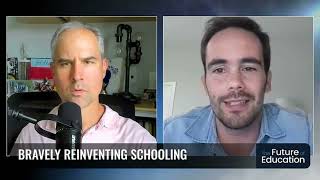
In this Future of Education interview, host Michael Horn talks with Luis Brito E Faro, co‑founder of Brave Generation Academy (BGA), a global network of microschools that blend self‑directed learning with community‑based hubs. BGA serves learners from 6th grade through university level, offering three pillars—knowledge (academic curriculum), skills (technical and soft‑skill development), and community (applying skills for societal benefit). The network launched informally in late 2020 and officially in September 2021 in Portugal with ten hubs, now serving about 800 students across Portugal, South Africa, Namibia, Mozambique, Kenya, the United States, and India, with plans to reach 1,000. BGA partners with existing online university programs (e.g., University of Bolton) to provide accredited bachelor’s degrees, while also delivering British IGCSE/A‑Level, American, and Swedish curricula, allowing students to choose pathways that suit their interests. The model grew from Tim’s frustration with traditional schooling for his children and Luis’s rugby‑inspired passion for mentorship; together they built a hub‑based ecosystem where learning coaches guide students in planning weekly goals, while course managers design curriculum content. Hubs are co‑working‑style spaces (≈1,500 sq ft) that integrate community resources (sports, arts, internships) and foster peer collaboration. Students design personalized schedules, balance academic work with skill‑building activities, and engage in community projects such as pottery workshops. Economically, BGA operates as a profit‑for‑purpose organization, charging roughly $850 per month per student (≈$10,000 per year) with about 30 % on scholarships, keeping overhead low by leveraging existing community facilities. Expansion is both proactive (targeting Florida, California, Texas) and reactive—opening new hubs when families request them, requiring a minimum of ten students for financial viability. The interview concludes with calls to action for interested families and potential hub partners.
Chapters
Welcome to the Future of Education. And now here's your host, Michael Horne. Welcome to the Future of Education. I'm Michael Horne and welcome to the show where we are dedicated to building a world in which all individuals can build their passions and fulfill their human potential. And to help us think about that very topic today, we have Luis Brito Yfaro. He's one of the founders of Brave Generation Academy. Luis, it's great to meet you and great to have this conversation.
It's awesome to be here. Michael, thank you so much.
Well, thank you. I mean, look, you're coming to us from Portugal today and I want to dive right into the morning warmup because you are one of the co founders of Brave Generation Academy. Before I give my spiel on what I think Brave Generation Academy, why don't we just go from your own voice telling us what is the schooling network you've set up?
Absolutely. So we're a network of micro schools. We serve learners from 6th grade and above up to masters, actually. So we already have a university BGA for adults. We use a self directed learning approach so our learners can set their own goals and define the pace that they study. And we basically have three pillars. Knowledge, which is the academic side. So the subjects that you sit or the bachelor's that you're taking, the curriculum that you're doing, skills, which, which are the technical or soft skills that you want to develop and grow and, you know, improve about yourself and then community, which is how to use those skills for the well being of the community, for the well being of those around you. This conceptually speaking, this is our model.
Yeah, very cool. Well, we're going to dig more into it in a moment. But when did you guys get started? How long you been in operation?
So informally, we started in 2020, late 2020. But our official launch was in September of 2021 in Portugal with, with about 10 hubs. Yeah.
Wow. 10, 10 hubs off this, off the bat. So you've been in operation then? Maybe just shy of a couple years, it sounds like. Officially, how many students have you served and how many students do you serve today?
I guess so right now we, we are at about 800 students and we're going to a thousand in September, most of them based in Portugal, most of them 6th grade to 12th grade, but already with a few with BGA for adults. And then we are in other countries. We are in South Africa, Namibia, Mozambique, Kenya, the US and then in, in India as well.
Wow, that's quite, that's quite the geographic spread. At each hub, how many students are at a given hub?
So the average is 30 or better. Even, you know, the. The maximum capacity is 32 learning coaches. Some hubs go a little bit over that, some hubs go a little bit under that number.
Gotcha, gotcha. And it sounds like the micro schools are located worldwide, but I didn't realize you guys are offering a university education as well. How did you get that accredited so quickly?
So we partnered up with universities that were already doing an online course, already had the platform, but lacked, you know, the feet on the ground like the hubs lack, the learning coaches, the skills and community just have a theoretical part of it. So we partner with a platform that has partnerships with universities such as the University of Bolton. So we offer computer science, business management education by Cambridge and sports management as well. Those are our four bachelors as well with upskilling and reskilling. But this is more for the labor force.
That's super interesting. So if I understand it correctly, basically there's a university, it has an online program, and you say, let us be your brick and mortar hub on the ground to create a community around it. So let's shift into our second segment work cycle, start to dig a little bit deeper into the, you know, what's the philosophy, if you will, behind Brave Generation Academy?
Yeah, so we have seen, you know, and starting with our founder Tim, he saw that his kids had really little time to experiment and to really figure out what were their passions. So we started coming up with a model that would be be able to create a space where learners could be themselves, where learners could fail, try, understand if that's what they really like, and throughout that process, actually develop the skills that we talk about nowadays so much, Those buzzwords of 21st century skills, flexibility, adaptability, setting goals and so on. We believe that has to be done organically, experimentally, not with PowerPoints. Theory can support that, but they actually have to go through the struggle process. And that's how we came up with it. That's how that's our vision. You know, help learners find their passions, become motivated and take their own initiative.
It makes a ton of sense. And so it sounds like Tim experienced a struggle with his own kids. It was this in Portugal or where was this?
So just just a little bit about Tim. Tim is a serial entrepreneur. He has no background in education, is. His parents are Portuguese, but he was RA South Africa. Eventually he moved up to Portugal. He had his kids in a really good international private school. But every day. Okay, how was school? It was okay. What did you learn? Same as you did. And he actually had the chance. Tim and his family, they do this every three or four years. They do this trip around, you know, sometimes they did. They did like coast to coast in the U.S. they did. They went to Mongolia and Russia, to Australia. They do this big trip. So they. He has to take his kids out of school temporarily and he used to take a tutor with him and his kids, and he would see that they were actually really excited about learning and they had time to do things they liked and so on. And then during the pandemic, that became even more evident when they were together at home. So he saw a chance as an entrepreneur. He saw an opportunity, saw a problem and an opportunity. So he took his two boys out. He has two boys and a little girl. He took the two boys out. They were the guinea pigs. He left the girl in school for a little longer in case he screwed up. But you work out fine.
That's great. What's your own background to join him in this?
Yeah, so I'm by. By study. I'm a mechanical engineer. I study mechanical engineering with. With a major in thermal energies and renewable energies. I never, like, actually wanted to be an engineer. I just wanted the problem solving into critical thinking. I was never a fan of school. I obeyed. So, you know, I follow the rules. But I had many discussions with my teachers about how things were done and. But what really made me fall in love with education was I played rugby all my life. So I played until I was like 21, 22. Then I stopped to go abroad for a year. And when I came back, I became a coach. And growing up, I was really lucky to have really good mentors and coaches in rugby, in life generally. So I could apply that and I could give back and I could be on the other side. And I could see the impact that having a mentor and having someone trying to again create this space, have a tool. For me, rugby was a tool to try to raise these. These teenagers. I saw the impact that I could have in their lives and that made me really, really passionate about it. And that's how I met Tim as well, because Tim is also a really big fan of rugby. So I was coaching the under 16 and his eldest son was playing under 16. So I went to play against him, his club, St Julian's and they ended up, you know, just crashing. Just terrible loss for us. I will never forget that loss. But, you know, in rugby, you always shake hands, you always have a beer afterwards. So I met Tim and from that moment On I started following him and so on, and eventually I saw him posting about PGA whilst it was still his kids. And I quit my job within a couple of weeks and started opening the first few hubs.
Wow, that's quite a story. It's interesting. One of my favorite friends in the podcast and innovation world is Aidan McCullen, and he's also a rugby background. Maybe it's something about you all that it causes you to ask good questions. But tell me one more thing before I get into curriculum questions, which is who are like, who are the families and students signing up for this? Right? Like, I mean, a thousand students in two years time, that is serious growth for a micro school network. These families jumping in because like, you know, Covid is behind us, Right. So who are making these choices.
And on top of it, this was done in a very, very conservative country where we're not accredited by the government and the parents know that. So we're expecting that when we get accredited, that number will probably double. But so these people, you know, it's a wide spectrum. So we have people coming from both homeschooling, Portuguese homeschoolers, expats, public schooling. So we have kids coming from Portuguese public school, we have private schools, we have a wide spectrum, 50, 50 in terms of international and Portuguese, at least in Portugal, that's where our majority of students are. About 90% of them are in Portugal. But they're coming from every background. In terms of goals. I think what they want is for their kids just to be happy and just to have a purpose when they wake up. I think that's one of the best things that the parent can see is just, you know, their kid just waking up with a purpose for their day. And this is what the self directed model does for a kid, which is to take ownership over their, their lives. And, you know, people like to have responsibility, like to have ownership. That's that the biggest cause of anxiety is normally lack of action. And normally you have lack of action because you don't have ownership over what you're doing or you lack it. And that's what we give the kids.
No, that makes a ton of sense and helpful in filling it out also. And it'll be fascinating to watch the accreditation come, I guess, and see that doubling in terms. So let's switch to our third block, the specials, and get into the curriculum and so forth. Tell us about what the curriculum you've chosen and how you move through, you know, the academic knowledge, the skill building and community.
Yeah, so we started with the British International curriculum, because it was a good balance between an accredited, well structured curriculum, you know, Cambridge IGCSEs and A levels. Every university in the world pretty much accepts it. In the us you have the ACE diploma, which gives you college credits similar to the ap. And it's flexible in the sense that you pretty much don't have mandatory subjects. You can pick whichever subjects you like. So you can do physics and you can do arts and design, for example. In Portugal, this isn't common. You know, you have to pick an area and then you stick with it and you can only do that.
Actually, hold on. Actually, hold on one second there. I just want to make sure I pull that apart. So in, in the British curriculum, the students are getting a lot of choice to say I want to specialize in X, whereas in Portugal they have to do this well rounded thing and they get less choice. Is that, is that the distinction? Yeah.
So, for example, in Portugal, you reach the 10th grade and you have to either pick. The three major areas are science and technology, and that makes pick physics and chemistry, which is a single subject in Portugal. And then you can pick between biology and geology or which is also single subject, or geometry, like this. Descriptive geometry, I think would be the translation, which is basically like technical drawing. And then you pick economics and within economics you have to do economics and then you pick between history or geography, and then you have arts and then you have humanities, which is more focused, like in law and history and so on. And then obviously you have like the core, the core subjects, which is mathematics, mathematics, Portuguese, philosophy, you have some core subjects. Whilst in the A levels you reach the 11th grade and you normally pick three subjects, that's the minimum, and normally between three and four. And you can do whatever you want to do depending on what you want to do after you finish high school. So if it is a university, you pick them depending on what the university has you to sit.
Gotcha. And is the curriculum online or how do you offer it to students?
So initially we partner up with an existing platform, but we ended up developing most of the of the curriculum. So we hired our own, what we call them, the course managers, who are the subject matter experts. So the learning coaches are not experts in any subject. They have a very diverse background. They can be engineers, they can be artists, they can be PE teachers. They're focused on teaching how to learn, not what to learn. The course managers are focused on teaching what to learn. So they're the ones developing the curriculum then. But a really important thing to say is that for us at BGA we see ourselves as an ecosystem where other organizations can just plug in. So for example, we also started offering the American curriculum, which is offered by a charter online school from Wisconsin. And now going to Florida, we're probably going to start offering also the Florida Virtual States School. We have some kids doing a Swedish platform. So what we want is we want to have several hats. You know, picture a kid coming into a store. We have several hats and the pick, the kid picks the one that fits him the best. That's how we see it.
Gotcha, Gotcha. So walk us through a day in the life then of what that student is. You know, if I think about the course of a day or a week, what does it look like for a student?
Yeah. So for people to visualize it, our hubs tend to be in, we try to put it, you know, always have these flagships, hubs where they're in really nice areas of the town where the kids can just cycle there or walk there and have tons of services around because we like to leverage the resources that exist in the community. So, you know, if a kid wants to play tennis, for him to go to the community. If a kid wants to do arts, to find an art studio or a music studio and he does all of those activities in the community so that everybody wins. So our hubs are really simple spaces. Think of like a co working space. 1500 square feet, bathrooms, focus room for them to do deep sessions of work, a relaxed zone and little kitchen for them to relax and eat lunch and so on. And the rest is pretty much collaborative space. So tables facing each other, peer to peer work, like proper co working space. It's open 8am to 6pm, 30 learners, more or less, two learning coaches and the learners do their own schedule. So let's pretend that I'm a learner. Let's say that I'm a surfer and I want to be a data scientist, for example. Okay, that's something I enjoy doing. I want to do it. So I'll come to the hub on Monday, I'll arrive, I'll say like I will arrive maybe 9, 9am that would be my time. I will already have an appointed time to sit down with my learning coach, to do my weekly meeting where I sit down with a learning coach and I present to him my plan for the week. So I'll be showing my learning coach, okay, today I'm going to be doing this and this topic of history and English and maths. Tomorrow I'm going to be doing science or physics or whatever it is And I show him the plan according to my timeline. So we have a tool that calculates how many topics do I have to accomplish each day in order to finish the course in time, take into account my goals. So everybody is going at their own pace. We never close, by the way. We're always open throughout the year. We only close two weeks in Christmas, one week in Easter. And so I show you my weekly checklist, my plan for the week, and that embraces the academic, these goals that I was just telling you about, but also the skills and community. So for skills, it will be surface. So I will tell him that on Tuesday, I'm actually not coming in the morning because the waves are going to be really good. So I'm going to be surfing in the morning Tuesday and Thursday. And then a couple of weeks back, I actually told my learning coach that I want to be a data scientist. So he found me a job shadowing so a person for me to go and spend a couple of hours in the company with them so that I could understand what a data scientist does. And I was also recommended a roadmap of massive online open courses to do and challenges that, you know, nowadays you go online, you have Google courses, you have IBM courses, you have the best company in the world offering the courses that you should be doing. So Wednesday I'm going to be doing academics and I'm going to be doing a little bit of data science as well. And then Friday we have a hub activity where everybody is bringing, you know, food related to the country where they come from. So our hubs have, you know, 10 different nationalities, 15 different nationalities. So our learning coaches like to create this type of have activities. So we're gonna have a lunch, you know, a hub lunch together, and this is gonna be my week. And then maybe Thursday comes and the waves change and I end up going to the hub in the morning and go surfing in the afternoon. Who knows?
Gotcha. So you have that flexibility. How does it work if, you know, you. You got 30 students there, couple of them are maybe taking the Wisconsin curriculum. The majority are doing the Cambridge curriculum. A few others are doing the Swedish. Like, we're all doing different things right now. How do we get opportunities to collaborate and sort of enjoy each other's company, even though we're doing very different academic plans. Yeah.
So we have to go beyond the academics. So I'm going to give you a practical example. Once I was in this hub and I was talking to a learner, trying to see what were her passions and so on. And firstly, she was very. She wasn't reluctant. I think she wasn't really understanding the question because she thought I was talking only about academics. So she said that she didn't really like anything special. But then I started digging in, filling the layers, and she said, no, you know, I actually do clay work. I work with clay. Pottery. I do pottery. I said, okay, that's awesome. So I started talking about that. And eventually she did a workshop of pottery for the other kids in the hub. So she taught all of the kids to do pottery. And now in the hub, they have little sculptures of what to do. It's. And we do this with everything, with sports, with arts. We always have kids that have their special talents, and it's really important for them to have something that they feel that they are good at. And this is the magical thing about not having a constraint curriculum, which is everybody will have something that they'll be good at which will boost their confidence, develop their social skills and so on. Then the learning coach. The learning coach will spend more time with the learner, taking into account the ratio that he has that in. I think it was. I did this math a while ago. It was something like. It's crazy. It's something like a week to three months. A week. You'll spend more time with a learner in one week than a traditional teacher will spend.
Oh, wow. Wow.
So you really get to know the learner. Really, really get to know. Really, the. The basis of the performance of the learning coach is a relationship that he has with the learner. You know, understand the vulnerabilities, the goals, the strengths, the. The weaknesses and so on. And then he'll manage the hub, taking that into account.
Very cool. So let's go into our last segment. Closing time. How do you make this work economically? What are the costs? How does this all hang together?
Yeah, so we're basically a profit for purpose. So we have to be sustainable because we don't want to be dependent on anyone else. But we can make it work because it's a very, very simple model. We keep the hub at 30 kids, two learning coaches, and you manage hub by hub. So what ends up happening, you know, in, for example, in the US our fees are about $850 basis per month.
Okay.
That's just over $10,000 a year. So. And. And we can make it work. Obviously, you know, some hubs, then we have a big scholarship. So we have. About 30% of our kids are on scholarships. So. So we have to. Some hubs have to take the hit, whilst others Balance it out. But we're actually much cheaper than in terms of logistics because think of a big school, you have the canteen, you have the football field, you have the labs. You have such a big staff with us. Very, very, very simple, very lean. And you just leverage what already exists. You don't have to build a new football field. There's one next door. Just use it.
Yeah, so that's what I was going to ask then. So. So they're paying essentially for the coaches, maybe the curricular access and the hub upkeep, that 1500 square feet. But my sailing or my surfing or rugby or whatever else. Right. Like that's stuff that I pay for and do outside, even though it's connected into school. Is that the way to think about it?
Yeah, exactly. So a part of the activities will be paid by the learners. But we actually have a lot of, for example, workshops and talks and all of the internships there. The learning coaches and we, from a central perspective, BJ central, we are the ones finding that. So that's also a big, big part of the learners experience that we, that we offer.
Gotcha, gotcha. Super helpful. Okay, so if I'm watching this, I want to find out more. How should folks do that?
So www.bravegenerationacademy.com that's our website. That's the easiest way to go. Our Instagram, same thing. YouTube channel. So we have a big documentary series that came out with. We have testimonials, we have a day in the life of a learner. We have a lot of content for people to check. And really we have a video of a hub. What does a hub look like? So people will really, really be able to see through their own eyes.
Very cool. And so you've mentioned Florida a couple times. Sounds like you're already in Wisconsin. Maybe if I'm, if I'm reading it right.
But only with the curriculum. Only with the curriculum.
Okay. Okay.
In Wisconsin.
All right, so what, what's next? Where's the vision? Where are you guys going with this in the US where can we expect it? I suspect some states are going to be wondering, you know, families, how do I.
We have two ways of going about it. We have our proactive expansion, but we also have reactive in the sense of a lot of times we open hubs and this is why we open also so aggressively is that we have a family saying, look, I'd love to have a hub in my city. And we say, okay, I need 10 kids to open a hub for it to be financially sustainable with 10 kids, we break even. So, you know, help me find the space. Refer to me a learning coach so that they can go through our training program and we open the hub. So from then, we can be opening in California, in Texas, wherever it is. Proactively, we're going to be focusing more in Florida, in South Florida. Right now we're in Boca Raton. We want to go up to West Palm Beach, Fort Lauderdale, Miami, and so on. So if anyone listening is interested in having a hub, just reach out, because we're going to make it happen. And we are really, really fast in making it happen.
Very cool. Very cool. Hey, Luis, thank you for coming on and telling us about what you all are starting at Brave Generation Academy. I mean, this microschool network sounds like something to keep an eye on, and a lot of folks are going to want to check out.
Thank you so much, Michael. I really, really enjoy it. Thank you for your time. And keep it up, eh? I'm loving.
Yeah, yeah, no, absolutely. And you guys keep it up. Keep reinventing schooling. And for all you tuning in, thank you for joining the future of education. We'll be back next time.










