Conversation with Former West Virginia Gov. Bob Wise on Education In A Recession
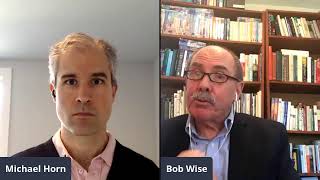
In this YouTube Live interview, host Michael Horn talks with former West Virginia Governor and former U.S. Representative Bob Wise about how federal stimulus actions have shaped K‑12 and higher education during economic downturns. Wise outlines the 2008‑09 stimulus—$100 billion for education, including a stabilization fund and a $5 billion innovation pool—and reflects on what worked (rapid funding, some flexibility) and what fell short (prescriptive mandates, speed of disbursement). He then compares that to the 2020 COVID‑19 stimulus, noting a $2.2 trillion package that allocated roughly $30 billion to education, with only $15‑16 billion for K‑12, and highlights the uncertainty of future funding. Wise introduces a “Three T’s” framework for schools—Triage (immediate crisis response), Turbulence (navigating budget cuts and uncertainty), and Transformation (building a new, resilient system). He stresses the need for federal flexibility, especially in reallocating existing funds, and calls for a substantial broadband investment to close the “homework gap,” arguing that broadband is a utility essential for both learning and broader social services. The conversation moves to longer‑term ideas such as Individual Learning Accounts (ILA) and income‑sharing agreements, likening a potential post‑recession education investment to the GI Bill after World War II. Wise advises governors to demand both additional funds and flexibility, and urges district leaders to communicate district needs to Congress, showcase innovative pilots, and plan for budget reductions while preserving transformative initiatives. The dialogue ends with optimism that the crisis can catalyze constructive turbulence and lasting educational reform.
Chapters
Welcome, everyone. I'm Michael Horne, joined by my friend and an expert in the field of government policymaking, education, the former governor of West Virginia, Bob Wise. Before that, Bob served in the House of Representatives. And I got to know Bob when he was at the alliance for Excellent Education, leading that organization and really helping the federal government rethink what, what should high schools look like across America? And we got very involved with each other working on issues of digital learning and how can you personalize learning for all students across the country. And Bob, first of all, welcome. It's great to see you amidst these times.
Well, no, it's good to see you, Michael. And I just want to comment. When we first started working together, I had hair. Yours was a little darker, actually, but.
I was going to say mine is faded.
Yeah, but in those times, it was a far different time than what we're in right now.
Exactly. And we got to know each other the last time we had a recession in this country. Really, I think we had met just beforehand in 2008 as my book Disrupting Class was coming out. And you sort of saw the potential in that. And then the recession really hit and the federal government swung into action a few times. I'd love you just to talk about what did the federal government do the last time that there was a recession as it impacts education? As we start to think about what we might see this moment going forward.
So a little bit of history, 2008, 2009. The federal government in 2009 followed up on a stimulus package that President Bush had put forward. Then President Obama comes in, he puts forward a stimulus package that deals a lot with education. $750 billion total, but 100 billion goes to education. And it was designed 50 some billion of it propped up what's called a stabilization fund, went to help school districts and states preserve the education systems. Essentially they had, and they even had $5 billion in there for trying innovative approaches. Now, that was 2009. Flash forward to the last stimulus package a couple of weeks ago. It's two and a half. It's $2.2 trillion, not 750 billion. And yet education got 30 some billion, about 1/3 the amount of which only 15 billion or 16 went to K12. And so everyone says wait till the next one. But the problem, what I've observed from 18 years in the Congress is there may be a next one and maybe one after that. There's no guarantee though that education comes out any better. And so while my concern is that this is a far worse recession than than what we're going to, than what we saw in 2008, 2009. And yet education, higher ed and K12 will be facing even greater problems and pressures at the state and local level. Yeah.
And so stay on 2008, 2009 for a moment and the stimulus packages there. What were the lessons that you took away from what worked well then and what maybe did not work as well? And then, and then let's, you know, we can take a pause and start to say, okay, what do we draw from that in this current moment? And there's obviously some deep structural differences as well, which we can get into.
Well, anytime you're trying to shovel $100 billion out the door in a matter of weeks or months, obviously there's a lot that is not done well. I think overall it was necessary, probably it was necessary to preserve the education system, basic education system. Having said that, in one ways it was too prescriptive. The administration announced there were only four ways to work with low performing schools once they fell under a certain category. So it could be prescriptive there. On the other hand, they also were willing to try some innovation and to, as I say, there was a five billion dollar fund. The reality is that anytime you have that amount of money that has to be sent out the door that quickly, if it's going to make a difference, then there are going to be some mistakes made, there are going to be some things done right. There is a key difference this time though. The difference is that in 2009, the Obama administration had just come into office. They got the stimulus package through the Congress, but so they had only, and they didn't have all their appointees in yet. Secretary Arne Duncan was fairly new. His assistants were secretaries were fairly new. And also the stimulus package in the amount that it was was very new. Now let's flash forward. If there is a benefit, it is that this administration has been in office, it does have the appointed people in place, we hope. And also there's an established bureaucracy and I don't say that in a negative way. There's an established Barack civil servant civil service that has been through a stimulus package before and should be able to get this one, get this one moving, particularly because this one does not have the amount of money connected to it, at least in this first wave that the last one did.
So are you expecting that to change? Like if you put in your crystal ball, do you start, I mean you said there's no guarantee certainly that more dollars are going to come in, but there's Certainly conversation that there will be an additional package that hits in May or something like that. What do you foresee and how do you think this will all unfold in the weeks and months ahead?
So I always live with the glass half full. And my hope is that this was just a down payment, a recognition that something had to be done in the short term while everyone's engaged in education triage, but that as the extent of the crisis becomes known, that there would be more allocated. I haven't heard that. I mean, most of the public discussion right now is around increasing the small business loans and forgivable loans and so on, and that's critically important. Extending unemployment and job training, particularly for healthcare workers. But I haven't heard the basic needs of education being discussed and also maybe extending Pell Grants yet. This is a critical time. Once again, there are two state. You can have a recession, and that was what we had in 2008, and it was deep. Don't. I'm not making light of it. You can have a recession and a crisis, and this is a recession and a crisis, unlike we have seen, where the entire country is shut down. Think about. I sometimes think perhaps the best thing to do for education right now is to call itself Boeing or airline industry. We've got 50 million empty seats in K12, we've got another 22 million. There's 750,000 people that work in the airline industry. There are probably 5 million that work in the education.
Yeah, I was going to say it's significantly more. Yeah.
And so from an impact on gdp, education, I think, which is roughly six and a half percent of gdp, is every bit as significant in an economic sense as much as it is in the fact that this is our future, in our country's future, that's not in those seats right now in some capacity. And I say that figuratively because obviously there's a lot of distance learning and online learning and some innovation taking place right now. But what we don't have is a fully functioning education system.
So from the lessons, though, that you learned in 2008 and 2009, and you know, what worked well and what maybe was too prescriptive, worked less well, or dollars didn't get out as quick as possible. If you're an educator right now sitting in their seats trying to navigate this crisis, and they've been in triage mode for the last several weeks, but starting hopefully to lift their heads up a little bit and the bigger picture, what do you, you know, what would you say for them that they ought to be doing, preparing for as they navigate the current moment.
You described it well. It's what I call the three T's. We're in triage. We're moving now against a backdrop of turbulence and how do we move to transformation? And so but you're right. In both higher ed and k12 for the very first time, you've been in triage for a month, you're able to lift your head up a little bit and say, hey, here's what's working, here's what's not working. Here's what we begin envisioning, what it is we're going to really move towards and also what it is we need. I would say that there are probably two more stages left. One is this stage of immediate triage because as these district leaders once again, 14,000 of them have to prepare their budgets and do their announce their layoffs or whatever restructuring they're going to do are going to, they're doing that right now. March, April and May, those are the months that you do that. And so they need immediate help. But they also need to know what it is that is coming down the road that they can be looking towards. And so they should. So what I would say you asked, is make sure, don't assume it's going to happen. Make sure that that representative, that member of Congress, that senator, that they understand what's happening in their districts, whether it's through digital, we don't do visitations right now, school visits, but whether through its digital meetings, requests certain showing what's happening in the districts that they're familiar with. It's about doing some informing right now.
If you are a governor right now and sitting in that seat, what would you be asking Washington for?
So I'd be asking Washington for understand my situation. And here, and here it is. I'd be asking for, yes, additional funds and I'd be making the case why. But I'd also be asking for flexibility. And to the administration's credit, that is the Trump administration's credit there is significant they've the secretary and others have given a lot more flexibility in how you use existing federal funds. Having said that, there are a couple of things that you specifically need. You need in this next stimulus package, you need a broadband package. There was no money put in except for $25 million for rural areas. There's no money put in to extend broadband. And yet we know that the Internet connectivity at home is as much important now as water, gas and electricity. More flexibility, no money. So $2 billion out of I think is what was requested in the House bill. Second thing I'd be requesting is as I say, some flexibility and moving that money to where it needs to be done. And I'd also, I'd like to a little federal pressure to say what is it that's going to come out of this? How do we make this turbulence, constructive turbulence in the sense of a lot of times you can be on an airplane that's pretty rough ride, but you get there 45 minutes earlier. That's what a pilot one time described as constructive turbulence. So what? So Washington shouldn't be dictating what I'm going to do in West Virginia or in California or in Alabama or wherever. But what it can be doing is saying how do we come out of this better than we were and how can we showcase what you're doing also and perhaps that's another thing is where there's a bright innovative idea and somebody's actually moving something, reward it and showcase it.
Yeah, that makes sense. So let's just dive in on the broadband and go through these components before we wrap up on the broadband. Obviously over the last several years, education superhighway has done an enormous job of moving dollars to schools so they could have high speed connectivity in every classro. Done an amazing job. I think 99% of schools now have high speed connectivity in the classrooms. Homes. Though we see in this current crisis are, you know, widely disparate in terms of that. What tools does the federal government have at its disposal to change that situation for students in light of the fact that, you know, it's pretty painfully clear this is a utility.
It's a utility and a necessity. It's what FCC Commissioner Rosenwortzel calls the homework gap. It's one thing to have the broadband connectivity of school. Thank goodness that goal of 99% coverage in five years has been met. Essentially we don't have. We don't. But the lifeline, that's the one that, that's the program that benefits low income families that is nowhere near funded enough. So it's a clear, in some ways, Michael, it's dollars and cents, but it's an investment that we have to make just like we made getting electricity to rural areas back in the 30s and 40s in a central goal of this country. And so I would say broadband is one because that's not only about that. First of all it's about students, but it's also about family's ability to cope and live in the society, increasingly technological society we're in as well, and then that also can lead you to are there ways that we can now provide social services using technology much more effectively? It's what some people call braiding. So that you want a community school. Is there a community digital school that you can have in which the department of human services, the welfare department, the mental health services, the counseling and so on, all of it has some online component or distance component that perhaps it didn't have before. And so that to me is another reason for the increased connectivity that's so critical.
Yeah, no, that makes sense. So let's fast forward in your crystal ball where a year out now we're coming back in April and we look at what districts, the federal government and so forth have done. What are your hopes in terms of the transformation piece of this? I mean you've made the point that what's different this time around from say.com crash or 200809 and the financial meltdown is that they're on top of brutal economic conditions at those times. And this may be even more brutal than those combined in some ways given the job losses that there is also, as you said, there's a deeper crisis occurring that is literally transforming how we school right now. So I'm going to guess that you're not going to say, hey, we're all going to be virtual schooling in a year from now, ideally. But what does this look like and what does really taking advantage of this opportunity in your mind, realistically, what can we expect states and districts and schools to do a year from now as they back to some semblance of standard operating?
I imagine so a year from now. First of all, let me go to the visionary. First is how they work through the next several months. And there are going to be severe budget reductions. There's no doubt about it. You cannot have 16 million people filing unemployment claims and not paying taxes for some significant period of time. That number will only grow and not expect severe reduction. So sales taxes, income taxes, all down. So no expense, expecting that. Then the district leader has two choices. You can follow the old inventory system, what I call lifo, last in, first out. And that means whatever you innovative thing you were working on, whatever changes you were seeking to bring, they go on the shelf. Last in, first out. Because that's you got to cut the budget. We eliminate those, throw that away across the board and we'll come back to it maybe in the future. That's the way to that. You do that and in a year you're not going to be any better off than you Were you'll probably still be in a hole and you're not going to have advanced learning needs and learning outcomes for students. So the key I think here is with the federal government, get some understanding of what the funding situation is going to be so that you have some predictability and then say, this is where we want. This is what we've been working on through triage. This is what we believe has worked, this is what isn't working. But we also understand that coming back, we're not going to be the same as we were before. And so therefore, particularly given the uncertainty of both the virus and the economy, so let's start moving and building support to move towards where we want to be. That's incidentally a collective process. That means that's a culture change, but it's also about bringing your faculties together, your, your students, the community to understand why it can't be the same. And so that in, in Michael, this is a case where every school and every district literally will be shaping their own vision. But it's going to be in. But it's going to be a different. The process at the end of the, at the end of the next year, you may not see improvements yet in student outcomes. You'll see improvements in processes that are going to lead to those changes in student outcomes. And let's also remember one other thing while we're talking about post secondary in some ways that this isn't about companies rehiring as the economy comes back because so many of these jobs are going to be lost and people will have moved on. This is going to be one of the most massive redeployments of a workforce that we've ever seen, perhaps ever, except for coming out of World War II. And so you've written a lot about the income sharing agreement and I talk some about ila, the individual learning account. There's a lot of similarity. We're going to have to look at the federal level as to whether or not there's a way to create a means for particularly students over 18 to 64 being always able to move towards, towards the kind of training and certification that they're going to need for their next job. That's much farther down the road. But it can't be down the road because once again, I honestly believe that for this, this set of conditions we're in, we're going to need the equivalent of another GI bill because which took 16 million GIs coming home, put 8 million, and there were no jobs for 16 million people, put 8 million of them in an educational setting, different settings. And the result was the single greatest economic development and acceleration in our economy for several decades. We lived off of it for three decades. And I think that as bad as all of this is right now, if we respond to that kind, with that kind of response, then we may well eventually see this as constructive turbulence. But it is going to be painful for education for a while.
Yeah. So. And you know the individual learning accounts idea, I think our friend Governor Jeb Bush, who ran unsuccessfully for president when he was running, he had this notion of individual savings accounts for education.
Exactly.
For every student. You know, one of the casualties of him not getting further in that race is that idea seems to not be talked about very much anymore. But I think it's a really important one as we imagine a future in which people are not going to school one time for college and then launching their careers, but they're going to continue to have to learn informal and informal ways through some programs that may not be accredited and to have a reservoir of funds that the government has said this is actually critical to the economy. Not just you as an individual, I think makes all the sense in the world so that they can navigate that turbulence in their own lives, let alone what we're seeing right now across the country.
Well, it's also the difference between a recession and a recession and a crisis in a recession. People say we're slow coming in, we're slow coming out, but we don't really have to change that much. And we don't. We lay a few people off, we go 3% across the board. Higher Ed takes a hit first. K12, usually not as much, but still gets hurt. Here we've got a crisis. And when you have a crisis, then sometimes big ideas do emerge to the fore. And once again, if you've got 16 million people sitting out there right now and more to come and they're going to be, they're not going all back. It's not going to be a V shaped recovery like some people write. Then this is a time to be actually talking about. And as a federal government is putting up two and a half trillion dollars in one tranche, there's money in there for an individual learning account that benefits us for generations to come.
So let's hope we start to see some innovation along those ways. But Bob, always wise, I appreciate you joining us.
I always blow your horn too. There you go.
Right. We'll keep marshaling folks forward in their education journeys and educators as they innovate and hopefully come out of this stronger but super appreciative of your continued work and helping people think more broadly about what they might do during this moment.
Oh, thank you, Michael. And thank you for bringing this is a critical time for district leaders as they plan their futures. Thank you for bringing these issues out.
Yeah. Deeply appreciative. And we'll be back next time on YouTube Live and Facebook Live. Thanks so much for joining us.










