Disrupting the School Bus
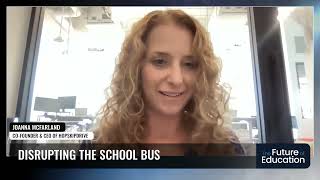
Joanna McFarland, CEO of HopSkipDrive, describes how the company uses vetted care drivers to handle student transportation that traditional school buses can't serve well, like foster kids and students with special needs. The service uses GPS tracking and real-time communication, and helps districts cut costs while addressing driver shortages. Arizona's $40 million transportation innovation program is already funding the model.
Chapters
Welcome to the Future of Education.
And now here's your host, Michael Horne.
Welcome, welcome, welcome to the Future of Education. I'm Michael Horne and I am extremely excited by today's conversation because we're living in this world right now where we're seeing a flourishing of more flexible schooling options for kids in a variety of formats from a variety of actors that really transcend the one size fits all history, if you will, of how schooling has always been done and the sense that it has to fit in a specific box with particular hours and a limited of flexibility and so forth. And yet against that world of innovation that I think is incredibly exciting, there's some real questions around. How do we make sure that this is accessible and equitable to all individuals? And, and a big piece of that I've come to learn is simply transportation. How do we make sure that kids can get to these different schooling options, this array of learning opportunities, not just frankly in the school building, but throughout their day to open up these pathways and opportunities for them. And my guest today, Joanna McFarland, who's the co founder and CEO of Hop Skip Drive, is literally reinventing how kids access transportation and really creating an on demand ride service for kids. She's probably going to give a much better explanation than that. But Joanna, first, welcome to the Future of Education. Thanks so much for being here.
Thank you so much for having me.
Yeah, so you can hear my enthusiasm because I think you're really reinventing one of these structures that we just assumed like everyone gets on the school bus or maybe they're lucky enough to walk and the hours are fixed and that's sort of, you know, we don't, we don't think about it past then, but I'm seeing in lots of communities a lot of desire for more flexibility or maybe people want different start times or different schooling options, an array of things. And transportation becomes the major sticking point in the way of those innovation efforts. So I guess I'm curious though, what caused you to start Hop Skip Drive? What was the main motivation and set of use cases that you saw? We need a different set of options for transportation.
Yeah. So originally when we started Hop Skip Drive, it actually had nothing to do with school transportation. It really had to do with creating options for full time working moms and families like mine who were really struggling to just make the, just logistics of running a family work. I was trying to figure out how to get my son to karate on Thursday at 3 o' clock and I came together with two other women. We are all moms we have eight kids between us and we were just dying and we figured. And those eight kids went to five different schools. And so we were all just really struggling with how to get them to school, how to get them to after school activities, how to maintain our jobs, how not to, you know, run out of work at 3 o' clock to make this all happen. And really designed it from the ground up with that idea in mind, with creating flexibility, with creating optionality, while also laying a foundation for safety. You know, we asked ourselves from the beginning, what does this need to look like for me to put Jackson or Sam in a Hop Skip Drive? What do I want to see as a parent? And how do you devise and design a system and a technology that is designed around the idea that the person in the vehicle is not the person who arranged the ride may or may not have a phone and is a little bit more vulnerable. And that's really where it came from. We started as a consumer business. We pretty quickly realize that there was this world of school transportation and that it was a very large world and that it was really broken even before COVID that it was just was not efficient and that there were, you know, we started with some of the hardest to serve students, you know, students experiencing homelessness, students in the foster system, and students with special needs whose IEP included transportation to a different school. So these are kids who don't fit neatly on a school bus route, or kids who are highly mobile and moving frequently. You know, if you are a child in the foster system who moves placements at 10:30 at night, you can't reroute a school bus to get that child to school. And yet Hop skip drive can get them to school the next day with no, no change in schooling. And we know that every time a child moves, and the average child in foster care might move three to five times a year, that might mean switching schools. Credits don't transfer. It can take several weeks to change schools. What one district teaches in fourth grade, another district teaches in fifth grade. And so that's one of the leading reasons that you see that the graduation rates for these more vulnerable populations being so much lower than the general population. We have federal mandates to fix that. But transportation is one of the biggest barriers. And a service like Hop skip drive really helps districts provide transportation for those hardest to serve students in a really flexible and way. That gives districts tools to solve all of these challenges. What we have seen post Covid with greater, much more exacerbated bus driver shortages is districts are struggling with all of their transportation. And so they're cutting routes or they're consolidating routes, which means kids are on the bus for hours because that's the only way that they can make it work. And that's kind of because we're using a one, we're trying to use a one size fits all solution for transportation. And as you mentioned, it's not one size fits all. So we need to redesign that and think about it more from a. The same way we're thinking about personalized learning and customized learning, we need to think about personalized transportation as well.
Gosh, I love so much of this. And it fits so neatly into the pattern of disruptive innovation as you're describing it, because it's starting in these non consumption or maybe overserved by the 50 seat or whatever it is school bus. But we just really need the, you know, the point solution for that kid that doesn't have access to that school option that they need for their iep. As you said in the foster system or whatever it might be, just it maps elegantly on. So let's talk about the solution then that you built for that because you really are motivating and allowing, I guess, caregivers as these drivers for children. It kind of looks a little bit like Uber, but much more vetted for the use cases. I understand it. So, so help us understand what the actual solution is that you've devised.
Yes, so we think about it a lot more as caregivers on wheels as opposed to like Uber. But what we have, what we have designed is a ride share model. So we are using technology to match very highly vetted drivers that we call care drivers with school districts, with families, with child welfare agencies who need to get kids to and from school in a very safe and dependable way. We call them care drivers because care drivers have to have five years of caregiving experience. So they are parents, they are nannies, they are former school lunch aides or former teachers. We have a lot of retired bus drivers, we have nurses. These are people who live in their community who want to earn a little extra money doing that in a way that is flexible for them. They don't want to drive late at night, they don't want to drive drunk people. But what we find is they really want to give back to their community. They're often driving in the same districts where their own kids went to school. And they feel very tied to the mission because rides are pre arranged and pre scheduled in advance. And because by definition these rides tend to be they Change a little bit. They're recurring, right? You're driving, maybe you're driving the same child, but they start to develop relationships and they start to, you know, they, they talk about, oh, you know, Sophie is my Tuesday morning ride. And I'm. I'm so excited to hear how she did on her history test. Like, they really, they provide a little bit more empathy than maybe a taxi driver. And the dirty secret of the school transportation industry is we're using a lot of cabs today for some of our most vulnerable populations. And so we're bringing caregiving and empathy and providing flexible income opportunities to the community to help solve the district's challenges and the community's challenges of making sure kids can get to school. On the other side, we're providing school districts with technology that allows them in a very easy way to see, you know, they understand who the drive, they know who the care drivers are in advance. They can book rides, edit rides, manage rides. They can see those rides live in real time. Parents can use the app, and so parents can see where kids are live in real time. You know, you order a pizza, you can literally watch that pizza get made and delivered to your house. And you know where it is at all times. We should know where our kids are too. And so with Hop Skip Drive, you can do that. What we see is that also cuts down on the phone calls and the emails that a district is getting from transportation on up to the superintendent. You know, where is my car? Where is the driver? Is my kid going to get to school on time? Is the bus going to show up today? Like with Hop Skip, With Hop Skip Drive, you can see all of that. And so it really gives peace of mind to parents, to the district transportation operators, and frankly, to the superintendent whose phone stops ringing.
Wow. So I'm learning so much. I love these conversations. So if I'm a district, I suspect a lot of districts are saying we need these more flexible options. They're probably coming to you in some cases. Where are you seeing the most traction right now? Is it at a state level? Is it the district level? What kind of districts? Give us a picture of where the usage is. Right.
Yeah, we are. Our partnerships are usually at the district level. So we are seeing a lot of outreach from districts. We're also seeing a lot of outreach from child welfare agencies and from nonprofits who are tied to the district in some way, shape or form, providing as we talk about extended learning opportunities and real world opportunities and things outside of school cte. Right. Like a lot of those opportunities Have a big transportation component and often kids are going in multiple directions. Think about a great internship program that a school designs, right? You've got 20 kids, you've got to get to different internships. You can't use a school bus for that. Or you think about, you know, a district who's, who's trying to figure out how to offer ap. Maybe they can't offer an AP class in every single high school, but one high school can have it. Well, how are you going to get 10 kids from different high schools to that one at the same time for an AP class? That's where services like this become, really create a lot of flexibility and allow districts to achieve some of their learning goals through infrastructure and through transportation, which you don't always think about as being central to meeting those goals. So we're getting a lot of outreach from districts and, and a lot of, we're seeing a lot of innovation in this space and we're seeing people really start to, you know, realize that they have to think differently to solve some of these problems.
So one other question, just to follow up on that, which is are you seeing districts, they still have their contracts with the school buses. Those are probably smaller than they used to be because of the challenges with the shortages and so forth. And then they're also taking a contract with Hop Skip Drive to fill in these point solution, flexible, etc. Use cases that, that really round out. Or are they going all in on Hop Skip Drive? What's the range of models and how are they paying for that?
Yeah, we very much complement the yellow bus. We are not, we are not getting, you know, we are not replacing the yellow bus. That's, that's not our intention. And it's interesting. You know, 2/3 of districts actually own and operate their yellow bus, so a lot of our customers own and operate their own fleet as opposed to contract out. Many of our customers also contract out, but they're using us as a complement to that. And some of our more innovative districts are really starting to think in a much more holistic way and we are helping them really think about what does your fleet size need to look like? How many buses do you need? How many drivers do you need? Because we're operating in this world of shortages. But when you think about it as a utilization problem, maybe the number of bus drivers that we have is actually sufficient. Maybe we can think about this a little bit differently, save money and use that money to increase bus driver salary and retain them. Retain the ones that we have. If we just think about this in a, in a slightly different way. As you think about a world of electrification and a world of sustainability, knowing what kind of fleets size you need is actually really important because districts probably need a smaller fleet than what they have today and they need different size fleets. When you complement with smaller vehicles and when you create a multimodal approach to this, that can really also help not just your operating costs on an annual basis, but your capex investments in electrification and can maybe help some districts accelerate that path because they actually need a smaller fleet and a different size fleet to than what they have today.
Love it. Leaner, greener. And it starts to transform frankly strategy across the district as well. Because now you can think about all your options in concert and in a variety of ways and start to manage differently. Seems like the opportunities are limitless. I'm curious, like where are the barriers to this growing? And I'll just say, you know, I'm in Massachusetts, my district right now having a fight over school start times for elementary schools. And I was like, why don't you have flexible school start times, you know, micro schools within the schools because you know, and you could use a service like hop skip drive for those families that wanted to opt in to say the later start time because I get it, the buses are challenged. That's not going to be the solution that, that scales. Where are you seeing the barriers though? Like why can't my school district contract with you?
Yes, no, I think that's, it's such a great example. Bell Times I think are one of the bigger challenges that districts are trying to figure out. And you have all this research saying that starting high school later better for kids. And the reason that we're not, we're letting infrastructure drive our decision making when we should be thinking about what is best for kids. And now how do we solve this? And I think, you know, there are, I think that one of the barriers is that people have thought about transportation the same way for 50 plus years and they have thought about the school bus as the only way to get kids to school school for 50 plus years. And so when you look at regulations at a state level or policy, it's really designed with a school, you know, a 12 ton yellow school bus vehicle and a driver who is trained to drive that vehicle. And Massachusetts is a great example. I remember last year when school reopened, Massachusetts had to call in the National Guard to drive vans to get kids to school because they had such a driver shortage. Massachusetts has regulations that say that only a type. I think it's called a 7D vehicle can drive kids to school. So what that means is a vehicle that has the school bus signage on top of the vehicle, the driver has to have a certain endorsement on their license that is not quite a commercial driver's license, but pretty close to a commercial driver's license. And has a lot of rules that were originally designed for safety in mind when driving a school bus, but don't necessarily make sense given technologies available today and options available today. You know, we talked about care. Drivers want flexibility. They want to find income opportunities in and around their regularly scheduled lives. They're not going to put a massive school bus sign and lights on top of a Prius. Right? They're just not. But with all of the safety features that we have and all of the technology that we have underpinning safety, we have shown that they are very capable of getting kids to school in an incredibly safe way. In over 20 million miles, we have had zero critical safety incidents. And we like to approach safety from a position, you know, we are relentless, we are innovative, and we are proactive when it comes to safety. We like to think about what are the concerns we have around safety, how do we approach those concerns using technology. We talk about the GPS tracking and the transparency and visibility. We have a safe ride team that is monitoring all rides live in real time with a series of proprietary alerts and technology that we have built. We have telematics who are in the app detecting driver behavior so we can actually see erratic driving or using your phone, which the largest reason for accidents and injuries is distracted driving and device usage. So how do we use tools available today to innovate on safety, not just checking the box to rules that were written, you know, maybe several years ago with different vehicles and different drivers in mind and not. Not asking. We like to ask, why are those rules there? What are they trying to solve? How can we solve those rules with a model that works and gives districts the optionality and the flexibility that they need?
I love it. It's a shift from thinking about the inputs, right, for their own sake, not forgetting the reason that they were put in place in the beginning, to a real shift to focus on the outcomes that we want to see, in this case, safe transportation to the place of destination, on time, and flexible, in this case, for each individual. So I'm just curious, like to drill into this, and I'll use an analogy which may or may not fit here, but, you know, Southwest Airlines, when they disrupted the airline, traditional carriers back in the day, you know, they started by just Flying point to point routes basically within Texas where the regulations did not touch because they were within a state. And then they built up their safety track record and frankly their consumer power as well and dollars, and then were able to go to the federal government and do the deregulation and re regulation effectively of the airline industry. But they did it, I guess, essentially by going around the regulations. So that's one pathway to transforming it Seems like maybe you have an avenue to do that on the direct to consumer. But I imagine once you start contracting with districts, that gets a lot harder, I would think. So what are the sorts of changes or places in the regulation do you. Are you sort of working on to get started in states?
Yeah, I think it is a great analogy. You know, we're not doing interstate transportation, so it's a little bit different. But I think it is. You know, we start in states where we can operate our model within the regulations. We've always taken a very collaborative approach with policymakers and regulators, again with the approach of thinking about what are we trying to solve. Here's a way we can solve it that works with our model and addresses these concerns. It looks a little different, but here's how we do it. And by the way, we hold ourselves very accountable. We are the only ones in the student transportation space that publish our safety data. Every single year we put out a safety report. So we really, you know, we're putting our money where our mouth is. We actually think everybody should do that because that's how you actually improve on safety. And then you can start to get apples to apples data. But so we do things like that. We do things by going above and beyond and publishing our data. We also do things by starting in states where we can do this so that we can create track records. And then we work with states, you know, on a state by state basis. We work from a legislative standpoint, from a policy standpoint, and we work with districts to try to help us go to, you know, departments of ed and say, this is what I need, this isn't working for me and this is what I need. And you know, I'll give you another crazy example. I was just talking to a state director of transportation and they're not used to this kind of model, right? Everybody has their own school bus or they contract with somebody who's driving just for them. And so in their state, each school district has to do a background check on anybody who is driving for that district. And so what that would mean is if we were to go into a city in that state. And let's say there's 10 districts in that state. A care driver would have to undergo 10 of the exact same background checks in order to be able to be on our platform to do rides in our. In that city, because they might be working with different school districts. Whereas we do background checks, we do fingerprinting. We do all of those checks on our own and have a clearinghouse. But because of the way that the rules were written long ago, that's what that state would require. And I tried to point, you know, in conversation, the director admitted to me, he's like, it doesn't make any sense. It actually creates way more burden on the districts and on us in the Department of Ed. And I said, so how do we change it? And he just kind of looked at me because he didn't know the answer to that. So we've got to get people thinking differently and trying to work together to change these things to give school options. Because I asked him, how are the driver shortages in your state? He said, they're pretty bad. We've got homeless kids who aren't getting to school because we don't have a way to get them there. So we're getting in our own way.
Where are you seeing the receptivity? You know, is it because some of this is under Department of Education, Some of this is maybe under Department of Transportation? Each state is probably different. Where are you seeing the receptivity? Are there patterns starting to emerge, ways that you're going into a state and saying, let us help you get this regulation to a commonsensical ground so we can make progress?
We are seeing that most of this is at the state level because the federal Department of Ed and the federal Department of Transportation don't really regulate this at the federal level. It really is all state by state. And so, you know, we try to work very collaboratively with each state. We try to identify where do we want to go. And then, well, in advance of going there, start to work with folks both on the legislative side and the policy side to get those changes made to allow us to go. And we use, you know, we get transportation directors from existing markets to speak on our behalf to talk about the difference that we've made in their district. We have school board members who have talked about the difference that we have made in their district and how much they've seen things change. And so we try to show by example and show districts that you can do these things again if you're willing to think a little bit differently.
So, last question, as we start to wrap up, which is in certain states, there's education savings accounts starting to boom and micro grant program programs. And we're seeing micro schools and all these like very sort of small, flexible, irregular, if you will. Options start to abound for a lot of kids. I imagine transportation is a major question to those being able to grow and serve a variety of students in those sorts of states. Are you seeing traction there? Where, where's the point of contract when you're doing, you know, those sorts of arrangements? And what's your sense of where all this goes in this world where we're seeing this fragmentation and a lot more choices for families right now?
Yes, it's a great question, because choice isn't choice if you don't have a way to get there. And we see over and over and over again, parents would choose a particular school for their kids, but they don't enroll in that school because it's across town, or it requires two hours on a public bus, or they just can't get their kids there. And we've seen a lot of innovation in this. Arizona has been doing a lot of really innovative things. And they, they have a $20 million transportation innovation grant program. They actually just launched the second one of those. So they allocated at the state level, $40 million of innovative grants that school districts could apply for, charter schools could apply for. You know, Phoenix itself is very like over 50% of the kids in Phoenix, I think, go to a school that is not their home school. And so these grants are designed, they recognize, hey, we need to do something about transportation. And they've seen a lot of really exciting things come from those grants. Some school districts are solving the problem themselves, are creating carpooling apps for parents. Several districts are working with us. We're creating a really great hub and spoke model. So it's a way of working with the bus, getting a bunch of kids from disparate areas to a bus stop to fill up that bus on its way to school. We're working with Tolleson Unified and Tolleson Union District in Phoenix on that. We're working with a number of districts there on helping them try to think about their driver shortage. So there are states and there are areas that are being incredibly innovative and trying to realize or trying to think through, how do you solve these things in a slightly more real time way, but really, how do you just get more efficient, more flexible? Because what that means is you're going to reduce time in transit, you're going to get kids to school on time and ready to learn. And you're going to open up so many more opportunities for kids to think about after school programs. How many kids don't participate in after school programs because there's no late bus to get them home? Right. Or the late bus is at 3, but football practice ends at 4. So if you, you know, and you think about, you might have a bus that is full in the morning, but in the afternoon it's empty because kids are doing different activities. So when you start to think about that, you can open up so many opportunities both inside and outside the classroom. Just thinking a little bit more holistically and a little bit more creatively.
Gosh, I'm learning a ton here. I'm loving this last question as we wrap up, which is just an open ended one, which is what else should we know about this burgeoning space that you all are creating in essence? And what should I have asked?
I think, you know, I think we will continue to see a lot of change coming as districts are really, really being forced to address this because they're, they're really starting to bump up against like we just can't solve this with our current way of thinking. And so I think, you know, one of the questions is what? How can we bring this to our state? How can we bring this to our school? And we would love to talk with you about how we can do that, how we can help you look a little bit more holistically and think about your transportation not just from the bus, but from a more holistic way to help you to help districts achieve their goals and then help states rethink potentially the way that they think about this. Because we're only going to see this continue. We're moving towards electrification, we're moving towards more choice, we're moving towards more personalized options for education. We like to say at Hop Skip Drive, the difference between struggle and success can sometimes be as simple as the ability to show up. We need to make sure we are giving kids the ability to show up so that they have the opportunity to succeed.
Love it. Thank you so much for the innovation that you're doing for sharing the story. For those tuning in Hop Skip Drive, check it out and you heard the call. If you don't have it in your district, reach out so that you can get it there. Work with the state to make sure that it's permissible and getting kids to where they need to be so that they can learn and be opened up to a lot of opportunities. Joanna, thank you so much for joining us.
Thank you so much for having me.
And for all those tuning in. We'll be back. Next time on the Future of Education.










