Do we need Algebra? Did we need Latin?
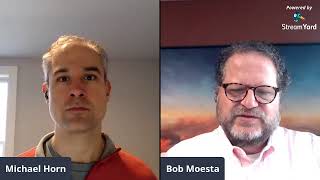
Michael Horn and Bob Mesta argue algebra, like Latin, teaches structural thinking but needs to evolve for high-dimensional data. They point to Common Core and Montessori as models embedding algebra early through real contexts rather than memorization, and stress that reading comprehension fails from missing background knowledge, not decoding problems.
Chapters
Welcome to YouTube. I'm Michael Horne, joined by my co author and colleague and friend Bob Mesta.
Good morning.
I wrote. Yeah, good morning. I wrote an interesting piece that got the social webs buzzing a little bit yesterday, Bob, about, you know, I was just sort of like, we're all talking about coronavirus and COVID 19 and those are important issues. I wrote about them today, but I wanted to talk about algebra and I just do we still need it? And after I wrote this piece for Ed Surge, I'll put it in the show notes. But you came back and you called me up and you said, michael, it's a little like Latin algebra. What did you mean by that?
Yeah, yeah. So my thing is algebra. I think it's more about the thinking of it. And if you think about Latin, Latin is one of those languages that is in the root of so many other things, whether it's medicine and law and like if you go to the root of words, it's just so important in what you, what you realize.
Like you learn to be good at an sat. If you actually understand Latin, you'll have no problem.
Exactly, exactly. So it's a really good foundational language. But what, nobody speaks it. It's literally not, it's not a language that, that you can do really anything with. But it's a great foundational piece. And so to me, like, I do believe that we need to be talking about the literature, the data literacy as you pointed out. But algebra is like in my mind is, is not old fashioned, but it's based on kind of the mechanical world. It's like three dimensions of like, what's the volume of a cube? Right. But the reality is like in, in days today we have like, like I just, I just walked out of a meeting where we're doing 26 dimensional math. Like I need to know algebra.
Yeah, I'm not going to help you with that.
Well, it is a form of algebra because it's just not three dimensions, it's 26 dimensions. But the fact is that the way we teach it is so like this is the way you can do it. And we teach people like, you know, what to think about it as opposed to how to think. And that process of thinking in multi dimensions is really important. But at the same time I just don't think that people appreciate the value of it. So as they're going through it it's like, well, why do I need to know this? I don't know what I'm going to look like. I'm never going to have to calculus, I'll just go to Google. Right. And so I think the fact is, at least for me in the innovation space, it's literally making sure that we have algebraic thinking. But I just think we need to update the way we teach it in a way that actually helps people things and see variables and understand how they relate. Ultimately there's a difference between correlation and causation. And so to me, what, what Latin does is Latin gives you the underlying root causes of how a word became something. And so the, the reality is that linear algebra has turned into a correlation thing where it's like people still don't understand how to use it. They just know that like these two things correlate. So when I correlate, you know, drownings and say drownings and ice cream, you know, I could actually come to the conclusion that ice cream causes people to drown.
So it's interesting to jump in on you on that. One thing I've been struck by is we've moved to more of a common core math. I'm not sure you're allowed to use that phrase anymore, but they basically are embedding algebraic concepts in much earlier math learning. And I've been struck in the Montessori math where my kids are right now that they're not even in kindergarten and they're literally doing algebra as they're doing math functions with real world manipulatives. And I think that's probably getting closer to what you're saying, which is teach the concept and the foundation. You don't necessarily need to make this an exercise in memorizing manipulation of variables for its own sake abstracted from the actual cause in which you would use it in the real world.
Exactly, exactly. And this is where I think applied learning is there and then when people want. So the hard part is we all learn differently. Like sometimes I need to learn the concepts and then apply, and sometimes I need to apply, then I can learn the concepts. And, and I think this is kind of the dilemma is the, the, the, the concept of pedagogy where we have to have the best way of teaching, but, but it's a two way street. The best way of teaching is, is actually relative to the learner. And so I just feel like that, that to, to your point, your, your, your, you know, twin daughters are just to the point where they're learning things in a very different way than we learned things when we were growing up. And that pedagogy has to actually come along with it and to realize pedagogy should be about how we actually help people learn, not necessarily how we teach.
Yeah, it's a really good point. And so one other question for you, which is one of the other pushbacks that I've seen, which is one I anticipated, but people saying, well, if they don't take algebra when they get to college, they're foreclosing them from certain STEM careers like chemistry or things like that. My take has been like, sure, but that means we need to re architect those subjects as well, to teach those concepts in the. In like, while learning chemistry. How do you actually teach algebra in the context of it? So it's useful and comes alive. But what's your take?
Yeah, so I look at it. They've tried to make, I'll say subjects modular. Like, I could take algebra and put it with geometry, and then I can put it with, you know, data science and I can put it with statistics, and we can put it together and make you a data scientist. Right. I think the reality is that they've made the boundaries. The key to modularity is the interfaces between the parts, and people have forgot about the interfaces. So if I learn statistics and I learn algebra and I learn geometry, well, they should naturally fit together, but they don't. And the way things fit together is in the real world is like, well, why are sales going down or why is the enrollment going down and why is the cost going up? Those are all data analytic situations you have to be able to do. So I think the problem is we've almost implied modularity, but it's actually not designed to be modular.
Last question, which is if you were.
By the way, I'm putting it out there. Right.
I'm in agreement. This is something that Clay and I explored and wrestled with in disrupting class was what are the bounds between subjects being interdependent with each other and where are they truly modular? My read, actually, is that a lot of the literacy problems. So let's take it out of math, for example, that a lot of the reasons people. Once you've learned the foundations of literacy. So I'm not talking about someone like you who has trouble with decoding and things like that, but once you've actually.
I actually am an expert at it. I'm just not good at the regular way. Your way of doing it. I have my own special.
You have your own system. But once you've mastered that skill set. Actually, a lot of our literacy challenges as a country are not because we struggle to decode words. It's because we don't have the background knowledge in them. Literally, we've never been exposed to certain subjects. The great example is baseball. You give a group of high performing readers who know nothing about baseball a passage about baseball and you ask them what's the main idea here? They have no idea because when you say the runner stole second base, they're.
Like, oh my God, that's terrible. Right? That's right. That's right.
They have no context for what they're reading. And what you realize is actually social studies, science, math, reading, music, arts, these are all actually interdependent subjects. And as much as we want to pull them apart and make them modular, if you don't treat them with coherence, they're just not then. And that's not where we are.
Well, and I think the other part is like, so Fos said something yesterday around, you know, you've been.
Yeah. For those that don't know, this is our friend and colleague of OSOMO at the Christensen Institute who wrote a great book with Clay Christensen, the Prosperity Paradox.
Yeah, you've been asking him that. You have been asking him a question. What's the question you've been asking? Asking.
Well, I've been trying to figure out what questions he's trying to answer because he's trying to figure out what he does next in something in the institute. And I said, what's the real question you're trying to answer? Because once you identify that crisply, the solution will be much clearer. But you haven't had crispness yet around the question.
So this is the thing that I think is part of the problem, is that it's actually as simple as that is asking what's the right question. And I feel like a lot of school is they're actually giving you the question and the answer as opposed to helping people frame the question. And I feel like the cool part from being dyslexic is I can make no sense of a paragraph. So I have to think about like, well, what are they really trying to say here? And everybody else would be implying. One is, I have to admit that I don't know.
Right.
School actually does not build that. I'll say lack of confidence or the ability to question and say, like, what are they saying? I don't know how to ask somebody that is there. The second is the courage to ask. And so I think the reality is the glue that's missing between these pieces is questions and the courage to ask when you don't know. Because everybody's so bought in that basically I should know it all.
Yep. And that's a good place to end for today, but we'll be back with more thoughts in the future. Right, Bob? You'll come back. Got it.
Yeah, we'll keep doing this. This is great. Thanks, man.
Thanks for watching.
Yep. By.










