Entrepreneurship by Students, Educators, and Networks
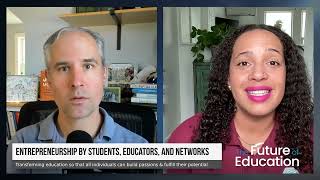
In this episode of the Future of Education, host Michael Horn interviews Sherene Ratigan, founder of Colossal Academy and the Innovative Educators Network. Ratigan shares her multigenerational teaching lineage and the series of experiences—public school, private elite schools, Montessori, and pandemic‑era POD teaching—that led her to create a micro‑school model focused on deep literacy and numeracy, nature competency, and entrepreneurship. She describes how Colossal Academy operates: small cohorts (about 30 students per site), ages 6‑12th grade, with four physical locations (Fort Lauderdale, Miami, Jacksonville, and Mérida, Mexico) plus an online program for older students. The school’s curriculum is project‑based, allowing students to request resources (e.g., drones, coding, surfing) in real time, and includes hands‑on projects like a food forest and a T‑shirt drop‑shipping business that teach financial literacy and branding. Staffing consists of veteran teachers who own their sites, supplemented by community specialists (permaculture, chess, podcasting). Ratigan explains how Florida’s Education Savings Account (ESA) policy has both enabled micro‑school growth and created challenges such as costly zoning, fire‑code, and health‑department requirements that treat small schools like large high schools. To address shared obstacles, she co‑founded the Innovative Educators Network, a grassroots coalition of micro‑school operators that provides visibility, shared resources (marketing, bookkeeping, insurance), webinars, and mutual support when schools close. The conversation also touches on scaling the movement—not by expanding individual schools dramatically, but by proliferating diverse, locally owned micro‑schools that serve families seeking alternatives to traditional education, especially those who feel marginalized by the current system. Ratigan emphasizes community ownership, flexibility, and the role of entrepreneurship in preparing students for a future beyond industrial‑era schooling.
Chapters
Welcome to the Future of Education. And now, here's your host, Michael Horn. Welcome to the Future of Education. I'm Michael Horne and you are joining the show where we are dedicated to building a world in which all individuals can build their passions, fulfill their potential, and live a life of purpose. And to help us think through how we get there, I'm really excited because we have Sherene Ratigan. She's the founder of a school we're going to hear a lot about today, Colossal Academy, as well as the Innovative Educators Network, which we're going to discuss what that does and the ecosystem really that she has built around helping a lot of school founders build meaningful places for kids to learn. So first, Sherene, great to see you. Thanks so much for being here.
Thank you so much for having me. You're one of the people. I have very little accolades and you're one of the, like, check marks. I'm like, no, Michael Horns.
That'S very kind of you to say, but you're the one doing the work. So let's dive into that, introduce folks, you know, your origin story to the Colossal Academy. I'm excited to hear it.
Yeah. So I am a fifth generation teacher. My great grandmother, my great great grandmother was a one room schoolhouse teacher on a farm in Illinois. My great grandmother was a teacher. My, my grandfather was a superintendent of schools in rural Illinois. My mother special education in an urban setting for 35 years. And then came in and I was like, no way. I'm breaking the cycle, right? And all signs pointed always back to being a teacher. And so I finally submitted to the fact that that's my calling and I went into public school because that's where you go when you're a teacher, you get trained, you become a public school teacher. And then I swiftly out that it was a dangerous, physically dangerous for me to be there. I was breaking up fights, I was pregnant. And I was like, this is not what I saw. I saw myself as Ms. Frizzle. And we're gonna go to the digestive tract and we're gonna learn all these things. And when we get there, it was like, mandates. Here's your curriculum. How come they're behind in the test? Here's the state. And it wasn't what I thought, but so I said, okay, let me, let me go to private school. It must be better there, right? Really elite, very expensive, top 2%, very elite. But there were bodyguards at for different reasons, right? Because these kids could take in, right. At the school that they had their personalized bodyguards. So and I was like, this isn't it either. I'm still checking in badges. I'm still. There were still some expectations there that I just was like, this isn't it either. Something's wrong. We're not outside. We're not not going on field trips. We're not in the real world. Maybe Montessori is it. Let me go find Montessori. So I went to Montessori and that was lovely. But I felt like something was missing for the future that I felt like students really needed to have some future forward competencies in order to be successful. Computations, coding, programming. And I know that many Montessori schools do that, but I felt like it needed to be real and relevant and actual. The pandemic hit and I decided I really love teaching. I didn't want to be a people manager and asking how long they're washing their hands for and mandating the mask and making sure it's up past their nose. It's not what I wanted to do. I don't know if I got fired or if I quit that short end. I no longer had a job at my school, which meant that some of the families that wanted to be a POD hired me to be their full time teacher. And I said, okay, well, if they're paying a little bit less than what they're paying as tuition, they could pay me to be. I need is four kids to make my salary. And then I started with four kids. We moved to 6 and 10 and 12. And so that's kind of the genesis. But what I found out there is like I get to do whatever I want and when. I mean whatever I want, it's whatever the kids want whenever they want, in real time. You want drones with control? They'll be here on Thursday. Let me Amazon it. Whatever. What do you want? You want to learn how to code? You want to go surfing? You want Whatever you want, I can be that and I can give it and I can create those opportunities for you. And I was like, this is it. This was the Ms. Frizzle that I had imagined. And it took me so many like stops along the way to get there, but I found it and I found where I was able to be the teacher that I knew I needed to be for. For young people.
So cool. I. I'm just reflecting on what I heard. And my father's family is from Illinois, sort of, you know, city, but not a main city anymore from there, so have some resonance there. And then I feel like I went to public schools. I was then in the independent school world, on the board of NAS for a little bit. Micro schools have certainly spoken to me. My kids were in Montessori schools. The pandemic hit. We went into sort of this pod like thing very similarly, but they went back to Montessori because we couldn't find a different solution that would lean into some of the things you just talked about. And to be clear, it's been beautiful. And I hear some of the excitement and passion you've introduced. So tell us a little bit more about the educational model itself from Colossal Academy. And as you do so, I'd love you to like, sort of reflect on, you know, kids desiring to learn about drones getting whatever they want versus, like, are there certain non negotiables that you say? Well, and this is really important that you learn through the experience. I'd love to hear you sort of walk us through that.
Sure. So there are definitely absolutes. We really firmly believe in a deep knowledge in language literacy and numeracy. We deeply understand that and we think that, that we're presupposing that we're going to need that in the future. Right. Even if we are replaced with the robots, I still believe in like passing on knowledge. Right. As humans, that's what makes us different than any other animal, that we're passing on knowledge and we're teaching. We also firmly believe and we're declaring that nature is a future competency. You have to be in touch with nature. You have to understand how nature works. You need to be able to identify plants and know how to grow some food. That is a part of our model as well. Entrepreneurship is really rich and deep. We understand that the traditional education system is outdated. And part of it is the reason it's outdated. It's not relevant for the future moving forward. We're not in an industrial era, we're in the future era. And so what is that? It's going to require people to be entrepreneurial, make their own jobs, problem solve on a deep level, and consciously make money. And that's part of what we do. And what we found is we have amazing projects. And we took over this vacant lot next door and turned it into a food forest. We're in downtown Fort Lauderdale in the art district and there was a vacant lot full of bricks and rebar and the kids themselves pulled it out. We got it. We had to talk about responsible dumping. Where do you, where do you put things like that? Where do you put a battery? Where does that go? Right. And so that was a beautiful project that we were able to do. And, and they love their garden and they think it's amazing and they eat from it. We, we have sugar cane and bananas and all kinds of local Florida native tomatoes and, and, and foods and, and roots. But what I find really unlocks them is when they, when they have an enterpr making money, that's where I find that it's like, oh, I gotta understand how to work. Okay, what's the spreadsheet about? I'm like, I told you guys, like, you need to see your projections. What's your Q3 looking like, guys? What, how many more to get your $200 goal that you spent for yourself? Okay, once you make $200, are you gonna, what are you gonna do with it? Like, so those things, those skills, I feel, become super relevant when there's an actual dollar amount that, that they are earning. So all of our students own their own business. They learn to be CEOs of their companies. They. Right now we're working on a beautiful project. Across the Colossal Academy, we have an online school as well where they design T shirts based on their identity. So they go into their identity, they build out T shirts, and they all have their own drop shipping site, right? And so all of that goes into being relevant. They learn how to use canva, they learn how to design, they learn how to ask questions, they learn how to like, show their identity, find their core values, attribute those to colors, find the chroma hacks, all of those things. They have a brand kit, all of their brand kit, and that's theirs. And they have to justify why they're using Kelly green, right? Like kids, like, I'm Irish, I'm using Kelly Green. I'm like, that's great. You have to be able to understand why do those colors create that kind of a reaction in you? And what is that doing for you and how does that represent the brand? And what kind of font do you want to use, right? So asking questions like that, and then the skills that we're learning in it are transferable. They're able to have that, they can build portfolios. They have their own websites that they build every week. They drop into their websites, they have their own LinkedIn accounts. They're meant to find and create connections with people because that's what elite private schools do. It's really your Rolodex that you get from a private school. It's not that the education is any better or the quality of learning is any better. And in fact, I might argue the opposite. Don't come for me for it. But I think it's different. Some of it is the accountability piece. Right. When you have a lot of money, you can turn those D's into an A. Right. Those things happen at very elite schools. And so it's not that their models are any better. It's that they've built a beautiful network of when you needed a job, who are you going to call? Right. And so we have to elevate who's within our network so that we can change our trajectory as far as who we're going to be out in the world. So that's kind of like the model itself. We center everything around relevancy. What is relevant for you? We have a very large wait list. We have four locations. But at the downtown Fort Lauderdale location, extremely large. I could just get another building, but I'm not going to, because once. Once you go beyond 30, you become a people manager. And then you have to use those old systems of, like, bells and whistles and times and clocks, and you have to manage people rather than, like, interact with people. And we just are refusing to get larger. And it might not be the best, you know, the old school, best business decision, but that's what we're doing.
But it sounds like you're spreading. I'm sorry, there's so much to love and dig into here. So let me go in this direction for a moment. It sounds like you are spreading, though. You have four locations, if I understood correctly, 30 kids in each. You have an online school as well. Tell us, like, tell us, like, who the students are, how many, and like, how are you staff? You know, these are not traditional teachers that are working with them, clearly. So, like, who are the adults that get to interact with them? Yeah, who of them? Maybe the right way to ask it is who of them are on your payroll versus, like, they get to interact in the community as they build the social capital you just described, which is beautiful, by the way.
Thank you. Yeah, it's. It's been. These are all questions I'm answering, and we're building it as we do it. But who we serve are really the students who are on the fringes of the intern, like the traditional ed. The kids with the largest adverse reaction to the traditional ed is who we're serving. And they're really the first generation of whatever education system is coming next. They really are the trailblazers. They really are the students that are developing the new. The new model. Right. But what's profound about these students is, although they have adverse reactions to the traditional model, with all Kinds of symptoms that can look across the board like many different things. What we're finding is they're extremely talented and totally capable of so many other powerful tools. That skill set that, that's going to drive innovation forward. Right. So they might not be great at sitting still and taking notes and doing. But what they're really great is problem solving and collaboration and communication and figuring out a new business that's going to. I have a student who has a costumes for new guinea pigs. So she makes wings for guinea pigs. Not a traditional student by any means, but where her talents lie is there. So that's, you know, who we serve. A lot of times parents are just like, I cannot stick my child in a traditional classroom. I don't know what it is. They're magical. I believe in them. They're dying in a traditional system, you know, and other matrices for us is joy. You should just, you can get to the same result joyfully. Right. So we try to unlock the joy in everything that we're doing. So our online school, as you know, most of what's happening in the future is going to be digital. How do you practice showing up online if you don't ever have to do that? What is your background? I'm not actually the prime example, but what does your background look like? How do you dress for online interviews? Online community communities that you're going to be in, that's the workforce of the future. So the, the online school really helps to solve that. Learning digital citizenship, how to show up, how to collaborate across screens. And that's allowed us to, to be with our students in Jacksonville and Miami and have all kinds of cross pollination. So our online school also serves 6th through 12th grade. Okay. So the beautiful thing about that is I as a micro school could not hire one biology teacher to come in three days a week for one hour. We just couldn't do it. What we're able to do now is be able to utilize the same pool of teachers to make sure that our students have access in the areas that they need to. We have partnered with ASU Prep and licensed some of their classes. And then we colossalize our other classes. So we use AI tools that help to help with research. They learn how to manage their projects and find collaborators across them. So to your initial question, yes, we have four locations. Miami, Jacksonville, and we have a school in Mexico, Merido, Mexico, and my school in Fort Lauderdale.
Wow.
Teachers own their school belongs to them. It doesn't belong to me. And the point is you serve your community. My community looks different from somebody else's community. And you need to serve your community and call on the community experts to pour in because they're dying to come into our classrooms and teach something. So my job is to teach you how to be a teacher for a day for 45 minutes. Don't talk for more than 10 minutes, sir. Do not talk for more than 10 minutes. How are you going to engage them? What are they going to eat? What are they going to touch and engage their senses? And so I give them like a rap sheet of how to do that and then they build partnerships within the community. So our staffing looks like we have two amazing veteran teachers whose goal I think most teachers goal is to like unlock the child within really deep discovery, joyful learning, play based learning, nature, nature awareness. And they're, they're both veteran teachers. Those are kind of like our staples. And then we have the other teachers that do some deep depth and then we have specials. In Florida, we're so blessed with so many people that decided to leave education but stay, leave the traditional classroom, but stay in education. Thank God for them. So that might look like just chess or home economics. We were able to bring back into the classroom or someone to do permaculture. And so these are our specials. Podcasting T shirt design. Right. Like those are the specials that we're able to bring in from teachers who have left the non traditional classroom and, and decided to start their own.
Very cool. Very cool. And so, and then the online, if I understand correctly, that's older students. The in person is that younger and older? Just younger. Like what's the age? You know?
Yeah, 6 to 12th grade. We're 6 to 12th grade.
Okay. That could be insofar as there's grades.
Yeah, yeah. That could be a seventh grader doing algebra. It could also be a seventh grader doing fifth grade.
Got it.
Whatever that looks like. But their age wise it's about 11 to 18.
Very cool. And so now as I'm jealous in Massachusetts of what you're starting to build in Florida, my turn to ask the next question, which is like you were frustrated as a public school teacher with a lot of the requirements, restrictions, things of that nature. Right. But how is the policy ecosystem helping you here and maybe where is it still leaving something to be desired as you're starting these new micro schools and, and serving families in these really cool ways.
Well, the policy in Florida has actually created more need for micro schools. Right. So people are deciding that they want something that serves their family because unfortunately the public schools have Become like a battleground of culture wars. Right. And so we've been able to build community schools or micro schools, however you want to, like title them in order to serve the communities that are needing that. So if that means you want to read African American history history and take an AP African American History class and you can design a school like that, and that's great. You want to be LGTBQI inclusive, build a school like that. And then the culture wars don't need to exist because you have a safe and inclusive space where students feel seen, loved, heard and can actualize. Right. And so the, the policy now, you know what, we're. We are open to having universal savings account, which really allows for accessibility so that students can make choices, families can actually make choices. The hardest part is really about the visibility, knowing that we're there because we're so tiny, which we could talk about with Annette, but we're also just so tiny and we're all just in our own little orbit. Right. So the ESA has really unlocked a lot of entrepreneurship and in fact that Broward county spends $19,000 per pupil. Our tuition is 15,000. And once I started to look at my budget, I'm like, where is all the money going? How are people? Every square inch of this place is accounted for. Every dollar is accounted for. If I had $19,000, they'd be Elon Musk and I would be putting kids in space. Like, if I had that much money, where's all the money going? Right. Yeah. So I think having access to funding that allows us to be sustainable has been amazing. Where policy and practical are kind of in dissonance. Right now I have the same school zoning requirements as a 4,000 person high school. So the fire, which is costly. It's costly to outfit a school. The zoning requirements, I have 14, 26 square feet and that means I need a sprinkler system and a whole fire. Whole fire system. We also need to. Some of the health department restrictions just start matching the micro environment. So those are where the opportunities for growth need to be. And I think we're working on it. Right. Like if you have 20 kids, do you really need to be zoned as a full fledged standalone commercially? It just does.
Doesn't make any sense.
It makes sense. Yeah.
It doesn't make any sense at all. Okay. No, super helpful. So that's a perfect transition then. Because the other thing you found it is this innovative educators network. Tell us about what it is and its purpose and why you created that.
Yeah. Thank you for bringing that Up. So I'm going to just tell you, if you don't know Surfskate Science, Michael, the next podcast you need to do.
Is focus on them. Okay?
I'm going to email you after this.
Cool.
Tony from Surfskate Science. Tony and Yuli Feliciardi started this amazing program, and our students utilize surfing and skateboarding on Fridays to learn physics, marine biology. We are out. They turn beaches and skate parks into classrooms. And it was during the pandemic and Tom and was like, would you, would you want to get like, lunch or dinner? And I'm like, yeah, let's get together and just like hang out. And we have the same issues, right? Like zoning requirements and where do we find this form and how do we. And so then we asked a couple more people. Tobin from Acton, Fort Lauderdale. Amazing. We have four kind of Fort Lauderdale locations here. And I was like, Tobin, Ms. Suarez, Ms. Ratchet, do you guys want to have lunch with us? And so it just started to grow. And as we were growing, we're realizing we're all facing the same issues. And so we just decided to do something about it. Tony is incredible about, like, super action oriented. I'm very grassroots. And so the two of us just have been such a beautiful partnership in making sure that micro schools and providers. We have 120 in South Florida, Florida, which is West Palm Beach, Miami and Broward counties, serving over 8,000 students. Tampa has opened up their own chapter, and so is Jacksonville. And so our key, our key pieces, the key contributions that we do are visibility. So we have showcases to let parents know and bring everybody together into the same space. We do conferences and showcases, press getting, helping. Getting the word out nationally and locally. Local is always hard. What else are we doing? Oh, just entrepreneurship. How do you keep your books? How do you do marketing? What's a funnel? Like, who's a bookkeeper? Where do we get insurance for 12 students? You know, like those kind of shared resources that we're able to help each other out with. And Tony's gonna kill me. There's a fourth one. Oh, yeah. Okay. Just like what just changes in education, in the platforms, like, what are the best practices so that we can share those better practices with each other? So we have guest speakers come in and you can choose to come to the webinars or not come to the webinars. And really what we are is community. We show up to each other's open houses. We cry when we have to close our doors together. We help you play. We had a school that just closed and we helped all of us buying a chair, buying some kind of something from the school, showing up, passing the word around so that when this person closed, not only did she place the students in a better environment or an environment that would serve them, but also just like helping her dissolve that business with love and kindness around the work that she's done. Wow.
Wow. Very cool. I want to connect that work to something you said earlier, because you said that your teachers own their own school sites. You don't own the one in Jacksonville. Right. Or Miami. Right. And so forth. Because I think you said something powerful, which we often forget in my experience in education, which is that these are really local of the community, of the context, institutions, maybe we call them, that exist in that environment. And yeah, there are things that are, like, common, just like the laws of physics, you know, transcend San Francisco to Boston to Miami. But how you build the bridge in each of those three places is very different because of the local terrain. And so too, I think, as you build these schools, and I guess I'm curious because as I hear you talking and you've built this innovative educators network, the thing that I keep thinking is like, scale. I don't think is one of these schools growing from thirty to a hundred thousand, but I suspect scale is like a lot of families getting the right option for their kid to make progress and sort of as a movement growing up over time with these principles underlying it. And I just. Maybe I'm leading the witness, but I'd love to just have you reflect on how we get to that greater scale. It's something that we think a lot about on my end. And Tom Arnett, sort of my colleague at the Christensen Institute, he sort of has this belief that as a sector, we're going to have to be able to solve more complicated and different kinds of problems, or like the kid that stays in a traditional high school because they love football, even though the rest of the experience sucks. Like, we have to sort of figure out how to bring those people in over time. I just sort of love you to wrestle with that question or tension or opportunity.
Yeah. I see innovative, educated network, and I see the moms, family members, aunties, caregivers, teachers. If you mess with our kids, which traditional ed has, we are endless, relentless. We will stay up till 4 o'. Clock. We will drive 8 hours for our children. Right. And this is true for both teachers and caregivers. And so it's like almost tirelessly we're taking on this mission. Right. But the other piece I will say is I feel like the independent microschool owners and the. And that's who in ed focuses on. We're like the mycelium of this movement, and we're a network that's just kind of underground. And we move really swiftly and we're supportive and super collaborative. Right. And I think that that root system is really going to keep us grounded. I can imagine as we see schools closing, we can still have a sports program. We can. We can have micro schools within a larger school. We can have 20 micro schools in a large high school. Like, there could be that showcase there. There are schools now opening up in malls. I think we have to really reflect and think, what is school? What is schooling? Who has to go to school? Should you have to go? All these, like, underlying questions of, like, what is education? How should we be delivering education? What's compulsory? What's not compulsory? As a society, do we want educated population? I'm going to say yes. That's my own standpoint. I think we'll solve those problems as we come. We see now we have, in our network, we have a coach, an Olympic coach, and he does PE for students and runs sports. And we have. Because there was a need for homeschoolers to also still be able to do the sports. They have a competing team. They have competing teams. So they're still able to compete and be in the. In the net, in the. And go for professional athleticism. We also find that professional athletes are using micro schools and homeschooling as a real option because they get their school done and then they do what they need to be doing. So they're training after school, or they have private trainers, or they're joining in in a different way. So, yeah, I think that. I think where our challenges are right now are some of the, like, landmarkers of graduation. And so I think we're just going to create those. I think there's a problem. We're entrepreneurs. We'll just solve the problem. So we'll just have a problem of our own, right? Well, when you're modeling it, one of our micro schools is doing a prom this year.
Oh, wow. Okay. And you're modeling it, I guess, right? You're modeling it for the students, what it looks like to be entrepreneurial, to build something meaningful and lasting that contributes value to the community and those who participate in it. So I. Let's leave it there, Sherene. This has just been really educational for me and just beautiful. Just beautiful stuff you are building out there, both within the schools that you directly support in this broader network. Thank you so much.
Thank you. Thank you so much.
And for all you tuning in. We'll be back. Next time on the Future of Education.
Sam.










