Future U. Visiting Northeastern: When Technology Complements Human Interaction
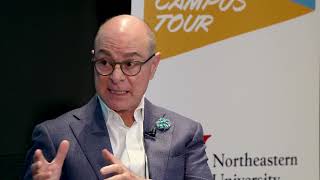
Northeastern's leaders and a Salesforce executive discuss how universities can adapt after COVID-19. They highlight the school's Humanics curriculum, which combines technology with real-world co-op work, and a hybrid NuFlex model mixing in-person and online learning.
Chapters
It's the Future youe Campus Tour and this week we have our first stop, Northeastern University in Boston.
Salesforce.org is proud to partner with institutions like yours to build a better future for all. We believe creating a technology enabled personalized and continuous experience throughout the learner lifecycle is so critical to driving student and institution success from anywhere. Learn more@salesforce.org highered.
So I want to talk a little bit about the vast majority of higher education because they are struggling right now coming out of the pandemic. So we're going to talk a little bit about Northeastern in a minute, but I want to talk more broadly about higher education. If you were the czar of higher education coming out of the pandemic, what should those institutions that do to survive and thrive in this decade ahead? Those institutions that may not have the means of a Northeastern or the student demand of a Northeastern, or be in a dynamic city like Northeastern, or have the research prowess of Northeastern? What should the vast. If you were the czar of higher education, what should the vast majority of higher education institutions do coming out of this pandemic?
Higher education. This is a good opportunity for higher education to reflect and also to see what opportunities we have moving forward. So let me explain. We know that during COVID there are many lessons that we learned in higher education. First that COVID 19 came, we were not prepared overnight. We had to move into the online learning and by brute force. But at the same time people realized that it could be done and we, faculty, staff, students learned how to live with it. Now we are in this situation where online learning is not something that you question. At the same time, people started questioning the residential model. At the beginning people said, oh, that's the end of the residential model. Well, we learned that this is not the case. Why? Because we saw that during COVID that the students of in, you know, wanted to the human contact. What's, what's it? Let me give you an example. When colleges, when some colleges and campuses closed, the students gathered and rented places around them around these colleges in order to interact with each other. The human factor is important. The human interaction is important. And you know, another lesson is obviously what happened with the Black Lives Matter and systemic racism and impacting many communities including the Asian American communities, the Hispanic communities, the Muslim communities, etc. So you know, this many universities were, including ours were caught flat footed because we realized that this was important to us over the years, but we didn't make it part of a university imperative. So we have to integrate all that. So now, let's look at where we are today in higher education. You said that some places are hurting. Well, this is a time for these places to look at themselves and say, what are we doing? Are we attractive? Are we differentiating? We talked over the years that higher education is diverse but not differentiated. So if you're not differentiated, how are you going to attract students to you? What is your value? Add. And this is an opportunity for universities and colleges to reflect on who they are and what they can do differently from others. Second, this is an opportunity for them to go beyond what they have been doing. For instance, in the United States. You all know, we all know that the large majority of learners are lifelong learners like us. How many colleges and universities consider lifelong learning opportunities or lifelong learning as part of the core mission of the university? That's not many. Well, that's an opportunity. Why? You know, you know, you wrote about it. You documented that we are an aging population. The percentage of undergraduate students who are traditional 18 to 22 students is shrinking. At the same time, the percentage of lifelong learners is increasing. So we have to look at our mission and say, our mission is not to educate the 18 to 22 only, but our mission is to educate people for life. This, this will open enormous opportunities to everybody, to colleges, to universities. Those that are hurting can benefit tremendously from that. So it's time to look at these opportunities. Other opportunities are going to arise. Can you partner with other colleges? Can you merge with other colleges? Can you bring a consortium together to work with you on issues that are relevant for society? We did it during COVID 19 universities worked together on providing solutions for COVID 19, whether it's drugs or whether it's vaccines or other aspects. So that's how I would look at it.
Northeastern obviously has been active in this partnering and other conversations with shared services with other universities. So let's use that as a way to shift into the Northeastern part of this conversation. And, and specifically, I'm curious, during the darkest days of COVID very early on, you set up a task force to think about strategic opportunities for Northeastern. So I'm curious, the thinking behind setting that up and then more specifically, what are some of those new and emerging.
Opportunities that you see for the university right now?
Looking at the future is always an imperative for us because if you don't do that, you know you're going to fall behind, you're going to miss opportunities, and you're not going to renew yourself as an institution. So this has been something that we value tremendously. Always think about what you do, always think about questioning it and always think about opportunities. And we did it, as you mentioned, during COVID 19. That was important to us because we knew at some point that COVID 19 will end, but the university will not end. So therefore, our teams started looking at what we can do, ranging from launching very robust B2B operations, business to business operations where we can embed ourselves with employers and provide them with upskilling, reskilling and reinvention, to the possibilities of partnerships such as the one we announced with Mills. And we're very excited about that. Two to the opportunity to continue to build our global university system throughout the nation and the world.
So I wanted to talk about thinking about the broader US Economy coming out of the pandemic present. And it's been really well established, of course, that automation and artificial intelligence was a trend before the pandemic. It may even become more of a trend coming out of the pandemic. Moving forward, what do you think that Northeastern and other universities need to do to maintain these long term connections to students, to the human element? In other words, how do they add value? You talked, for example, about students wanting to be here on campus, even if they weren't in the classroom during COVID You've talked a little bit about lifelong learning post pandemic. How are universities, given the rise of automation, artificial intelligence, which I know from your last book, is a topic of great interest to you, how are colleges going to maintain that human connection? What do they have to do to maintain that human connection going forward? Coming out of the pandemic.
We already know that students at all levels, whether they are 18 to 22 or more, mature lifelong learners need the human connections. So therefore, it is not the case that people are going to be satisfied with purely online learning. People need to be part of the community. You are learning not only from your professor, but you are learning from each other and you are creating with each other. So from this perspective, what we learned during this Covid period is that there is a difference between a university and a campus. Because we always assumed that. For instance, if I ask you, what is Princeton? You say, oh, Princeton is in New Jersey. New Jersey. When Princeton closed its campus on New Jersey, it doesn't mean that it closed the campus, that it closed itself. It kept functioning. So this congruence between the university and the campus has been called into action. We have been liberated from there. Therefore, in order to maintain the content, the contact with the students, you have to go where the learners are. And that's what we're doing without building a global university system where we are in California, in Canada, in Seattle, in London. So in order to maintain the contact with your learners, you're creating a lifelong interaction. You have to go to them, be humble, listen to what their needs are, and then provide these needs wherever they are, whenever they need it. So don't ask people to come to a campus, let the university come to you.
Do you think this will also shift kind of what is a signature program here and which is increasingly being signature programs in colleges and universities around the country, which is experiential learning? Right. It's really what Northeastern is built on. How does that change coming out of the pandemic in your opinion?
Once again, we globalized our co ops over the years, so this served us well. Obviously during COVID 19 we had to rethink it because we already had built experiential opportunities, even when in a virtual world. So for us, the experiential opportunities are key in order for students and learners to integrate the classroom experience with the world experience. And whether you do it virtually, whether you do it physically, those are different matters. Clearly, during COVID we had to do it virtually. Now it reverted back to physical setting. But we learned that you need to do both. So what is the impact? The impact is that when you are working with lifelong learners and they need a certificate, we want all these certificates to be experiential now, even when they are on short term certificates for four months, therefore we have opportunities to give them virtual and physical experiential opportunities. So integrate that and that's what we have learned to do. Well.
My question is about general education for all students.
How is it that schools like Northeastern.
Should be preparing every student for a digital future when most degrees do not include any applied science activities in the actual applied mode?
So obviously everything applies if they learn in general education. But how is it that they're supposed to get the experience if those aren't.
Required for graduation degree requirements?
Here at Northeastern we talk about curriculum that is based on humanics. And this precisely going back to the idea that AI and robots and intelligent systems are displacing people. And we don't want people to be displaced. So therefore the question is how to do it. What we want is people to understand machines, the products of these machines, and to focus on what machines cannot do, which is something that is the purview of humans. So we are in humanics calls us to have three literacies to focus on. Three literacies attack literacy essentially in understanding machines and how to interact with them, data literacy, understanding the product of these machines, and human literacy, focusing on what we as humans do that machines cannot duplicate in the foreseeable future. The ability to be innovative, creative, entrepreneurial, to understand how to work in teams, to look you in the eye and to understand your body language. Is he with me or isn't he with me? To be ethical, to be global, to be culturally agile, et cetera, et cetera. So what we are saying is that the core curriculum should include all these dimensions. And in addition, we are saying something more. It is not enough for you to learn about all these dimensions, tech literacy, data literacy and human literacy. What you have to do is practice them in real world settings through experiential education, through co ops. Why? Because all our students tell us that when they come back from their co ops that they see opportunities that they didn't see before in a classroom setting only. They understand first of all what they are good at, what others are good at. They understand gaps, they understand needs, they understand inequalities and racism in a different way. And they step in and they say, we can play a role in making it happen. But also in so doing, we call the premise we want to understand machines, but we want to focus on what we do that machines cannot duplicate. From this perspective, when you do the experiential education, you practice what learning specialists and some are here today will taught us is that you do far transfer. What is far transfer? It's taking your knowledge from a domain and projecting it in a completely different domain.
Next up is our discussion that we had with Northeastern's provost David Madigan, as well as Marilyn Minus, a professor and chair of the Department of Mechanical and industrial engineering. Brianna McClary, a political science and criminal justice double major who is set to graduate in 2023, and Jason Belland, a vice president at Salesforce. And here's Jeff with the first question to that panel.
It was interesting. I wrote a paper last year called the New you and in it concluded that the. The physical campus in a specific location was always the differentiator for most colleges, in fact. So Northeastern, right, sold the experience in Boston. It's a little bit more difficult when students are spread out everywhere and you're not in Boston to differentiate Econ 101among institutions. So this seems to indicate kind of a hybrid future for higher ed. But I think hybrid means different things to different people. So maybe could you just describe what it means to you? What does hybrid mean to you? And then basically, what might it look like more broadly at Northeastern or in higher education in the future, and then what do we need to get there? So what is hybrid? You know, what does it look like at Northeastern or at other campuses? And most important, what do we need to do as a sector to get us there?
Thank you.
So I think, yes, we did learn just how important place is and being together and whether it's, you know, whether it's here in Boston or at some other location, this desire that, that, that we all have to be together like we are at this stage right now, you know, is extremely powerful. We also learned, you know, that that a single modality education is.
Is.
Inefficient. It's suboptimal. It's not Just to have students and instructors and instructor and students in a room at the same time is one modality. There is surely a role for that, a central role for that. But higher education going forward is clearly going to weave together different modalities. I think we talk about, and we talked a lot during the pandemic about in person versus online, you know, as if this is a kind of a sharp dichotomy. And, you know, we all know what in person means, right? Instructor and students together in a classroom. We, I think when people use the term online, generally speaking, what their meaning is, different place and different time. So, you know, think Coursera, edx to you, etc. So, you know, you're in your own space looking at something that's recorded. It's not a synchronous experience. They are two valid points of. On in the spectrum of modalities. I think education, higher education, perhaps all forms of education going forward will embrace both of these. But there's so much space in the middle in terms of, you know, for example, a different place, same time. So, you know, that we call that Nu Flex here, our version of that that we used during the pandemic. I think in the future that will be much more, much more widely used and also much more sophisticated. In many ways, what we're doing at the moment is pretty prim in terms of the experience. An instructor in one place, possibly with some students, some students in another place or other places with not really the full experience of being in the room. I think technology is going to change that. So immersive experiences where students and instructors, and I think the definition of instructor is going to change as well. We will have seamless experiences at the same time, but in different places. And I think that is going to be centrally important.
So for you in the classroom setting, Marilyn, I just want to turn there, you Know, let's imagine this hybrid world that's just been articulated. And, you know, one thing the pandemic clearly showed us is that, you know, teaching and learning, it's not a binary choice between in person or online. So given that, it's likely to be a mix of both with the spectrum that David just described, that obviously requires faculty, though, to make some changes, to rethink how they're teaching, what tools they use, how they use learning analytics and so forth.
So.
So I'm curious, what are the pieces of the hybrid world in your mind, that faculty have largely figured out? What do they still need to figure out, in your view? And where do universities need to really support them in figuring out, and what does that support need to look like?
Yeah, thanks for the question. I think something that the faculty have really figured out, we had to kind of learn very quickly what students can learn from us in person and what students could learn on their own. Right. Because we had to redesign the curriculum to really think about things that will just be delivered electronically through the technology and then come in, and where do they need us to deliver that same material? So that was something we had to figure out very quickly at the beginning. But I think we've largely understand that better. We understand the students better in a different context. I think the technology is still something we're trying to figure out. David mentioned. It's a little bit primitive, but it's still something where a lot of people were not using technology to the full capabilities and had to really learn a lot of new things all at once. And so what happens there is you use the minimum, and then you start to realize why there's more functions, there's more things I can do. So I think faculty are still trying to figure out all of those functionalities because that's going to essentially factor into the way they design the curriculum and the way they design the material that can be delivered in different modalities. I think that the university can continue to educate the faculty and educate students, educate us more on all the opportunities that we do have from a technology point of view. We got a lot of training, but a lot of that training was really about pivoting, getting ready. We've got to do this. We don't have a choice. But now that we know we can do it, now the education needs to shift to what kinds of things we can do with technology, what kinds of new things we can do that we didn't know we could do before. Because now we're ready to receive that. I think we're out of the pivoting mode, get it done mode. And now we're into, okay, redesign, rethink our curriculum.
So, Brianna, that's the view from a distinguished professor and a provost. I'm curious to go to you as a student and get your view on this and about how the future of higher ed as a hybrid model sounds to you, in effect. But you've told us that being in person was important to you. You liked, though, the flexibility, to some degree, of the hybrid. What I want to dig in is what that word flexibility means and what's desired about it specifically, like scratching that word a little bit deeper, you know, do you want flexibility within a course, within your schedule, that you can do some courses online, some in person, maybe even being able to be flexible about when you're on campus over the course of the year? Just really, what does flexibility mean to you, and what does it look like in the ideal?
Yeah, so I have taken hybrid classes fully in person and fully online classes during the pandemic. So I've kind of gotten the entire scope. And for me, flexibility is best seen as like, almost the hybrid model that we had at the beginning and middle of the pandemic. Obviously, that is sort of like, at its, like, primitive state, so I'm sure that can grow from there. I honestly don't know much about technology, so that's not the place for me to speak about. But I really liked the flexibility that the university offered when we were able to select the exact classes that we were going to go to in person for the next week. And that could change week by week. So, like, I could choose my Wednesday class would be in person one week. The next week it would be online. So that was a lot of flexibility that I didn't really expect us to have. I was expecting us to go fully online. So it was a nice surprise to be able to go in person for classes that I wanted to. I would say that I was the kid that was always there in person during the pandemic. I liked. I love that in person instruction. That was something that I really, really valued, especially over the pandemic, when most people are online. And I think professors being able to, again, like, utilize the technology more, because there are still a lot of hiccups that come along with it. And thank God, Northeastern, it comes quickly to classrooms when issues come up. But I think sort of having a more immersive experience will also be helpful because there were times when I was in the classroom and I was one of two students that came in person and the rest, the 20, 20 other people were online. So obviously something is missing. We felt like something was gone. So somehow making that more inclusive for the people who are online and in person, because both people want the same experience.
So, Jason, I want to turn to you to get your view, both as a technologist and someone who partners with universities to solve their most pressing problem. We tend to think of technology in a very bifurcated way. It either replaces something or it complements something. But it could kind of do a little bit of both on college campuses. And so where do you think that technology does this the best right now? Where do you think it complements what campuses are already doing? How is technology in your mind, kind of creating time for faculty and staff to focus on other parts of the human experience? Right. We keep hearing this. People want that human experience. Right. So technology enables us and frees us up in order to spend more time on that human experience. And where do you think there are opportunities to extend that even further? So where is it gives us a chance to complement what we're doing to free that time up for the. For the human experience.
Yeah, I love that question, Jeff. And it reminds me, I had a great conversation with a leader at a very prestigious university who said, you know, every employee here wakes up every morning and they love the mission, they love what we're doing. They're very excited to come to work every day. We're going to help students. We're going to change the world. And then they get to campus, and throughout the day, they take this journey toward apathy because they can't find the data, and they're searching around, and it's frustrating as they're hitting roadblock after roadblock. And that's really where technology comes in to clear the path for academic advisors. We talked about the seamless experience in the classroom. We need to make sure we have a seamless experience and a delightful anticipatory experience in and outside of the classroom. So how do we take advisors, how do we take faculty and others, admissions officers who are here to help students, to help connect students to opportunity and get the roadblocks out of the way by empowering them with the data that they need. By the way, the data that the university is collecting every day, but bringing that together in a way that makes sense, that's easy to access so they can leverage that information and reach out to students? I think this is one of the great things that we're seeing coming out of the pandemic. One of the, I think, silver linings if you will, of the pandemic was universities got really clear very quickly, out of necessity about what are our values, what matters to us, and pivoted very quickly. That has led to some very real conversations about how do we engage students using technology in a way that to the audience question earlier really leans into making sure every student feels that they belong and they have a place at the institution.
So I actually think that sets us up nicely to have a conversation beyond just the hybrid moment, because this seems like a broader sort of sea change, potentially a seismic moment more broadly for higher education. And so I want to turn to you, David. We've talked a lot this spring and future you or winter and spring, spring season. Right. About the value specifically of higher education. And the US System as a whole, we know, has lost a million students during the course of the pandemic. Some of those would be students might enroll eventually, but it's fair to say that we don't really have a great picture still of where a lot of these individuals did instead of college. And so meanwhile, students and parents everywhere and on both sides of the political divide are constantly questioning, you know, the price of college tuition, whether it's worth it. They're calculating the return on investment. And yet against that backdrop, a place like Northeastern and colleges like it are at least judging by applications, more popular than they've ever been in many ways. And so I'm curious, you know, because your previous employer, Columbia, also very popular, but I'm curious, is that more sort of a historical legacy of them being in the Ivy League? So that's the first question. And then the second is depending if yes or no, sort of what's Northeastern doing so.
Right.
And what other, what lessons should institutions learn from it so that they can get this popularity and defy some of these broad trends we see in public opinion right now with regards to, you.
Know, we've, we've seen dramatic increases in applications here in the last couple of years. And, you know, I think we've generally learned, you know, it stems from, from, from several different places. One is, you know, the increasing value that people place on experiential learning and experiential education. And, you know, this has been accelerated by Covid. The value, I think, is even more apparent to people, you know, than it was pre Covid. I think, you know, that's, that's one reason, I think another reason, rather more down to earth is, you know, Northeastern succeeded very well during COVID and, if you will, had its act together. We had our act together. And you know, what we learned from students applying to us and so on is they really valued that. That was important in the pragmatic sense, that students had confidence that if they came here, we will be open, and we are, and we will be. So I think that was hugely important. I think the global dimension to Northeastern is also hugely valuable in the marketplace. So we provide opportunities to students that are so much richer than many of our competitors can provide and becoming more so. I think, to me, they're the three dimensions that have us where we are right now.
Marilyn, I want to talk about something else that's been in the news a lot lately, and that is the great resignation. We've been hearing this in both higher ed, but we've also been hearing just faculty burnout. This has been a tough two years for faculty, but at the same time, we've been talking a lot about innovation and how it has to continue coming out of the pandemic. What do you think colleges and universities need to do to really keep faculty engaged and extend this innovative mindset that has come during the pandemic?
That's a great question. I think one thing I think all faculty, if I can speak for all my fellow faculty, have gotten to this business for is we love students. We want to educate students. We love educating and reminding faculty of that. Here's a new opportunity that we can transform what we do as educators. We can do something very different than what we've done before. We don't have to just prepare the notes and deliver it or give a test when our professors had transparencies and all that. We have PowerPoint slides. Now we get to do something new and different. I think one thing that I know we did in our department in engineering and others might have done similar is we shared a lot of good news with each other. We shared a lot about the positive things we were doing, the times that the students would come and say, wow, that's really cool what you did with the Zoom meeting, or this is really great that we can attend these office hours in this virtual setting. We shared those with each other, and I think that kind of kept people from feeling the burnout as much. We were working overtime very hard. But sharing that good news, you kind of remember, this is worth it. This is why I'm doing what we're doing. I think that's kept us encouraged. But what's exciting now is how do we go forward? How do we utilize that? Through the canvas, we've created sandboxes that allow faculty to share it one another. I'm doing this in my class and here's how to actually implement it in the technology so we can transfer it easily so someone who is not as good as the technology can adopt it very quickly. These are some practices that we put in place to remind us that this is not just figure out what to do during the pandemic, but it's an opportunity to do something different.
Briana, I wanted to ask you about the student experience during the pandemic because we know again from the headlines in the news right now that students are really struggling to find a sense of belonging on campus. What do you think needs to change about the student experience in the future to really give students, if it's going to be this hybrid experience, if it's going to be this in person experience, if it's going to be this online experience, or if it's going to be a mix of all three, which is likely going to be how. What do colleges need to do to give students that sense of belonging and purpose so that higher education is more valuable to them?
Yeah, I mean, I think like having clubs and organizations meet in person is really, I think like the only way that's possible. You can take your classes online. As we've heard, like, students don't really mind if their classes are fully online, but being on campus and meeting with clubs is I think the best way to kind of keep them here on campus. I'm in multiple different student organizations and coming back in person was a huge, huge deal. I'm in an acapella group and it's a very small, tight knit community. And so that's one thing we really can't replicate over Zoom. So being able to do that in person was just so, so, so fun. I started a club over, over the Pandemic and on Zoom and it was really difficult to retain members. It was really difficult to keep people coming back. We had new people coming every time and then they wouldn't come back the next time. So I think retaining a sense of community on campus with in person clubs and in person events is really the way to do this. And I know Northeastern has done a pretty good job even over the pandemic. There were some small in person events. And then as things started opening back up, there were events and events and events. And I know we just had like a dining one with like Mardi Gras and stuff like that. So I think those are really ways that students like to be together and they like to have fun because obviously we don't only come here for the academics. Although that is, you know, the primary reason we do come here, for the social scene. And I give tours on campus and I always get asked without fail, every single tour, what's the social scene like? How do you maintain your friends, especially with co ops and study abroads with people coming and going? That is one question I get every single time.
So yeah, core purpose doesn't change that. Students like to have fun, so makes sense. Jason, I want to turn to you last question from us before we go to the audience. You know we've been largely talking about the traditional four year college experience to this point. But, but we also know is that as President Ayoun said, colleges and universities are increasingly looking to build relationships throughout people's lives and continue to educate them throughout their lives. And we know that that starts the first moment of contact in high school. It goes through enrollment, it goes through the student experience itself and then out into graduation and as alumni. So I'm curious, what is this lifelong relationship mean in the near future as we project forward? You know, does it look traditional from the traditional alumni relationship of the past which was really built around social networking and advancement and opportunities and of course development for the university and our colleges prepared to service that relationship given, you know, the handoffs from admissions to the registrar to alumni affairs and so forth, the that are often missed as it is right now. Right. I mean universities have melt in their freshman class, they have retention issues and you know, they do lose touch with students. So what, where do you see this right now and what needs to occur?
So we just did a, at Salesforce, we just did a survey, a workforce survey that came back to 76% of the global workforce is not prepared for the jobs of the future. They don't have the digital, the skills that they need. Think about what that means for Northeastern or any university alumni. How are you engaging those alumni to come back? Many of those alumni, I can speak for myself, I'm not going to take two years off to get another degree. But I very much am investing in myself and I'm looking for more bite sized credentials that I can stack over time that help me as my career is going to pivot four or five, six times over the course of my lifetime. It comes back to the engage. I think this is important, creating that seamless experience for students. It really comes back to, I think what Brianna was just talking about and that's belonging. I think belonging really is the new competitive battleground and we need to get proximate, get close with prospects, students and alumni and figure out how do we create multi channel personalized experiences that adapt over time as one's career changes? The university has a lifelong, almost subscription based, if you will, partnership with you that can sustain over the course of a lifetime. And I think it's important for universities like Northeastern is already doing, but others to really think we're running a B2C business, business to student, but we're also running a B2B business and we need to keep both of those running in order to make sure that we have this constant connection with the business community. So we're providing value back and the business community is connected back in with the students.
Thank you. Hi, my name is JoJo Jacobson, I'm the assistant director of tutoring. I was just wondering basically for everybody up there, the opportunities you see for using technology to discuss issues of diversity, specifically in access. In some of my experience throughout the pandemic, there were definitely students of color, female students who had dealt with stereotype threat and definitely dealt with microaggressions in.
The in person environment that were definitely.
Changed when they were just a name on the screen or you know, they could alter all sorts of things when interacting, sometimes asynchronously, sometimes just remotely. So just thinking about the opportunities that technology provides to actually deal with diversity.
So any. Anybody?
Well, I just added an anecdote that's a fantastic question, worth probably a full discussion. But one thing I had a conversation with, with somebody from a school in upstate New York, a lot of international students. And she was telling me, and this story always comes back to me, she was speaking to me about how they had created online communities, they'd done a lot of digital work to kind of help connect students of many different backgrounds. And she was just talking about how what it would an impact it made on those students feeling connected and like they belong to the institution because they were kind of able to show up differently, if you will, in an online environment and kind of think about what does their presence look like and how can they better connect with others in ways that are very different in person. So I think there's a, there's a real role for technology to play in terms of in a sense kind of democratizing some of the engagement that happens across campus.
Any other thoughts on that? We don't have to go to everybody, but any other thoughts?
I could just say really quickly from student access point of view. I think we became very aware that when you're off campus, you don't have the same access. Some people have better, some people have least right. And you had to deal with that and we had to figure out how to make sure accessibility to education is the same. But I think for tutoring and for, for students who wanted to ask questions, it got better because you could have a student now post a question and multiple students could benefit, whereas you can barely get them to raise their hand in a classroom. But now everybody's willing to chat. And that really allowed people to have things presented to them in a different way. Recordings and other things allowed people to have access when, you know, maybe I'm not a good note taker or maybe I don't. I need somebody who could take notes now. You could watch it over and over. So I think it presented a great opportunity, but it also made us, us being professors, very aware and not everybody had equal access. And we had to really rethink that and we had to really appreciate the humans that our students are and get away from them just being a crowd in front of you.
We can wrap up there. I'll ask you though, Jeff, because for any closing thoughts or reflections you've had after two great conversations.
No, I thought these were two great panels. And there were a couple of things that really struck me. First, President talking about kind of differentiation versus diversity. Right. Or the kind of the campus versus the university. And I think coming out of the pandemic, it's going to be really critical for us to really think about those terms, particularly the campus versus the university. And that the university could be everywhere where the campus is obviously physically here. I've always said that unlike Home Depot or Walmart, when the market changes, you can't just close down the.
You.
Unlike those places where they could close the store down and they could open up five more in Phoenix or California or wherever growth is, universities can't do that. Right? They have their place. And then I think the other thing that Jason said that everybody has been talking about here in terms of relationships, Michael, as you know, earlier today, Axios had this piece about airlines kind of rethinking their relationship with passengers and really kind of more loyalty. They want more loyalty coming out of the pandemic. They're coming up with subscription based models now for, for pricing. And I think we have to do the same thing in universities. We have to really redefine the relationship not only with incoming students and current students, but this kind of lifelong relationship that we've been talking about. Because I think it's really going to change the relationship between alumni and their alma mater because it's not just going to be social anymore. It's not just going to be, hey, call, you know, call you up to ask for money. They want, they want that. Professional development opportunities. How about you, Michael? Any final thoughts?
Well, hopefully this won't be controversial, but I'll say I way more have a lifelong relationship with my university than an airline. So I'll say that up front. But the just three thoughts is, you know, one human connectedness. We heard that over and over again. I love that. Belonging is the new battleground. I think that's a really important idea. The second that I would just point to is the same thing that you picked up on. Not just diversified, differentiated. And that's something that universities haven't learned, leaned into nearly enough. And I agree, Covid really showed how important that piece is. And then the third one, just Marilyn, thinking about how faculty were able to stay energized here during, you know, despite increased work hours and a heck of a lot of stress, recognition for their efforts and helping each other was incredibly important. There's a lot of research from universities showing that motivation comes from the opportunity to receive recognition from your colleagues. And research is an incredibly important function of higher ed that doesn't get talked nearly enough. But recognition for the incredible work that faculty, students and others are doing, I think is an incredibly important piece of creating that community.
And Michael, that does it. For our first stop on the Future you Campus tour. Thank you again for joining us. Thank you especially to salesforce.org for their generous support of this tour. And thank you to Northeastern for being such a gracious host. Thank you again and have a good day, everybody.










