Khan Lab School's Growing Partnerships
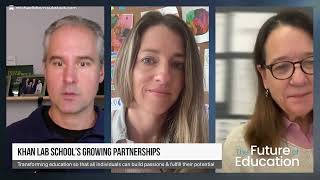
In this episode of the Future of Education podcast, host Michael Horn interviews Kim Dow, Executive Director of Khan Lab School (KLS) and the Khan Schools Network, and Elizabeth Dean, Head of Learning Design at the Village School, the network’s first East‑Coast partner. The conversation provides a comprehensive update on KLS’s growth – now in its 12th year, operating three campuses (Mountain View lower school, Mountain View middle/upper school, Palo Alto lower school) and a new campus in Wichita, Kansas – and its student body of over 300 learners. Dow explains how KLS has moved from a scrappy micro‑school to an established but still innovative institution and why the organization chose to create the Khan Schools Network rather than franchise more KLS sites. The network is positioned as a collaborative ecosystem where schools share resources, templates, and expertise, with partners ranging from U.S. charter schools to international schools in India and France. Partner selection hinges on philosophical alignment (self‑directed, mastery‑based learning) and a concrete request for support, such as high‑school design or charter applications. Dean outlines the Village School’s origins in Arlington, Virginia, its growth from 12 to about 80 Pre‑K‑8 learners, and its ambition to launch a high school with the network’s help. Both schools emphasize project‑based, mastery‑based, self‑directed learning and the development of human skills that AI cannot replace. The episode delves into how AI is being woven into K‑12 curricula: from third‑grade writing assignments that incorporate AI research, to middle‑school projects that produced an AI‑use handbook, to upcoming teacher‑upskilling summits and the use of Khanmigo and other large‑language‑model tools. The hosts discuss the ethical dimensions of AI, the need for student reflection, and how early exposure (even in kindergarten‑age settings) prepares learners for a future where AI is ubiquitous. Throughout, the dialogue underscores reciprocity: KLS provides templates and consulting, while partners contribute curriculum mapping and real‑world project insights, creating a two‑way learning network. Key takeaways: KLS has expanded to multiple campuses and a national/international partner network; the network model prioritizes shared learning over replication; partnership criteria focus on alignment and specific needs; Village School seeks network support to build a high school; AI integration is approached as a tool for learning, ethical practice, and teacher development; student‑led AI projects exemplify mastery learning; and early‑grade AI literacy is embedded through guided, reflective use.
Chapters
Welcome to the Future of Education.
And now here's your host, Michael Horne.
Welcome to the Future of Education. I'm Michael Horn. You're joining the show where we're dedicated to creating a world in which all individuals can build their passions, fulfill their potential, and live lives of purpose.
And.
And to help us think through that today, I'm really excited for our two guests. We have Kim Dow. She's the executive director of the Khan Lab School and the Kahn Schools Network. So first, Kim, great to see you.
Thanks for having us on your podcast.
You bet. And then we've got Elizabeth Dean. She's the head of learning design at the Village School and the first Kahn School Network partner on the east coast, which we're going to hear more about today. But first, Elizabeth, thank you so much for joining as well.
Thanks for having us.
Yeah, you bet. So, Kim, let me start with you. Just Khan Lab School, I've been there probably a handful of times over the years, but if I'm being honest, it's probably been like seven or eight years since I was last there. I was trying to do the math this morning as I was preparing for you to come on. And of course, Sal's been on the show a few times, but still, I think the audience would love an update. Sort of like just Con Lab School. We'll get to the network in a moment. But just like, you know, current state of it, how many locations do you have? How has it evolved over time? What's the student body look like? Day in the life students just give us a little bit of the color.
Conlab School is actually going into its 12th year this year, and I've been here for about eight years and it's been quite a journey. And the school, as you know, is a Mastery based school. One of the earlier Mastery Based schools schools were located in Mountain View, and we've also just expanded to Palo Alto. And so the school has grown over the past decade or so. And so now we have a campus for our lower school folks, and then we have a campus for our middle and our upper school students, which is based in Mountain View. In fact, our middle school this summer, we just did some rehab and just moved into the old Khan Academy space. So we have moved from about which the students love. And so the program has grown from the early days of about 20 students. I like to say it's achieved escape velocity and we now have just tipped over 300 students, which is super exciting. So we often say that we have evolved from being scrappy to established, but not Too established. And so we've really tried to retain those kind of startup, innovative roots and everything that we do. But it's been amazing to grow to, you know, a larger, a larger school.
I love it. One more question, Kim, before I bring Elizabeth in. Just 300 students. I've always thought of Khan Lab School as a micro school. Do you, do you all still consider yourself as such at that size or like, how do you think? I mean, some of these classifications are sort of silly in some sense, right? It's more about the educational experience. But I'm just sort of curious how you think about that.
I think that we have evolved away from being a traditional micro school just partly because of the number of years that we have been around. And I think that moving into kind of being more of a, of a grown up school based on, you know, the number of years that we've been around, some of the things that, you know, are part of our operational elements, I would say are part of being, you know, a larger school. It's interesting, you know, most recently about, you know, three years ago, we also decided to expand the program and we can, we can get into this in a little bit later, but we expanded the, the model to, to open a school in Wichita. So we are now three campus Mountain View, one in Palo Alto, where our lower school is, and new campus in Wichita, Kansas.
All right, we're gonna have to get more into all of this in a moment. But Elizabeth, I want to bring you in because before the partnership, the Village School was alive and well, has a good history. So tell us a little bit about the Village School, its roots, who it serves, you know, what a student experience is like and so forth.
Yes, thank you. So similar to Kimberly, we started eight years ago. So this is the village school's eighth year and we started out with 12 learners, preschool through elementary school age. And now we have close to 80 learners and we're pre K through 8th grade. And we're hoping to launch a high school in the future, which is where our partnership with Khan comes in, hopefully helping us with that. With all of their wisdom and launching a school and growing it to 300 learners. Our school is really built. We have our roots in a self directed learning model and we have a really entrepreneurial founding community. Some of those founding families still here, really active and have just kind of pushed us to continue to expand and explore. We're really focused on self directed learning, of course, as that's really where our roots are, but focused on project based and mastery based learning and really Wanting to make a school model and a learning experience that is really the future of education. Focusing on those human skills that are going to be really important as we continue down this road of AI and all things that come with that.
And tell us a little bit about, like, that founding story with those founding families. You're all in Northern Virginia, right? So just a little bit about, like, what was the. Why the rallying cry, if you will, that said, hey, we gotta. We have to put something different together.
Yes. So I can speak to that as I was one of those founding families before I worked here, so I was a member before I was an employee or I think there's a famous line about that. But I might be dating myself with that. But you all get it. I see you laughing.
Yes.
The families are really. Come from a really. You know, I wouldn't. It's hard to describe. It's not like they come from one particular background, really, just families that were looking at their current young, you know, their children's school experience and just wanting it to be more than just fine. And I think something that all families, especially that founding group, really has in common and something we hear every time we take our new families out to a coffee is that, you know, they played the game of school, and they either played it really well or they didn't play it well at all. They figured it out either way, but they wanted something different for their. For their kids. And so it's really that just knowing that they're just really wanting something else, which is like what I like to call them, entrepreneurial. Right. They're really seeing that disconnect or seeing something that could be better and wanting to figure that out. So that's really what I feel like brought. Brought us together. And we are. We're located in Arlington, Virginia, right outside Washington, D.C. and we really take advantage of our close location to all things in the District of Columbia that are, you know, take the kids on really great field trips and have access to a lot of really wonderful professionals who are willing to come in and share what they do with our learners. So we. We're really.
We take.
Try to take advantage of our location, for sure.
Very cool. Very cool. All right, Kim, let me go back to the Con Lab school, because then I. We also part of your title, Kahn Schools Network. Right. You guys started to expand, I think, a few years back, if I'm not mistaken. And it's. It's global in fact, at this point. So. So sort of tell us about that evolution of Con Lab School into thinking about it as more of a network, if you will. How many partners in the moment? Where are they? What do they look like? And. And why partner as opposed to, like, just build lots of Con Lab schools yourself?
Very early on, I would say. And it's actually a separate entity from. From Con Lab school. And so. But I would say, you know, one of the things that, like, innovative schools in the Bay area and all over the country, everybody gets requests to come and visit their school, especially like Elizabeth, if you're in a large metropolitan area. And what we were finding is, in fact, we've got a visit this morning. I've got another visit later in the week. You know, one of the schools is from India, One of them is from France. This happens to everybody who is in this space. And one of the things that I found was these conversations were so rich and that we, you know, folks would come, they would spend an entire day at the school, but then, you know, we would sort of drift away. We would stay in touch. You know, we would email each other every now and then, but we really weren't continuing that relationship and those opportunities to learn from one another. And I would say probably about two years ago, we started thinking that we had gotten, you know, some things together about our model. And we have, like everybody else, have made tons of mistakes along the way, But I felt that we had learned enough that maybe we were ready to have some things that we could share with other schools. And so, you know, we tapped into some of those schools that had come to visit us, and we decided to create. And about the same time, we were creating the Wichita program, Kahn Schools network, and not as a way to franchise conlab school, but a way to really create something a little more organic where we could create partnerships through these relationships with other schools. Not that we wouldn't create another one or two con lab schools in the future, but they have.
Wichita 1 is a con Lab school, Right?
It is a Con Lab school, Correct?
Right.
But what we really wanted to do was to help facilitate, because we were finding this from folks who were visiting us as well, is how can we learn from each other? And one of the things we like to say is be in the lab with us. Right. Because the learning really goes in both directions. And so even though we have, you know, materials that we have shared and that we have codified and we have put up on our schools network.org website, you know, we're really putting them in good, good shape and then hoping that that will serve as a model, you know, for Elizabeth and Others then to share some of their best resources as well.
So it's really almost conceptualized as, like, this. This isn't like a series of copycat schools. It's more literally a network where you're both. You're all learning from each other as a network would. Is that the right way to think about it?
100%.
Super. Interesting. All right, let me ask one more question before Elizabeth. I want to hear your sort of turn on this. I suspect a lot of folks would love to be a partner with Con Lab school in some meaningful way. How do you decide, you know, who gets to be a partner? Are there criteria around that? Why did the village school feel like, yeah, that's a, you know, that's someone we want to partner with, be. Have them be in the network?
Well, you know, it's interesting, Elizabeth. We find that folks who, who are approaching us come with a very specific request. It's not help us build a school. Right. And in the situation, the relationship in partnership with Elizabeth, it was, we have a K8 program. We're aligned philosophically around how we, how our schools, you know, run. They're. They're independent entities. But you have built a high school before, right? And help us think about how to build a high school. And so what we found is that folks will have a very specific request, like help us write a charter application for a mastery based charter school. Help us think about what progress reports and transcripts look like for students who are. Who are headed to college. And in Elizabeth's case, it was, you know, how do we really engage with our community and with our board and all of our other stakeholders and kind of frame, you know, building and expanding our existing program to include a high school. What are some of the things that you maybe did right or did wrong that you could share with us? They're. They're in the driver's seat. We're really just a. I would say a consultant. But the wonderful thing that happens is that as a result of this partnership, I know that Elizabeth and her team are doing wonderful work around curriculum mapping. An offshoot of that is we will take something back from that relationship as well. And it's only by deepening these relationships that I think that these innovative schools, you know, continue to stay regionally, you know, important and distinct. But we're connected by these kind of core principles of, you know, self directed learning and mastery based learning.
Terrific. Elizabeth, let me turn it to you. Like, what were you looking for when, you know, why did you say, gosh, this is an important partnership for the growth of Village School as you started thinking about high school.
Yes. So I think just what Kimberly shared about just collaborating those really important core pieces of our program that we are so aligned on. Right. Like we might not share a governing structure, but we believe in project based, mastery based self directed learning and are trying to build something different. I think we as our school really was excited at the opportunity, especially given our entrepreneurial spirit, to get in on the early end and be an early, an early partner and, and try to kind of help shape the network as much as, as much as we get from it. Right. We could also give. And really I think being an independent school that is trying to create a different vision for education and a different experience. Right. We're not built and we're not designed as a to do what most schools are built and designed to do. We're trying to really be intentional about having a different outcome. And anytime you're trying to do something different and kind of push back against status quo, it's really great to be in good company and have cheerleaders if they're across the country, you know, thankful that technology can connect us and just having somebody that has gone through it, especially in building a high school, you know, around we've, in our experience, we've learned that people are willing to take perceived risk on their kids Pre K through 8 experience. But high school comes with its own challenges and people are afraid to take the risk because the stakes are so high. And so we really want to get it right and we're looking for help and support and cheerleading to, to get it right and serve the community well. Our community really wants it and so we want to do right by them. So just looking for a partner, looking for a partner in that. And this seemed like a really great, you know, marriage of purpose and values and you know, just ability to get it done and to help us along the way.
It's interesting because that, that sense of partnership and sort of whole, you know, we're, we're in this together with the network. If I'm not mistaken, you all have like basically I think India now the village school, you've got Ohio right in the Heights Academy and then there's a proposed charter I think in Georgia. So like what will the work of the network look like? As like do you have a sense of cadence of how the interactions will go? What's the sharing of information look like between schools? Because I imagine it's not just like one way traffic, con lab, school hub and spoke. Right. It's probably Also getting to connect with others in the network too.
Yeah. And I would say it's definitely early days. But one of the things that's interesting is that even though there are some public partners, over this past year we have been approached BY maybe about 30 different schools that are interested in being partners. And we are currently a very small team. And so we have tried to be really thoughtful about taking the time to meet with each one of them individually to really listen to what are people saying in this space that they need. Most of these schools, I would say, are, you know, either a couple of years old or like Elizabeth's. They've been around for a little bit, but most of them are less than a decade old. But they really have, I would say they are sustainable in their own community. And I think one of the things that's interesting to me is that I expected all of them to be small, but they're not all small. We are partners with another small school in Florida, which created an innovation, an innovative mastery based school within an existing school district. And so that was one of the surprises to me that charter schools, public schools, small schools, international schools. I was surprised by the fact that about a third of the schools who are reaching out to us are in fact international schools. So about 10 international 20 that are around the country. We didn't even have a website for the first half of the year. So we figured if people were contacting us, they must really want to be part of the network.
So it's the best, the best marketing is inbound when you're not asking. Right.
So it's been fun. But I really want to emphasize that we're not trying to get a lot of publicity, be a flash in the pan, be super fast. We are, I would say, slow and methodical and listening to our partners, trying to be here for the long term. We don't charge anybody. And so it's more about, you know, the, the right relationship and the fact that there is a willingness, I would say, as Elizabeth said earlier, to share back within the network that again, we're not creating a product. We are codifying things and trying to put them in good shape. So they are generic templates that other people can use and trying to connect folks, you know, with, with one another.
So that reciprocity you just mentioned in high school in particular, because, Elizabeth, I share the same observation. Right. There's like a lot of parents who are willing to do different things for elementary and middle school for a variety of reasons. Right. And then there's sort of like it Seems like a gravitational pull of a few things that happens in high school. One is college, but the other is nostalgia. Right around prom, Friday Night lights. Whatever it is, it sort of pulls people out. I just love, like, mastery based learning being such an important part of both of your, you know, school philosophies, designs, etc. I guess I'm sort of curious, like, in the age of AI, right? Like, how does mastery based learning intersect with AI? Is that maybe a bigger rallying cry where people are realizing, hey, since I can probably do most of the work by itself that is being assigned in today's high schools, maybe we actually are looking for something different. Just like, talk us through that dynamic and maybe. Elizabeth, you start and then. Kim, I'd love your reflections on the same question.
Yes, yes to all of the above. I really hope that AI is kind of a rallying cry, if you will, because I think, at least for us in our conversations, it's really having us double down on the human part of what we're doing here, which is like, you know, we always say, one of the things we say in our school community is we care more about who our learners are than what they know. Because we care more about who our learners are than what they know. Especially now that, you know, AI could pretty much ace any test that they're giving or any of the tests that I certainly took when I was going to school. And I know some of the tests are still giving in my neighborhood high school. So students, you know, my neighbors come asking me for help. I think that, you know, we think that the future really belongs to those who can do what technology can't. And one of those things that technology can't do is really teach me about my, like, know myself and my own experience. They can't reflect for me on that thing that just happened. And so really just double, like I said, doubling down on the human, human aspects of our learning design. And that's really what mastery based learning is all about. You can't. I think mastery based learning is really all about, like, those authentic assessments, like assessing to discover, not assessing to demonstrate. So we have really been energized as a team to dive more, even more deeply into mastery based learning. One with, because of our partnership with Khan, but also just because of what we've seen and what we've experienced, experimented with in terms of AI and how it's impacting what we actually. What do we care about? You know, what's important here? What's worth assessing?
Kim, I'd love your thoughts on this as well. I have a number of questions off of what Elizabeth just shared, but first, I want to give you a chance to jump in.
I mean, I would say one of the interesting things, you know, for us is obviously it's a quickly shifting landscape. And, you know, the AI that students use today is probably the worst AI that they'll ever write encounter in their academic careers. And so I think it's worth keeping all of those things in mind. The other thing that I think is really at the forefront for us is that as a K12 school, AI is pervasive not just with our high school students, but down to our youngest students as well. And so what does the ethical use of AI look like? And there is also so much focus, I would say, in school environments about how does AI support teachers and what can students do and not do, and what should we train students to do, do or not do, and how important is critical thinking and all of those things that, you know, continue to need to need to be important. I think one of the things that we have also tried to focus on is that what does AI mean for the rest of the school? Right. What does it mean for the administrative team? What does it mean for the operations of the school? And there's a lot of kind of A.I. ed. In fact, we're doing our own summit in a couple of weeks about AI and ED for teachers. Right. But one of the things we're trying to make sure also doesn't happen is that, you know, in admissions and in marketing and in our finance department, that we're also upskilling everybody on those teams as well. So it becomes more of a community embracing and having thoughtful conversations about, you know, appropriate use. The last thing I would say is that as a school, we are kind of in this unique situation as being a sister organization to Khan Academy. And so when there are, you know, changes in KA or there's a rollout of, you know, Khanmigo, which is a. Which is a tool that a number of schools will use, is that our. Our students have kind of this early look, and they are used to kind of trying these things out in collaboration with kind of a software nonprofit. And so I think that we have so many students who are in the driver's seat of being really early adopters as a result of this kind of synergistic relationship with a software entity. And so I think that has made us look at kind of the school use pretty early on and to think about what's changing and what isn't going to change. You know, for students and for teachers.
Well, so I. Let's dig in on a couple of those things. On the student side in particular, Elizabeth, you mentioned like, knowing yourself being critical, but obviously like you have to have knowledge around the world and sort of like you have to know something to also know yourself relative to others. Like, how do you parse that? What's your current philosophy? Or where do you think? Like, what will the high school look like as you guys build this? I'm guessing it's not going to be adapt subjects and sort of 45 minute bells. So, like, what will a day in the life do you think look like for a student navigating these questions that you posed?
Yes. So I mean, I think it'll look similar to how especially our middle school runs, except which I'll share. I think the goal for high school would be that they are, you know, off campus a lot more than our middle schoolers are. They're off campus quite a bit. But we really want. The vision really is to put young people in. In the world and having real experiences, not artificial ones. Right, Real experiences. And I'd say, you know, the, the balance is always tricky. Right. Is of like. I think a great example would be the project our middle schoolers just finished a couple weeks ago, which was the first project of the year, which was just really all about like AI. They had, they wrote a handbook for other middle schoolers on how to use AI and in order to write that handbook, they had to use it. They had to talk about how they felt after they used it. They used it for all math, writing, reading, you know, civics assignments. They worked in collaboration. They used it on, on their own. Just really like diving in and then taking the time to process that experience. Like, how did I feel using it? Which did I learn? Did I learn more by using it or not? By using it or by collaborating with it? Like really posing those. I feel like those questions were all like, I'm asking about my own life and using AI, so just slowing down a little bit and, you know, not gatekeeping or not, not making it a forbidden fruit, if you will, and just inviting young people to the table to have the conversation about this new tool that's everywhere and impacting all of our lives and being really thoughtful about how we want it to impact our life and knowing that we have agency in that decision.
Quick question.
When they're interacting with AI, is it Khanmigo, is it other apps? Is it the large language models themselves? What does that look like?
I would say it's all of the above. Some of them we have experimented with Khanmigo, and some of the learners have really great success with that. They, you know, there's, there's. And then with some of the large language models. Excuse me. As well. So really they made their own AI chat bots as a part of this. So just they consulted with some people in the, you know, experts in the real world who work with AI policy. We have a lot of policy experts around us here. Right.
It turns out one of the things DC does well or poorly, depending on your perspective. Yeah.
Yes.
Yeah, yeah. They had some hard questions for those AI policy, and they got some great feedback on their handbook. And then also just other, you know, young people who have just graduated for college that are using AI in their, in their work, in their daily life, whether it be like using AI, the large language models, or using AI in some type of, you know, backdrop to their career path that they had not thought of, because when they were in high school and college, I wasn't, you know, really fully developed. So just really connecting them with those experts and, and focusing on that. Those process. The processes. Right. And so it's not just like the tool, but the whole, the, the experience that goes along with it. So, and that's, I think we take that kind of approach in all of our learning design, and that's really the approach that we'll take with the, with the high school, too, is going out, having experiences, coming back to this, to our. To campus or wherever, to kind of reflect and talk through that so that you really are understanding more about yourself. An experience I often wish I had as a young person in school. But yes, I think, you know, I. Somebody I was talking to recently said that in the future, our competitive. Your competitive advantage will be to really know yourself. And I think that that's. That's what we're going for. That's what we're trying to design for.
Yeah. And it is sort of amazing that there's no opportunities really for reflection in the traditional high school experience for students and they sort of graduate not having a keen sense of who they are and where they, where their energy drives from and so forth. Kimberly, let me maybe ask you this last question as we start to wrap up here, which is you mentioned that AI is impacting even the youngest learners that you serve. I think you said kindergarteners. How do you think? And your point is? Right. Like, this is the worst AI any of them will ever see in their lives. Right. So I'm just sort of curious, like, you know, obviously there's the know yourself. You can build in reflection and sense of metacognition and so forth throughout the experience. Right. Of schooling. But how do you think about AI preparedness there, especially as the youngest learners are. Are perhaps working with these tools in some cases.
You know, it's interesting, I. And it really goes hand in hand with, I would say, what the teachers are learning at the same time. And I was in a third grade classroom the other day where they were writing short essays, and it was fascinating to me to see how the teacher was really weaving it into, I would say, traditional things, not a traditional approach, but teaching students how to write. But then she would pivot and have them use AI to look things up and then to integrate it back into their writing. And so it was very much a light approach and not now we are shifting to use AI, but it was just integrating it into the fabric of what she was already doing. And I thought that that was really powerful. And so I wouldn't say we're all the way down to kindergarten, but I would say that students as young as third grade are using AI in the classroom pretty regularly.
And it sounds like the guiding philosophy there is to figure out how do we cooperate with it as opposed to outsource cognitive, you know, work to it completely. Is that the right way to think about it?
Students are not sitting in front of an AI tool, you know, for a half an hour independently and doing work that really teaching students, you know, the skills, I would say, of how to use AI as a, as a tool and to. And to be naturally curious about it. And it's, you know, it's the same old learning how to learn, which we both do in all of our schools. Right. And really teaching students to build that mindset into their use of AI because it will evolve for them.
Well, and I guess that's the same thing undergirding the project that you just outlined. Right. Elizabeth, is like if you, in order to write a handbook, I'm sure many schools are writing handbooks without this curiosity. But to have the curiosity of how does it actually work, what is the impact on me. Right. And others in the community as we use it, allows you to write a much more robust, I would imagine, output, but then have a much deeper sense of understanding underlying that, which is maybe the more important part, I would think.
Yes. And I think it speaks to the mastery based piece. Right. Mastery based learning is. There's a big part of that is character development and work habits and deliberate practice. And, you know, that's. That's a really important part of the experience. Right. So whether you're writing a handbook on AI or, you know, learning algebra, character development is an important part. And I think in this age of AI, it's really the. It's what we focused on eight starting, you know, eight years ago was our main focus. And I think just even more highlighting even that it's even more important to us now because of. Because of AI Super.
All right.
Well, I feel like I have. We're scratching the surface of like a million questions I want to dig into with you both, but for time's sake, I'm going to let you go. This is a super interesting conversation. Exciting to see this network evolve, exciting to see the village school be part of this group. And frankly, Kim, as this evolves over the years, it'll be exciting to see how big the network grows. What are the learnings that you start to all get out of it in the years ahead. So huge. Thank you to you both for joining us and for all you joining us. We'll see you next time on the Future of Education.










