Module 2: IV.) Our Protagonists' Student Learning Experience
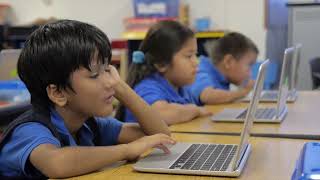
Three elementary schools structure their days differently to build student ownership and mastery. KIPP LA uses 80-minute rotations through math and phonics blocks with blended learning. Gilroy Prep's lab model achieved 97% third-grade math proficiency. Summit Public Schools lets students drive their own learning through playlists and project blocks.
Chapters
You.
It's really interesting to look at how our protagonist schools have made decisions with this ideal student learning environment in mind. Now, one caveat. These schools are a work in progress. So the schedule and their systems are changing very rapidly. But that's part of the point. It's an iterative process that they're discovering with their students.
One of the best ways to understand the big decisions that these schools have made with regard to student experience is to understand the schedules that they have for the typical student day. To understand this, we'll start with what KIPP la, our station rotation school has done with their student schedules. Have a listen to the founding school principal, Margarita Flores describe it.
All of our students start the day with family literacy and you're able to see students and families interact with literacy activities. A child might be reading with their friend's dad or playing a game, a literacy based game with another friend. For kindergarten through second grade students, their day then goes into morning meeting and it's really a time for them to start the day as a community. They greet each other and go through different activities to build culture and community. And from that moment on it really becomes an individualized program for each child. After morning meeting, students have highly individualized program and I'll take you through a typical second grader's day. So after morning meeting they would go into an 80 minute math block and during math they are going through a rotational model. So they have a small group lesson with their teacher. They have a blended learning rotation in which they're either on ST math or they're going through different applications on an iPad that have been identified by their teacher to do spiral review. And the last rotation is doing independent practice. After math they would go into a 20 minute recess and then come back for an art lesson. Depending on the day of the week, they're either going to art or going to science. Science is given in Spanish for all of our students. K3. After that you would see students go into their phonics block and we would call it a phonics block, but it's really another 80 minute block in which students are getting phonics guided reading, doing independent reading, and another in a rotational model as well. Technology is integrated through Achieve 3000 to make sure that our students are being able to read high interest nonfiction text and also be assessed on it at their Lexile level. After the phonics block, students would go into a reader's workshop block and during readers workshop, students have independent book boxes with books at their level in which they're Reading the books being assessed on them at Accelerated Reader. And the teacher is being able to pull students to do one on one reading conferences. Then they would go into a 40 minute lunch block and they get to eat, have recess, enjoy their time with their friends before they come back and do a value circle. So during the values circle, it's another way of hitting this character development piece. After value circle, our second graders would have an ethnic studies class. Ethnic studies is really focused in second grade at self identity, learning about what it means to be a student of color in the context of Los Angeles. After ethnic studies, they would do a writing cafe in which it's followed like a writer's workshop model. The teacher gives a mini lesson and students are able to write for about a 30 minute sustained writing block. And the teacher is pulling kids to do either small group or one on one conferences. The student might have at that point a read aloud and reading comprehension. And at the end of the day they close out with a values review.
I just love the thoughtfulness with which KIPP has made so many decisions in their schedule. And it's even hard to understand until you're in the building with them. But they're thinking about where students should go from for what kind of lesson, what the ideal grouping is for each learning activity where students can show mastery, where we need to do review. And it just shows the masterminding happening behind the scenes where they're creating a new vision of school rather than accepting it will always be the way it's always been. So to help, just get a simplified version of what the actual schedule looks like. Take a look at this graphic to show you the basics.
Now let's see how our lab rotation school Gilroy Prep made these decisions around schedule, keeping in mind that focus on ownership, personalization, mastery based and relationships.
So when our students arrive at the school, we have a morning opener which kind of gets the entire school together and united. It's a high energy. We sing our chants. The students will then move into their rotation for the day. The rotation stays the same throughout the school year. But I'll give you an example. Second grader would begin the day in the math class. They have a 60 minute math lesson and at the end of that 60 minute math lesson, we assess the student's learning for that day on what we call daily learning objective. Those who got it go on to the blended learning part and do ST math for 30 minutes. The rest are pulled into small group intervention. We have a para that comes in and covers the computer time while the students are working. The teachers are working with the kids. Recess. That group of students will come back and go to their language arts teacher who will do a very similar strategy session where they'll teach for an hour. The Common Core Standards identify which of the students didn't learn that daily learning objective for the day and send the percentage of kids that did off to the computer lab. They'll do their language arts blended learning while the teacher holds back the students. A paraprofessional will run the computer lab. Lunch. After lunch, we break our students up into small group reading, where our paraprofessionals come in, and we'll cover groups of 10 using a very systematic phonics instruction to make sure all of our students are reading well. That goes on for about 45 minutes. They then go to their PE session. They'll have a short break in the afternoon at that point, and they'll go back to their language arts teacher for a second session of language arts. At that time, they're doing writing. They have the Chromebooks available to do some of the different software programs we use, such as Kid Biz. We use Lexia and a few others where the kids can be broken off into individual needs at that time. And then the last part of the day is our enrichment, which is our way of psychologically having the kids go home with a really great feeling, which is, hey, I just did art, or I just was involved in board games, or we were doing a leadership class, and the kids leave having a great experience at the end of the day.
At Navigator and Gilroy, they're using the lab rotation in a really dynamic way that shows their thoughtfulness. At the end of each lesson, a teacher gives a quick assessment. And for the students who show mastery, they get to go to the learning lab and do free reading at their level or use online math programs to go deeper or farther. And for the students who don't yet know the material, they stay in the classroom and get one on one or small group time with the teacher. It's so different than a traditional fixed time schedule where kids are just sent to work on the computers as a form of digital babysitting. And when you think about the deliberateness behind this model, you understand how they get the results they got, which have, frankly, just been extraordinary. On the most recent state exam, Gilroy Prep had 97% proficiency for third grade math scores. And this is in a state where proficiency is a very high bar to reach. It's simply extraordinary outcomes.
So now let's take a look at how our Flex School Summit Public Schools designs their schedule with these same ideas in mind for students.
The day at Summit Denali starts students arriving between 7:30 and 8:15. Once a student walks in the door, she immediately starts with her personalized learning time, grabbing the Chromebook, logging on to her personalized learning plan and going from there, working on the playlists that correspond to the goals she has set. At 8:25, she's going to head to her first project block. This is a two hour block, either humanities or math and science. In this block she's working on a skills based project facilitated by the teachers in that class. Afterwards there's a short break and then all students re enter and go into their personalized learning time. This is the time that it's a complete one to one environment. And this is where students are progressing through their content playlists, taking content assessments at their own path, at their own pace. Following that is pe. And so students have PE twice a week and this allows them to explore physical fitness as well as yoga and other mindfulness strategies. Then they have a block that we call Summit Reads, which is a time for them students to read a common text to build reading comprehension. That's capped by a Socratic seminar to develop the academic literacy that we want them to develop here. After lunch, this student's going to return back to her second project time block. So if it was humanities in the morning, now it's math and science or working on an interdisciplinary project or a collaborative teaching project in the math and science class. Day ends at 3:15 and students who want to stay after are able to stay after and do personalized learning time, just like they had done earlier in.
The day in the station rotation and the lab rotation model. It's a pretty clear distinction between when students are offline and when they're online. And what you see in these flex models is that those lines are being blurred a little bit, which we think is great because it opens up new possibilities for how and when technology and how and when personalization can happen. Take a look at this more simplified version of the Summit schedule to give you an example of how they're using time.
What you probably notice is that for a portion of the day, and in fact all of Friday, students are learning off of playlists where they get to make decisions about what and how they're learning the material. Summit thinks of this as that PLT or personalized learning time. And it's worth digging in a little bit more to understand this concept more deeply.
We were surprised, we thought that one of our biggest challenges was going to be the norms and expectations and keeping students on task during personalized learning time. During this, students are in a large open space working completely on their own goals, and there's just a couple teachers who are around the space to support some learning and also to proctor the assessments. What we found was that student engagement went through the roof. Students took to this with minimal guidance and minimal instruction because they're excited to drive their own learning. They're excited to be able to pick what they want to work on and also to pick when they're ready to take their assessments. On our end, we're supporting students who are eager to take these assessments and show what they know. Their ownership is the key to their engagement.
During personalized learning time, a student logs into their personalized learning plan and it shares with them everything that they need to work on. All of the content that they have not used yet, shown proficiency on, and everything that they actually have shown proficiency on turns green. And every single project that they need to work on is all in one place. Now a student has a choice to drive their own learning and to know exactly what they need to work on next. If I would like to work on a piece of content, then I go ahead and I know I select that content and it shoots me over to a curated list of resources where I can learn exactly that piece of content and I can self assess myself. And as soon as I'm ready and I take an assessment, I can show my understanding right on the spot. And then I would go ahead and come back to the plan. And instead of being white, it would turn green to tell the student that indeed, you have shown a certain level of proficiency.
And at Summit, when students aren't in this personalized learning time, they're in project mode where they're working with their teachers on the skills that they're going to need and applying that knowledge. And the essential thing is that students get experience working independently in small groups, in teams, which is just going to help them immensely when they get out into college. And frankly, the workforce, where those are the kind of environments we're all working in.
It's interesting to see the different decisions that these schools made with regards to their schedules and so forth, Even though that they actually share very similar beliefs around ownership, personalization, mastery based education, and relationships. And the takeaway is that different models are actually better or worse at optimizing for different goals. Or depending on the types of students.
That you're serving, I mean, exactly. Think about Summit. Their model with elementary school students might be hard I'm not sure how many kindergarteners are yet ready to take that kind of agency. And then you think about it navigator, they've decided to have a few more adults in the kids lives each day rather than one which has some trade offs on relationships and then in other ways brings more adults into the kids lives.
And if you think about kipp la yeah the teachers are making some trade off that they can't have instructional time with the students when they're online, but they gain so much more in small group instruction and one on one time with students.
The takeaway is that the decisions you make have impact. And I think we forget this as educators. We act as if God gave Moses a tablet that says thou shalt have a six period day, thou shalt have 47 minute schedules. And God forbid in one of these schools you have a lesson that goes 52 minutes. Those poor kids are going to wreak havoc on the campus as they walk around. We need to remember that as we design schools, educators need the full suite of options on the table to be designing from the beginning of the day to the end of the day, the beginning of the year to the end of the year, or all his options.
Now I know what you're thinking, that maybe in your context you don't have control over every single one of the elements that we've identified. But that's okay. You can still do high quality blended learning. The key is to optimize on the variables that you do have control over.
And think with a generative mindset. Don't focus on your constraints, focus on your possibilities. There's after school time, there's summer, there's flipped classroom. The list is pretty impressive if you start to get a little creative.










