Brian and Michael Horn discuss how grit, persistence, and interpersonal skills develop in blended learning. A struggling algebra student used Khan Academy's streak feature to master a problem, showing how technology can support persistence when students control their own pace. Balancing online and offline work frees teachers to build relationships while students take ownership of learning.
Chapters
There's one more really exciting thing to think about around those student experiences in a great blended learning setting, and that gets at the sort of mindsets and skills that we're hoping students have a chance to really develop. These are those ideas of things like grit, persistence, intrinsic motivation, and interpersonal skills. What has been called lately a lot in the press, non cognitive skills.
There's a lot of complexity in this subject, let's be honest, and we're not the experts here, but there are a lot of people who've been writing about this lately and it's worth digging in to learn more about it. One recommendation. Paul Tough has written this great book called How Children Succeed that really summarizes a lot of the greatest research on grit right now.
And they also did a nice summary of this piece in the New York Times in an article called what if the Secret to Success is Failure?
I'll recommend one more, which is the Chicago Consortium of School Research has put out a great paper detailing a lot of this. And if you only have time for a little bit, read the first chapter to start to understand these topics in.
Some more depth and you overachievers dive in and read the whole thing.
We've put these on the resources page so that they're all there for you. So take a look and navigate through.
So you may be asking yourself right now, where does non cog skills fit into blended learning? And we're raising this because it's actually a very interesting question. Do you think that a blended learning environment and the use of some technology helps or hinders the development of these skills and mindsets in students? Now, taking a critical view, you could argue I don't want this computer screen. Interacting between the relationship and a computer is not going to teach a kid grit and persistence. And on some level I think we can agree with that. It's why we're more proponents of blended environments where there's some online and some offline, than just a purely virtual kind of learning experience. But on the other hand, if you think about in a great blended learning environment that the teachers have more time to think about this other side of the education process and that kids have more ownership and practice it, it can really make for more powerful learning for students and a better environment for a teacher.
So let's make sure not to lose those deep relationships that students have with their teachers. But let's also think about the positive side of the of what blended learning brings to this equation. Just think about it for a second. If we start to move toward an environment that has much more student ownership and mastery based education, then we can start to embed the skills of persistence and grit into the everyday learning. Think about the contrary example. If we don't have mastery based education and students just move on regardless of how much effort that they put in, what kind of job are we doing teaching them persistence and grit?
Then I think one of the ways that blended learning gives kids more agency is that they have tools right at their fingertips where they can go off and learn the things they need to learn lots of different ways. And I don't have to do it the same way as my neighbor, and my neighbor doesn't have to do it the same way that their neighbor's doing it. So once kids are released to the world wide web, it's a pretty big place. It's pretty amazing what they can do to find the tools they need that work for them, particularly in the beginning when teachers release them to what I would consider like the safe choices for them to go and learn from.
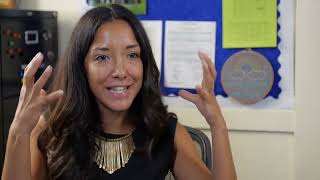
So with blended learning, we're able to do small group differentiated instruction, and you really are able to see the gannis come alive in kids. All of our students have core, their core literacy, and core math learning happens in small groups and teachers differentiate to their level. So we always want to make sure that our kids are sweating. We want to get to that point where they're struggling. And you actually see it. You see it in their face, and it's almost like you see it in their brains. They're just like, ugh, like, this is really hard. And the way we get there is by doing the small group instruction. The way that we're able to do that is with technology in the classrooms, making sure that our students are being challenged not just with their teacher, but also challenge and engage with technology.
Actually, Brian, you had a really interesting story when you were running a blended learning pilot a couple years ago that you told me about after that experience about a student who experienced ownership for the first time.
Yeah. We were doing this summer school pilot for students who had failed algebra in the ninth grade. And I remember vividly this one student who gave every outward appearance of not being a successful math student and had the attitude to match it. And. And we put her on Khan Academy. And this is back when Khan had that streak feature where you had to get 10 in a row right, to move on. And even if you got nine and then failed, you started over again, which some people said was pleasantly frustrating and some people just found annoying as heck. And they've since changed. But in this moment, this student was working and literally got to the ninth problem and then got it wrong. And I watched her slam her hand on the table and go, arrrgh. And the next moment mutter under her breath, I'm not leaving until I get this right. And she sat in that room after the bell and she finished that 10th problem, got her streak done, closed her laptop and walked out of the room. And I just, I can't imagine that student would have ever shown that if we had been in a traditional setting with me saying, stay, do two more, do two more. There was something about her being in charge and it all being on her shoulders that just lit a spark in her.
So there's a lot more to this idea of non cognitive skills than what we've just presented here today. And that's why we suggest so strongly that you dive into some of those resources we provided to learn more, because it's a fascinating topic. But for a moment, think about all the decisions that the schools we visited with today have made over student agency, personalization, mastery based education, and how to deepen relationships.
And remember, they all start with this idea of what is the ideal experience for the student. And that's where your assignment for this week starts off. So we're gonna send it to Rob to give you the details and realize that this assignment ties in directly to your final project.
And next week we'll think about how does a teacher actually make this come to life? How does a teacher's role change to create a high quality blended learning environment? We'll see you soon.