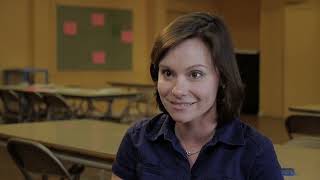
In this module, Michael Horn and several KIPP LA teachers discuss how the teacher’s role has evolved in a blended‑learning environment. The conversation emphasizes three core responsibilities: (1) driving small‑group instruction, (2) intentionally cultivating character and values, and (3) weaving the best of traditional direct instruction into technology‑rich lessons. Teachers describe a rotational classroom model where groups rotate among carpet instruction, Chromebooks, and iPads, using adaptive programs such as ST Math to deliver visual‑spatial math content. Small‑group work enables one‑on‑one language practice, rapid feedback, and mastery‑focused reteaching, even when class ratios are high. Data from online quizzes and dashboards provide instant insight into standards mastery, allowing teachers to adjust instruction in real time. Character education is woven throughout, with explicit values (courage, honor, reflection, ganas) and social‑emotional learning activities that start in kindergarten and continue through secondary grades. Teachers frame their work as guiding students to become transformational leaders who will attend college and serve their communities, positioning empathy and responsibility as essential outcomes alongside academic rigor. The module also notes that KIPP retains purposeful direct‑instruction moves, arguing that blended learning need not replace traditional teaching but should complement it with fidelity.
Chapters
In terms of me explaining my job, I say that I don't teach as much as I am guiding them to becoming better people. And sometimes it's, to me, the learning is secondary. Well, the learning is, of course, primary. But I come in with knowing these are going to be transformational leaders of changes. And they need to know math and they need to know measurement. And that's what gets me at the end of the day, every lesson. They need to know this to go to college. They need to go to college to become transformational leaders of change. And that's what I tell my friends.
My role as a blended learning teacher is a little different in three main ways, I would say. First, I'm able to spend a lot of time doing small group instruction while my students are interacting with adaptive learning programs. So I'm able to work with small groups of students and increase my impact in that way. Second, while my students are not with me, they're still spending a lot of time learning. They're still learning through visual spatial math programs. They're still learning through apps that reinforce basic skills like math facts. So they're learning at their own pace, even when they're not in front of me. And third, I'm able to maximize my impact by collecting data and having students interact with technology as we integrate it into the core curriculum. So I'm able to have students take quizzes online, and I get instant feedback about how they've mastered the standard that day without even grading papers. I can just see it on a graph online. Or when my students are publishing their papers for writing, rather than writing it out in black pen, they're able to type it up just as they will in high school, in college, and in life. So I'm able to maximize my impact through technology in a lot of different ways.
As we shift to looking at KIPP la, what we see and what jumped out to us was that the teachers there are really focused around three things and their new roles as blended learning teachers. The first one is driving small group instruction. The second one is instilling character and values. And the third one is that they actually still take the best of traditional teaching and weave it into these new blended learning environments.
So to that point of their holy grail, it is small group instruction. And it's an interesting story of how they came to this focus of blended learning in many ways because of budgetary pressures that forced them to think about new models. Beyond that, though, it's also fascinating to see how much they've embraced this role of small group instruction. And that for them, they just see the gains from this amount of time far outpacing any other thing they can do as part of their educational model.
We believe in small group instruction because it allows for one on one conversations, for so much language practice, and for repeated hits with a skill so that students are able to get to mastery even faster.
Clearly, many teachers around the country are already doing small group instruction or what we call a workshop model. But what's different in blended learning is that rather than just being rotations through worksheets or other assignments that may or may not be connected to an individual's needs, because students are working online, you can really focus and tailor that instruction to the individual students needs.
For my students, it's especially essential that they get lots of practice with the language around whatever I'm teaching. So we have a lot of English language learners. So because they're in a small group, they're able to talk frequently both to me and to partners. And I'm able to follow up with them to make sure that they're using the academic language the way that they need to. They're also able to get a lot of feedback. So I'm able to interact with each student throughout the course of the lesson on an individual basis. As we go through the lesson and I figure out which students are mastering the content quickly, which students need more reinforcement, I'm able to pull. I usually end up with a group of two to four students in front of me, just working with them to address any misconceptions they may have. So I'm able to have that powerful one on one impact even when the classroom ratio is 1 to 27.
So at KIPP, the teachers explicitly see their role as building the character and the value of their students. You cannot step foot on this campus without understanding how it permeates every part of their soul. And they want to teach things like grit, determination, values, ganas, or desire for learning. It is the core job of a teacher in their school.
We would argue that in blended learning environments, focusing on character and values is really important because we're really giving the power to the students to be their self directed learners.
Character education at Ecomienza begins day one of summer school. During summer school, we really focus in on the character and we do that through values. We have four school courage, honor and reflection. Courage means to take risks, means never giving up. Honor is to respect oneself and their community. And reflection to our youngest kids means making the right choice. And when you don't make the right choice, which happens to all of us is really turning it around. You know, we really focus in on the values and on this character development to make sure that our students are growing social emotionally. You know, for us, the academics is what's going to get our kids to college, but it's not going to get them to and through. We really believe that it's going to be the character, their character that's going to get them through college.
Educating the mind is just as important as educating the heart. And when I think of our students, I see them as transformational leaders of change. And I want them to go to college and I want them to come back and serve their community. And part of that has to do with having empathy for your fellow, for your fellow man. And it starts in kinder. It starts in first, it starts in second. So we actually have developed in second grade a social emotional learning program about empathy, about relationships, about relationships with people. I developed it actually, and the way that I mean to bring it back to the concrete. We do it through books, we do it through role plays, we do it through writing exercises. It's something that definitely is at the forefront of what we want them to be. We also teach character through our values, courage, ganas, honor and reflection. And we anchor all of our actions through our values. So our friends don't break rules. A friend is not showing honor to Ms. Magania when they are talking on the rug. It's not that they're breaking a rule. So it's definitely ingrained in our language. Going beyond that, we do see a need to teach students more about qualities like empathy and responsibility, things that will take them so far in life.
So technology allows for small group instruction, because in my classroom during math, for example, we have a rotational model where the one group of students is on the carpet learning the lesson with me. One group of students is on Chromebooks, and one group of students is on iPads. And then they rotate through those three stations throughout the math block. So all three groups of students see me, see Chromebooks, see iPads. So during that time, I am able to work with a very small group of students that's leveled. So. So I'm able to push some of my students who need pushing beyond the bounds of the lesson. I'm able to give reinforcement or reteaching to my students during the course of the lesson if they need it. Because I have a small group of students, between seven and 11 students in front of me on the carpet while the rest of the class is doing technology, that time that they spend on technology is incredibly intentional. Because, for example, they may be working on ST Math, which is a program where they're learning math concepts through visual and spatial strategies. And so I'm able to sync up the curriculum of ST Math to match what we're teaching in content. So that may be pre teaching something that we're going into next week. It may be reteaching something that some students need reinforcement on, or it may be directly related to the lesson of today. So today we are teaching measurement on ST Math. They may have done measurement last week, or they may be doing measurement currently to reinforce it. So I'm able to both have my hands in what's going on with the students right in front of me and also know exactly what's happening with the students who are not with me.
It's interesting to see that KIPP still does do a lot of direct instruction. And we raise this point as a reminder that this is not an all or nothing proposition. You don't have to have a religious conversion to blended learning. If you're going to still do direct instruction, go for it. But just like kipp, do it with purpose and fidelity. So when you watch a KIPP classroom, when you see these KIPP LA schools, their direct instruction, the moves they use are tight and purposeful. And it's that attention to detail that keeps the kids on the edges of their seats in the learning process.
By the end of the lesson today, you will be able to measure objects in feet or in inches. That is your first job. Your second job is to look at an object and tell, should I measure this in feet or should I measure it in inches? So you will know you're successful where you can answer those two questions. Ready to rock? Ready to roll? Hold up your pencil. Would you measure it in inches or feet? Think to yourself, whisper to your pencil, I would measure you in. The other essential thing that you have to know before you measure is what the halfway point is. Say halfway point. Halfway point. The halfway point is smack dab in the middle between two numbers. Mark. Why would you measure a book in inches? Because a book is too small. Because a book is small.