Module 3: VI.) Shifting Teacher Mindsets
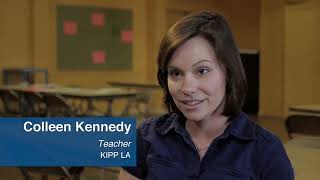
Michael Horn and educators discuss how teachers shift from lecturers to facilitators in blended learning. Technology handles grading and routine tasks, freeing time for one-on-one moments that spark breakthroughs. School culture, relationships, and intentional routines remain essential.
Chapters
So we've introduced a lot of ideas about how the teacher's role changes as we move into these blended learning environments. And as we think about what are really mindset shifts, it's important as teachers to think about what can we do less of.
And if there's one big idea I'd encourage people to let go of, it's the pacing guide. This concept that we're supposed to have every student moving at the same speed. I mean, our education system is virtually built on an assumption that we're the world's best astrologers. You say a student is born in the Year of the Rabbit, and therefore 15 years later, on October 27th, he's supposed to be ready to read chapter six of Huck Finn, pages 68 to 71. Why not give a system that lets the student get that material at the right moment for them, Let the student control the pace.
And to do this really well, it means that we as teachers can't just be one week ahead of where students are at any given point. We really, if we're going to let students self direct their learning, have to have the entire roadmap laid out for them in advance so they can drive this learning and keep moving at their own pace.
Now, one important thing to remember is that there is still something important about setting a minimum pace so that students don't fall too far behind. There's a really great story that Dustin Hoffman told on stage when he was having a dying conversation with Laurence Olivier, and Laurence Olivier was talking to him. And finally Dustin Hoffman said, Laurence, like, why did you go into acting? What does this do for you? And he reached out and he held Dustin Hoffman's face and he said, look at me, look at me, look at me. And I think if we're honest, as educators, we have a little bit of that. We want the attention on us. So an idea I'm going to encourage all of us to think about in a blended setting is we don't always need to be the focal point of the attention. We can turn students loose and let them work on different things. And if we do that, it frees us to not have this burden of managing the whole classroom in lockstep. We can be thinking in groups and it actually could take down some of our stress level and let it be a little easier to work in smaller groups at a time, but still be incredibly productive. We hold students to a standard of productivity rather than lockstep attention on us.
Now, another thing that teachers can start to move away from is feeling like you have to grade every single little task when, if we're being honest about it, some of the technology can actually start to take that burden off of us and just automate some of that grading.
Also, the technology that we have, which is part of the blended learning, is giving me that I don't have to go home and grade tests and see who didn't get it. I know right away who didn't get it, and then it's fresh in their minds and I can correct immediately what it was that they missed.
We see schools doing lots of these little tiny tricks to save some teacher time when a student comes in. Automate the process of the do now launching of the class, or automate the collection of data at the exit ticket at the end of class. It's really all about taking something you used to do manually and seeing if there's a way to try to make it automatic, quicker, and save time for teachers.
One story I always tell parents is that there's no reason that a teacher should ever write, administer, or grade a vocabulary test, because we have computers that can do that better and faster and turn that data back to students immediately. Instead, our teachers are better able to focus on designing great lessons for kids and focusing on the project based environment that we know is going to allow their skills to remain at the forefront of their learning experience.
As we talk about these big shifts away from things that we used to do in traditional classrooms, in these blended learning environments, three things we think stay the same. The first is a focus on culture. The second one is relationships, relationships, relationships. And the third one is those magical light bulb moments.
So we've talked about culture a lot today, and the thing that I just want to stress more than almost anything we've said about blended learning is that these schools nail culture. They are vibrant, joyful places that can also snap to attention when they need to and get down to work. So we want to show you some different kinds of classrooms and pay attention to how silent they can be when they want to be silent, how boisterous they can be, but in total choral response with each other, and how teachers just zone in on what they want and expect students to get there and hold them to high expectations. But the unifying theme of culture permeates every school that we've been talking to you about in this whole course.
The culture in a blended learning classroom is really essential. I think the biggest piece of culture is students knowing that every minute that they're spending with me and every minute they're spending on technology is intentional. So before they Launch any program before they do anything on technology. They know the purpose behind it. They know that this is helping me to grow my brain as a reader. They know that I'm practicing math facts because I need to practice my fluency with single digit additional. They know that they're learning st math because this is something that we did in class last week. So they need to review so they know the purpose behind every program that they interact with. And therefore they're engaged in the technology and they're purposeful in their learning.
World around you.
Stop.
Let's give her some shine on. Shine on for sure. So much courage.
Shine on, Shine on.
When you have a student body that feels like a uniform group of people, almost like a team, you have the ability to teach faster and more. And every second really counts in the school day versus so much time being lost in a traditional school. We get our kids into the classroom. They know that they need to be in their seats in 12 seconds and they need to be working on the do now that's on the board. When the students are in the computer lab, they know that in 15 seconds from when they walk through this, the door, they're counting down in their head. They should have their headphones on and be logged into their software program. And those are the types of things of student culture and efficiency at our schools that really lends itself to what is called bell to bell learning, where there are never down times for the students. Because we have maybe five or six different dynamic groupings throughout the day. Those students get little mini breaks as they're traveling to their next area. It's almost like they have these little mini recesses that help them reset. Okay, now I'm on to my next task.
Ready?
Set in.
Almost there.
Got 100% eyes on me.
Eyes on you.
Last time, guys. Third time's a charm. Ready, cher?
Okay.
The quickest deposit you've ever done in your entire life.
Deposit, deposit.
That was pretty quick.
Relationships are going to remain absolutely critical in these blended learning environments. It's not like a computer can replace that special relationship between a teacher and a student where teachers are really nurturing and caring for students to turn them on to learning.
Technology is a huge part of our school. It's not the biggest part of our school. We always are going to focus first on the student teacher relationship and that.
Relational moment, that spark, that aha moment. That's what education is all about. It's those light bulb moments that all teachers can tell you about. And the reason that is the case is because students are getting really close to a concept, but there's like one fundamental misunderstanding or a missing piece of the learning process, and that's where we need the teacher. That's the moment where the teacher can just say one thing, make a different analogy, give that, like, wink or encouragement, and the kid can go flying. And the whole idea with blended learning is to save our most precious commodity, the teacher. And just having as many of those magic light bulb moments as they can because they're in smaller group settings or they're working one on one. Because I know when I taught, it's really hard to look at 31 kids and know who needs what light bulb when. But give me two or three kids, I can find that moment.
When we often talk about blended learning, we focus on the technology, and we actually make a huge mistake by not focusing on the teacher. And when you think about the magic moments that potentially could happen in a classroom, and I would suggest some of those are Socratic seminars that one on one conferencing those rich discussions that transform the way you think about learning or you think about content, the truth is, in most schools, it's a very small percentage of the time. In some schools, tragically, it's nonexistent. And so, from my perspective, blended learning is a lot about how do we increase those magic moments to once a year, to once a week, to three times a day, such that a big chunk of the teacher's time is able to be directed to those things that we know that adults can uniquely do with other children and other adults and other people. And so I'm very focused on. On the magic moments, which, frankly, has nothing to do with technology. But I think this is the great opportunity. It's frankly why people got into teaching. And we often forget with the classroom management and the meetings and the hundred thousand decisions we're making during the day, why we really got into teaching. And I think this is one of the keys to increasing these magic moments for us as teachers and for the kids who need these moments in their lives.
Kids are still the center of my day. I still work really hard every single day with kids, talking to kids, planning and doing activities with them in the classroom, Trying to teach them scientific inquiry skills. I think when I first started thinking about this model, before I started teaching here, it was easy to think that my day would look so different, my job would be so different. But the truth is, in many ways it's not. I think what I'm focusing my time on has changed, But I actually think that's a good thing. And I think it's going to allow me to spend more time working with kids on what actually matters more. I think spending more time helping them develop the skills is way more important than helping them understand specific pieces of content knowledge.










