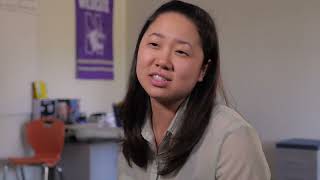
Michael Horn and educators discuss designing physical spaces for blended learning. They stress that classroom climate affects student outcomes and space should follow learning goals. Examples include movable bookshelves for flexibility, station-rotation zones for instruction and independent work, and repurposed furniture like IKEA cubbies that serve as dividers and whiteboards.
Chapters
The last topic for this week focuses on the facilities for blended learning, really meaning the space or the classroom environment that you create where blended learning happens. What we know from a body of research is that the climates we create for students really impact directly student outcomes. But what we also know is that blended learning is so young still that we're not quite sure how to optimally design these environments still.
So rather than just giving a list of things you should do when building a blended learning environment, we want to share the learnings of what our schools are finding. And the first piece of wisdom that they've shared is that we have to be incredibly clear about the desired outcome of learning and then build spaces or design spaces towards that outcome in mind. It's the architectural adage of let form follow function.
Exactly. And what that means is really start with the student experience in mind, design your blended learning model, figure out the culture that you want in place, and then design the facilities to meet those outcomes. Don't let really make those facilities be a slave to that mission that you're trying to achieve, not the other way around. And just don't accept the four walls of the classroom with the teacher in front and the whiteboard as the given. When you get into this work, I.
Think space gives you a sense of value. You know, when you walk into a classroom and you see tables all in a row, all facing one direction, that is where the energy and the flow will be is towards the front of the board. When you walk into a space where furniture is facing each other, you can't see where the center is all of a sudden. Then you must realize that the user is the center. And so in a lot of ways, being able to look at space can help you understand how aligned you are to the principles that you say that you're going to use.
We also want to talk about flexibility. So when Rocketship designed their newest blended learning space, they knew that they wanted a more open space, but they weren't sure that they wanted those classrooms always wide open spaces with no walls. So they put in these flexible bookshelves, in essence, movable walls that allowed them to close things back up if they decided that was more optimal in the long run. They didn't commit to one thing and then just have to stay there.
So really, it's a question, you say to yourself, when do I want students working with a teacher directly? When do I want them working independently on a computer? When might I want them working in projects? It's that kind of questioning that lets you think about the ideal Space.
Yeah, that's exactly right. So let's actually try to answer that with a station rotation model first. How would you start to set up that experience?
Perfect. So in a station rotation, we actually see schools don't need to actually change the architecture of their school that much. They might still want to have an area for direct instruction, but maybe it's got a smaller footprint in the classroom, because generally they're working with fewer students in that direct instruction. And then there needs to be some separation generally, so there's a place for students to work kind of independently. Maybe it's more quiet. Maybe there's less visual distractions for the students there. And they. And then they need a space that's set up for good group work where the students can interact with each other and maybe be close to some supplies or be in a part of the room that won't disturb the others if they get a little louder.
And here's where it actually gets really fun, because as you think about those students working on computers in that one part of the space, do they need to be at desks typing away at computers, or can you create more flexible environments depending on their age or what they're trying to accomplish? For example, maybe they could be on beanbag chairs just looking through their tablets and. And reading material. Alternatively, you're at the project tables. Do they need to be desks just clumped together? Or can we create creative spaces or tables of different sorts that really optimize the type of learning that you want to see happen in that environment? You may also need to think about sight lines so that you can have one teacher in a room. Just quickly scan the entire room and know what all of the students are doing so that they're actually on task.
So let's say there's three different stations, and one station is small group work with the teacher, maybe with small whiteboards that the kids are working on. Another station is solo work on the computers, and a third station is groups of kids working together on some meatier project or problem where they're discussing and throwing ideas back and forth with each other. So in that situation, I would take each station one by one and say, so if you want kids to be able to do whiteboard work with you, what kind of furniture would you need? Or given the furniture you have, how would you put it? Where would you put it in your room? And teachers generally have a lot of good instinct about their own space. And so we just go with that as the initial try. When it comes to the kids working on Solo computers. I recommend generally, particularly with the middle school kids, that orient the screen so that if you're over here working with the small group, that if you glance over there, you'll be able to see their screenshot.
So let's move beyond just the station rotation now. And when you start thinking about a space in these settings, maybe we can be a little more creative in how we use space.
So let's listen to our protagonists and their take on it. First.
Our physical space here started as an empty office building in an industrial park in Sunnyvale. We blew out the walls, we blew out the ceiling, and we've made it a brightly lit, vibrant, colorful space that is open for student learning and should be adaptable. To make it adaptable, we've put all of our furniture on wheels so we can rapidly convert big open spaces into sectioned off areas if that's what the project focus demands. A couple things we've done is made up racks of Chromebooks using simple supplies of an aluminum rack and plastic containers like you would see in a magazine rack. These are what hold the Chromebooks and it's a built in charging station. We've also taken a typical 4x4 IKEA cubby. We've put wheels on the bottom, whiteboard material on the back. These serve as both room dividers, learning spaces, and cubbies for student materials.
This is, as you've visited, probably the most interesting facility you've seen. Richard Barth said after he's visited over 100 schools that this is the most interesting facility. And you know, you open a door and there's more kids, and you open another door and there's more kids, and we could let the facility, you know, hamper us, or we could just, you know, ignore the facility and do what we need to do within the space. We've believed from the beginning that great facilities are not the key to our success. We want adequate buildings, but the building doesn't determine the student outcome. Some of it's just a mindset, right? Like we'll make it work in whatever facility. And we've taken classrooms in this building and cut them in half. We've taken spaces and cut them in four or five different pieces to make it work and then really flex the room.
So in our library, we've designed a portable to be an incredible reading space for our students. We have the students seating in quads and you just. All the books are displayed, so the book cover is out. It, it looks like a colorful space. The students are able to transition from the old school sitting and reading a book to popping open an iPad and taking a cloud based quiz.