Optimism for the Future of Business Education
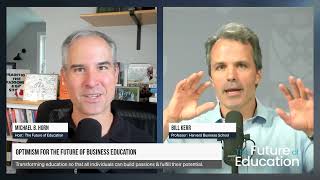
Bill Kerr, a Harvard Business School professor, argues that business education must become modular and lifelong as digital skills turnover faster than managerial ones. He describes using generative AI to personalize case work and feedback, and warns that immigration policy directly affects the quality of international talent pipelines.
Chapters
Welcome to the Future of Education. And now here's your host, Michael Horn.
Welcome to the Future of Education. I'm Michael Horne, and you are joining the show where we are dedicated to building a world in which all individuals can build their passions, fulfill their human potential and live a life of purpose. And to help us think through that and frankly, the shifting landscapes and how we prepare managers and leaders to lead organizations in this world, I'm delighted to have Bill Kerr. He is the Darbeloff professor of Business Administration at the Harvard Business School, Senior Associate Dean for Faculty Development and Research. Long list of accolades, but the one that I also want to hit is he's co director of Harvard's Managing the Future of Work initiative, which is so critical in thinking about how do we develop human talent and how do organizations, leaders, managers evolve in this world. And he's faculty chair of the Launching New Ventures program. I could go on and on, but I'll also just add Bill's neighbor, friend, and used to be a CrossFit buddy. I think you still work out occasionally with my wife. But Bill, it is great to see you. Thanks so much for being here.
Michael thank you for having me. For your work and for those listeners that don't know it. Michael is amazing at CrossFit. He smokes me every time.
Not true when we get on a rower, but. But this will be fun. So look, so much is happening in the world of work right now. Big technology changes, automation, rapid changes in skills, demographic shifts could go on and on. Haven't even mentioned AI, obviously. But I want to focus on the areas in which you teach as well as research and think about the future of business education itself, particularly at places like the Harvard Business School, where you're training the next generation of managers, leaders, frankly, through the exec ed programs, people already in leadership roles. How do you see business education itself evolving? Bill?
Well, I think there's a very robust future for business education, Michael. I would suspect that the future is going to have many more types of programs. They're going to be more granular, they're going to be fit for many different purposes. But all the features that you began describing the world's kind of constant evolution and very rapid pace of change is going to require business leaders and business students to stay at that cutting edge. So I think our MBA program is going to have a robust future as people look to prepare themselves for careers that will be ones where they're going to change jobs a number of times, and they're going to be thinking about the impact that they could have on the world. If you go later in career, many companies and many individuals are going to need to retool, reskill themselves for that future. That's going to give us a lot of exec ed opportunities and gaps to kind of help there. And then you can go even back upstream. Harvard Business School doesn't teach undergraduates, but many schools do. And in that business context, if you're an engineering student, you're going to want to have some business school courses to go alongside that. We don't separate those two functions anymore in the corporation. And so likewise education is going to mix across them.
Yeah. So I want to then focus Bill. Like I'm just sort of curious because we talked about all these technical skills changing. You talked about more granular ways of educating leaders more on the job, in many cases adapting curriculum, but sort of at a base level as you think about the future of work and frankly where we've been like have the essential skills for business leaders changed all that much in recent decades? Like right. Do we see the same velocity of change in those skills that we do in the technical fields?
Well, let me start the end part there. There has been some important work that describes the rate of change for technical skills for digital skills and similar compared to more traditional non digital skills. David Deming, who is a faculty member in the Kennedy School, did a remarkable study where he looked at the same job 10 years, so 2009 to 2019, same company, same position, everything was exactly the same and did this at scale with many, many job postings and quantified that digitally focused activity had a faster turnover in the skills that were required, what the job ads were asking for compared to non digital activity. So if you looked at what traits people or qualifications employers were requesting, if it was something that's closer to the digitally based world, it moved f than otherwise. But how that plays out for the broader landscape of business success, what helps a leader move faster up in the career? I think we're still learning a little bit. My favorite study on this regards goes from Joe Fuller, who's my co director of the Managing Future of Work project, as is Rafael Sedun, his co author here where they looked at CEOs and job descriptions and also what mattered most for CEO success over a 2030 year period. And there was a lot more emphasis on social skills today compared to two decades ago or three decades ago. A lot more emphasis on technology and kind of products and sort of those relationships to consumers. Less on things like finance and some of the more traditional strategy functions likewise, if we look at some of the the profiles of people that have been most likely to kind of ascend up through the ranks and ultimately end up in the CEO role, they've been coming out of a different set of line responsibilities than before. So we'll anticipate that continuing forward. And the question I think many of us are going to have to work with is in a world where it moves so fast, let's face it, sometimes the academic programs don't move as fast as we need them to be. And you're going to see some differences emerging both across fields, across schools and so forth as to what's the gap of the recency of what's required in the workplace versus the syllabi and so forth that are being taught. There's some very interesting work that's being undertaken at Yale right now that's measuring that for the first time, like actually measuring syllabi and what are they teaching there versus what are employers kind of saying is the crisp latest frontier skills that they're hiring for?
So I want to come back to that in a moment, but I want to stay on what you just were talking about also about if you look at job postings and what employers at least seem to be requesting from technical skills, the rapid turnover that we've seen in the past decade now plus there compared to maybe other managerial skills, what some people call the softer skills. I don't always love that phrase of turn, but I know it is one. But I'm just curious, like as you analyze this space, how much stock do you put in? You know, the job descriptions and what people say they want. Leave aside the technical skills for a moment but you know those, the softer skills, the social skills, the managerial ones, how much stock or do you think we can really read into what's in a job description versus actually like spending time shadowing managers CEOs to see what they actually do because and I'll betray my hand a little bit, it often seems to me, of course I'm going to write critical thinking and problem solving in the job description. But what that actually means on the job is not always as clear, if that makes sense.
Yeah, yeah. Let's first off, we will label soft kind of a social skills because I think that at least captures a bit more of the essence there. Michael, you raise a great question of that. I'm going to broaden slightly, which is a lot of the ways we have been talking to employers at the Managing Future of Work project is to appreciate what is their expectations of new hires and what is it they are kind of most hoping to grasp with the new talent that they're bringing in? And there's one version of the world which is I am going to wait until I have a specific need. I'm going to write out a very exacting job description, and I'm going to expect a fully loaded, fully prepared candidate like Michael to show up and then offer his services to me at a very, very low rate. And that really doesn't work for a variety of reasons, including the overall challenges in finding the talent these days. But it also doesn't work in an environment where six months, 18 months after Michael joins the job, I'm actually probably going to need to have him shift into different types of activities. Like the pace of change is going to move where he is. And so what we would hope that the employers would begin to appreciate more is the willingness to go learn, the openness to new experiences, the capacity to learn on the job through that shadowing process, through the ability to kind of see both what others around me at the organization are doing, and then also what, what's the emerging opportunities that I should be learning as quickly as I can, ways to be useful for those tasks. So it's going to be both in the job ad, but it's also in the expectations of how we're hiring somebody for the next. If you're going to keep somebody for five years, 10 years, which should always be your ambition or goal, then you're going to have to anticipate they're going to have multiple waves of the things that they're doing on the job. And so let's not overly, overly make ourselves rigid around what we're expecting on that very first assignment and task.
That makes a lot of sense. So let's go to then the other part that you ended the previous answer with. That seems to me to link to something which is you talked about, you know, given rapid velocity of change in job roles, curriculum needing to keep pace. Historically, that's been a challenge. From my perspective, that points to one of the big things that, you know, goes on at a place like the Harvard Business School, which is you're not just teaching and delivering, you know, obviously case study method in the case of Harvard, but you're also doing a lot of research, presumably so that you stay on top of the big changes and are able to adapt curriculum accordingly. Just talk about the interdependence and link between those two areas. Not every school, frankly. Actually, let me. Before you answer, let me just say to the audience, there is no school that I've ever come across that cares about teaching as much as the Harvard Business School does for a research institution. It is truly different from anything I've seen up close. But talk about the link between those and how that enables you, presumably, to keep curriculum up to date.
Mike this goes back to my sort of overall point of view as to where the world is, what matters for business success, and then what's the role that business education and business research plays into that environment. And you began the podcast by describing this rapid pace of change and the many, many things that are coming at us one after another and that have material impacts on how our businesses operate, what our employees need to be tasked with, and how we can best guide and lead them. I think you have to be increasingly focused on where new information is coming from, new insights, new technologies, new opportunities, and then how you as a person, and also you as a business, can be connected and learn from that. So it's a strong mindset shift from maybe where we were 15, 20 years ago, where oftentimes you had this idea of, wow, we have a wonderful R and D division. We are accumulating a body of firm specific knowledge, and we're going to think about that as the asset that we take out into the world. And there's still certainly places and opportunities for research that happens inside companies to really push it into a proprietary advantage. But increasingly, you also have to be able to be close to these places where new stuff is springing forth coming out. And I think business schools are going to play an important role in facilitating those types of connections. Being a conduit for an individual manager, or maybe even a broader company as a whole, to have access to those pieces of knowledge. And where that then ultimately brings the faculty member into is a concept we often call absorptive capacity, absorptive advantage. That if you're engaged in the research process, if you are out working in these new ideas in their applications, you're going to have, first off, some stuff that comes from you specifically. Maybe Bill Kerr has a lab that is producing some of these insights. But it also puts you on the ground and gives you the tacit understanding of how to interpret many of the other things that are going on in a place like the Boston area, where you have MIT and HBS and Harvard and all these kind of different places stuff spring up. It gives you a way of kind of harnessing some of those and providing them into the classroom and into the lives of these business leaders for them to then work on and grapple So I think this research teaching kind of combination is actually going to probably strengthen going forward due to this way that it puts you close to the frontier so that you can both appreciate it and then you can also help transmit it or help others understand how it could be useful for them to grapple with.
It strikes me that it also could increase the connection for experiential learning and sort of embedded, certainly the case study, but also simulation, anything that has the individual learning more closely connected to the case or set of experiences that they're actually going to be working on. It strikes me that that'll be strengthened as well in this fast moving environment. Is that your view or do you see it?
Absolutely, absolutely. And it's something that many of us are going to need to be much more hands on in the future in our work lives as well as also in the classroom to support that. You hear phrases like hands on the keyboard where it's not that management is just up there kind of architecting direction, but without direct hands on the keyboard type applications, you're not going to understand the technologies, you're not going to understand what they could do to the organization and build it, build it from there. It also has direct implications for how we think about the life of a person and what points we can connect into them. We're not in a world where there's going to always just be early education. Be an undergraduate or an MBA and then you're done, you're good, you can go work on this for 20, 30 years and send us an alumni check every so often. We're going to have a lot more interaction with, with people on the way because you know, the part of the, the value proposition was to be close to where these insights are coming, but they're going to keep coming. And so how can we be somebody's signal? How can we help them discern what could lie around the corner?
I'm curious, in your view does that like maybe we start seeing business models and business education around lifelong learning models? Where to your point, do the MBA come back a couple years later, get a two week course, get an online module here? Just a lot like, does it open up to creativity around that?
I think it's going to open up the necessity around that and then creativity will probably follow as we and other schools work to that end. I don't have the one to one translation of this metaphor down, but what has struck me recently is the idea of hard hardware being built for software based applications. And so one of the cases that we've taught at HBS is around Toyota and has some sort of linkages here. But like the example of hardware, for a hardware based application, you tend to be very exacting. So if you need 10 gigabytes of memory in that hardware, you don't put in 15 like you put in exactly 10, you cut the cost right down. You're ultra efficient. If you're building hardware for a software based application where you're going to anticipate continual upgrades being needed into the future, you often overbuild the hardware. So 10 gigabytes would do right now, but you want to put in 30 gigabytes because the next software upgrade and the one that's going to follow after that and the one that's going to follow, they're going to be ever more memory intensive. And so you're trying to build the hardware in a way that can allow the product to stay more relevant, to stay more up to date into the future. So if I then kind of bring that into the business school world and we agree that the lifelong learning concept and the rate of change is going to require us to have continual check ins, maybe that means that we should be thinking about things differently. At the very first MBA level, early career investments, are we overbuilding the hardware at that point with the notion that you're going to be coming back to campus every three or four years for one of these kind of software updates and then you're going to come back again and that maybe the package that we provide to, to the people that are part of our community will engage in this kind of longer term. You're a citizen here. Once you kind of enter into this world, we're going to be a way for you to stay at the edge of the new ideas and concepts that are emerging and that preferential access is what we're building for.
It's interesting because it's often said education is wasted on the young. And I know graduates of the MBA program often say, wow, that case study on X, 20 years later, that's when it all of a sudden I realized what it really meant and it was so valuable to me. It just occurs to me that you know, as you, as you describe this, really helping people see this is something that they can keep coming back to. It's a change in relationship. It makes probably the ask from an alumni, you know, this is for schools more generally who are saying, how do we get donations? It's not a donation. I actually feel like I'm getting a service on a real time basis. Does this also point to a Lot more virtual education in your view, Bill. And what does that look like in the future?
Yeah, let me begin with the first part of your statement there, which is, you know, when you're an MBA here, Michael, I'm guessing you had approximately 600 cases or some crazy number over the course. And some of those are ones that have immediate applicability. Whatever you're going to do right after, you need to be able to interact with the team member and so is developing some of those skills. And then there's probably had a case or two that had you as the CEO of a large organization, which nobody was going to go immediately into that task. But it was both a way of learning how the world operates and then also kind of preparing the almost like a future capacity to be in that spot. Like we want to open up these conversations earlier and awareness of the types of career dynamics that will later occur, knowing that by the time that a student actually becomes the CEO of one of these large organizations, the world will have shifted and they're going to need to have kept up the pace there. So sometimes again, you want to kind of open the student's perspective to the bigger set of issues that are going to go into the future. And it's actually almost like the value proposition of business school. You may have been for three or four years really crunching numbers away at Goldman Sachs on the latest deal with or doing something for Deloitte consulting on its packages. But you didn't have the chance to kind of see the bigger picture of the world of business that you are going to be working in for some time. And we're trying to start that conversation. Just like in the entrepreneurship group where I've been for 20 years. At the school, many of our students, in fact the majority of our students who become entrepreneurs don't do it immediately upon graduation. Usually there's a few years, maybe due to student loans or to other kind of desires, of building a knowledge base before they launch business where they're going to go do something and then it's five years later that they begin their enterprise. So we want to prepare them for what that journey might look like ahead, recognizing that when they get there, they're going to need to know the actual term deals that a venture capitalist will provide. So we like to have that kind of capacity. This does think about and again it goes to this idea of the hardware and kind of continual software pieces. I used the phrase citizen a little earlier and it's an interesting, I think, term of how we might think of our communities Because a citizen both has rights and responsibilities and you think of the package that somebody is participating in, we're in that relationship. And to your point, I think it does change how one thinks about being a citizen of a community over a longer horizon. And that this is not just, hey, as you think about your philanthropic giving, maybe you can spare some money for us as well as also for some other good causes, but instead kind of think about, we want to be relevant to you. We want to be somebody that is on your short list of where you might go for insights on the following. And so how can we make that an attractive package for the future? I think the digital piece is going to be critical. That was the last part of your question there. Because even if I was to describe this idea that you're going to come to the campus every four or five years for one of these upgrades, there's a lot of time that happens in there. If you were going to come to campus this year, the last upgrade until now would have been the introduction of ChatGPT. That would have happened within that window and it probably would have been a little too long to wait until your next time on campus to pull that off. So I think we'll want some very high frequency digital outreach again, in part of the relationship to being at the cutting edge, that you have to be able to hear things faster and, and that will be an important component to sit inside this broader, the broader suite of executive ed type activities.
I want to get to AI in a moment, but something you just said triggered this, which was your colleague, my co author, Ethan Bernstein made the observation recently to me that, you know, no wonder Gen Z has this reputation of being so impatient to sort of rule the world and have these rights because we constantly keep yelling at them, hey, your technical skills, your skills are eroding faster than ever before. And they're like, well, I want to put them to use. I guess when I hear you say all of what you've said, I wonder if it can put them at ease a little bit and make them a little bit more secure in, hey, you're going to have a progression and progress in your career and there is some patience and it's okay because we're going to be, you know, sort of rebuilding around your needs. It's not just sort of come in for the MBA and you're out and gone.
I guess my thought on that one is it's a yes and it's a both. The atrophy of digital skills is rapid and to some degree, if you are trading off of your digital skills, you should be very impatient to get them to work. And I do the opposite. When I talk to large organizations, I basically, you tell me you want to go hire all this digital talent. Well, let me tell you about the worst thing you can do is you hire. But then they can't put anything to use. They can't see progression. They are stuck at the bottom of a very, very long process that's in front of them. You have to have the escalators, the things that can allow them to put their skills to work faster and also stay up to date. The worst thing a company can, I think, do. That's actually not true. There's many even worse things a company can and have done. One of the worst things in this context that a company can do is have its employees feel like they're missing out on the next generation of skills. So they came. The company is stuck in what was maybe even very relevant in 2019. But the talent base doesn't feel like they are staying at the edge of the skills that are defining right now and will be relevant for the next two to three years. An organization that people look at it in that way is going to find it very, very hard to keep the talent that needs to be kind of always up to date and always refreshed with their skill base. So I want to recognize that dimension, but on the opposite side to, I think the second part of your perspective there is to appreciate that the most durable skills, the most durable things that people are going to be able to build careers on, probably go back to those social skills, probably go back to kind of their ability to coach young team members. Many of the things that are not the specific hard skills of this moment, but instead are the things that the organization most needs in order to activate the technologies that are available to it, to activate the talent that it has in place. The things that are. That are impossible at this stage and probably will be for some time to automate, but instead can be important for the employees to be able to realize the potential of the organization.
Gotcha. Okay, so I've teased this AI thing that we're going to ask you some questions about that for a while now. So let's get into it. I'm just curious how you all as faculty are making use of genai by students and their work and the tools that you're developing for them to use or whatnot. But also if you could reflect on the research side as well, how that might be changing the work or even the curriculum itself. It strikes me that, you know, building simulations, for example, that put someone in the shoes of a case protagonist rather than just reading about it, you know, those things might become more possible than sort of future imagined state. And so I imagine there's a bunch of things you can do with it if it's not feared. But I'm curious what the reaction has been.
Yeah, the reaction has been overall, has been positive. I think maybe there's like a cautious optimism of us bringing into it. There's no try to hold back the tide here. I think our stance from the beginning has been Genai is going to be here. It's going to be a tool in the workplace. You should use Genai. And if anything, I think more often than not we have been kind of prompting students to actually use it more than they otherwise would. And even going so far as early in their MBA career, having them be introduced to Genai. And it can do this and it can do that because not everyone that comes to campus has been as immersed in ChatGPT as other people. And then the second is kind of making sure that in some classes, professors been even very pushy as I want you for every class to ask ChatGPT the following types of things about the case. Now I was actually, as I was walking over to this podcast, bumped into a colleague who was describing, however in his class how he's getting very disparate answers and the quality level's not right. And he himself is also using ChatGPT to see what he thinks that it would tell them as a potential answer so that he can kind of think about like what is their independent learners. So there's complications and things that we need to kind of work through in this level. But the overall stance has been that this is here to stay and we should make it work. We don't use it for. They're not allowed to use it for exams, obviously. We have, even before the introduction of large language models, had a policy of no Internet use during the exams. And that continues to hold. So it's still at the end of the day. Michael in the case is going to be the final product. But it's important along the way. We're excited at HBS about the ways this can make faculty more effective towards the classroom. One of the things that we've always struggled with, and this isn't a live product yet, I'm just kind of, you know, putting on the roadmap. One of the things we've always struggled with is if we're going to do case based work it's very, very time intensive for us to do a practice exam or to do anything. That's like taking Michael and his 93 section mates, have them write an eight page case that we're then going to provide detailed feedback about Michael and what he was getting right or less right on the exam. Large language models ChatGPT. That gives us a lot of opportunity. If we can train the models, the models can help us provide this feedback to students early on. It's still going to be the case that faculty will grade the final exams, but nonetheless we can provide a lot more kind of real time development along the journey There you raised the idea of simulations and the like. I think our state of the art right now are bots that we have developed for specific classes, both in the first year as well as also in the elective curriculum that digest enormous amounts of material that is about the course. Like every case study that's going to be done through the course, some background notes, some other things that within the walled garden that the instructor places in there lets students then engage in Q and A and sometimes they're doing some stuff that's about like can you remind me what this acronym means? Or what was the concept that brought this? And then that can kind of bring all these sort of things to help make the student more prepared for the classroom environment. We're going to I think see going forward innovations on the material itself using AI as you're rightfully suggesting. I think the easiest kind of cases are going to be let's customize our case library a little bit. So if Bill is going to Turkey for an exec Ed program, maybe I can try to take a case and have it customized to the Turkish context. Like kind of fill out a few of these extra pieces that make it more locally relevant than it would be if the case is set in Brazil. Maybe some things that we can bring across from there. Likewise, we'd already begun experimenting and building out some more traditional if then kind of bots that have been had been developed based upon data for things like venture capital, term sheet negotiations. I think there's going to be the next generation of those types of products that can take advantage of this power as well.
It's, I mean it's really cool frankly to hear where this could go and the tools that you can probably envision. You know, before it was sort of futuristic and science fiction. Feels like it's in the roadmap now. Last question as we wrap up here. I'd love to talk about the global picture and internationalization of business education. When I was at the business school, one of the most enriching things was not just that cases were worldwide and HBS had research centers all around the world, but also that my students. Right. My fellow, you know, my fellow peers were from all around the world. That's obviously been a big trend in higher education more generally in America over the last many, many years. It's also one that, as you know, not at Harvard per se, but elsewhere, has receded a little bit over the last. Call it eight to 10 years. And there's sort of winds blowing. Right. Bill, in the political conversations about a retreat from globalization. I'd love your perspective. Like, you know, international students continue to be a growth sector for US Business education. Is this something that retrenches a little bit? How do we think about this in the current context and what matters here?
Goodness, Michael, you like to end with a big bang. A bang, yeah, a bang there. I actually related a little bit back to where we ended the last one with AI and kind of. I'll start there because one version of hearing about all these new even phrases, kind of crazy simulation world that perhaps we could generate and live in and just the digital world would be, is that going to somehow weaken the need for a student or the desire of a student to come and be in Boston for a period of time with their studies? And I think exactly the opposite. There are probably going to be a large amount of synergies between what we can do in the digital world and what we can also do then in the physical world. And if we have the amazing content to help somebody work on their business problems in the time that they're away from, what we can also then do is make it more valuable that they were a part of the campus and made some of those personal ties and connections at a period of time that we're kind of continuing to refresh and update from there. The analogy I've given, and I think others certainly have given as well about this, is when you think about phone calls and emails and zoom, those tend to be used mostly within organizations. Number one people that I zoom with, or other HBS employees. The number one destination of emails is hbs, and yet it makes the campus even more important and vibrant, despite the technologies being weightless. So if we kind of start with that premise, which is to say that there is a value to being on the campus on location, then yes, I think it's important and will be the case that international students will continue to want to be in the US for higher Education. And recently we've gone back up above 1 million total students. This is undergraduate, graduate and so forth, which was we're slightly less than where we were in 2019, but we're almost back to 2019 levels, recovering from the pandemic in that way. So there's the demand there, there is pressure that is blowing in political winds. And it's not just the United States. A number of countries are kind of struggling with the questions about what's the role of immigration in our economy and in our society in some way. And I think broadly speaking, I have a very long term enthusiasm and again, support, I think you're going to recognize, especially for the most skill based work, countries are going to start competing like crazy for talent. As you look ahead to environments where there is an aging population, you have large physical imbalances, you have the need to stay towards the cutting edge of technologies and so forth, there's going to be a fight for talent rather than pushing it away. And that gives me the enthusiasm, the optimism for the horizon. Can we mess it up? Oh, we absolutely can mess it up. I think one of the scariest studies, and they didn't actually think they were writing a scary study, but it was scary for me was a group of scholars that looked at H1B visa reforms that happened in 2002. And so as a little bit of background, the US had its most expansive policy towards skilled immigration in the early 2000s. And in 2002 there was a sunset clause that basically brought the program significantly down terms of its size. And perfect for researchers, most countries were affected by that decline, but there are a handful of countries that weren't affected due to specific relationships they had with the United States or exemptions under the policy. So it gave a wonderful kind of treatment and control group to look at. And what this study looked at was the inbound students in 2002-2003 as this decline was happening. Now let me again position this in time, they're not going to enter the labor market for another four or five years. These are inbound college students. When the decline is happening. And they found that the treated countries had a 10% lower international student application and coming to the United States rate. And the ones that we were most likely to lose were the best students of the group. So the SAT scores also went down. And your listeners are education scholars. They're probably not interested in the minutiae of immigration policy. But this was not like an extraordinary change. And it was also something that if you had been a part of the policy environment at that time, you would have imagined we could easily correct or change. And yet it had that level of impact on forward looking students as they thought about, I want to go to school at the place where I also want to have a career and work. And so when I come back to our current political environment, I always emphasize that choices around education are often an investment. And as an international student, I want to invest in being in the United States in many cases, because I also then want to anticipate working in the United States and whether or not we have direct policy change, whether or not we have a lot of animosity about the issue, it's still going to tarnish and then lead to weaker investments among the inbound students that we could have competed for. So I hope that we can find a way to navigate through this and not have those tensions flare up the way that they have over the last decade. But it's a very important topic for higher education.
No, it's super helpful, Bill, because I walk away thinking the war for talent is heating up, if anything. And so those countries that are the best at being attractors talent which starts in education, best positioned right to come out on top. And I believe in positive sum worlds, but there is certain zero sum elements of where talent goes.
Yeah, let me, let me second that by saying I think there are several, what we call pathways that immigration operates. And in the United States context, arguably the most important pathway has been the education pathway. People that came here as a high school student, people that came here for college, people that came here for graduate school, their impact both while they were here and you know, there's various studies that have quantified the billions of dollars for the local economy. But even more importantly, like how they then connected to the United States staying for work, even when they went back home, the interactions that they facilitated with our economy were very important and we absolutely must keep that alive for the future.
Beautifully said. He's Bill Kerr. You can see why he's terrific. And you should check out his Managing the Future of Work. What's the podcast name, Bill?
Managing the Future of Work. We always stay on brand.
Yeah, that's what I thought. You stay on brand, you're better at it than I am. So great work. Keep it up. Great to see you. And for all you joining in, we'll see you next time on the Future of Education.










