Reinvention with Teach for America
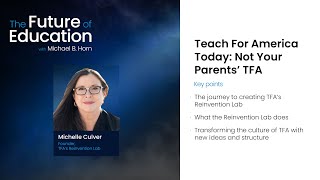
In this interview, Michael Horn talks with Michelle Culver, founder of the Reinvention Lab at Teach for America (TFA), about her personal journey from a 1990s TFA corps member teaching in Compton to a senior leader questioning the limits of traditional schooling. Culver describes how a pivotal experience watching her own daughter thrive in a curiosity‑driven school sparked a series of “why, what, how” questions that led to the creation of the Reinvention Lab as part of TFA’s 2030 strategic vision. The Lab’s mission is to imagine and build the future of learning, operating through two parallel units: a Product Studio that designs new offerings such as the Ignite tutoring program—an early‑literacy and math tutoring model co‑designed with youth that foregrounds belonging—and a Learning Studio that cultivates bold, radical imagination among TFA staff and alumni, teaching them innovation methods and co‑creation practices. Culver uses the metaphor of rebuilding the Bay Bridge to explain TFA’s “dual‑bridge” approach: maintaining the existing corps‑based model while simultaneously investing in new, scalable learning structures. She discusses cultural challenges of integrating this ambidextrous work, including how new corps members are exposed to emerging ideas (e.g., brief AI‑focused lessons) without overwhelming their day‑to‑day responsibilities. Finally, she outlines how the Lab measures impact not through linear metrics but via an emergent, “composting” approach—rapidly testing hypotheses, gathering feedback from a diverse Reinvention Council, and iterating or pivoting based on early signals. The conversation highlights the tension between sustaining current equity work and daring to reinvent education for broader economic mobility and holistic student well‑being.
Chapters
This is the future of education.
And now here's your host, Michael Horn.
Welcome, welcome, welcome to the future of education, where we are obsessed with helping all individuals build their passions and fulfill their human potential. And today we have a guest, Michelle Culver, who's the founder of the Reinvention Lab at Teach for America, who I suspect is dedicated to something similar. Michelle, it is good to see you. Welcome to the show.
Thrilled to be here, Michael. Thanks for having me.
Yeah, you bet. So let's start with biographical information and sort of where your own personal conviction comes for the important work of education. But also, you know, Reinvention Lab sounds like it's up to something maybe bigger than we've historically thought of, you know, schools as they are right now. Right. Reinventing them in some way. So just talk about your personal journey into this work first, and then we could talk about what the work is itself.
Okay. Well, you know, I began my career teaching in Compton in the late 90s. And for me, at the time, and even actually still today, I still think of the act of teaching as an act of activism. So for me, as a college student, as a young person, I remember being in New Orleans and I was so struck by. I could not come to grips with the difference between my public education that I had received growing up in Montgomery, Maryland, which was really quite good, and what the students who I'd gotten to know while I was volunteering at the housing projects in New Orleans were getting. And that just sort of growing outrage inside of me was very present when I found out about Teach for America. So I joined the corps at the time in 99. And it was a way for me to get into action on becoming a part of a community and stepping into this radical injustice that we see in our country. But, you know, I'll say this. You asked about reinvention specifically. That's more recent. So that was a while ago. Actually, I should say this, too. You know, there's something that happens when you're a core member, and this is not unique to me as an alum, but you start to fall in love with your students, and when you become so in love with your kids, you become unwilling to accept that the system has sort of charted for them. And so what was started as a two year commitment is now well over two decades. And so it's almost because I've stayed in it that this desire to understand how to reinvent systems has been a emerging conclusion, or at least question. I should really say it's a question. And it was in my last role before starting the reinvention lab that I started to grow really convicted around this. And it was because I had this unique opportunity as a part of Teach for America senior team on a national stage to, to get the rare privilege, just be immersed in some of our fastest improving school systems in the country. And the reason that's important is twofold. One is, you know, when you're young, you sort of naively expect that the world is going to change, but over time, you know, it was a rare opportunity to actually witness that when communities come together around a bold vision that change is actually possible. And that's important because these days we are disillusioned. It is hard to find hope and inspiration. And so I do not take it for granted ever, that I can wake up with evidence based hope, you know, evidence based optimism. And yet, because I saw what we, what many consider the best of the best, I had this unease, this growing dissonance that I thought, well, gosh, if you take these models, put them on steroids, fast forward through to its most logical conclusion, this cannot be it. And so that growing dissonance got me to a place where I kept thinking, not that I'm not proud of some of these hard fought wins of the last several decades, but I'm not doing another two decades like this. And so that was growing inside of me, that real dissonance. And I became a mom at that time. I had kids later in life and I enrolled my kindergartner at the time in a school here in Denver that's designed to optimize for curiosity. So the tagline is where learners are co architects of their education. So she shows up. Elsa, my oldest daughter, shows up first, you know, first week of school, and they say, elsa, what do you want to study? And we had just recently seen some community theater. And so she said, I want to study plays. And so the first thing that the school did is they took her out of the school building, put her next to a female director while she was casting, so she could ask questions about, are you making those choices in the context of the real world? And then she came back and they matched her with an older buddy. And this older buddy at the school helped her then write a play, cast her peers direct, and then star in this play in front of the whole school. So at the time I sat in the audience and Michael, I lost it. I mean, just, you know, and the tears, and the tears crying for two reasons. One is, you know, I'm a proud mama. That's my gruel. You Know, I'm so, I'm so good. But it was actually just a moment of deep humility. I had helped to craft at Teach for America curriculum around high expectations for all kids and scale this with thousands of leaders across our country. And yet it had never occurred to me that a five year old could do this. And so I just had this thought where it wasn't the case that I believe this model is the right model for all students or for all families. But I did have that opportunity to make that choice for my own daughter. And what it prompted was a set of much deeper questions coming from that place of real humility. First, what is the purpose of education that we're optimizing for? What are kids learning? What are those outcomes that we're designing for? And why does that matter today? The what and the why? The question about how. What are the pedagogical underpinnings or the methodologies or the use of tech, or what are the methods in which we're bringing this up into life for kids? What, why, how? I was asking questions about where does it just have to happen in the four walls of a classroom? Or can it be out in the real world? With whom? In this case, it's not just a single educator, but of course, all of these people in the community who are engaging older peers who are engaging in the learning. It's from this place of asking, what are these answers to these questions and who gets to decide that? I realized we at Teach for America, we the field of education, need to be asking a very different set of questions at this moment in time and broadening not only the suite of answers, but who gets to answer them. And so that was a big part of this genesis of the journey into reinvention and specifically the reinvention lab.
Super interesting. And by the way, I knew obviously some of the story about your daughter before, but I didn't know that you were in Montgomery county as well. That's where I grew up too, so we're too proud. Montgomery County Public School. I was Walt Whitman High School.
And so I was right down the street, Prince Richard High School.
Okay, there you go. So, you know, going out in the world and realizing it looks quite different from what we had. But the I, I, I'd love to talk then your founding journey to the reinvention lab itself before we talk about the work. So you come out of this experience, you start asking these big questions about why, what, how, where, and then what, what, what do you do next? Like, because you're working at TFA you're in a structure that's been there for a few decades at this point. What do you create?
Well, my journey coincided so beautifully with Teach for America's next strategic direction. So this was coming up on about our 30 years as an organization and our CEO, Elisa Vino of Beard, who is extraordinary, was herself asking big questions about, you know, where does the world need to evolve? How is the world evolving? What is that going to require of us as we ourselves 30 years later need to change as an institution? And so we basically launched this massive process of just engaging multiple stakeholders from our community members, our students, to industry, to school partners, to community leaders and asking them, what do you hope for our young people, students? What do you most want out of your own learning journey? And from that we birthed a 10 year goal. So, so we were thinking on a different horizon about what our contribution could be. The goal is that by the year 2030, we would see twice as many children in the communities that we serve reaching key academic milestones, educational milestones, and that are indicating that they're on a path to economic mobility and co creating a future filled with possibility. And those key words, through conversation with so many different stakeholders opened up, you know, and unlocked several things for us. First, it really helped us hone in that there is still, there has been in the past, there is now, you know, at least that I see in the short term future a real need for us to understand what, you know, it takes to realize those sort of key academic milestones at third grade, third grade literacy, eighth grade math, those do in fact matter. And we now have a body of research both about brain science and also methods about how to bring this to life in a way that's much more intentional. So it actually gave us in some ways focus. At the same time it also gave us an opening to ask a much broader set of questions. And so now all of a sudden we're talking about economic mobility and a future filled with possibility, where young people are co creating that. And so it forces us to start to interrogate narratives about assuming all children successes. All children from our communities go to a four year university. You know, we start to understand now as an organization that that's just too simple. If you're really thinking about economic mobility and if you're thinking about a life filled with possibility and you're talking to our kids, there's no way to think about mental health simply as a means to an academic end. And if you talk to our young people who are grappling with anxiety, trying to find their own aliveness in the world. That's an outcome worthy of. It's an outcome in its own right, not just a means to an economic end. These conversations start to get unlocked in the organization and you realize if you're going to take on something this big, it has to be with others. And it requires us to build new capabilities. We have the word co creating in the goal. One of the first things my team started to take on was this idea that that's going to require new practices to do youth adult co creation. And so getting into action, actually learning how to do that in earnest, and codifying our lessons along the way. When do we get it right and when do we go go back to the patterns that we've all learned and how do we discern the difference? How do we build some muscle about those things? So this goal really came at this sort of important moment of my own personal aha. With an institutional transition. And that became then the catalyst for launching the Reinvention Lab.
And so this is like around 20. 20. 2021. Is that when we're talking four years ago now? Four years ago. Okay, so 2019. So then, yeah, so then, so then you get to tell us, like the Reinvention Lab, what is it? What do you all do?
Well, our charge, we wake up every day asking ourselves, where is the future of learning going? Or more more precisely, where do we want it and need it to go? And then how do we put teacher's assets to work on behalf of that future? And so our motto, which is inspired by Grace Lee Buggs, is to transform ourselves to transform learning. So specifically, what it looks like is two things right now. One is we just launched a product studio last year where we're trying to build and design new offerings that can be for our current school partners, for our alumni, for other innovators who are already working at that intersection of equity and innovation. And we could be of service to what they're trying to get done. So we're trying to build new offerings. This idea that we might not just be a two year core program, but perhaps we could be some other things too. We've seen real success with Ignite, which is. Which was one of our first new offerings. It's a tutoring core that combines this focus with early literacy and Middle Ages math with a real intentional emphasis on belonging because we co designed it with young people and that's what they said was most on their minds. The adults cared about literacy and math. Young people were saying, but I'm feeling so Anxious about being back at school and figuring out how I can be in relationship to people when I don't sometimes know that.
Awfully hard to learn if you don't have that connection in the first place and feel like you belong.
Yeah, that's right. So it's not a surprise that all of a sudden this program is taking off and we have thousands of college students right now who are zooming into classrooms who are in relationship to these small group learnings. And we can't keep up with the demand for that. So the question now is, could we take some bigger swings? Could we build something that pushes even more fundamentally on the construct of school as we know it? And that's, that's the, that's where we're headed next. So the product studio is one part of the work. The second part of the work right now is what we call our learning studio. It's been focused on helping Teach America staff members have a bolder vision about what's possible for the future of learning. Because many of us have worked in schools that are deeply inequitable and look a lot like the schools that we went to and our parents went to and grandparents went to. So even just imagining what else is possible has been a big part of our work because nothing transformative ever happens absent radical imagination and a bold sense of vision. And then also secondly, building some of those capabilities around the innovation methods that very few of us in the field of education get practice with. And so we're trying to build some of those new ways of doing and being. We may compost that second body of work in service of trying to share the learnings that are coming from our research more broadly. So that's a little bit about where we think we may be headed next.
Super interesting. And I love that you guys are pushing and inquiring on this because, you know, as I often say, is like the system we have gets exactly the results it was designed to do. And so we, you know, we push at the margins, in effect, but unless we question the fundamental tenants, we're going to keep doing this. So I love this. You have this prod product studio and ignite. I've seen some of the research. It looks astounding with the impact that they are having in the field and then the learning studio around vision and methods. This though, I mean, it should be said, right? Like for people who think of TFA as recruit, you know, 21, 22 year old college grad, put them in classroom with, you know, with with students who really need good instruction and haven't gotten that sort of support. That. That's the job. This is very different from what that is. How does that get received within tfa? How does that get absorbed within tfa?
Yeah, I appreciate you asking this. You know, I'll start just by saying sort of a paradigm that informs a lot of this work and. Or maybe I'll use a metaphor even better.
Metaphors always win.
You know, I've been thinking a lot about the rebuilding of the Bay Bridge. Have you. Did you ever watch that? Was like. It took place over a good decade.
I was living there then. I forgot. Yeah, yeah, absolutely.
Okay. So here's what I. Here's what I saw. You tell me if this matches your observation. But, you know, we all recognize that that bridge was in the 1930s, considered a great engineering feat of the time. And then for decades afterwards, it was widely understood that it no longer was up to code up to modern safety standards. And yet it was until the earthquake in 89, when a portion of the bridge completely collapsed in on itself, that the city was forced to reckon with that. So what they did, I think, is instructive. They both propped up the first bridge in order to ensure that, you know, families, tourists, people who are relying on that day in that bridge every day for, you know, to see their loved ones or to get to their jobs, you know, they still had a way to keep moving. And then at the same time, they hired another group of engineers whose job it is to build the second bridge, this more modern bridge. And once they had that second bridge, slowly and responsibly, they took section by section, you know, part by part, and transferred traffic from one bridge to the second. So I say this because at tfa, we believe both bridges. Bridges matter. You know, it is the case that our kids are still looking to this current outdated system to serve at least those most immediate needs that don't yet exist, at least not at scale for all kids to be able to access an alternative yet. And so the real challenge I think we see is that it's taking up every bit of resources and energy and creative talent to prop up that first bridge. And we still do not have enough leaders thinking about working on the second bridge. And so that's really. I think the chart of Teach America is to honor that both matter internally and in the field. And our job is to be a strong champion for both, and particularly the second one, which has just not been part of the discourse in the same way.
Okay, so that analogy totally lands for me. That's exactly what I saw in terms of the process of the rebuilding is that they were building literally a parallel bridge that is gorgeous and wide open and amazing even as they were keeping the existing one up, up, you know, afloat to your point, so you could get across the bay. And it really, I never thought about it before. It really mirrors the dual transformation process that I talk so much about in terms of you continue to support the here and now because that's where the students are, that's where the educators are. And then yes, you also put some set of resources, more I think that you're right than we've historically put in the education system. But, but it's not, you know, it's not 50% toward building this brand new set of options. And you take, you know, some bets on this. Not everything is going to work out because you are building the new. And so you have to take informed bets on that to develop that new. I love that. So culturally, for tfa that's still a shift, I imagine. How much do the core members that are coming in get exposure to, if you will, this transformation be thinking of building the new structure and how much does it inform perhaps how they're teaching in the current system as well, even as they're limited by today's structures?
Yeah, you know, I appreciate you asking that. I'll talk a little bit about culturally in a couple different ways. One is just even first, I'll start with staff. You know, as an institution, culturally, how do we embrace this? One of the things that I think have found that's so important is because we designed the reinvention lab and a lot of the strategy dp, what we call based on the ambidextrous research of trying to keep it both separate and connected, you know, distinct, so something new can emerge but really integrated at the top. And one of the things that I've seen with staff is when folks get an opportunity to be immersed in this, it's so inspiring. But because we sort of put our heads down out of humility to figure out if we do in fact have something to offer before bringing attention to it. Part of the work is helping people now see what we are learning and be a part of that co creation process with us. And you know, I share that because you know, when you think about our how we will start to create more folks who are working on the second bridge, it is my case, it is my belief that staff touch a number of folks every day, not just core members. So our core members are the obvious. What's you think of Teach for America, that's the media thing that comes to mind. But we have over 60,000 alumni who are doing extraordinary things on both bridges. And so figuring out how do we, you know, how are we in different relationship to our alumni, how are we in different relationship to our school partners who again we're talking about every day? So we're trying to think a little bit more about how to get that right, balance with the number of different stakeholders that we're working with as it relates to core members. I'll just be honest in saying this is a tension point. We've tried a few things where young people who are coming into the profession for the first time, we see that they are very motivated and inspired by this bolder sense of possibility. And yet on a day to day they are held accountable to delivering for their kids in the current construct. So you think about the journey of a new teacher. There's so much for them to learn and to master in order to be able to just show up and deliver for their kids. So we're trying to find what are the right pieces that are most useful for an incoming teacher and then how do we start to, as they get to the place where they're more competent and capable, they're able to be broadened from there. So we're trying to scaffold that and figure out what are the right pieces. One of the new ideas that came up last week inspired by AIEDU and some of the work they're doing is trying to figure out how do you pull even like 10 minutes out of your instruction to help young people experience and practice working with some of the emergent AI in order to get again some of the exposure to the tools that they're going to need over the course of their careers. This is just going to become the norm. And we know if we're not intentional about bringing this to our kids now, the equity implications are just going to get even more pronounced. And so, okay, is there a 10 minute lesson that an incoming corps member or a new teacher could get that allows them to practice some of these new things that we know are going to have an outsized impact on our young people's lives? So that's the kind of mapping that we're still doing and I'm frankly still learning.
No, it makes a lot of sense. And I imagine just from a cognitive science or learning science perspective. Right. The working memory capacities of your core members are probably quite overloaded as they're just trying to get through the day to day. And then you're like and then there's this new thing coming. So I like the where are the little leverage points? Is it a flipped lesson? Is it an AI exposure? Rather than banning the AI, how do you productively use it, for example? Which is a great example because look, there are a lot of kids that are going to get access to that regardless of whether it's in school or not. So let's be intentional about using it in a productive way and exposing it to individuals that otherwise wouldn't because they're going to need it. To your point. So last question as we wrap up here, which is as you start to think about impact and how you measure what that looks like, you know, on the one hand you have the Ignite program, you have clear measurable outcomes right from something like that. On the other you have this, I suspect, but tell me if I'm wrong, sort of harder to measure. Reimagination, co creation, informing, thought leadership, if you will function that you're playing. How are you starting to think about impact? Are you already measuring it in some ways? How should we think about this narrative as we look, in my case fondly upon this reinvention work?
I love this question because we are obsessed with impact. And yet you're right, the old tools of how I've historically measured success don't quite work in the same way here because we're not working from a clear end goal with a linear backwards plan that we just need to execute against. This work is truly emergent, especially the R and D efforts. And so a lot of what we're asking ourselves is the pace at which we're learning and our ability to quickly compost when work is not actually having the intended impact so we can pivot those resources to something new. And I don't yet know exactly what the ratio is going to be where you need to pursue X number of ideas to yield the one that's actually the breakthrough. We're still early on enough to be able to get that rhythm exactly right. But what that requires us to do is to engage differently around accountability or our responsibility to impact. So for example, we just had, we've been working on this idea, this is one among many of this idea of creating the possibility of Teach America creating new roles to help make it easier for schools to pull forward these reinvented learning. So the observation is kids show up every day with more learning needs and schools are designed to meet most all of the solutions require the teacher to learn it. But we cannot ask more of our teachers and districts are faced with this unbelievable Talent shortage. And so the hypothesis is, again, it's a hypothesis is that perhaps we could create some of these new roles to make it very easy for schools to just hire in these, these folks to take on some of the other learning goals that they might have at their school. And so, you know, Teach for America could therefore, if we co design this, we could then recruit, select, train and support these folks as they step into something new, make it easier for teachers to do this work alongside another, another team. And because we are in this exploratory research stage, we have some mixed data about whether this idea is going to be a go or whether this is not something that's actually going to be be able to be effective. And so part of what we did is we just brought all of that research to a group of folks on our reinvention council that included young people, superintendents, educators, funders, and we asked them to interrogate this and at the end give us feedback. Is this the moment to compost or keep going? And if we keep going, what specifically would we need to look for in order to see that this is in fact going to have the impact that we hope it might? And that kind of process of regularly just interrogating the work and opening it up for others to learn with us and to influence and shape it, I think is the way in which we'll at least in the short term, start to know if we're on the right path of what we build. And then once you have something, you know, measurement needs to look different at the next couple stages. But that's where we are right now.
I love it. It follows a lot of the thinking of discovery driven planning to that success. Right Is getting a clear outcome on the test and then figuring out do we double down, pivot or. I like the phrase compost as opposed to ditch and stop doing this. So tremendous work. Michelle, I'm so glad that you are leading this charge at Teach for America to think about these fundamental tenets of what education looks like and this sense of what students can imagine and build themselves, not just learn at a narrow academic scale. So thank you for coming on and sharing this with us first and foremost, but even broader, thanks for the work that you're doing.
Thank you, Michael. And you know, I'd be remiss to say, even though I may be the intrapreneur who started this venture, I will say there are just so many extraordinary people, both on the team and in the community who've been shaping and co shaping and revising this along the way. And so gratitude to the full set of people who've been a part of this journey with us. And Michael, you've been one of those bright spots that we've looked to for learning and inspiration along the way. Your books were some of the foundational underpinnings of some of this work. So thank you for your leadership.










