Shaping and Transforming the Future of Education Through Philanthropy
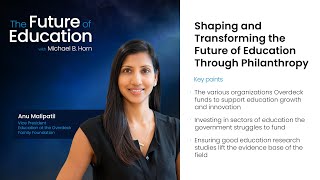
In this Future of Education interview, host Michael Horn talks with Anu Mali Patil, a founding team member of the Overdeck Family Foundation, about her personal journey from a classroom teacher to a philanthropy leader and the foundation’s strategic approach to improving education. Anu explains how her early experiences—her father’s education‑driven migration, a childhood ambition to teach, and a career that moved from Teach for America to developing open‑source curricula—shaped her belief that work is worship and that education can unlock every child’s potential. She outlines Overdeck’s theory of change: investing in three pillars—innovation, evidence building, and growth—to fill gaps the federal government leaves, especially the meager R&D budget. The conversation highlights concrete grantee examples (Parent Corps, LENA, Springboard Collaborative, TalkingPoints, Zearn) that illustrate how the foundation supports scaling, public‑funding eligibility, and rigorous research. Anu discusses the synergy between research and innovation, describing how the foundation couples early‑stage pilots with appropriate evidence methods (pre‑post, A/B tests, RCTs) and partners with data fellows and third‑party researchers. She critiques the superficial research claims of many curriculum providers and emphasizes Overdeck’s role in raising evidence standards. The interview then moves to four priority areas: technology for family engagement and real‑time assessment; re‑imagining out‑of‑school time; leveraging pediatric health visits as early‑learning channels; and redesigning the educator workforce through team‑based roles and differentiated compensation. Anu also shares what the foundation deliberately avoids—technology‑only solutions and standalone social‑emotional learning programs—and flags upcoming systemic challenges such as union contract constraints, a looming funding cliff, and projected school budget cuts that could lead to teacher layoffs. Throughout, the dialogue is conversational, optimistic, and grounded in practical examples, offering a clear view of how strategic philanthropy can drive scalable, evidence‑based education innovation.
Chapters
Welcome to the Future of Education. And now, here's your host, Michael Horne. Welcome, welcome. Welcome to the Future of Education. I'm Michael Horne, and I'm very excited about today's guest because it's someone I've known and gotten to work with in the education field for many years now, back to when I helped start the Robin Hood Learning and Tech Fund and then have remained as an advisor to it. One of my favorite people in the world of education, Anu Mali Patil. She is the founding team member of the Overdeck Family Foundation. We're going to get into what Overdeck does and much more. But first, Anu, it's really good to see you.
Yeah, it's so great to see you too. Thanks for having me.
Yeah, you bet. So before we get into sort of the professional side and what you're excited about right now as you're helping to shape the future of education, I. I guess where I want to start is you have an interesting personal story and journey through education into philanthropy. And I suspect that people checking this out will be sort of curious. How does someone start an education then end up in this place where you get to invest dollars into promising ideas and help shape innovation and research in the field? So I just love you to share your own personal story in this world.
Yeah, thanks for that question. Well, my personal story really starts with my dad. My dad grew up in a small r farming village in South India, and education was the key that unlocked his ability to pursue college. And it was also the key that gained him entry into the US On a student visa. So this concept of unlocking potential for every child, which is the vision of Overdeck Family foundation, is very personal for me. And this connects to my own story because I knew that working with kids to help them unlock their potential would be the way that I would shape my life purpose. In fact, in fourth gr, we had an assignment to write an autobiography, which was quite funny as a nine year old. But on the last page, the assignment asked us to write about our life ambitions. And at that age, at age nine, I knew that my life ambition was to be a teacher. So when I finished college, I joined Teach for America. I taught seventh grade math and science at PS Ms. 95 in the Bronx. And it was the beginning of really living my life on purpose. And the second part of my story that I don't talk about as often, but I think it's at this question of how I got into philanthropy, my life has been really guided by a strong sort of cultural principle, which is called work is worship. And it's this concept that you put your full heart into your work and that your work should be something that makes your community better. And so I really applied this principle to solving challenges in my current context and then also trying to create better conditions for those who were to come after me. So I started in my first chapter of my career as a teacher. As I mentioned, I felt wholly unprepared to step into the classroom. So I committed the next chapter to really coach and develop and prepare teachers to be more effective in their roles. And then as I started supporting teachers all over schools in the Bronx, I really saw this common challenge of them not having enough access to high quality instructional materials or common assessments. So the next chapter of my career I devoted to really building and architecting the first open source, high quality curriculum, which is called Engage New York, which certainly played an important role in shaping the curriculum market today. Then as I saw that and was involved in that work, I saw the role that philanthropy played in getting ED reports off the ground. I was there at that very first meeting. And ED reports, for those of you who don't know, is a really important market shaping mechanism for high quality instructional materials. It was that meeting that I decided that philanthropy would be the next place that I wanted to sort of have my contribution and impact and so to really think about how to lead in different areas in education. So here I am at the Overdeck Family foundation, as you mentioned, as the founding team member, but almost over nine years into the role, investing in innovation, evidence building and growth to do just that.
Wow. So I love these conversations because I get to learn something. I hadn't heard the work is worship piece before either from you, but I want to get into the Overdeck then philosophy on philanthropy in the education sector and sort of your theory of change, and you mentioned it there around helping build evidence and innovate. I'd love you to elaborate on that and what that looks like on the ground. What are the sorts of investments and the over girding philosophy that's guiding those.
Yeah, of course. So our mission at the foundation is to open doors for every child by measurably enhancing education both inside and outside the classroom. And we really see our role as grant makers focused on scaling cost effective sustainable solutions that we think can improve both academic and socio emotional outcomes for kids. But based on my background and my professional experience, I think we're smart enough to know that scaling programs isn't enough. And so we also invest in the ecosystem to build favorable conditions for these impactful solutions to scale. So we do this by investing in research, program evaluations and various policy and field building efforts. And so through all of this, we really try to help our grantees unlock innovation, evidence building and growth. And I think one of the underlying philosophies that you asked about that I would might want to touch on here, is that we really try to do what we know the government struggles to do, that we know The Department of Ed spends less than 110 of 1% of its budget on R and D, A stat that I know you know quite well, Michael. So we invest in innovation because we know that philanthropy can take risks. We invest in evidence building because we know that while there are grant programs like IES and nsf, those are often slow and burdensome for organizations to be able to apply to. So we aim to provide evidence building support that is timely and helps meet grantees where they are. And we care both about proving and improving program effectiveness, which is oftentimes harder for the government to be able to support. And then lastly, we invest in growth. We support organizations on their growth journey. We advise them in building key capabilities that we know are required for sustainable scale, really helping to position them for sustainability and public funding down the road.
So I want to get back into that research and innovation in a moment, but let's just stay on the growth trajectory. Can you give us some examples of some of the organizations that you funded along that growth trajectory that have really helped, I guess, launch them into escape velocity toward the sustainability trajectory, if you will, that you get really excited about when you think about widespread impact on kids?
Yeah, of course, I would say a handful. There's so many organizations that we're so excited about, but a handful that really stand out to me. Parent Corps, which is an organization that works to prepare parents for their little ones sort of joining school in a more formal way. That organization, when we first started supporting them, they were operating in a handful of schools in New York City. They had a strong evidence base behind them, but have yet the scale. And so we supported them through a really important growth trajectory where they became eligible for New York City funding. And we helped actually helped them unlock the public funding to be able to provide their program in most pre K and K programs across the city. Another example is Lena, which is most folks know them as the organization that creates or provides the pedometer that goes into sort of children's vests to help count the words that an adult might articulate or communicate to a little one. We call that sort of conversational turns and word count. And so that organization, when we first started funding them many years ago, they were operating in a handful of regions. Today, we've supported their growth at least 3x over the last five years, reaching over 18,000 students and young ones across dozens of regions. And then of course, we support organizations like Springboard Collaborative and Talking Points, both of which have had immense growth over the last several years. And we've been with Zern for many years of their journey as well.
And that's obviously an incredible scale story there. Let's we could deep dive in all of those organizations for a while. But I want to come back to this conversation you had around. You're investing in areas where the government struggles, I would say tragically struggles in the case of the research piece, because in other sectors the government does pretty well in terms of funding research and so forth. But in education, as you noted, it's scant, it's barely scratching the surface. But there's a lot of folks, as you know, that will say, well, research on what works is at odds with innovation, where you just need to be trying things. Or I'm not quite sure what the narrative is, but you know, they sort of have this at odds sense of it. I certainly haven't seen it that way. I know you don't either. How do you think about these things as working in concert with each other? And why should we not see them as opposite ends of the spectrum, if you will?
Yeah, it's such a great question. And I agree with you that I think oftentimes folks will tend to pit these two against one another. And I think, as you mentioned, they can really work in concert with one another. And so we at Overdeck Family foundation, we don't see this as attention. We think both really matter. And I think we know, and I think we'll admit that the current way that kids are learning, the way that teaching and school is organized is not really working. And we've seen that, of course, with the decades of plateaued NAEP scores and the most recent decline in both math and ELA in fourth and eighth grade. And so I think we really think innovation is critical to look at these challenges in new ways. And we believe that understanding if those innovations work is equally as important. So we support organizations on their evidence building journey so that we're not just testing and trying and tinkering, but that we're also understanding if we're tinkering and trying and innovating and that we're supporting those innovations to be as impactful as possible. And so just to give an example of what this might look like, you know, I think we know that teacher professional development, the research is fairly conclusive that one and done PD doesn't work. And we have early signals that PD aligned with high quality instructional materials can actually result in better outcomes for kids. But the thing that we're really interested in innovating around is a delivery model. Can it work in a hybrid model? Can it work in a virtual model? If so, which components are best suited for virtual delivery? And does the dosage matter? Does it need to be different in virtual versus hybrid versus in person? And so our support of an organization and collective called the Research Practice Partnership for Professional Learning, also known as Ripple, is structured to do just that, sort of understand these innovations and understand the impact of them over time.
And is that your practice in general, like every time you're making an investment in an early stage, either organization or new spin on something that they've done, that you're also coming in alongside and saying, great, we're going to invest in your program capability, your development, your growth, whatever it is. But we're also going to make sure that we're building a research base. Or are those things decoupled in some instances?
Yeah, they're mostly coupled together. I would say we do think about research both as sort of like little R research and big R research so that we're sort of really meeting grantees where they are. As I mentioned before, that you know, if we're really testing a brand new innovation and you know, it's built off of existing evidence based and existing evidence base that maybe like a pre post is appropriate for the first round or an AB test is appropriate and then as the innovation builds, kind of we have some evidence that can build or data that signals in the right direction we can start to move towards more rigorous research like a qed. And in very few cases, but I think critical cases, we do think about RCTs when the organization is ready and when the program we think is where an RCT would be meaningful for the organization and their journey. We certainly think that there are different stages of that journey. And as much as we can be supportive to meet organizations where they are is I think the best we can do. So we invest both like we have support organizations both in gaining key capabilities, whether that's personnel. We partner with the Harvard Strategic Data Project to place fellows in our early stage organizations where they oftentimes don't yet have data teams to help them sort of think through a theory of Change and a logic model and then in later stages actually support by partnering organizations with a third party research provider who's best suited to help them. So kind of all of the above.
No, but that makes sense. And then I guess, you know, just staying on this because you talked actually in the beginning of your career realizing you wanted to go into philanthropy, the influence of ed reports on that and the way it made the market. Right. Bringing forth what's actually aligned to the, to the standards and so forth. And think about materials through that light. You're doing all this research building now and so forth, one of the biggest struggles. And people joke about it often they say, well, how do you know if you know the curriculum or the ed tech or whatever it is, right. That you're going to adopt works or not? And people will jokingly say, oh well, I'll go to the website of the company and look at the, you know, 10 studies that they list. Right. And most of them are pretty poorly done and so forth. So how do you make sure that these good studies that can actually inform adoption and so forth sort of lifts the evidence base, if you will, of the field and is distinctive or distinguished maybe from all the other stuff that is out there because companies realize they have to have something with the word research in it.
Yeah. You know, I think that I will say that the nonprofit versus for profit curriculum providers are definitely different. Have a different, let's call it, spirit around research. And I would say we partner mostly with the nonprofit organizations that provide curriculum. And so what I would say is that, you know, we oftentimes partner or incentivize organizations to do the sort of, the right sized, right stage evidence building. But the truth is, is that they're buy in is important on both sides of the, of the sort of table. Right. So the organization needs to understand what having better research will do for them. Both from a customer selling to customers, but also for their end user, the student and, or teacher and student. And for us, I think we see it as our unique, one of our unique value propositions in the philanthropic sector. I think there are many foundations who would like to see evidence behind programs before they would fund, but are not as interested in actually putting the dollars to invest in building the evidence. So that sort of feels like a really clear place where I think we can add value and fill a gap in the field. But look, I think it's really, it's a really tricky thing. I think a lot of times curriculum providers are very quick to sort of put a stamp on the front of their, of their book to say it's curriculum, it's standards aligned, or it's, you know, it's efficacious in these ways. And the truth is, is it's important for us. I think, we think we can be a clear leader and sort of, sort of help to shift the behavior towards rigorous research. Especially when we're talking about curriculum getting in front of millions of kids across the country.
Yeah. And I mean, obviously the folks you fund are literally doing that. I mean, we're talking about millions and millions of kids. So I want to shift then to the innovation side of this and the innovation specifically that you and Overdeck are most excited or interested in right now at this critical time in American education. What are you looking at and why is it interesting to you?
Yeah. Wow. There is so much here. There's like really four big areas that I'm excited to talk with you about, Michael. Four areas that I know you're deeply interested in as well. So I'll sort of name these four top level and then I'm happy to sort of go into a little bit more detail wherever the conversation takes us. But the first is using technology to help kids and families. The second is re envisioning out of school time to create more connection between after school summer and in school time so these things are less siloed. The third is reimagining healthcare as a channel to support not only physical milestones, but also academic ones. And then last but not least, redesigning the educator workforce to better meet the needs of students, which I know is a topic that we are both very interested in. So I can start by talking about what we're excited about and technology to help kids and families. There's a couple areas that I think we see really great promise. The first is in family engagement. I think for decades we've known that family engagement is critical to a child's success. But reaching parents is oftentimes difficult and expensive. And so technology shows us that it can be done at scale. We support an organization called Talking Points, which is a two way multilingual family engagement platform that uses text messages. They have found that 98% of teachers were able to reach families they had never reached before through their platform. And 100% of non English speaking families were more engaged with their child's schools, with their child's schooling after using Talking Points. And so we know that a child's first teacher and often supporter is their family and parents. And so it's critical that we continue to find ways to make this engagement really easy and effective. A second area we think technology has a lot of promise is an assessment. On the assessment front, we know that technology can allow teachers to understand student progress and gaps, as I call both the pluses and the minuses more frequently and informally. So platforms like Quill.org and Centerpoint offer real time insight through diagnostics and non graded quizzes and worksheets. And then we know that research suggests that oftentimes when these types of assessments are paired with high quality curriculum, they can also save teachers time by providing actionable data and kids can get more timely support. And then two areas that are close to your heart, personalized learning and tutoring. We're seeing lots of promising evidence that's starting to build on both of these areas.
That's awesome. Let's go then to the. I mean there's all. These are really freaking fascinating. To be totally honest. I'm super interested in the connecting of silos, the reimagining the healthcare side of this, because I think the health and wellness conversation. I know there's a lot of schools that say we want to stick to our knitting, but the reality is given the conditions that students are arriving to them at if they don't think about their health and wellness, good luck doing the teaching and learning itself. So maybe let's do a beat on that and then let's talk a little bit about redesigning the educator role and what you're seeing there and excited about.
Cool. So on the healthcare side, I would say actually we're thinking about healthcare as a sort of like delivery channel. We know that almost every child has a well visit, sees a doctor with a parent or a child caregiver. And we really think that this is critical in the earliest years between birth and age 3, where we know that about 80% of a child's brain is formed. Organizations like Reach out and Read actually think about integrating reading into the pediatric visit, advising families about the importance of reading and sharing books that actually support healthy childhood development. So I think what you're touching on too though, Michael, is that there's sort of the mental health and wellness even in the canine school experience. I think there is a lot of work to be done there. We think that there's a lot of action also currently in that space. And so we've chosen to sort of focus our energy in this 0 to 3 space for now.
It makes a ton of sense. I love that. And it is also ultimately closing the gap that for all the early childhood education efforts have been unable to do, which is to get before age 3 in this country when, and honestly a lot of this development really occurs to your point. Let's go though to the human capital piece of this and redesigning the educator role, something as you noted, I'm incredibly interested in as well. What are you excited about in this area? What are you trying to accomplish? Who's doing interesting things in your view?
Yeah, so I mean, I know you've written about this extensively, Michael, but I think like I'm not, I'm not going to tell you anything you don't already know, but I think the thing that we've just been struggling with or grappling with for quite some time now is that this traditional model of teaching as one teacher to 25, 30 kids, it just, it's not working. It hasn't worked for quite some time. I think back to the days when I was teaching middle school science. I was teaching seventh grade, five classes of 30 kids. There was no way that I could understand even the needs of kids in the classroom, adapt and modify my lesson plans to, to meet each of their needs. So I think knowing that the gap for students has widened, knowing that the needs are more diverse today, a redesign model is just so critical. And it starts with understanding the needs of students in each classroom, but also assessing the strengths of the adults in the school and designing solutions that really optimize for both in service of student outcomes. And I would say that largely the conversation has not been focused there. It oftentimes is solving for staffing shortages or solving for a very acute problem versus this more kind of macro challenge that we're navigating. So I think this could look like a lot of things and this could look like having your strongest seventh grade math teacher teach to a class larger than 30 kids or having expert teachers taking on coaching and mentoring for other teachers, more novice teachers. You could have teachers that are maybe less great at classroom management, actually do more of small group tutoring or sort of one on one type coaching for kids. And then you could also think about how to better amplify kids who are doing great work and allow for greater near peer mentoring options. We know there's a strong evidence space behind it. It's an opportunity to allow kids more agency and leadership and to learn from one another. And then of course, we think that technology could be leveraged in ways to really help a teacher be able to better meet the needs in their classroom. And so there are a couple organizations that we think are doing this really well already. Just to answer the sort of question of who's doing it really well. Public impact Opportunity Culture has done a really nice job of kind of creating or defining different roles for adults, giving them various career opportunities and compensating them differently based on the roles that they play in a school. And this works really well, especially in places, districts and states that have light and thin teacher contracts. It doesn't work in all places, but I think that we're seeing lots of positive impact in places where they are currently working. And then I think on the more, I would say early side of things, but I think very promising as ASU's next education workforce efforts, they really focus on building workforce teams of educators with distributed expertise. And so really envision these as like dynamic teams of educators who share sort of a common larger roster of kids. But these teachers can work together to deliver better outcomes for learners while also making the job more rewarding and sustainable. We've heard teacher testimonies around not being siloed and having to work alone, but getting to work with a team both really lifts joy and satisfaction with the work while also making them more effective in the job.
Super interesting. Okay, so as we're running out of time here and last question, because we've heard about all the things you're excited about, these four areas putting you on the spot here. What aren't you excited about? Like what wouldn't you invest in right now? Because that's actually part of the really important job. Right. Of an effective philanthropist is to help be clear about what you, you won't do. And so I'm sort of curious what, what's out there that either you're not excited about, the foundation's not excited about, or maybe it's overhyped or maybe it's just crowded and you feel like that's not your area.
Yeah. So I think it's a really great question and it's, it is a strategy question we always ask every time we sort of do a revisit of strategy. What are we, what are we going to do and what are we not going to do? And just to your point is it's just equally as important one area that I think there is a fair amount of like field energy around, but I think we've just decided is not, not for us. Is technology as like the sole driver of educational outcomes for kids or sort of technology being the sole contributor? I think we know what the research says about how important it is for kids to have a caring relationship or a one on one relationship with an adult. And so we look for organizations and Models that actually really blend a caring adult with a technology component. So that's one, I would say we tend to veer away from technology only solutions. We also have sort of steered away from socio emotional learning solutions that are standalone for the reason that oftentimes we think that socio emotional learning can be embedded in academics where it can have the greatest impact. It's sort of, it's not meant to be a separate, separate time or a separate period of the day where you just focus on grit and persistence. It happens in class, it happens throughout the day. We have historically supported Valor's Compass model which we do think very highly of. It's hard to scale those types of models because they really rely on a deep amount of educator expertise. Let's call it on socio emotional learning. And so as they started to scale, I think we felt like, okay, actually let's figure out how we can integrate these types of practices more into the school day versus a separate call out period.
No, it makes a ton of sense and I think it's consistent to your point with the research base which says that these sorts of skills like executive function, agency, grit, whatever, it is much better when it's woven into the actual academics. And we're showing kids that this matters as opposed to just having a standalone period and telling them that it matters. But then maybe the rest of the day doesn't in fact reflect that, which is the irony of our today's education system in many ways.
I know, totally.
Yeah.
Couldn't agree more.
So, last thoughts from you wrapping up like, you know, as you think about where Overdeck is going to make the biggest impact, what's the one thing that you haven't said to us yet that you're like, okay, that's going to be the thing that, you know, in a couple years from now we're going to be all talking about that maybe you didn't see coming or that we're doing early research on and you're particularly piqued or intrigued about.
Okay, well, there's two things that we are thinking about a lot that we are seeing coming but have not yet figured out what to do about it. So maybe I'll speak about those two. One of those is, I think, to really envision and redesign the educator role, we really have to figure out how to break down this barrier of union contracts specifically around key policies like the seat time waiver and the number of prep periods and teacher compensation. I think without being able to sort of move and flex, those contracts are really going to struggle with that redesign sort of vision that we have. And then I think we're looking really clearly at an Esser funding cliff about two years time. We're looking at a declining school population, as you've noted in one of your recent articles. And so we're expecting drastic, I think, school budget reductions. We know that personnel is the largest cost for schools. So we're expecting teacher layoffs in two to three years time. And so the thing that we're thinking about or grappling with is what would it take or what do we need to have in place now to be able to navigate sort of what will feel like a really tough set of conditions in 2024, 2025?
Super interesting. And it's interesting how through all of the work you're doing, human capital considerations and the people that are working with kids pervades every single one of those. And it comes out loud and clear.
Yeah, 100%. I mean, it's true in every, every sector, I think. Right.
Yeah. The people matter. And so Anu, thank you for joining us in the Future of Education. Keep up the great work at the Overdeck Family foundation and really appreciate all the contributions you're making.
Thanks, Michael.
And for all you tuning in, we'll be back. Next time on the Future of Education.










