Using AI to Drive Alumni Engagement
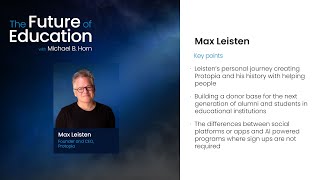
Max Lyston built Protopia to connect students with alumni mentors using AI and existing email or Slack, without requiring a new app. Volunteering makes alumni 3.5 times more likely to donate. The platform ranks alumni by relevance and capacity, then contacts them via blind email to opt out if they're not interested.
Chapters
Welcome to the Future of Education. And now here's your host, Michael Horne.
Welcome, welcome, welcome to the Future of Education. I'm Michael Horne and we are here where we are passionate about helping all individuals build their passions and fulfill their human potential. And today, on that journey of learning more about the education ecosystem and edtech startups that are helping enable engagement and so forth, we have Max Lyston. He's the founder and CEO of a company called Protopia, and they offer what they refer to on their website as personalized donor experiences at scale empowered by artificial intelligence. There's a lot there, I think that's very interesting. As someone who has been a fundraiser for my alma mater since I graduated, I'm particularly intrigued by this. And Max, first, thanks for joining us, but I'll give my personal event up front because I think you helped solve it, which is. It's always struck me that, like, you know, when you're fundraising, you have all these mass announcements historically going out to every member of the alumni body. And I, you know, some people really love green energy and want to give to campus initiatives. Some people probably think it's the devil and don't want to. Other people really get excited about financial aid or research or whatever else. And yet we're broadcasting all these messages historically in a mass way. I'm. We're going to get into it in a moment, but my guess is that this is what you're tackling. But I wanted to start with your own personal background before we get into what Protopia is. How did you come on this journey to founding this company to start to give these personalized donor experience?
No, thanks, Michael. And I'm extremely excited to be here. Thank you for hosting us. And we probably should come up with a safe word once I start talking, because I'm so passionate about all the things you just mentioned and particular the journey that got us to where. Where we are the company today. Yeah. So first of all, Max, founder and CEO of Protopia, and that accent is German, so before you're curious, it is German. I came over here a long time ago. My wife's from North Carolina, and that's how we ended over here. And it was a little bit, I think, like most founders, a painful journey. And I advise founders up to this day on when they should start a startup or not. And in most cases, to be honest, I say run while you can because these are tough journeys. But I worked for a number of decades at SaaS startups, always in the enterprise side and I work for higher education Enterprise software in a product management capability. Always love working with customers and the problems they solve. And we had just finished raising a serious D for my startup and, you know, we were incredibly burned out. I was burned out. My. My soul was gone because it's really hard to work in a startup. And so I quit my job and my wife has an impact job. And to be honest, Michael, I got actually really jealous that she managed to make a big difference. And. And I thought, well, why can't I do something that I feel better about versus, you know, more software? And I went on a big learning journey. My undergraduate degree is in marketing hr. I've always been curious about people's careers. And that was like the last time I felt really good and why am I doing this? Why did I start my journey on that career side? And I had a lot of lunches with people and I basically said, tell me a little bit where you're struggling with your career search. And the second stage of the career search is the resume. So most people get feedback on their resume from friends and family. They know it's not good, but because it's not relevant and most cases, family will never tell you the truth. So we basically started by taking your resume, sharing it with people that are relevant to you. And I would say, give me feedback 5 minutes blind for Michael, and I'm going to collate this and share it with Michael. And Michael felt great, right? You would say to me, oh, my God, this was amazing. I can't believe they told me the truth. Here's the thing that really sparked where we are. The people I asked to help to give you feedback on your resume called me back. They emailed me and said, where's my next resume? I want to help. This was amazing. I loved it. It was quick, it was blind. And I turned to my wife saying, I don't know, I'm going to make money with this, but I feel like a million dollars. Like, I feel like I make a difference in Michael's life and in the life of people that help others. Because behavioral science shows that helping someone actually feels better than getting help. It validates who you are. You feel amazing for a few minutes, and you want to know that you, your community is there for you when you need help. So it validates a little bit, you know, all the things you've done in your past. So we went on a road trip, looked at the data, and it turns out that one of the greatest affinities why we help others is alma mater. There's. We looked at Women re entering the workforce, veterans, people living in the same city. But if we would say, hey, here's a Carolina grad that needs help. Not only would you recognize why you should help that person, but in a sense, you also remember that amazing experience you had on campus. You're thinking back to a time where, you know, the world was still amazing. You had so many options. And that combination had people engage at a much higher rate than other affinities that you, you know, you may have in common with someone. So we went on a roadshow. I did a bunch of reading. And it turns out that institutions sit on that gold mine of goodwill because, you know, you're alma mater, you can't wait to help someone that's on the same journey that you're at. And these institutional leaders, when I talked to them, I said, wow, you're sitting on this gold mine of goodwill. How are you mining this? And they started complaining, saying, well, we're trying to solve it. We're building platforms, and we don't know why our alumni are not coming back. They're not signing up, and we want them to help students. And then we talk to students, why are you not signing up? Why you're not joining this mentoring program when we talk to alumni, why you're not helping what's in the way? So from a design thinking perspective, we did a lot of exploration of what's in the way of something that comes so natural to us that we all desire, give, and get help from each other. And so that's. We built the platform from there, but it was quite a journey, to be honest. And for me, the true north always was make it easier to help each other. Because it was totally selfish, to be honest, Michael. It was what makes me feel good and what helps me make an impact. And that guided that journey.
It's awesome. And it's interesting listening to you because obviously your founding story then is very different from what's on the website right now. It sounds like you essentially built a tool that could help alumni connect to each other.
And.
And you're totally right. Right. Like someone from my alma mater, I'm much more likely to help than someone from another random place. Because human beings, for better or worse, we like tribes, we have these affiliations. And so it seems like you're unlocking that progress and really helping people connect on their own career journeys. How does then Protopia move to this donor side of the equation? Is that sort of like the, okay, this is what we're doing for the alums, but we also have to do something for the institutions in the process or how does that.
It is funny. Like in most startups, it took us a while to understand who the buyer is, right? So I can lead with an emotional story. I want Michael to help someone because I love seeing Michael happy that he gives back. The funny thing that took us a while to realize there is. There's a lot of established data that when an alum helps and volunteers, she is three and a half times more likely to donate money. It's impossible to go to institutions saying you need to connect alumni and students, right? You feel good, but what's the actual benefit to the institution? And the benefit is that the alum, when she discovers, you know, reconnects the institution, it is a lot easier to unlock and get her to donate. And one, one thing, I firmly believe that nearly every alum would give money to the institution if you make it about them personalized and relevant and simple. And it was a conversation with the Advancement Shop, right? I mean donations as I think about 30 to 32% of an institution's operating budget. So they are really dependent on donations. Not, I'm not just talking about the capital gifts, I'm talking about a long tail giving in, curating and building that donor base of that next generation. And for us was, well, there's many reasons you can get that alum back to come to campus. In particular with COVID it's got to be digital, right? They're not going to travel back to campus. And nothing works better than to get that alumni to volunteer. And for us it was how can you make that volunteering easy, that giving back where you know, Michael would share something with another student and feels good. And then the person that really cares about this in a sense, as you can see in our website, is the frontline fundraiser, right? It really. Sometimes I talk about this in Venn diagrams, right? You've got the alumni that's looking for impact, you've got the student that's looking to, for you to deliver on that promise of a lifelong community. And you've got that frontline fundraiser that says I need more and better conversations with the right donors. And that sweet spot, that's where we operate.
It's super interesting. So then the business model in effect is you're going to the university, they're paying you some license fee. I'm assuming you're not getting a percent of donations and then so it's a license fee and then you're basically sitting in the middle of this and facilitating these different interactions. Whether it's students to alums, whether it's alums to university and basically allowing them to have a personalized moment to be able to give back in some way. Is that the way 100% spot on.
Couple of nuances, Michael. We often actually say that you've got to make your entire community to everybody. So one customer is NC State University. And when you look at what they do, they invite prospective students to come back and ask current students, past students, faculty, researchers, entrepreneurs, parents. It really is making the entire community available at the push of a button. And then our job is to find the right people that can respond to something. Right. And the nuances going back to a little bit, who pays and the business model. Yes, it's a license fee, it's based on how big the institution is, but also giving you ROI for this.
Gotcha. So let me ask a question then because there have been other companies, and I know we emailed about this beforehand, that have come into the space of trying to connect alums to students to help them with their career journeys. Right. People grow, for example, comes to mind. Others, I don't know that they've jumped to the donor side of this equation, at least in my knowledge. But sort of how has your approach done different from some of these other plays out there that have been trying to create the mentorship opportunities, so to speak.
Yeah. So let me, let me start at the tail end. I, I actually in intentionally avoid the word mentoring because that's actually one of the challenges and I think the space seems to be moving away a little bit. If you look at people growth, they're now really a career platform versus a mentoring platform because the problem with mentoring is that it's a really hard step. Right. It's students often not looking for mentor, they're just looking for. And alumni are not looking to become mentors because I don't know about you, it's a big commitment. So we often say we spark relationships. Now how we're different. It really goes back to design thinking, asking students, alumni, what's in the way of them connecting with each other. And number one is we're actually not a platform. There are some amazing platforms out there. The Graduate, the ALMA based, the Hypebright, the People Grove. But the average professional uses 35 different apps in her day. They're not looking for app 36. Right. It's really easy. As you know, we're going to get to the AI part. It's never been easier to build an app like I can go to ChatGPT, give it a command in Python saying build me an app that you know is great for alumni engagement with some event management and a forum and you know, two, three years from now it will help that build in an hour. And then my challenge becomes on how do you differentiate from everybody else out there? And you just have to go to G2 and how many alumni engagement platforms out there? But the core challenge is in a world where we're flooded with apps, another app was not the answer. That's really not what we heard from alumni and students. So we're not an app. The second problem that's closely related to this is that alumni told us they don't want to sign up for anything else. They don't want to sign up or sign in for anything else. They don't want to opt into anything else because. Because they're overwhelmed. That does not distract from their capability and desire to give back to something. So we are really sitting, we are an opt out platform. We typically get the institution's entire member data, constituent data, and that is what we use to then find and mine the best alumni that can help. An analogy I often use and how we're different is, and you may remember this fidelity. You actually had to sign up for 401k about 10 years ago. And the industry basically said, why is it so hard for someone to get out, sign up for something when we know that's what they want, right? So they flip the model. Everybody's now opted in your 401k. You have to opt out because it's in your interest to hear this. To save money. We've taken the same model. Everybody is enrolled because it is hard to get somebody often. I'll give you a statistic. The typical alumni engagement Software has about 7% at most of alumni sign up. That is not the fault of those platforms because they're really good Swiss army knives. But alumni will not sign up. And about 2% of alumni come back on a regular basis. And we flipped this around. We said, okay, we know Michael wants to help. What's it going to take for him to help? You know, let's go to him, let's use tools he's already using. Let's not force him to do something, a barrier that prevents engagement. But it really is, we're different. There's no platform, nothing to sign up for. We use tools that you already use, email, Slack, sms. And our job is to tell you the right story about somebody essentially who wants to be you in about 20 years.
In essence, you basically get access to all the Data in a university's CRM, maybe their sis, whatever, whatever systems that they are using to store that. And then I'm guessing this is where the artificial intelligence comes into play. It's starting to make pattern matching recommendations and so forth. And it says to a student or an alum or whomever, hey, we have a connection for you. Would you chat for 10 minutes with this person who's struggling with X or whatever it might be. Uh, or maybe it's, it seems like as you've gone down the donor way, like hey, you love Duke basketball. Here, here, here's a, you know, they, they, they just, you know, Coach K retirement. Like see watch this great video or whatever it is based on the proclivities. And you're probably looking at past campaigns and things that I've clicked on my LinkedIn profile, whatever things to understand who I am as an individual and what are the sorts of things, things that I'm likely to engage with and bring me some value. Is that. Am I getting it?
No, you're getting your spot on. It really is about personalization, right. We want to, we want to make something as relevant to you as possible. So you are the custom ultimately as that alum, right. Institution the beneficiary. And from an AI perspective. And it was, you know, and there's a lot of conversations I'd love to go to where we are around AI and chat, GPT and AGI. But the process you described is exactly that Anybody can ask for help. We've got a natural language understanding engine that takes apart the question. There's multiple models based on what you ask that identifies what exactly is Michael looking for. Is it more important around career advice, entrepreneurship, academic question, a project, an assignment. There's all kinds of buckets that the intent and that criteria is then run against the data that we have institutions saying, not unlike Google, who are the top 20 best alumni that can help with that? And it's actually multiple alumni we ask typically about 25. And then we ask that alum via blind email. So the student doesn't know who we're asking because we want to protect your time and privacy and saying can you help someone because that feels relevant to you. And so if it is relevant and our performance shows this, I know you're going to open the email and you're very likely to help because you understand why you received this. And by the way, Michael, if you can't help, we're going to ask the next alum, right? Because it's not just make it irrelevant to you, you also have to have a way to easily say no. Like, there's a lot of conversations we have with alumni why they don't help. And that saying no is so hard, right? If I reach out to LinkedIn to you, Michael, and you have to say no for a few seconds, you actually think, I cannot be that best person that I think I am, and I'm less likely to help in the future. It was amazing to watch all the dynamics that drive that giving. But this is now what we learned working with advancement because they said, well, Max, you know, there's 150, 200 really good alums in New York City, Duke basketball fans, you know, work on Wall street, amazing careers. I don't really want to talk to all 150, 200 of them. Which ones of those are major gift prospects? Because wouldn't the student be helped if, you know, she gets amazing advice from money, working on Wallstream and the alum feels great, and I get to talk to major gift prospects. So that really is where we look at propensity and capacity and engagement from the CRM system. Say there is a world where the alum is really relevant, where the student is going to get amazing help, and we get the right fundraiser to have a conversation. So really, to your point, is all that data that the engine looks at, and the engine also, from an AI perspective, looks at the philanthropic goals of the institution. So we often sit down with someone advancement saying, you know, do you have a campaign running? Do you want to activate lags? You know, do you want to look at lapsed major donors? We understand this, and that is actually influencing the targeting algorithm that we then apply and how we stack, rank and look at everything. And there's other nuances we really believe about building diverse dialogue. We may look at opposite gender, we may look at clubs you belong to, right? Are you. Are you part of the Black Alumni Association? So it really, sometimes I describe it as a team composition. You wouldn't field 20 quarterbacks. And we build really a relevant team that matches all kinds of different goals.
So let me ask one other question, because you mentioned the student wants help, right? How do they make that known to you? Right? Like how. How are they asking the question that you realize, hey, Michael's a junior trying to figure out what to do for his summer internship. He has a question that these alums could answer. How do you even get that surfaced that I have that question?
So let me start at the. You know, we call that a dimension, right? How do you create demand for alumni and it often it varies by institution, but it comes down to campus partnerships. Sometimes I describe what we do. It's like alumni as a service. So you go the admissions team saying, is there an opportunity to connect prospective students to alumni who can share their amazing career journeys that they have after graduation? And they're going to say, yes, how about I make that easy for you? So you not only have the best alum that can help, but you no longer have to ask a fundraiser if you can involve that person. Same thing in the classroom. Some institutions, it's a requirement. So students, maybe even fields that are more introverts, like engineering, have to use us so that they learn that networking is the most powerful way to tap that community. Same thing with young alumni. So it comes down to marketing. Some institutions use sandwich boards. They integrate us into digital communication. They have the student president talk about us. Right now we're in the middle of getting ready for graduation. So they're thinking about how to give that gift of community to graduating seniors. But it really comes down advancement. Alumni saying to the entire institution, wouldn't it be amazing if we can give you the best alum to help your constituents at the push of a button? And then we get that question and, you know, like I said, we kind of take it apart and do data mining.
Super helpful. So let's get into this last piece then, which is the topic du jour around artificial intelligence. AI. You all have been using it before ChatGPT came out to the public. But I love your, you know, it's obvious that AI has found a good use case in where you're using it. Right. I'd love you to though, to sort of zoom out a little bit and reflect beyond, you know, where you're sitting, what you think AI's impact on higher education is going to be. Where is it going to be useful? Where is it maybe overhyped? Where are we maybe missing the story, so to speak.
Right. So I'll start with a disclaimer for the more technical audience. There is no AI, right? So when most of us say AI, we refer to AGI, artificial general intelligence. And there's a lot of conversations around when we get there. Ray Kurzweil, if you know him, the author of singularity, said 2029. Some thinkers say it's the end of the century. So even ChatGPT just uses large language model. It's not AI, but it's, it's a good term we use. We use it in our marketing, but it doesn't exist yet. It will. And personally I'm extremely excited. There's obviously ethical concerns, there's concerns about how we apply it, but from an education perspective, and I am totally biased, you know, if you look at that, it's going to be a lot easier for us to buy education online, you know, just in time learning how do institutions differentiate themselves? And from my perspective, there's no more powerful value that you can deliver than the community of prior graduates. Right. That community for me is, and that's the lens I look at, is an unbelievable asset that even mid tier institutions are underselling. There's a customer we have, they have 250,000 alumni, they're you know, middle four or 500 ranked institution. And if you can't compete on the knowledge and you know, maybe you can compete on the campus value of coming here, having community, you should absolutely compete on that network being the most valuable asset that you can ever bestow upon your graduates because they open doors, they give advice. So again, I'm a huge believer in this, that AI is going to help you unlock this and make this even more valuable. But from an AI perspective, right, There's a lot of tech companies that apply AI in the classroom. As you know, there's a conversation going around, you know, how do I allow chatgpt when writing essays? I'll tell you a true story. When ChatGPT came out, I have two 16 year old boy twins and I was so excited and I demonstrated how they can write an essay because it's not a matter if you allow it or not. The cat's out of the bag. You now have to teach students how to use these tools to be more competitive. I'm a huge believer in this and I think the field is changing. So that's one element in higher education. Learn to embrace these tools. I am a firm believer that liberal arts education is going to be more and more important going forward because a lot of, lot of engineering, computer science is going to be automated. One of my sons is generated Python scripts via ChatGPT. But it's that critical thinking that's going to be so important, that creativity. And in order to take advantage of those tools, those are going to be hugely important skill sets. So that's what education has to teach. And again I see that a lot already with customers saying we're going to teach them that. But I'm personally I'm extremely excited, not losing sight of all the dangers. But we are going to be in a world where we take advantage of those tools and make it exciting for us.
Max, there's some big takeaways from this conversation. I appreciate you having it with us. Some things that I'm going to take away are reducing the friction to letting your community, your alumni be your biggest asset. And you're right. Look, donor rates have been falling for years at higher ed institutions. Alumni engagement by many measures is at an all time low on a lot of places. Yes, the overall giving is up because of big ticket items to some big ticket universities. But in terms of the population. Right. Yeah, it is. It's not where it needs to be for these institutions. But you're right, the value so often is the community you enter when you leave. And that's what people really want to be part of and embrace. And whether that's for transactional get me my next job or just because it's fun to be part of a nostalgic and great to be part of a community, I think you unleashing this and making better use of it could be one of the most valuable things colleges and universities can invest in. So Max, appreciate your work, appreciate you doing this for individuals and the institutions and we'll keep a close eye on your journey.
Absolutely. Thanks you really for hosting. And as you can tell, we're super passionate. Simplicity is the key and simplicity in making it more humane. That's huge value for institutions.
Well, we'll keep an eye on it. Thank you for joining us and for all you listening, we'll be back. Next time on the FUTURE of Education.










