What Do Parents Prefer for their Children's' Schooling?
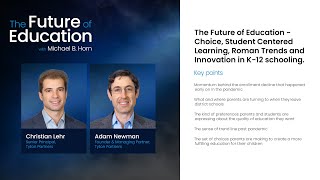
Adam Newman and Christian Lehrer of Titan Partners surveyed parents nationwide and found a 10% drop in public school enrollment since the pandemic, driven by concerns about academic quality and safety rather than COVID. Parents want alternatives like micro-schools and learning pods that focus on happiness and self-fulfillment, but 40% of families in underserved areas have no access to these options.
Chapters
Welcome to the Future of Education. And now here's your host, Michael Horne.
Welcome, welcome. Welcome to the Future of Education. I'm Michael Horne. We have a great topic lined up for you all today. It involves choice, student centered learning, enrollment trends, innovation, and more, all in K12 schooling. And to help us unpack that, we have two terrific guests. Adam Newman, the founding and managing partner at Titan Partners, as well as Christian Lehrer, a senior principal at Titan Partners. They are the authors of a series of research reports that are just fantastic. Choose to Learn in School. Disrupted. I like it. Not just because it has the name disrupted in it, but they have really unpacked these trends around choice. Some of these enrollment trends we're seeing in K 12 school districts, parents desires and for what they want for their kids. And I'm just excited to unpack a lot of this. So first, Adam, Christian, thanks for being here.
Hey, great, Great to be here with you, Michael. Thanks for including us.
Yeah, thanks.
Yeah, you bet. So a lot of interesting findings in these reports that, that you've. That you've published. I've actually written about some of your findings, but I'm excited to hear about it directly from you guys. I think one of the most interesting things that you found, frankly, is that the momentum behind the enrollment declines that we saw early on in the pandemic from school districts is not abating, at least as of spring of 2022. And so I'm just sort of curious, you know, that that finding seems to have gotten more attention over the last several weeks. But why is that from what your research is showing?
Yeah, no, absolutely. It's a. It's a great question, I think. Listen, honestly, we were. We were surprised ourselves, really, to see the magnitude of the. The transition out of public district schools and into other. In other options, you know, two. Couple important factors. Right. Our enrollment numbers are through the lens of parents. Right. So our work is based on, you know, a large, nationally representative survey of parents of children in K12. It is not the official data that states capture. Right. So it's the parent perspective, and it's really focused on what they believe they are doing or want to do for their kids, which, you know, we think is incredibly important. Right. Parents are a voice that we don't often hear from regularly in this debate, really. We saw two things that were, you know, primarily driving the disenrollment in public district schools, you know, from the spring 21 through spring 2022. The first was academic quality and perceptions of academic quality, which we could spend the whole hour Talking about. Right. I mean, I think for different parents that meant different things. Certainly within the context of the pandemic, it meant the quality of the experience, the educational experience their students were getting based on the type of school model and format that they were participating in. The second dynamic was actually an interesting one to us and a little bit counterintuitive, which was school safety. But interestingly, it was not focused per se on health, you know, health oriented safety issues related to Covid. But some of the more, you know, unfortunately, sort of age old issues of bullying and violence in our schools that, you know, are really, you know, independent of the pandemic and those effects, but certainly as we see unfortunately in the news on an all too frequent basis continue to be really prominent. So those are really, you know, two of the drivers and I think, you know, the third one that I think underpins that is, you know, the pandemic. And you've written about this, Michael, in a lot of your work too. You know, parents had a front row seat into what their educational experience was like for their students as a result of the pandemic, and they realized it was not what they wanted it to be or what it could be. And so this idea of parent agency married with a proliferation of choices and alternatives that started to emerge in response to the pandemic, you know, we think are what were many of the drivers that we saw in that, you know, fairly significant 10% disenrollment from the district public schools. From the, you know, from the perspective of parents.
One of the most interesting pieces of that data point that you just said, the 10% was that your sense was only 10% of that, if I recall, was was due to sort of the demographic declines or dropouts or delayed entry into K12, which we heard a lot about sort of the red shirting phenomenon in the wake of this. But the academic concerns, the bullying, which frankly, if you talk to educators, they say that the school violence issues that they were dealing with were a lot worse coming out of the pandemic and return to school as well. So that adds up, I guess. But I guess I'm just sort of curious in terms of what you found that parents are choosing instead of what are they turning to when they make that choice to leave that district school? You mentioned that there's a lot more options. They feel like they have a sense of agency. What are you learning about in terms of the actual choices that they are making in a proactive way?
Yeah, no, it's a good question. And I think at a headline level I would say there's a scaled level of alternative activity that parents are pursuing, but it's not happening in any one place. There's no sort of scaled model models per se quite yet. I think it's more of the let a thousand flowers bloom dynamic. You know, certainly during the heart of the pandemic, things like learning pods and micro schools were very prominent and were sort of the near term solutions. But what we also saw were a lot of community based initiatives, a lot of parents who, you know, wanted and used the pandemic as an alternative, as an option to sort of find an alternative model and explore alternative models. Certainly virtual schooling in the heart of the pandemic was prominent. That enrollment has declined to some extent relative for the pandemic highs. But you still have many more parents open to and looking at either fully virtual or hybrid models. Our assessment is the hardest thing right now, Michael, is it is the classic case of an emergent market. It is messy, it is poorly defined. People use, you know, even the term micro school means different things to different people. So I think right now it's hard to sort of definitively define. Definitively define. Right. It's hard to define exactly what the categories are other than to say they are much more student centric, they are much more flexible in terms of things like time access, you know, convenience for parents and families. And you know, they are, they are working to find models that can scale and can be replicable and sustainable over time.
Christian, let me turn to you on that part, because the learner centered piece of it, or the student centered piece, it seems like parents are expressing clear preferences, at least in your research, around what the. So, so if they can't define what the options are and we can't define what they're called and Adam, that's like the classic, right? Clay Christensen, non consumption. There's no data. So like do we know to investigate or not? Problem. But I guess, Christian, they are expressing preferences, at least as I read in your report, around the qualities of those options. Can you tell us more about that?
Yeah, absolutely. And you know, one of the questions we grapple with is is there a bias towards the status quo to how school has always felt or a bias towards something new? And, and it became very clear and evident in the most recent studies that there is a strong bias, a pronounced bias towards something new. Right. And what that is, when we zoom out, there are really two, two parts of parents aspirations that are important to unpack. The first is around outcomes. And so increasingly they're interested in a broader array of outcomes for their students. Academic preparedness does reign supreme in many ways. It's an important core function and outcome of school, but so does happiness, self fulfillment, discovery. Right. And we see an increasing trend towards wanting learning environments that really support that. The other element is a bit more structural and to what Adam mentioned around student centricity. So. So a program design and a learning environment that is really tailored around who that student is, who their child is, such that it can catalyze those outcomes, not just get you academically prepared, but also, you know, make you excited, make you feel fulfilled, because you've discovered a passion. And I think what we're seeing is learning environments, whatever you call them, right. Micro school learning podcast, that are more conducive to both of those, to broader outcomes and to more student centric learning experiences. I think I don't want to lose sight of the fact that they do come in all shapes and sizes, though. We had, as part of the research, visited Atlanta and got to attend sessions at three different micro schools. Right. But they were very different. However, they all would hang their hat on the idea that academics are important, but so is self fulfillment, discovery and happiness. And they would all hang their hat on the fact that we've designed everything about our program around what our families and students really want and need out of their education. The Life School, the Forest School act in Buckhead, these are some of the examples. The Life School, you know, when you're in the building, felt like the charter school I worked at in New York City. But then you recognize that almost half of all the hours of time spent in school are outside in nature, in the community. They're going and exploring, and students and families are really excited about that. They're knocking on the door. I think with the Forest School, this was more creativity, flexibility, design. I actually set my own hours and the days I'm going to come to school and learn in certain capacities. And many families really appreciated that. And then Acton, Buckhead, this was Lord of the Flies. For all the right reasons, though. It was, let's scale back as the adults and, and let the students kind of form their own expectations of how to solve problems, how to hold each other accountable, how to reach the standards that they set for themselves. And there was a lot of exciting things going on at each of these environments. I think the through line is it gave parents a sense of, my kids will get more than just kind of rote academic training and they're going to do so in a way that's going.
To breed agency so interesting, because that sense or desire, if you will, for finding who you are in that fulfillment, it's something you can find in the comprehensive school, obviously through the extracurriculars, but it sort of caters to a percent of the population. This is much more tailored and everyone is going to get something out of it to sort of develop themselves and find that potential and passion, which seems markedly different, I guess. Fast forward a little bit beyond your research reports. I'm curious to the extent you have a pulse on this, if you see that this momentum for choice and opting out of the traditional district system, the sort of set it and forget it mindset, if you will, is that continuing this school year, are we seeing enrollment declines continuing in the districts? What's your sense of, what's your sense of the trend lines, as we really do feel more and more post pandemic right now?
Yeah. So I think there are two pieces and I'll speak to one. I'll speak to the macroeconomic environment. MICHAEL Right. Because I do think that to the extent that, you know, parents are paying out of pocket for some of these options and alternatives, you know, one of the things we've heard anecdotally this fall is, you know, with the current economic climate we have, it has probably led to some folks returning to public schools. You know, we were hearing stories of schools seeing higher than expected enrollments in part because families are a little bit concerned about economic circumstances and conditions, which completely makes sense within the context of the research we did and sort of the considerations that families make around some of the decision making. Right. So I think we're, you know, we're at a point in time right now where there's this macroeconomic dynamic which is probably slowing a bit, the disenrollment dynamic. But I think Christian can speak to, you know, a little bit some of the work that he led about, you know, what the underlying attitude and perspective is of parents, which would suggest over the long term, while we may not see the same sort of precipitous drop we saw year over year, there's a tremendous amount of pent up demand and interest in alternatives. Krishnada, if you want to comment on that a little bit.
No, the major tailwind that could propel this trend to continue is that the belief that we just spoke to earlier is persistent. And we have strong evidence to suggest that the idea that learning can and should happen anywhere, that it should be tailored around what my student wants and needs, is a persistent and adamant belief that the parents are expressing across demographic lines. And so I think there's reason to believe that that agency and the exploration and the rolling up their sleeves and making choices for their child that are really going to work is something that will persist in the future. I think the other dynamic that's at play though that does affect, you know, the bottom line enrollment trends as we've categorized them is that, you know, in response to this, many schools and districts are starting to reimagine how they do business and how they operate. Right. Can we actually be a bit more flexible, a bit more student centric and, and provide a little more optionality and agency so we don't churn families and they recognize that we can meet those aspirations. And so not only are there macroeconomic conditions that, you know, may keep families enrolled in a public school environment, there may be pockets of public school districts that are innovating in ways that can are copacetic with families kind of attitudes, values and needs. And I think, you know, that's exciting because it's an opportunity and they do need partners if, if there are, you know, more options and more choices and more pathways for students. So it's not one size fits all four walls of the classroom, 30 students, that means new learning environments, new settings for parts of days, for days of the week. And, and I think that, you know, who's serviceable now becomes all students, right? Not just those, you know, few million who have, who have made the leap and have the full fledged support behind a micro school environment. For example.
Yeah, no, and just one. It makes me think of one historical example which is not that historical, which is New Orleans. Right. So early in my career I taught in New Orleans, taught 6th through 12th grade English. Ironically, I ended up getting married the weekend that Katrina hit New Orleans and unfortunately had a couple colleagues who were former educators who weren't able to make the wedding. Right. Not surprisingly. But one of the stories that occurred as a result of that terrible tragedy was people fled and left New Orleans and ended up in school systems that were unlike New Orleans public schools had been prior to Katrina. And one of the things I kept hearing through my networks was about families who realized what school could be in other communities. And, and suddenly when they did move back to New Orleans, had a much higher expectation for what that public school environment was going to be. And we've all seen sort of the large scale experiment that New Orleans public schools has been, and it's been pretty powerful right since then. And so to me, what's interesting, and this is jumping now a little bit to the end, right in Some of your questions, which is if we think of the pandemic as a similar type of systemic shock where everybody. And again, this is what our research is highlighting, like parents suddenly had a front row seat, will our system be as sort of innovative or challenge itself in the way that the community in New Orleans did to, you know, as Christian said, really rethink and reimagine the experience not for the system as it was, but for the students as they want it to be and the parents as they want it to be. So, you know, when you put it in that context, it seems that that's a pretty significant systemic driver independent of the ebbs and flows of year to year, whether the number goes up a percent or down a couple percent, it's.
Eloquently said and I think it's a really important piece and hopeful piece. Right. If we have a more dynamic education system writ large, who cares where they go? That's great if students are being better served. Right. I guess off of that you made the observation, Christian, that a lot of parents, even if they're not switching their schools, they still have this expectation of some sort of customization or choice as part of the day. And so I guess, you know, you've written and researched about some of the options that families have and the choices that they make for out of school programs and experiences. Right. To fill out their day and some of the findings from your choose to Learn series specifically. And I guess I wonder if you could highlight some of those broader sets of choices that families are making that even if they aren't switching the main schooling experience, they're assembling, if you will, different experiences from the range of providers broadly thinking of what enrichment and education programs look like to create that more fulfilling experience for their children.
Yep. No, it's a great question and they really want to a wide variety of options and experiences because that is what correlates in parents minds. Right. To the broad set of outcomes. I think one of the things that we found that was really striking was that there is a bit of a limiting belief or preconceived notion of what school is for and then what can happen outside of school. Right. And whether that means it's a weekend program, a summer program or an evening or it's like we've talked about more of an assembly approach with multi sites throughout the week. Either way, the belief is school is where my child learns and meets the expectations of society writ large through standards. Right. They get grade level promotion and they get to graduate out of school. Is where the fire gets ignited. Right. It's where they become happy and self fulfilled and pursue their specific passions. Why does it have to be that way? Is the question we asked ourselves. Right. And I think that, that, that that belief and bias towards school is for learning and out of school is for joy, relationship building, passion, fulfillment. Makes us wonder what happens if, if more families can access a wider variety of experience and learning environments. Well, throughout the week or on the weekends and in the summer. Right. And, and by and large, like Adam had mentioned at the start, there is extremely pent up demand for learning happening anytime, anywhere for a more variety of learning experiences. The issue is that 40% of families from underserved backgrounds report that their child does not do any learning outside of school. Right. And so just zoom out and put that in the context of what I just said. If out of school learning is where children are joyous and feeling fulfilled and pursuing passions, and roughly half of all of our underserved population children do not have access to that, it's incumbent on us to rethink the design of the learning experiences and reimagine ways to get them involved in a wider variety of learning experiences.
Yeah, no, Michael. And that echoes the nice narrative you have at the opening of the chapters of your recent book, right? The student, Jeremy, from a single parent family who doesn't have access to the same things Julia has in her family. And that's really the risk here as we think about this. Like the opportunity, right. To frame it within the opportunity. The opportunity is significant. The risk is if we don't figure out a way to make it sort of accessible to all students, not just those with means or with access to, you know, getting to these programs.
It's well said. I appreciate the shout out also, but the.
No, absolutely.
I guess the, the other piece it points to, right. Like there's a lot of pressure then on the existing system to innovate, right. To become this more fulfilling place for more individuals, more families opting out in some cases, which creates the pressure for them to be more dynamic. Like there's a lot of opportunity. And I like that word, that framing opportunity. I mean you could see it as a threat if you're the traditional district, but it's really opportunity because the parent expectations have changed and the hopes have changed. So I guess I'd love you both to extrapolate out a bit and you know, like your predictions, I love predictions, as you both know. What are your predictions for how this evolves and what sorts of innovations we see in the world not just of micro schools, but in districts as well and sort of where this all goes in the future. If you, you know, you look five, ten years out from now.
Yeah, no, it's a great question. And listen, just to ground, and I know Christian and I have referenced this, but, you know, both of us started our careers as educators, right. So, so we do this work at Titan, but we also care implicitly about this work as educators of folks who've been in front of students and been in classrooms in different communities. And for me, it's really, I think, what I hope and what I expect at the same time, what I fear a little bit is that schools will need to be more dimensional in what they are able to offer to students. Right. And we've talked about this over the years, and whether it's the, the early college. Right. Or the school within the school or the pilot school in the district, or the career oriented program, right. It's. How do schools figure out how to balance some of these models more effortlessly? The analogy I've been using is ice cream flavors, right. If you go to an ice cream store that has just vanilla. Vanilla, right. You know, you go there from 8 to 3, you sit in a classroom with 25, 30 other kids. Like, you get bored of that, you know, that ice cream store pretty quickly. Like, how do we have strawberry and chocolate and maple pecan and all these other flavors? And how do schools manage that? My hope is, and what I believe will happen in some communities, but not all, and this is where the risk is, that in some communities, the challenges wrought by the pandemic has opened up a willingness for them to rethink how they run their schools, what they need to own, what they can partner for or bring in from the outside, and that the really thoughtful districts will start to sort of mix and match or use your term, Michael, be maybe a little bit more modular in cases where there'll be some things that they own and that they drive, but then there might be other types of programmatic elements that they'll look to partner for or bring in. And so at the end of the day, in any, you know, in any community, you might go to a school district, your local school district, but there might be five or six different options of ways you can pursue the things that motivate and excite you about learning. Right? And to Christian's point, it doesn't have to be a, you know, in school or out of school dynamic, a choice based one, you know, so the opportunity, I think is for districts to really, you know, Offer a lot more flavors of ice cream within reason. The risk is and will continue to be, will all districts have that vision? Will they have the resources and the community support to execute against that effectively? And that's where I think I get, I get concerned a little bit, but I think the opportunity and the promise is significant.
Christian, what about you?
Yeah, I would add two predictions, as you like to call it. The first is around just micro schools, community based learning initiatives. You know, in the near term, I do anticipate them to grow, right. And I think we did engage with around 150 organizational leaders who operate micro schools, community based learning, hybrid learning initiatives, and by and large they express that there is pent up demands. Folks are knocking on their doors and they don't have the capacity to serve them. Right. I think the challenge, and so there's a desire to either expand capacity at the current sites, to open up new sites and expand to new cities, states, regions and, and that's exciting, right? The challenge is by design, these are intimate learning environments that are highly curated and personalized. Right. And so, you know, it does take a village and so understanding how to one perform effective outreach to continue to acknowledge that parents have these aspirations but often don't know where to turn and to, you know, bring them in and move them along. But also navigating the funding dynamics that are at play and really exploring the most creative funding solutions out there so that they can invest in quality, in care, in learner centricity. They can have fidelity around that model, but also just serve more families and students, recognizing that the cost may be a barrier for many. So there is demand, there is a desire to increase capacity and grow among these providers. And with that I expect, you know, we'll have more examples like the ones I referenced before about some of these phenomenal learning environments sprouting up. In terms of what happens in the districts, I think like Adam said, I would agree there's just some greater specialization that's required. Right. Districts are, are, are burdened right now with teacher attrition and recovering from learning loss. And that's taking a lot of time, resources and attention. You know, what supplemental academic services can be engaged to perform high dosage tutoring on one end. What partners can help explore extracurricular activities outside of school and open up those options and avenues for families so that they can, to use the word modular, start to assemble more of the learning throughout the week. And so I think there will be some greater flexibility in the districts, but sort of a consistent increase in families engaged and benefiting from, in many ways, micro schools and community based learning initiatives.
Yeah. Michael, one other thing I'd add is I think that and this is less a prediction and more of I think a call to action is we've really got to push the envelope on measurement both in terms of how we do it and what we are measuring. And the challenge with that, as we all know, is it takes time and it takes dollars and it takes a commitment to sort of looking beyond the easily measurable things. And I think if we can do that, that will unlock considerable opportunities and considerable transformation of our system. Right. So again, less a prediction, more a call to action in terms of our willingness to do it to create this sort of this vision that we've been talking about.
I like leaving it there, frankly, because I think you're right that what we measure and how we measure it more point in time, flexible student, you know, for the student what they're in fact investing in and learning and assessing mastery of those skills and knowledge and so forth makes a heck of a lot of sense and will really help us understand and help parents understand these choices that are starting to burgeon that you've talked about and create more opportunities for districts to hopefully have confidence to invest behind them. So, Adam, Christian, really appreciate the research that you're doing on this front from Titan Partners to help illuminate what's an incredibly dynamic early emerging space that a lot of us are struggling to get our head around, frankly. But then also your insights about where do we take it from here and what should the educators on the ground be doing to help serve these students and these parents who are increasingly having higher expectations for that education?
Experience.
Experience.
Absolutely.
Thanks.
Thanks, Michael. Enjoyed the conversation as always.
And we'll be back next time on the Future of Education.










