Why Implementation Matters for the Science of Reading
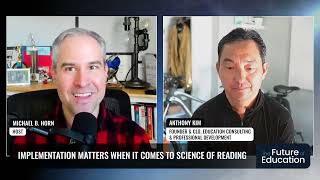
Anthony Kim explains why schools with simple, well-executed reading programs outperform those with fancy tools that aren't properly implemented. Real change needs three things: shifting teacher mindset, building professional learning communities, and creating systemic support like Texas did with certification and funding. Small, repeated wins compound into lasting reform.
Chapters
Welcome to the Future of Education. And now here's your host, Michael Horn. Welcome, welcome, welcome to the Future of Education. I am Michael Horne and I am incredibly excited about today's guest because he's been a longtime friend, collaborator in this, in the field of education, frankly, for almost as long as I've been in this world. I've known today's guest and he's someone from whom I've learned quite a bit, but someone who does incredible work on the ground as well. He's currently the chief learning Officer of Scolaris at Elements, is a part of the Scolaris companies. Anthony Kim is our guest. He's also a serial entrepreneur in the education space and someone who's great at spotting the trends but then also making sure that they actually get acted on to create real change on the ground to benefit human lives. So, Anthony, it is great to see you. Thanks for joining us.
Thanks for having me, Michael. I'm happy to have this conversation more publicly because over the last 12 years you and I have had a lot of conversations and worked on a lot of projects together where we talked about some of the things that we're going to talk about today. One, I know we're generally mentally aligned on some of the things that can happen in education. Glad to be here and open to sharing some of the thoughts that with your audience that we would normally have in private, I guess.
But really, Anthony, when I think about you, one of the things that I admire most about the work that Ed Elements has done over the years, and I'll say as a former board member was proud of, was the way you worked with all sorts of school systems, from private schools to public school districts and individual schools and all the rest of the to not just help them innovate, but actually operationalize in a really strong way the work that they were doing. And maybe before we get into the topic that we both want to delve into today, I just actually love to have you reflect as a consultant that comes in with a school district, say, and isn't just consumed with helping them think up the next big idea or create a fancy looking deck or whatever like, but actually being committed to put into action what they're saying that they want to do. How have you all developed that capability and where is that? Where does that expertise come from for you?
You know, that's kind of the topic I wanted to talk about in general today. And quite frankly, I think a lot of that started day one when you and I were working together in creating the edtech market. Map. So if you recall, like, that was 12 years ago, maybe.
Yeah, that's probably.
And we were asked with Ted Mitchell to start to organize edtech at that time, before people are starting to think about it. And when we were doing that research, I recall, like, there, I mean, there were so many good products out there. And everyone would argue, like, you know, incrementally, like, this product was slightly better than this product, or this one was good for middle school, and this one was better for middle school or elementary. And there was a lot of debate around, like, where they got categorized what to use them for. And I think from my early interaction with you and that work, we saw that implementations varied dramatically regardless of the quality of the product. And there were schools that implemented a very simple product really well and got results, and their schools that implemented something that was really sophisticated poorly and got bad results. And so that's when I started to wonder about more of the implementation as opposed to the product, because I knew that a lot of companies were investing a lot of time and thought into the research of the products themselves and the efficacy of the products. But the idea of the implementation was always designed around perfect conditions. And we all know that implementations aren't in perfect conditions. And there are a couple things that we also learned when you and I were active promoters of blended learning. Right. And how hard that was to implement something that we knew would actually get results.
Yeah, no, there's no question about it. And you all built a muscle around. It strikes me, not just seeing the problem, but actually getting people to row in the same direction and operationalize. Let's spend one more beat on that before I jump into the sort of topic du jour, if you will, which is just, how did you build that muscle then? Like, you have a whole team. What, What? You know, how do you help the schools and the educators themselves get that fidelity to implementation, to what they've designed? Or maybe that's the wrong question. Maybe there's another secret. But how do you get that discipline and actually in acting. Because again, you said it well, like you hear all the time, our friends in the edtech space, they'll come up to us and be like, our product's amazing, if only they would use it right? And you're like, well, they're going to use it how they're going to use it. So, like, you have to take that into account somehow. But it seems like you've done a really good job of both building systems and then getting people to execute in a realistic way. I don't know how else to say it. And I'm just curious, like, how you've built that muscle, not just to recognize it, but build the muscle and see it enacted.
Yeah. You know, I think part of it came from when we were doing all those tours during the heyday of no Child. I mean. Nglb, Right, nglc, sorry, Next Generation Learning Challenge. Right. And it was Race to the Top and Innovation grants, and there was a lot of visits to schools that were doing something slightly different. And different schools had different products that they were using, different ideas around grouping of students, different ways of scheduling students, whether it was sections or blocks, the variety of ways schools were getting implemented to create those innovations, and also the outcomes was pretty diverse. And I remember when you were at the Christensen Institute, you were doing that research too, and you were trying to show patterns through the different models, and.
We couldn't draw anything to efficacy because the implementations were totally different.
Yeah, yeah. I mean. Right. And. But like, even with like a station rotation model or a lab model or a Flex model, one school would try to do a Flex and do it really well, like Carpe Diem and other schools try to do that and did it really poorly. And so what I realized is that a lot of it has to do with the culture of an organization and the human reality of how people work together. And I, I think, you know, having been in startups for so long, there are a lot of companies that get started with similar ideas, but the actual implementation of the actual company and how they operate varies a lot too.
No, super interesting. So let's get in the topic that has become hot not just across the education space, but in a lot of communities, a lot of parent communities, people tuning in and all of a sudden discovering this new phrase, the science of reading, if you will. And basically, I mean, for those that haven't followed the basic idea, I don't think is actually anything that new. It's that teaching kids to decode and learn their phonics and pattern, match what they're seeing on a page to the auditory sounds and then build fluency and, and, and so forth turns out to really matter. Like, you can't just guess at words and look at pictures and try to pick up hints and somehow be able to read more complex texts over time. But I think you're asserting, you know, that all these training programs around teaching teachers about the science of reading or changing out the curriculum, that didn't do that. That did, you know, the triple cueing or whatever methods, instead of building this foundation, that that won't be enough if I'm understanding what you're. What you're arguing.
Yeah, I mean, you know, I think that when we think about implementing something as comprehensive as a reading ELA program, and what I see happening right now are a lot of debates, classroom to classroom, building to building, state to state, whether one program approach is better than the other. And there's probably, you know, some variation. I've talked to some academics and professors that, like, are arguing the benefits of. Of both. One they say is easier to implement and so easier to adopt as well, and the other is more complicated to implement and also takes a lot of, like, rote development. Right. Of. Of students. And so there. The reason it shifted to one form or the other is because kind of the. The movement and the trend kind of shifted because some. Something was hard to do. And so now we're at a place where something that seemed easier to do actually doesn't seem to be producing the results that they had hoped. And so now they're like, okay, well, let's go back to this other thing. And there's this whole debate now. So my experience in looking at this has been that there's a lot of conversation around the academics of it, but for anything to be implemented, well, there needs to be a system of implementation. And what, you know, just kind of going back to what we started with, there's. There's a way in which we see this thing being implemented, Science of reading being implemented well, that seems to have more stickiness and the momentum building that we started to see in things like blended learning and personalized learning, but didn't continue on. So. So what I wanted to kind of create an analogy around is, you know, the concept of the flywheel, right? Like the, you know, the good, the great Jim Collins flywheel. And what he says is in the flywheel analogy is that through these, like, small pushes and rotations, you start building momentum. And once you get to a certain level of momentum, like, it spins on its own, right. It has inertia to, like, continue to spin. And if you actually don't do that, well, there's another term called the doom loop, and it, like, reverses the progress. So when I think about our work with blended learning and personalized learning, what the early stages of the flywheel were funding through programs like NGLC or, you know, Race to the Top, examples of pilot schools that are doing different things. And that's what Christensen Institute did a lot of studying around. Then other communities of practice, like digital promises, like League of Innovative Schools, started to create this momentum, because every year there were new members that wanted to become members of the Digital Promise League of Innovative Schools. More grants were given out, and then more pilot schools were created. And so people were like, okay, I got to jump on that. And it created the necessary momentum around the flywheel. So if you want to do something like that around, like, a shift towards science of reading, what do you need? And that's what I started thinking about. And one is teaching conditions and teacher mindset. Right. And the way I think about it is if I'm trying to do a diet in November, going into Thanksgiving and the holidays, it's unlikely I'm going to be successful. If I try to start a diet in January, it might be a better time, but still, most people are unsuccessful in that time frame. So my mindset has to be right in order for me to fully commit to something, in addition to the fact that there has to be less roadblocks and things like that. So one is just what makes the right conditions for a group of people to be successful in implementing something new for a set of goals that they have. And I think that's a human condition thing. The next piece is professional learning communities PLCs. And, you know, whether you're training for something like CrossFit or doing a diet or. Or I'm training for something, or I'm trying to learn something new, having that community to share stories and share experiences together is really key to maintaining momentum. And then the third piece is systems of support. And in the case of the work we're doing in Texas, where the state of Texas is actually providing certification and funding and time to do those things that those three things working together allow for that flywheel of implementation to take place. You get into doom wheel when there's fewer successes, small successes, right. Smaller wins. You don't have wins, so you don't see improvement. Then you start getting into a doom wheel, right? And when you start seeing a lot of negative activity, right, where people are saying, well, you know, this or that doesn't work, or they're constantly bashing you about stuff. And I think we saw a little bit about that in the blended learning world, where, you know, people were talking about, like, too much tech, blah, blah, blah. And so, you know, then Covid comes along and it's like, everyone, we need tech, right?
Yep. Then. And then all of a sudden, we were in a disaster situation. So. So mindsets, the professional learning communities around you, systems of support that reinforce that. Those are the three big ones. I was going to ask you you started to allude to it. Who's doing it? Well, it sounds like Texas has put some things in place, but who would you spotlight that seems to be getting that balance correct?
In the blog post around this that I wrote, which is called Implementing the Best in Imperfect Conditions, Tips to Making change in Instructional Practices at scale, the way I see it happening is at a school level, different teachers are excited about something like science or reading. And then what's happening is that they have to expend so much energy convincing people. There are a few schools that are implementing it really well. And then at a district level, I think one of the things that is hard is there's, as you know, educator exhaustion, there's leadership changes. And so what happens a lot of times when districts have those things happen, like especially leadership changes is like, well, every time a new leader comes in, they want to reevaluate everything. So that is challenging for programs like this because you're constantly restarting and revalidating what you're trying to get done. So you never really get to the point where you get that flywheel motion and you get into the doom loop. So I think states like Texas are actually starting to think about it in a way where there's a longer term plan, there's strategies that are supporting at scale, and they understand that different clusters of teachers are at different stages of mental readiness. And so they're anticipating that. And I think they'll be more successful than other states trying to implement science of reading or something else just because of the way they're thinking about readiness, longer term planning, and also the fact that like, people are coming at different starting points and need different lengths of time. And a lot of times when I see schools trying to implement programs, they think everybody's educated at the same level, they're ready at the same level, and they're going to commit the same amount of, put the same amount of time into implementation.
It's funny when you, when you say that, I mean, frankly, it's the same problem with the school system writ large, right? Which is that we, we feel, oh gee, you were born in the year of the rabbit. Therefore, we expect on September 1 that you have automatically already learned these things. Maybe you have, maybe you haven't, maybe you've learned much more, maybe you've learned much less. But we're all going to give you the same thing no matter what. And obviously that doesn't work well. And the same is true with teachers. Also. The other piece that I just pull out there is you talk about Building on successes, Right? And I've sort of said, you know, just like they say success is the best deodorant in team sports, that it sort of masks over problems among the team chemistry and makes people sort of get along and get excited and will get on board and builds culture. I think the same thing is true in education. It attracts parents, it attracts teachers. A lot of the school board fights go away if you have this sense of momentum and success, that we're all, we're moving towards something desirable. And in the blog post, you brought up something another. You know, you talked about the Jim Collins work, but you have another trendy book in there, James Clears Atomic Habits, that I think relates to some of this. So why don't you just spell that out? Because I think that was. It's an interesting set of points and I think it's one that resonates with individuals, frankly. Like if Jim Collins speaks to an org leader, Atomic Habits, I think right now speaks a lot to individuals making changes in their lives.
Yeah. And I think you, you bring up a great point. What one of the problems I see that's different in terms of just wins in education versus, like other industries that I've been in is when a school wins, there's a lot of questions that come up, right? You just don't take it for granted that they did it well. People were like, well, you know, that school leader, that those kids were different. They got this extra money or whatever it is. And we've seen that happen over and over again. And so the wins are. The credibility of wins are often questioned instead of just saying, hey, you know, like, I could win too. And I think that's a really tough mindset in the education space right now, because in other industries, when people see other people winning, they're like, I could do that too. And I'm going to win and I'm going to do it. And that's how we get Silicon Valley, right? Like, that's how we get innovation happening. And we often try to stifle innovation in school systems because we're always questioning the valid validity of something or how they did it or why they won instead of just appreciating it. And so that's where I think the Atomic Habits does come in. And you know what I like about James Clear's work is it's repetition, discipline, and small wins. So he talks about 1% change, right? If you do 1% change cumulatively, cumulatively over a year, you make massive amounts of change. And he says, let's say if you want to become a runner, you could start by saying, well, I want to run ultra Marathons at 50 miles or 100 miles, and that's a daunting task and it looks scary. And then you're going to try and you're going to realize you can't even run 10 miles straight, right? And so if you want to start a runner, maybe like, and you haven't been a runner, maybe the first step is just getting up to run every day. Like, that's 1%. Like you just got up, got out of the door. Because first you just need to build the habit of getting dressed and getting out the door. And I think part of the reason why a lot of folks that you hear on, like, you know, other podcasts and stuff and self improvement books talk about cold showers and cold baths. It's not only the physical benefit, but it's the idea that you could put yourself in a condition every day that's uncomfortable for short periods of time. And building that repetition, even with something as simple as a shower, creates the notion that you could do hard things over a longer period of time. And you're building that habit and muscle memory.
So I'd love to bring this back to the classroom, right? Like, I suspect some people tuning in are like, okay, this all makes sense. But like, at the end of the day, I'm subbing in a textbook from the textbook I had before. It's better written. I've got new lesson plans. Like, is this really that hard? Are we complicating this too much? You know, to that person who's maybe looking at it that way and feels like it's just a, you know, change the ingredients, stir once and then repeat. Why is this more complicated when we're talking about science of reading than sort of that specific mental model I think some people have when they, when they come to this conversation in particular, which I'll just add, I think a lot of people think it feels different from other conversations because it feels like, well, you swap textbooks all the time, right? Like, we're not asking anything more than that. So why is that mental model too simplistic around this?
Yeah, I think one of the reasons it's hard is because somehow the idea of phonics got marketed, you know, from, with various companies in different ways and it created a mental model of the problem with it, with it too. And so now I think when you start bringing up phonics, like people think hooked on phonics and like, that wasn't a great thing. And, you know, it was kind of a sham and whatever. And so there's a lot of preconceived like biases that exist and that's one thing you just have to get rid of in order to start getting to that 1%. It's like you think it's bad, then you're not going to naturally want to implement it. So one is you just have to like get those small wins, those 1% wins by trying it. Right. And trying a little bit of it. We're not asking you to do something major, just let's start trying small things to see if you could see the improvement instead of just having that biases and saying that it won't work because that's like preventing you from doing it.
Very cool. Last question as we wrap up here. You love to make prognostications and look into your crystal ball for the year ahead. We're still early in 2023. You're thinking a lot about this topic, implementation science of reading, but you're also looking at the broader landscape. Any big predictions or things that you see coming that maybe the rest of us are blind to right now.
Yeah, thanks for asking that. Yeah. Because I do try to do the predictions every year and you know, some years are definitely easier than others. One, I mean everyone knows about the political landscape and you know, we have elections, we have Esser and all of that. So that creates like some unique conditions. But one, I think there's going to be a refocus towards career education and a relooking at what that should be. And because Perkins V was reinstated and such, there's funding around this. But what's interesting is there's growth in things like AR and VR in this particular space because I, I think also Covid like made it hard for people to actually go into offices anymore to experience what happens. So now you kind of are stuck with those experiences right on in a virtual mode. So that's one area that, and then you know, I, I start, I, I, I know chat GPT and AI is like a hot topic, but it was one of my predictions too that AI is going to come up again. Because one of the things that we heard from school districts, which was interesting, is that a lot of districts implement bought tutoring services, for example, and when you buy stuff at scale at a short period of time and those companies are trying to ramp up too. And we saw that with Amazon and we saw that with other like even larger companies, even Zoom, it's hard to keep up with the demand at like a rapid pace. And So I think quality was really different and varied in a lot of the programs like that. And what students have found is that sometimes it's just better to have AI interact with you. And if you had to return something on Amazon or you had to interact with some sort of customer service angle product, basically you are often interacting with AI and you don't even know it. And so it's gotten to a point where you kind of don't know until you get to the 1% problems, not the 99% problems. And I think that I'm not talking about the plagiarism, stuff like that, but sometimes the experiences through AI seem to be more consistent and people are getting more and more familiar with it through the experiences that we all had together.
Super interesting, super interesting. And a different take on AI and how it's going to keep coming into the school system no matter what educators and their well meaning efforts try to ban it or the like. Anthony, appreciate you coming by and it's just good to catch up and hear what's on your mind. And I think a set of lessons around the implementation that people would do well to heed now rather than go five years from now, the hype around science of reading. And then we're sort of back in the other cycle where there's a backlash to it because we didn't think about these things up front.
Yeah, and I agree and I think we're at a interesting stage in education. And you might have thoughts around this, Michael, because you're talking to so many people, but we went through like this rapid like adoption and change during COVID Now people are talking about things like learning loss and stuff like that, you know, teacher retention issues, all sorts of things that are destabilizing the infrastructure. And you know, we have the option to go down and kind of rebuild what we had or we modify and evolve and rebuild something different. And you know, I'm not sure which direction the industry is going to go, but I do think that there's a little bit more towards doing something slightly different than there was before just because even just because parental understanding of education is heightened much more than it has been in the past.
Look, I totally agree with that. And I think while I'm dismayed, I think often by the number of places that are just going back to business as usual. As you know from your board role with the National Microschooling center. And we had Don Soyfer on here as well, to your point, there are a lot of parents and there's a lot of educators that are saying no, this is we're not going to go back to normal and are creating all sorts of novel innovations and ways of doing schooling and ways of connecting with students and flexible schedules and the like that that work for frankly. Also a big shift in like family units and what parents need from school as well that that doesn't fit in the 8:30-3, if you will window for a lot of families. And I, I personally think that's a positive because I think that'll also create more pressure on the districts to innovate as well and figure out new ways to reach not just the students but also the families in a larger sense.
Great. Thank you, Michael. Thanks for having me.
Yeah. Look, Anthony, thank you for the work you're continuing to do. Appreciate it, folks. Check out the blog post. I'll include it in the link here as well. And keep an eye out on what Anthony is writing about and what they are doing on the ground. And we'll be back. Next time on the future of Education.










