Win-Win for Students and Employers: The Power of Mutual Benefit at Western Governors University
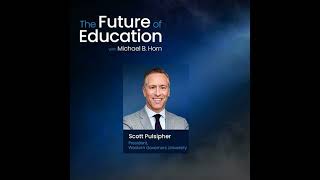
Scott Pulsiver, president of Western Governors University, explains how the school's competency-based model serves both students and employers. WGU uses employer councils and the Lightcast skills library to align curriculum with job trends, and 92% of employers rate graduates as excellent or very good. Ninety-five percent of graduates refer a friend, compared to 35% nationally who say their education was worth the cost.
Chapters
Welcome to the Future of Education. And now here's your host, Michael Horne.
Welcome to the Future of Education. I'm Michael Horn and delighted you're joining us to continue to explore how we can build a world in which all individuals can build their passions, fulfill their potential and live a life of purpose. And to help us do that, today we have a special guest, Scott Pulsiver. He's the president of Western Governors University. For folks who've followed my work for a long time, you're probably sick of hearing of Western Governors University because I find them to be such a powerful example of disruptive innovation and competency based learning to really make sure all learners succeed and master what they are trying to do so that they can get ahead in the workforce. So first, Scott, thanks for joining us. It's great to see you.
Great to see you too, Michael. It's always a privilege and a pleasure and I certainly hope that your listeners aren't sick of hearing of wtu, but we hopefully are always providing something new and different to spur their own innovation and things that they can do to serve their students better than they currently are.
Well, amen to that. And they better not be sick of it, I suppose, because I'm not going to stop talking about it. So that's the other reason. But today I really want to explore this idea of mutual benefit with you. This concept that doing things that benefit others but also benefit yourself and finding these areas of overlap really actually strengthens both sides of the equation, if you will, and leads to more lasting value and progress for people. And you all. You know, the part of this that I want to explore is that Western Governors University, the original design wasn't just to have this incredible competency based learning model for learners, but it was to make sure that what they were learning was aligned with what employers actually wanted. And so you all, as I recall back in the day, would have boards of employers in different sectors you worked, you'd bring them together, they would help you understand the skills and competencies required to do the different jobs. And then you all would design degree programs effectively around those competencies and make sure, of course, as I said, students are mastering the key ones. How has that work evolved over time? And how are you working specifically with employers now?
Yeah, there is little doubt that the founders of WGU and we that are still carrying on that purpose are always trying to ensure that we're doing maybe two things. One is to help individuals change their lives for the better by helping them advance into the opportunity. But we're also Wanting to ensure that those that are completing their credentials at WGU, that they are in fact ready, ready for the roles and the work that is in fact defining the future of the sectors that we serve really well. And so to do that, that actually even, sorry, as a quick aside that even became one of our core differentiating things is the quality and relevancy of the learning to the, to the work and even really the future of work. And to make that a reality, like you noted, is that from our, from our beginning we really have tried to partner closely with those that are representing the employer's perspective, representing the workforce, representing the trends and changes that they are seeing. And so we've always been really good at aligning with subject matter experts and employer councils and even program level councils. By that, what I mean is the right representatives that can help us define the learning outcomes at a credential program, at a degree program level, so that the skills that an individual has demonstrated competency in can in fact be directly readied for those roles that these employers anticipate in the future. I think that's actually, we've tried to elevate that even further because some of the things that even those employers, those individual subject matter experts that comprise their councils, if you will, they aren't always, you know, masters of all the data that is needed to understand not just how one role at one employer is needed, but really how the sector is changing not just regionally, but nationally as well. And so we're taking advantage of some really powerful tools that are available today, like the lightcast library of skills that you can actually scrape all those roles and all those definitions and identify specific skill sets that are starting to emerge in certain job descriptions in certain fields of study. And that we can ensure that we have a better sense then of how our subject matter experts define that or help us define it into actual curriculum outcomes. And we're always trying to make those skill connections. So there are job skills analysis surveys also help us ensure that the voice of industry is evident in our program planning and designs. Another I'll just give a simple example is that when we really saw the future of health care, what was certainly emerging is how this coordinated care that had to exist across all the interactions that individual patient may have with a primary care physician, with a hospital or health service provider, health center, with even at home care that you have, that you also knew that what was needed there was a more holistic view of an individual patient. So out of that emerged our credential programs around health services coordination and Value based healthcare and what were the capabilities that were needed in the individuals to do those roles really, really well, rather than targeted more acute care of nursing in an emergency, you know, emergency room or something like that. And so those things emerge. Other things I think I would note today is that the reaffirmation that maybe exists around some of the skills that are more core human skill sets and how to communication and problem solving, et cetera, how do those get better articulated as to exactly what those skills look like in particular fields of study? And it's not exactly the same if you're going into accounting versus if you're going into computer, you know, cybersecurity versus if you're going to healthcare, because even those skills manifest differently. And so we're always making sure that how we articulate the learning outcomes are relevant to the world of work in which our graduates are, are entering into.
Super interesting to hear you say that because something that makes sense, but frankly a Clay Christensen saying, right, if you listen to your best customers, you focus maybe on what they want now, but maybe not where the future or where the puck is going to. And so I love your answer that you're not only taking their data and input, but also these bigger trends, these bigger pieces of work that may become important as graduates go out there. I want to stay on this topic just and push you a little bit, which is to say that sometimes employers don't know what the skills and competencies at the heart of their successful employees are. A lot of times their job descriptions, as you know, are littered with everything they can think of that might screen out certain people. And so they're not necessarily reliable markers of the actual work or the skills it takes to do the work. Well, how do you all sort of work around that? My guess on the surface level would be they know the technical skills pretty well. But my guess is that they struggle a little bit more on those critical thinking, problem solving, habits of success, durable skills that are maybe a little harder to define or measure, but you all probably pay a lot of attention to. So how do you sort of work around that?
Yeah, you're absolutely right. And even as my like pivot into answering that, I love what you also mentioned is that sometimes, you know, the employer as a customer doesn't exactly know everything that's coming in the future or they can't really think about designing the role of the future. And it reminded me of a conversation long ago that I had when I was still in consulting with, you know, heads of design and automotive and they basically Said a rather ironic statement, which is the last person you want to talk to when you're designing the future vehicle is your current customer. Customer. Because often they can only innovate from their current reference of an automobile. And you're like, you know, I think the joke even was like, if you ask them, they just say, hey, we need more cup holders and can you put a bit there? Et cetera. You're like, they aren't reinventing something. And. And that is often the challenge of those of us who are too close to a problem. You really have to project many years forward to say, what do you see as that? And that future state? And if you start working backwards from that is like, what are you then identifying as the scale skills? They're going to need it in that future space. And so to this end is like, employers also have a difficult time articulating exactly what does problem solving look like in the context of this job field, and what does communication look like or teamwork, et cetera. And I think what we try to do is to better understand what those skills actually look like and versus the technical skills like you mentioned, you have to ask questions like, what does good communication look like for this particular role? How collaborative is that role? Are you working cross functionally? Or you're mostly within the same roles within the field. You know, what ways do you actually have to articulate and balance even things like inquiry versus advocacy? What are the things that are there communicating about? So are there ways to actually test effective communication on a particular topical area that's relevant to the field of work? What are the tools that they're likely to use in communication? So it's not just like, hey, can you write effective emails? Like, actually we have a lot of communication tools and it includes multiple different things, even visual communication and slides and presentation formats like that, that you have to also understand those components to really see how good communication actually is effective. That same can apply to even problem solving is like, you know, if you're talking about an engineering problem or an algorithmic problem in computer science, like your problem solving there is, hey, how well do you deal with polynomial equations and how well do you apply calculus to new problems, etc. That's very different than solving a financial problem or solving some kind of organizational problem in leadership, those are different dynamics. And so even starting to surface, like, what problems? What are the variables that problem solving is going to be incorporating into that role? And those are the types of things that we're asking such that even when it comes to this, the Skill outcomes of what could be called liberal education. You have to go one step further to say the manifestation of this in this applied field looks like this. These are the kind of tools, these are the types of topics, these are the types of engagement you're going to have with your working peers, if you will, so that you can understand what statistical analysis looks like in a particular field or you can understand what dealing with ambiguity looks like in a technical field versus in a health field. You certainly could see like dealing with life and death situations versus, hey, did my recommendation engine work correctly in a technical field? And so that's what we're trying to do so that, so that you don't have employers just saying, hey, you need to be effective communicator. Like, well, I think I'm an effective communicator, but what does that look like in that role?
Super helpful. I love these conversations because I learn so much every time I have them. And I'm curious, you started to go here, right? Of what effective communication looks like in a technical field might be very different from a healthcare field, might be very different from education where you do a lot of work. How do you, how do these types of arrangements where you're working with employers, you're working with experts in the field, how do they sort of differ depending on the field size or the employer type or who you know might be hiring your graduates? How does it sort of. Are there broad rules of thumb that the work looks different in different fields?
There are probably certain dynamics that we certainly consider in terms of how we engage with that particular field. And one of those, as you mentioned, is like, is a pretty obvious one, which is what's the total scale of the workforce need here? And to some degree this gives us a sense as to how strategic is it. For example, and I'll just bring up like a teacher preparation example is that there's a lot of work going on in terms of how you teach math and what is the, you know, what does math instruction look like right now? There's some pretty healthy debates about how you increase the effectiveness of that. Speaking as a parent of six children trying to figure out the new way they were teaching math is like, I was thoroughly confused. And so you have to think about these even pedagogical approaches to even the subject matter within teacher preparation so that we know that the skill sets that we're helping development develop are relevant to the way in which instruction is improving. There are other dynamics there. For example, in dealing with interpersonal dynamics, there are high stakes experiences that you have with parents and their children and administrators and teachers. And so that's an example of, well, designing that learning environment for us at WGU meant how do we utilize things like virtual reality or augmented reality to lower the stakes and pressure for experiences that individual students need to have before they're thrown into that more high stakes experience, Experience in the workplace. And so you can start seeing and measuring the development of ambiguous situations, or dealing with interpersonal dynamics, or dealing with heated matters or heated issues where there's lack of clarity about what the right answer, who the right person or which person may be in the right. These are examples that we're dealing with there. So you can be more targeted. Now I will say that that's where we're also leveraging certain things which is, is this something that is broadly applicable? Meaning can we see it across all regions, in all school districts, in all schools, something like math instruction? What's the right approach to that and how are you developing? Or the science of reading is one of those developing areas right now? What's that looking like? And what is the adoption level? What kind of, you know, expert support do we have around those dynamics so that we can ensure we're doing it? Now what we have to start also seeing is where are the large scale employers that you can actually have successful rollout with this? And are there subject matters there within those employers that we need to have at the table to also help us design what are the criterion reference assessments to know whether competency has been demonstrated at a student level in a particular course in a program? And that's where you do have to see is like, even if it's a national thing, you need to be able to see it applies applied specifically to an individual student in a specific circumstance. And that's where these, you know, large scale employers give us a lot of experience, a lot of input, because they also see things that scale the same way we do. So it's not with a unit volume of 10 individuals, it's like, no, it's thousands of individuals. Because we do want, in at least WGU's model, we want repeatability, we want consistency, we want fairness. Because in a competency based approach, we have to know that every graduate has demonstrated that competency against the specific skill sets. Because if they don't, they won't be successful at every employer, in every region, in every locale. That's what we're really trying to solve for. And that can be very different than a community college that's working with a local set of employers. With a more narrower scope in terms of what the specific challenges they're meeting. And that's okay. It's just a different context for us at WGU because we do just think a larger scale while also bringing it down to a unit of one as.
A student makes a ton of sense. So I want to start to dig into the mutual benefits side of this a little bit more. And one of the famous, maybe infamous debates in higher ed, as you know, is who is the quote unquote customer, if you will, of a college or university. And on the one hand, you know, the argument would go well, employers are actually the end customer because they receive the product in terms of the graduates in the form of obviously the students. And they pay their salaries, which is what in turn allows students to afford, if you will, the investment of tuition and so forth. On the other hand, it's kind of obvious that students feel like the customer. They're the ones often paying. They're consuming classes, they're consuming the teaching, the support and, and the like. So it would stand to reason that they're the customer. How do you think about this sort of age old question in higher ed?
Yeah, it's certainly one of those for us, maybe at WG a little bit weird, as if somehow there's some trade off to be made there. And maybe that's the point of the idea of mutual benefit is that in fact there we think that there's significant, not overlap like congruency in some way that exists between the customer of an individual and the customer of the workforce represented in employers, that we don't see it as a dichotomous kind of thing. But having said that, we probably do think about it more in a primary, secondary kind of context, meaning that at the end of the day, at the point of decision about whether someone pursues post secondary education, that happens at an individual level, that even the debate about education as a public good, in a pure economic definition of a public good, it doesn't meet that threshold of this non exclusionary, non rivalrous thing. Because most of all the benefits fundamentally accrue to the individual first and to society as a positive externality or to employers and workforce, which is they are getting talent that they need for their workforce. However, the individual is first making the decision as to whether it's in their interest to pursue that education. And so that's where we see the individual student, that individual is the primary beneficiary of everything that we do as an institution. Now the reason that this is not mutually exclusive with serving Employers as a customer is because the very thing that benefits the employer as a customer is serving that individual really, really well. That there is incredible alignment between those interests. Because when you're enabling an individual to have all the skills and competencies needed to actually traverse into opportunity or to access opportunity, it's the very skills that employers need to meet the talent for their workforce, to advance their processes and practices and products into the future of what they're designing for. And so there's incredible alignment of the interest there. And so having said that, we think employers are still a secondary thing to the individual, meaning that in serving the individuals first, you ultimately serve employers. If you serve employers first, you won't necessarily serve the interests of the individual who really want a self determined life. They want to have a lifetime of progress and economic mobility and optionality around the opportunities they pursue. And the key to all that is acquiring the knowledge, skill and ability to do so. And when they do so, certainly enough, you now as an institution could produce a volume of graduates with the skill sets that are needed to also help employers advance the workforce. And so that's where we see that true mutual benefit working is that serving the interests of one actually helps serve the interests of the other. And therefore they're in fact in complete complement to one another. But having said that, like we are fundamentally about changing lives for the better by, by creating pathways to opportunity. And that requires an intense focus on serving the individual and then ultimately serving the employers as providing them the readied and skilled talent that they need for advancing, advancing their own strategic priorities and the workforce aligned to that.
So let's maybe talk about those outcomes then, in that order. Right? Students first and then the employer second. Because in your impact reports that you put out annually, you measure both the satisfaction and life outcomes of the students, but you're also measuring the satisfaction and outcomes for employers. Talk to us about your results, what you've learned, why it's so important to measure both of these things. And perhaps my sense is that you doing so, you delivering for both is what has driven so much of the organic growth, you know, the word of mouth referral. Right. That has driven the growth of WGU more broadly.
Yeah, that's right. You know, I think this, this fundamental mutual benefit, it was even captured, I think, a study by STRADA that highlighted that nearly 80% of all Americans say they pursued their highest level of education in order to support themselves and their families into the opportunity. So they themselves are making this connection that existed between the advancing of my life means I have to acquire those skills that that align me with the opportunity. And so we know for the promise of education as a pathway to opportunity, it has to deliver that value proposition for both the individual and for the employer. And so you're right, which is if we look at our surveys from Gallup and our partnership with them for over 10 years, among our graduates, as you mentioned, like our net promoter score of our graduates is 74. Fully 95% of all of our graduates have referred a friend or colleague to wgu. That gives you a real sense that they are making an estimation that was worth the cost. That I actually had faculty that encouraged my dreams aspiration that I was ready for success in the opportunity that I want to pursue. And that's some of the data that we have that says 77% of them say my education was worth the cost. And that's compared to a national average of 35%. We see that if you ask them, even around graduates, are you thriving in all dimensions of well being? You know, 60% of our graduates were thriving in two or more. And I think it's consistently shown the graduates of WGU were more than twice as likely to be thriving in all five dimensions of well being relative to their national peers. Now, on the employer side of that, you have to know whether the graduates that they're hiring are in fact possessing the skills and competencies needed for the job. And certainly one of the coolest indicators is that 92% of all employers say that our graduates are performing excellent or very good relative to the job. Or 99% of our WGU grads, or 99% of employers say that our WG grads meet or exceed expectations. And fully 95% of them say that they would hire a WGU graduate again. And that's this sense that they know that they can keep coming back to WGU graduates as a source of the talent that they need into the jobs they're filling. And there's some other long term benefits to this, Michael, I think, which is we already know how many challenges exist around the cost of education. We also know that other trends have shown the declining employer perception of the readiness of graduates across the sector for the jobs of the future. But we also know that employers are investing heavily in the development of their talent. Like the individuals they have, they're trying to invest in education, they're trying to invest in training and development because they know that they have to up level the skill sets that are needed for the future. And when we're delivering on that kind of value, Proposition. We also see employers engaging more in funding that education too, as an alternative to even federal financial aid programs they want to deploy. Well, the money they're committing to education benefits to those programs and pathways that they know the graduates in completing them are going to be directly aligned with the skills that they need in the jobs that they're trying to, you know, up level their, their employees into. And so we even think it has that benefit to say for an employer now making economic considerations like, oh yeah, was that worth our cost invest in education? Absolutely it is if I know that greater than 92% of the outcome are meeting or exceeding expectations, actually exceeding expectations. So that is a great economic value proposition for employers. And I think that will continue to change even the dynamic as the to how do individuals fund their education that they need?
Okay, so clear, mutual benefit as we wrap up here, last question, which is how do you represent this idea of mutual benefit to the other constituencies you work with beyond the employers and students, so specifically your faculty and other employees. Because as you know, traditional higher ed, which you are not, but nonetheless traditional higher ed, they aren't exactly known for wanting to serve employers and students both well at the same time. So how are you all attracting the right people, educating them around the importance of serving both of these constituencies and really making them, you know, students priority one and employers following right behind?
Yeah, you really can't serve one without serving the other. I mean, that's the like, you have to serve both really well. Otherwise your value proposition of education is the, the surest path to opportunity kind of falls apart. And so it requires that. And I think you're absolutely spot on. And this may be an interesting answer to most of the listeners or the viewers here because it does start with certain core beliefs that are at the center of or foundational to everything that we do. And those core beliefs start with the inherent worth of every individual and that if given the opportunity, everyone has something big to contribute their innate capacity for learning and growth. And even that phrase that we've heard, which is talent is universal. But even if opportunities abundant, the pathways or bridges to them are not equally universal to the talent, that also as a core belief says, well, education is in fact a catalyst for people to change their lives for better. It is a means to an end, meaning it helps people project or telegraph themselves into opportunity. And so for us, I think how we really communicate that mutual benefit, it started very clearly with the mission statement around we change lives for the better by creating pathways to opportunity. That is what we're about to do that. It means that you have to deliver that value both for the individual and for the workforce, the employers, for that promise to work. The second thing is that we were really clear about our key results. And you can see that in all of our transparent outcomes, which our key results are really simple for it to be a pathway and a promise like, well, you got to complete it. So our first key result is completion. The second is having completed it, a better actually result in opportunity and a great return. So you have to measure like, are the completers of that actually achieving what they need? If you increase completion and ensure relevancy, like you're delivering on that promise. Our third key result is really important for higher ed generally and WGU specifically is that promise has to work for everyone. So equity is a key endeavor that we want to make sure that promise is working for everyone. What does that mean for our employees? For example? You have to be really aligned with those core beliefs. You can't elevate your worth over someone else's. You can't think that we want to serve a certain type of individual versus another, like, oh no, we are about fundamentally changing lives for the better. And nothing qualified you for that work, nor nothing excluded you from that work. You are human and therefore we endeavor to serve you. And that's even how we try to align all of our own people and employee practices to say, you are just like our students, that you are, you know, you are invited to do this work to advance your own life. We also are, you know, project that messaging and positioning to employers. Like when you're really thinking about hiring and developing the talent you have, how are you actually helping them progress and grow and develop? We certainly are trying to persuade those across the sector to say, hey, all the investments we're making in higher education, they really should be about helping these individuals be successful. And when we're doing that, we also know we're actually advancing workforce and therefore society and the communities that comprise that society. That's how we try to communicate that. And we do that internally across our town halls, our all hands, all of our storytelling around this, all of the alumni, one by one stories, et cetera, to where all of our cultural beliefs and our leadership principles are effectively written and designed and practice in a way to amplify that mutual benefit mission. And I think that's, you know, we're trying to be really transparent about that impact. It becomes pretty simple for us to measure and we're really clear about who we're serving and how we try to measure that impact. And and that singularity of focus, I think, becomes incredibly empowering for all the things we're doing, trying to do.
Makes a ton of sense. Scott Puls for Western Governor's University with a master class, dare I say, on mutual benefit and how you all are designing for students and employers really appreciate the ongoing work that you're doing and that you came on to share with it about it with our listeners.
It's been really a pleasure. And we always love to tell the story of WGU and the ideas that originate it and the and the ambition that we we continue to pursue. And we certainly hope to impact the lives of every individual and doing that hundreds of thousands of times.
Love it. Love it. Well, thank you so much. And for all our listeners. We'll be back. Next time on the Future of Education.










