Meet the author of Self-Management Book || Dr. Michael J Cameron || IIMT Open House || Bhubaneswar
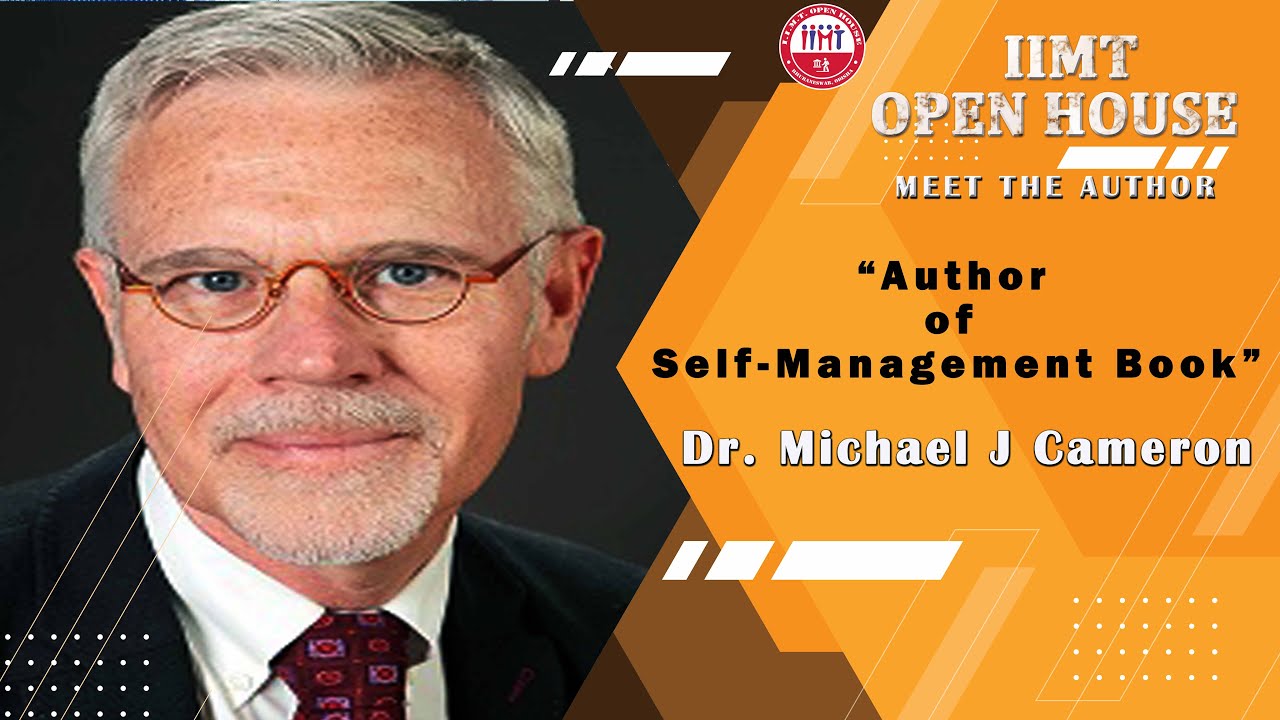
In this YouTube interview hosted by IIMT Bhubaneswar, Dr. Michael J. Cameron, Ph.D., BCBA‑D, LBA, discusses his chapter “The Science of Collaborative Groups: Acceptance and Commitment Training for Leadership” from the second volume of Self‑Management for Individual and Organizational Success. Cameron introduces his background in behavioral science and organizational behavior management, then explains how he integrates three major frameworks: (1) Elinor Ostrom’s eight core design principles for thriving collaborative groups; (2) the transtheoretical model of change (pre‑contemplation, contemplation, preparation, action) as a stage‑based approach to assessing and guiding employee readiness; and (3) Acceptance and Commitment Training (ACT), emphasizing cultural and neuro‑diversity awareness, values‑based interventions, and committed action. He describes how these concepts together provide a practical roadmap for leaders and HR professionals to foster shared identity, equitable benefit distribution, inclusive decision‑making, and monitored behaviors within organizations. Cameron also shares how he applies the chapter’s content in his own teaching at the University of Southern California, training future leaders. The interview concludes with an invitation for future collaboration and the dissemination of the material to Indian students and practitioners.
Chapters
Hi, Dr. Patnaik.
Namaste from India.
How are you? Meet you in person. Yeah, yeah.
So although we have worked and exchanged mail, for the first time we are seeing each other.
This is great. It's great to finally, finally meet you. Yes, what, uh, what time is it for you? 7:30 in the morning?
Yeah, it is 1:21, so we may start, no issue.
Yeah, yeah.
So how are you doing?
Very good, very, very good. Yeah, healthy and family's good and Survived COVID. Yeah, yeah.
Director of IEIMT Bhubaneswar, India. And today we have with us Dr. Michael J. Cameron from USA, an author of the second volume of the book Self-Management for Individual and Organizational Success. He has contributed the chapter The Science of Collaborative Groups: Acceptance and Commitment Training for Leadership. Good evening, Dr. Cameron.
Thank you, thank you for having me.
So let me introduce Dr. Cameron briefly. Dr. Cameron, a licensed board-certified behavioral analyst, the chief clinical officer BCBA-D for Blue Spring Pediatrics. Dr. Cameron is also a faculty member within the graduate program in Applied Behavioral Analysis at University of Southern California, Los Angeles, USA. Dr. Cameron is experienced in the area of leadership, knowledge management, behavioral intervention technologies, Behavioral Medicine, Behavioral Health Assessment, Intervention for Diverse Populations, and Higher Education At-Large. Dr. Cameron was also a tenure associate professor and the founding chair of the Department of Behavior Analysis at Simmons University in Boston, Massachusetts. Dr. Cameron earned a master's degree in applied behavioral analysis and a Ph.D. in experimental psychology from Northeastern University. With this, I introduce Dr. Cameron to the audience. We shall be listening about his work on science of collaborative groups through question-answer session. Let me ask him the first question. What is your background and from what perspective did you write the book chapter entitled The Science of Collaborative Groups: Acceptance and Commitment Training for Leaders? Dr. Cameron, please.
Thank you. Yes, my, my background is in behavioral science. I'm a behavioral scientist, and when I received the invitation to write the chapter, it particularly interested me primarily because the interest that I have is in optimizing people, optimizing individuals not only in the context of their personal life, but optimizing them in the context of their professional life and also within their work in organizations. As well. So the, the sub-discipline that I have expertise in is what's referred to as organizational behavior management. So when I saw the opportunity from you to write a chapter on this particular topic, I just accepted the invitation with alacrity because it's an area that interests me greatly.
Yeah, within your chapter You talked about the work of the Nobel Prize-winning economist Elinor Ostrom. Can you explain the interconnection between the individual and organizational success and Ostrom's work?
One of the things that interests me, and I think, you know, the entire audience will appreciate this, is that I think as cultures, you know, not only U.S. culture, but but pretty much every culture. I think we, we spend a lot of time thinking about problems in this world and, and also thinking about the things that are broken and things that are not working. One of the things that I really appreciate about Elinor Ostrom's work, who, as you mentioned, is a Nobel Prize-winning economist, is that in her research, she identified the 8 core principles that are responsible for communities being optimized in terms of their collaboration. So she went looking for what is right in this world and what really works well for individuals and what brings people together and makes them collaborative. So when I was thinking about writing this book chapter for the book on individuals and optimizing people within their lives and also within organizations, I thought this is a really good contribution just to share with the community, just exactly what her work entailed. She identified and extracted 8 core principles in terms of, you know, what's necessary to make people thrive. The first one is that she really emphasizes shared identity and purpose. So having a sense of purpose, and it doesn't matter if you're working in technology, if you're working in human services, you're working in any discipline, just having an idea of what your identity is within that group and what your purpose is within that group is, is critically important. The second thing she emphasizes is the equitable distribution of the benefits as a result of what the group produces. So as a result of new technologies, for example, you know, people can benefit in, in personal ways as a result of their contributions to, uh, to that. And she really emphasized the importance of of ensuring that people were benefiting and that they understood how they were benefiting as well. The next thing that she emphasized is what she refers to as fair and inclusive decision-making. So everybody having a voice and everybody being able to contribute their own ideas. And many times, that has to happen independent of hierarchy. It can be individuals who are entry-level engineers, for example, or entry-level computer scientists that will have the most amazing contributions. And to create a space and a place where individuals can contribute intellectually and contribute their own perspectives is something that allows communities to thrive. The other thing that she emphasized is monitoring agreed-upon behaviors. So having a code in terms of conduct and having a code in terms of being responsible for example, for your own productivity is critically important. So I can go through all 8 core principles, but they're all in the book and in the book chapter. But I think the message here is clear, is that when somebody has done research and somebody has derived, you know, the critical factors necessary for people to be cohesive and collaborative, we really have to listen to that and benefit from it. And I think it's a good beacon and a good guide for anybody that's interested in really optimizing organizational productivity.
Correct. So you have pointed out clearly 8 points for this purpose in your chapter.
Exactly, exactly.
You also touched on trans-theoretical model of change in your book chapter. Can you explain to our audience what implications that model has for organizational management?
Yeah, this goes, this goes nicely with Ostrom's 8 core principles as well. In the transtheoretical model, it is all about behavior change, and when we're working in organizations, this is essentially what we're trying to do. We're trying to bring people in different directions and Many times we have to change their thinking about something or how they're thinking about something or how they're approaching any problem at all. The transtheoretical model is also what's referred to as a stage-based model because people are in different places with respect to their own willingness and readiness to change. In the first phase, it's what's referred to as pre-contemplation. Meaning that the person is essentially unaware that, that something is even an issue or something is not working or something that may be problematic. So for an individual that is unaware, the best approach with that individual is educating them and pointing it— pointing things out to them. In the second phase of the transtheoretical model, it's what's referred to as contemplation. That means that the person's willing to acknowledge that something's not right, willing to acknowledge something's wrong, but they're not ready to do anything about it. They're just not quite ready to take that next step and to change their direction or change behavior in any particular way. The reason this entire model is, is so important is because ineffective work from a leadership standpoint, you have to do a rapid and quick assessment in terms of where that person is. And then you have to adjust yourself and the way that you interact with that person to make sure that whatever you do is impactful and it's not something that you do that could be unproductive for the individual. The third stage in that model is what's referred to as preparation. This is where the individual has not only acknowledged that something has to change, but they begin working with you to take the action steps that are necessary in order to course correct. And, uh, and to change direction. And then from there, they move into what's referred to as the action stage, and that person is just ready to go. And, um, as a leader and as somebody that manages other individuals, it's really important to quickly evaluate where they are and then to adjust yourself and then to take a stage-based approach with, uh, with that person. If they're a valued employee, there's somebody that's valuable to your team then understanding this model and a person's readiness for changes is something that can be very productive for and very healthy for everybody that's involved.
Correct. So you have also covered very two distinct attributes, that is acceptance and commitment. Can you explain how acceptance and commitment training could influence a person's leadership ability as well as their self-management capabilities.
Yeah, what I attempted to do in this chapter is to pull together, you know, and to make it evident in terms of the importance of all these contributions. You know, we've got Elinor Ostrom and we got her 8 core design principles. We know what we should be doing. And then we've got the transtheoretical model. So we know how to approach a person about what they should be doing. And then when you unify that with Acceptance and Commitment Training, the emphasis there is in teaching people awareness, teaching them to be aware of cultural diversity, neurodiversity, being aware of their communication, how they're communicating with other individuals, how they might be received by another person as a result of what they said. How they reacted when something was said to them. So this emphasis on awareness is critically important. The other thing that is a core process in Acceptance and Commitment Training is understanding what other people value. You know, where are their values and what are their values? And really, really probing that and examining that with another individual. Because if you align their work with what they value, then you're going to optimize the individual. If you end up assigning work activity and different projects to an individual and it's inconsistent with their values, then you're going to get suboptimal work and it becomes problematic. So the whole area of acceptance and commitment training, which emphasizes awareness and value-based intervention and also the importance of committed actions from the individual, just provides a thread that, that really unifies everything else that is discussed in the chapter.
Correct. So I am pretty sure your empirical study as well as the very nice way of presentation of all these concepts will help our HR professionals who are engaged in the corporate training and corporate HR So definitely it will be helpful for them. I have a last question. Since the publication of the book on self-management, how have you used the content of the chapter in your own workplace?
Yeah, because I, I have my foot in academia as, as well at the University of Southern California here in Los Angeles. One of the things that I'm responsible for is training leaders.
Yes.
And teaching people to be prepared for leadership roles. And this is, you know, a form of education that a lot of people, you know, just don't get. And I imagine that's exactly what inspired you to produce this book, right? Is because you want to contribute to that. So since the publication of the book, I've been using book chapters in my class for leadership and management of other individuals. So I thank you for this contribution and this book because it's a very good volume and has served me well as an academic in my profession.
Correct. Our students in India are not getting the opportunity to listen directly to you in the classroom, And through this, uh, we have an IIMT Open House. It has been, say, in a YouTube channel. So, uh, we are uploading your video to our, uh, say, channel, uh, IIMT Open House, uh, for sharing the knowledge and, uh, with the mentoring session to the HR professional. So this will be of immense help to not only to the student but to the practitioner and academicians. Thank you, Dr. Cameron, for sparing your valuable time with us. I invite you to visit IIMT campus at Bhubaneswar whenever you are visiting this part of the globe. Thank you again. Namaste.
Thank you so much. Thank you for the invitation.
Thank you.
More from Michael


Dr. Michael Cameron's Gracious Introduction of His Mentor, Dr Paul Dores #mentoring #aba #behavior

Mentorship Espresso #1 | Dr Michael Cameron #motivation #mentorship #inspiration
How To Control Behavior With Choice | Behavior Analysis w/ Dr. Michael Cameron