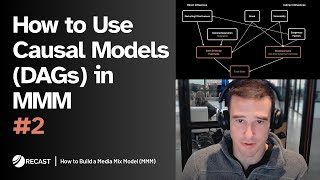
Tom Vladek and Antonio Vargas explain how directed acyclic graphs (DAGs) help media mix models capture real marketing dynamics. Using causal models instead of pure correlation lets you account for how different channels actually influence sales, not just correlate with it.
Where do statistical models come from? Are they flown in by storks? What is so magic about linear regression that makes it so commonly used? If you've ever wondered what it truly means to build a statistical model or how structural model assumptions are made, then you're in the right place. I'm Tom Vladek, statistician, marketing scientist and co founder of Recast, and I'm here to to show you the secrets and science behind building complex statistical models in the context of the marketing mix models that we build here at Recast. This is how to build a media mix model that won't destroy your marketing program. Presented by recast episode 2 media mix modeling is nothing new. Businesses have been using media mix modeling to understand the performance of their business for a long time. That means that there's a academic literature and a wide range of studies to build off of. Unfortunately, many people are still using modeling approaches that we think are totally backwards. So this backwards way of working is starting with a model and then working backwards to make your assumptions fit the assumptions of the model. There's a better way. It starts by working from your assumptions and core beliefs and then finding or building a model that handles those assumptions and beliefs natively. If you started with linear regression and worked backwards to make your assumptions and data fit the requirements of a simple linear regression, you would get a media mixed model that didn't perform very well. The approach that we recommend generally comes from the research and the literature on causal inference. It starts by creating a map of how things fit together and what causes what. This is generally called a causal dag. The DAG stands for directed acyclic graph, but you can think of it as a visual way of describing how things fit together. For example, consider how demand capture channels like retargeting or branded Search work in the context of marketing. A really naive media mix model might show a marketing channel driving sales and an organic channel also driving sales. But what about retargeting and branded search? These are more complicated. Those channels themselves are also driven by marketing activity, and our DAG must become a bit more complicated to handle that. Here the DAG is showing how demand capture channels are influenced by demand generation channels and both of them influence sales. Now, this DAG is still probably too simple. If you're developing one for your business, you need to account for things like seasonality, ad stocking, brand effects, exogenous variables, you name it. If you haven't created a dag, we would really encourage you to do so. Now that you have your dag, it's time to find a modeling framework that will allow you to estimate the parameters of interest. It's important to recognize that in general, you're not going to be able to estimate everything that you want. You're going to have to make trade offs in order to focus on the effects that are most important for your business in general. In the context of MMMs, the most important parameters are the incremental ROIs or CPAs for each of your marketing channels. So you're probably going to want to start there. If you are going to work with an open source model, you'll want to make sure that you understand at a very detailed level how the model works under the hood and that the assumptions that that model is making reflect your core beliefs as well. It's very likely that any open source model is going to not match your true beliefs in one way or another. Now, whether or not that's important will depend on what trade offs you're making, what you really want to estimate, and what you're a little bit more flexible about. We generally believe that all of the currently available open source models are not sophisticated enough for most brands. So if you do decide to use an open source model, I would suggest considering that as the starting point on which you layer additional logic. At Recast, we've developed our own Bayesian model from scratch. A link to the documentation is in the description so you can read more about the assumptions that we've made. The DAG that we're working off is complex. Here is Antonio Vargas, senior data scientist, who's going to walk you through it.
I'm Antonio Vargas, head of the applied modeling team at Recast. The goal of Recast's DAG is to account for how marketing works. This is our representation of how different factors influence a brand's total sales or acquisitions through the mechanism of marketing. So conceptually, we break sales down into two main buckets. There's sales driven by paid media and there's baseline sales, sales not driven by near term marketing. So for example, on any given day you will have people buying a cheeseburger at a fast food restaurant because they've seen an ad for the restaurant recently. And you'll also have people buying a cheeseburger there who have not seen an ad recently. So for each of these two things, sales driven by paid media and baseline sales, we can break them down further. We can talk about what directly or indirectly influences those sales. So sales driven by paid media is directly influenced by the effectiveness or or quality of the marketing and also the amount of spend either on demand generation media or on demand capture media. So these are media targeted at different points in the conversion funnel. On the other side, sales driven by paid media are indirectly influenced by things like brand seasonality, promotional activities, and all kinds of other exogenous factors. Things get a lot more complicated than this in practice, but these are some of the broad assumptions that inform recast staging.
Part of what Antonio is explaining here is how seasonality impacts both organic sales and the efficacy of demand generation sales. At the same time, all of the underlying code that powers Recast is driven by the causal model that Antonio has just described. So what's the most important thing to take away? Whether you're developing a model in house based off of an open source model, or working with another vendor, you should understand the causal model and how it relates to the model code that is being run to estimate your MMM.