Wharton's Prof. Peter Fader: How to balance brand growth with CLV | Coffee Breaks
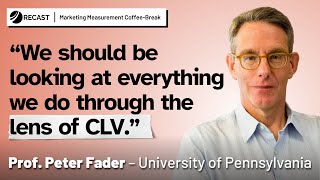
Peter Fader from Wharton talks with Tom Montgomery about balancing brand growth against customer lifetime value. They discuss marketing mix modeling and attribution, and how to decide where to spend when both matter.
Foreign people are still joining, but we're a couple minutes after and we keeping this really tight 30 minutes. So I'm just gonna. I'm gonna roll in. So for those who don't know, I'm Tom, one of the two co founders, co CEOs of Recast. We do media mix modeling. Our platform helps brands measure and optimize their marketing spend. Joined here today with Professor Pete Fader. As a Wharton professor, really well known in the marketing community for his work on customer lifetime value, I was lucky enough to take his, like, legendary marketing776 class when I was an MBA student. I don't know if that's still the number, Pete, but it was at the time.
It's inflation. It's now 7760.
7760. Okay. We've appended a digit, apparently to the course numbers. Also runs a really cool company called Theta clv, which does lifetime value modeling for companies and investors, which maybe we'll hear a little bit about the end. So we just have a short time here. So I'm going to dive in. Pete, thank you so much for joining. Really appreciate it.
Tom, it's always a pleasure talking to you. You know, it's. It's not only a pleasure to teach students like you, but to learn from students like you. And then that's been the case even before you started the program. I remember some of our good conversations.
Well, thank you very much. Well, so for everybody that joined, when I initially reached out to Professor Feder about joining us for this coffee break, I said, hey, you know, would you be willing to join? And you said, you know, I'm willing to join, but you may not want me as a guest because I actually have some real deep skepticism around media mix modeling. And I thought that that was a really provocative and interesting conversation. So maybe you could kick us off by laying out some of the areas where you're sort of skeptical of mmm.
I will. I will. And I want to put it in a proper context because I've been at Wharton for 37 years now. I'm back in the early 80s and 90s when I was a young pup. I was doing a lot of mmm myself. But as I started really kind of learning my skills as a modeler, and it's more than just the technical skills. It's the storytelling skills. It's the desire to really understand the true underlying unobservable process that customers are going through. I really moved more and more towards, well, it's a popular word now, but often misused Generative models. I want to tell the story about each individual doing things over time. And all too often, like almost always when we're doing, mmm, we're doing an aggregate level, we're just mushing all the sales together and we're just saying, hey, if we have a different media mix, sales go up. And I want to know more about that mechanism. Did it help us acquire a new customer? Did it get someone to accelerate a purchase that they were going to make or to make a purchase they wouldn't have made otherwise? And so very often the failure to tell stories at that more granular level makes me, as you said, skeptical about how well Eminem and it can work in terms of curve fitting, but the validity of the insights that emerge from it. Happy to elaborate, but that's the basic idea. Yeah.
And I mean, just to dig into the validity point a little bit, there is the validity mainly around like statistical validity. Like if you don't know the mechanism and you want to forecast the future, you're unlikely to succeed. Or is the validity around, like, I really just, I don't care that it goes up. I want to know why it goes up. And even if I can predict in the future that it will go up, I still care about why it goes up. Like which of those two points is like the, the main objection?
You know, it's a little bit of both. Depending on the setting, I'll lean towards one versus the other. So from a statistical validity standpoint, if we're just mushing together all these very different cells, again, I'll stay with that same example. A new versus a tenth repeat purchase, an acceleration versus an incremental sale that was generated. If we just mush all those sales together and treat them as if they're all being impacted more or less in the same way by the same marketing activities, then the betas, the coefficients, the parameters that we're estimating won't be as valid. So there's that statistical point, but then there is that kind of narrative point that sometimes my desire is to really tell one of those stories or the other. You know, what we just did, let's say a win back campaign and we want to know how many, you know, seemingly dead customers did we resuscitate or we just launched a loyalty program. We want to know how many incremental sales is generating. So sometimes I care about decomposing sales into these different kinds of buckets. So it all depends, but little bit of both.
Totally understood. And I mean, I think that from our perspective, we're very Much in the camp of, you know, in some cases we're mushing all the sales together. Right. We're forecasting revenue. In other cases we're just forecasting acquisition. I think in both cases you would have a reason to sort of object because, you know, not all acquisitions are created equal. Right. And in the other case we're sort of mushing all of the revenue together and we, we come up against those points that you mentioned. But one of the things that I think we talked about that we do a little differently is like, we're not really focused on the like forecasting, you know, repeat purchase behavior or thinking about how customers will do that. We're just help you typically trying to help marketers forecast the aggregate. Right. And we're not getting down into the nitty gritty. And I think that's an area where, you know, at least last time we talked, we sort of accepted like, okay, you know, if your use case is this, that's okay. You know, then as long as the model is well specified and you know that it has good out of sample fit, we can, we can sort of agree that that's an okay use case.
Yeah, exactly. Exactly. Right. That depending on the use case, sometimes, first of all, sometimes we can't get the granular data so we just have no choice. That's very, very, very common. It's areas where, you know, companies will come to me and they want to maybe ask some of the granular stories, but they don't have the data at the right level, say, sorry, I can' and that's not a good answer either. So sometimes you're going to play the hand you're dealt and what you're doing is admittedly more broadly applicable than the kind of narrower things that I like to focus on. So a lot of times it really is the best approach to take because there is no choice.
Yeah, I want to switch gears a little bit. Just we've got a short time block here and one of the things I remembered from our class, it's just like way back now, this is like eight years ago, you had a very provocative sort of approach to teaching marketing. And you, I remember you assigned the book like how Brands Grow and you were like, a lot of companies do segmentation and segmentation doesn't matter. Right. And here's why. And you had a lot of the way that you taught was very quantitative and you really didn't accept as gospel any of the like marketing truths. Right. You wanted to investigate each one of them individually.
Well, marketing myths, I would say.
Right, right, right. The things that were canonically accepted as truth. So maybe, you know, we have a ton of marketers on the call. I would say what are some of the myths that you think marketers believe are true but just you don't believe are true that they are not well backed up by the data.
So. So part of it is you mentioned How Brands Grow by Byron Sharp and I have the ultimate love hate relationship with that book that you know, 80% of it's spot on. People should read it and instead of arguing why my should accept it. So some of those ideas that it's really important to grow the base that you know, focus more on penetration than say something like purchase frequency or loyalty that the latter will follow from the former that advertise broadly emphasize a variety of different messages. So there's all that and people can kind of read Byron's book if they want to know more. The other thing that a lot of companies focus on is let's come up with products or campaigns that are broadly popular that we're going to measure, measure a success based on how many people clicked on the thing or how much buzz it generated or even how many units we sold of the thing. I'm much more interested in lifetime value. I'm much more interested in well, what kinds of customers did the clicking or the buying or the responding and that we maybe will sell a product or sell a bunch of units to a bunch of customers who never bought from us before and are never going to buy from us again. The ROI on that long term ROI isn't going to be that high. Whereas we might come up with a product that doesn't really sell a lot. But if it helps us acquire high CLV customers or elevate the CLV of existing customers, then that that second product might be worth 10x more than the first one. So we should be looking at everything we do through the lens of customer lifetime value. And I have this kind of quasi religious fanaticism about it which also goes back to one of the concerns I have with MMM that it tends not to be CLV focused. It can be and again we've discussed ways about that. So it's focus on value through the customers as opposed to the things that we do and the things that we sell.
Instead of value through the products and or value through the region, you're thinking about it from the customer's perspective. And I think that, I mean I was sold on that obviously when I I took your class. And if for anybody on the, on this webinar that does not know how to calculate their clv. There are tons of online resources from yourself and Professor Bruce Hardy that have, like, Excel workbooks and formulas that are pretty easy to diy. So I won't get too much into that, but I do want to ask, like, okay, let's say your data science team has a CLV model, right? You can take your database of customers and say, okay, we're going to append a CLV to each person and we can predict what the CLV will be. But just to intersect where your world and our worlds collide, say that one of those predictors is like the channel that they saw, right? They came in through Google or through Facebook. Now, that assumes, in a sense, that we can know what channel a customer came from and in the future, when we allocate our budget, that we can know that we'll get similar customers in the future. So a lot of models assume, you know, what channels customers come from, but with complex conversion pathways, you may not know. So how would you recommend or how do you think about resolving that. That issue?
It is such a great point. It is one of the biggest surprises and disappointments I've had. And I'll end up by saying, why? I give you guys a lot of credit for it. So, you know, the close cousin of MMM is attribution modeling. And so that became super popular 10, 15 years ago and said, okay, we're.
Going to get this right.
We're going to come up with a way of doing it that's going to have a generative story and that could lend itself to lifetime value type estimates. I don't remember what data set it was in automotive space. And we'd look at all the different funnel activities and try to apportion credit to each one. But one of the things that we did that was a little bit different is we were humble about it, and we recognized that we can't capture every touch, we can't capture every interaction, we can't capture every influence. So we had this kind of none of the above factor in the model to say it's outside of the touches that we can see. How much credit should we give to this kind of garbage can of everything else? And it turned out that that ends up being the biggest driver in the model. That as much as we can give credit to the things that we can observe, that's great, but most of the credit is going to. I don't know. And that kind of takes a lot of the wind out of the sails. It just makes our ability to Do. I mean, go ahead, Tom.
Well, I was going to say clarify. So you're saying. Okay, let's. We have an attribution model and we have assigned every customer to a channel. But in the model that predicts what CLV will be, we also have this like idiosyncratic, every customer is different factor that's different from the channel that they came from. And there's much more variation that's just idiosyncratic to every customer than there is by channel. Right.
That's a bit more than just channel. Yeah, that if we're trying to do, let's say multi touch attribution, again, multimedia mix modeling, that we can give credit to the things we observe, like channel, like exposure to a campaign, like they hit the website. Great. But when we allow for this, there's other influences out there. Not only the fact that people are different from each other, I mean that too. But even when we try to apportion credit to all these things that might be influencing them through the funnel, there's this none of the above factor. And again, even that might be heterogeneous. Some people are more impacted by the garbage can of everything else than other people. But, but for a lot of people that might be the single biggest factor. And so rather than trying to give credit to all of those touches and campaigns and so on, I ended up waving the white flag myself in this case and saying, you know what, I'm going to stick with last touch or I'm going to stick with something like channel where it is observable, where there's going to be a certain amount of crispness to it.
And by channel in this case you mean distribution channel.
Exactly.
Not marketing channel.
Correct, Correct. Okay, exactly.
So you just said, okay, if we, if we try to do this full funnel attribution thing, it's. The data challenge is really complex. It muddies up the model. So you just stick with a last touch attribution and you know that it's not necessarily reflective of the full set of pathways, but that's the best way for you to navigate the, the trade offs between the complexity of the data required and the fact that you can't really reflect it. And you know, something that actually gets to influence or you know, tell you something.
Exactly. Really a big aha for me. And I, and I know it's the same for you, which is great. Even like when we're building our CLV models and again we'll bring in things like channel, things like campaign, things like seasonality, competition, Covid and we'll and we'll, you know, see how much credit they get towards clv. But there's still going to be this none of the above component and we'll use some of these ML type approaches to capture wiggles and jiggles in the sales patterns that we can't attribute to any particular observable activity. It's vitally important to do that for me is big wake up call just in the last couple of years. I know you guys are doing the same kind of thing and it's really important to, to do that, to do that well and to kind of IGN acknowledge the fact that that's going to be a big chunk of the variants explained, even if we can't fully explain it.
We were getting like an absolute ton of questions in the chat, so I'm going to sort of like ditch the agenda that we said to try to get to some of these. So one of the first, one of the questions that people have been asking, and I think I could phrase this in multiple ways, is like there's the, in the attribution sense, there's the sort of garbage can of sources of conversions. There's also this percent variance question. And so in your experience, like framed either way, like as percent of conversions or percent of variance explained, what generally rule of thumb, percent of the model falls into that bucket.
Interesting. So it used to be, I'm just going to give you the whole history lesson. Used to be I didn't care. Used to be that all I wanted to do was to capture the overall baseline of sales. And I have a group of customers, a cohort and I'm watching them, over time they tend to get worse and all those wiggles and jiggles around that I just didn't care about them. Noise, transient. Turns out it matters a lot. Turns out that if we ignore that, then our ability to say what is each person's lifetime value will be biased. So for me it's not so much trying to explain all of that variation, but it's making sure that I capture enough of it so that I can trust my individual level estimate. So I can say, here is your clv, here is her clv and trust it. So to me, and this is where we kind of differ, but we're also on the same page in some ways I'm not that interested in saying, well, I've captured all of that variation. I'm not even interested in saying what it's necessarily due to. I just want to make sure I do a good enough job of getting it out of the way. So that I can make accurate statements about each individual or a cohort of customers.
Amazing, amazing answers. The second question I had is, do you that. It's Tom Montgomery's question. I'm curious for the answer myself. Now, when a brand is entering a new market or staying in an existing market, do you typically find that the CLV for that audience or that segment is fixed as in like the CLV is what it is. Right. If I'm selling to some segment, some product to some segment, the CLV is that. Or do you find that they can actually increase it in some way or another? Like that the brand's actions can actually make CLV go up or down, whereas the only way to make CLV go up or down is to change your customer.
Okay, I love it. So yes, there really are two parts to the question. So one is, for a given individual, how much of their CLV can they become a different person with buying in a different category or through a different channel or something like that? And the answer is yes, in many cases we're working with say a multi product retailer and sometimes they'll want to break down the CLV for the same set of customers. Let's say we're talking about a pet retailer. So let's look at their CLV when it comes to, you know, kind of food and replenishables versus their CLV when it comes to more cages and more durables, they might appear to be a very different customer across those categories. And so sure enough, if we can somehow push them into the category, they, they might act differently. So, so, so yes, people are not necessarily monolithic when it comes to the way they interact with, with one company. Now there's the other twist on that. When we look at a customer's buying, let's say for a given category, can we elevate it? And the answer is, yeah, at the margin we can do things to either incentivize additional purchasing or to kind of, you know, make them love us a little bit more. And I'm good with that. I'm fine. A little bit of upselling and cross selling. But you know, back to the way you phrased the question, you're going to move the needle more through effective customer acquisition. So instead of just trying to squeeze more pennies or in addition to trying to squeeze more pennies out of existing customers, let's try to find ones who more closely resemble the customers who already have high lifetime value. It's going to be expensive, it's not going to be an efficient way to grow but it's going to be a more effective way to grow. So, yeah, I'm at the margin, a bigger believer in smart acquisition than I am in despite obsessing over, over different kinds of customer development.
Got it. So just the macro takeaway is you can, if you want to increase your clv, by far the more important thing to do is to find the right customers than it is to try to make your existing customers more valuable.
And now what I'm going to do is go full circle, if I may, because one of the things in CLV land that we really, really obsess about our customer cohorts, but we want to look at each tranche of customers that we acquired a different point in time and hope that as we go to the next cohort they can be as valuable as the cohort before. That's another issue that very often the aggregate models don't take that into account. And sometimes, hey, companies doing a good job, they're bringing in better customers than the previous batch. That's great. If the model's not breaking that out cohort by cohort, we might given ourselves too much credit for the media activities. Look, things are all of a sudden better now. I'm saying it's because of, it's a better mix. But the aggregate model would be saying it's because of the media exposure. So it goes back this idea of having that more granular story.
That's a really interesting point. You know, you might, the, the, you might be giving credit for the media. Right. Oh, our creative is so much better. But really what the media has been doing is it's been doing better segmentation. That's right. Now we would argue, you know, and our lens on it is, is that the media is better. And the reason that the media is better is because it's been more effectively targeted. And in our. MMM. We'd see like the coefficient, you know, for whatever channel rise. But I think the, the mechanism for that would be more along the lines of what you're saying, which is that you're, you're reaching a better consumer and they're buying more on the first purchase and they're repeating more. Yeah, and you would like to know that, right? Exactly.
It could be the case that you're taking existing ugly ducklings and making them beautiful swans. It's usually not true. Usually it is. You manage to bring in better customers, but I just want to be able to sort all that out and give credit where it's really do.
Yeah. And obviously the most powerful thing would be a Combination of the two. I think I just wanted to sort of circle back. Somebody had a question about how you're, you know, we talked about Brian Byron Sharp early on and his view is like, you got to go, you know, massive reach. Right. And that the, the size of your brand is sort of the size of the amount of like repetition and reach that you have. Whereas you're saying a little bit more like we need to find those segments that love us and we need to sort of essentially fire everybody else. Right. And focus on. Okay, no, okay, you did talk about firing customers back in the day, but maybe I did before I kind of woke up.
So let me give the reconciliation because.
On one hand I would love that.
I'm the strong advocate for Byron Sharp. On the other hand I'm saying things like focus on the right customers for strategic advantage. How do we thread the needle? Well it turns out so most of our customers are eh. Most of our customers aren't buying from us that much. We can't move the needle with them much at all. And for them, for that, you know, 80% of our customers, I really do believe in a lot of the Byron Sharpe stuff. Let's keep it broad, let's keep it efficient, let's focus on a variety of different messages. Great. But for those high end customers, for those customers who just were born to love us, who get our logo tattooed on their body parts, they are substantially different. And the value that they're going to bring to us if we look at what they bought from us or how much they bought from us last year versus how much they're going to buy from us next year, it's a convex curve that the more valuable customers are going to have much, much higher return than the so so customers. It's not linear. And so there's something different about those high end customers. And to figure out what makes them different in terms of the products they buy, how they use them, how they talk about them, how we acquired them and to kind know, double click on that and acquire more like them. So I'm talking about basically doing both.
Yeah. If I were to summarize it, it's sort of like you want a barbell strategy. I mean everybody talks about everything being a barbell strategy. But it says like, okay, on one sense we want, you know, the market is Sharpie in, right. And we want a broad distribution, lots of reach, lots of frequency. Right. And that market will operate in how brands grow. Sense. Right. But there is some subset of super loyal customers that are gonna really over index your Sales and it would, you know, you really need to find out who those people are, how to service them, how to retain them because they can really dramatically increase your revenue and your profit. And so those are fader Ian.
To a nutty extreme. So it's not just a matter of giving them the white glove service, but look at everything we do and everything we sell through the lens of how many of those customers are buying it. And what's going to happen for most companies is their most popular products are going to under index on those really high value customers and there's going to be a few low down products, a few items or skus that you're not even aware of or you're not aware of what they're doing for you that do over index. There's just something about those products that are the bait to pull in or hold onto the high value customers. You got to know what they are. So you got to be looking at your products, your campaigns, your messaging, everything through the lens of the value of the customers interacting with it and then that's going to give you wonderful guidance about how to acquire more like them.
So we are coming up right at the edge of time and I think one of the wonderful things about 30 minutes is we can get really amazing people like yourself to join without a huge ask task. One of the downsides is we're never going to get all the things. But I did want to just reserve like one minute for you to talk a little bit about what you're doing with with Theta CLV and maybe you can hold up your book if you want. Again, I just love to, you know, outside of what you're doing at marketing at Wharton, just what you're doing with data.
Thank you for the opportunity to do that. You know, I've been talking about it and having wonderful students like you saying, hey, here's the models, go use them. But there is a bit of a last mile problem to really implement the models and to keep tweaking the models and to have the narrat around the model so people can make the best use of them. So that's why we first founded one company, Zodiac, sold that to Nike a few years back, founded Theta in 2018 to really, to take a lot of these concepts and methods and make them just, you know, instantly accessible and to be able to work with other firms like yours, to be able to say, you know, we're doing this one thing, it's, you know, it's an inch wide and a mile deep. Deep. But recognizing there's lots of other marketing problems out there that can dovetail with lifetime value but aren't necessarily, it's not necessarily, you know, a question being phrased from that direction. So you know if people are interested thetaclv.com but really it's thinking broadly about the quantitative marketing landscape and that's why I love talking to you about it.
Thank you so much. And so it's been 30 minutes. For those who are interested we're going to have another coffee break one month from now with the folks from Meta who do Robin the media mix model. There's some details of that in the chat. You'll get it. But I think it is time to wrap up. And thank you so much, Professor Feder for your time. I really appreciate you stopping by.
Sure thing Tom and team, keep up the good work and with everyone else happy to keep the conversation going, let's do the LinkedIn thing.
Thanks everyone. Perfect. Have a great Friday. Thank you.
More from Michael



The Continuous Testing Loop That Separates Great Marketing Teams From Average Ones







