Why Marketers Need a Product Mindset | Michael Kaminsky (Recast, Harry’s, Away)
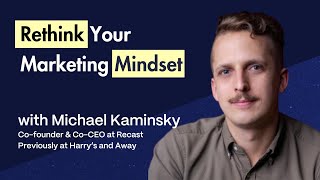
Michael Kaminsky, co-founder of Recast, explains why marketers need to think like product people. He covers attribution, media mix modeling, and how to measure marketing in an omnichannel world where traditional tracking breaks down.
So how do you advise marketers to rethink measurement strategies to keep up with not only an omnichannel world where conversions happen both online and in store, but also like an omnichannel world where you're marketing online and in store.
But the thing that I've seen that seems to work the best is where companies do a couple of things. So one, they accept that there's going to be uncertainty, they're not going to have perfection. They just sort of embrace that. And I think that that is actually a really good first step because it gets everyone starting from a healthy place. Exact. Exactly. And then the next thing that they do is they really sort of think about operating their marketing program in a way so that planning, budgeting, experimentation and measurement all live on the same plane and happen together.
Hi and welcome to Growth Talks where we dive deep into the world of growth and marketing with industry leaders. I'm Christina Rubino, the general manager of Offline at Right Sideup and your host. Today I'm joined by Michael Kaminski, a co founder and co CEO of Recast, a startup that is building the most rigorous media mix modeling platform in the world. Michael was trained as a statistician and econometrician and has spent his career building software to help people make better decisions. At Recast, Michael's helping brands take a holistic, data driven approach to evaluating marketing performance across online, offline and every stage of the funnel. He's collaborated with high growth companies like Harry, Mockingbird Away and Rocket Money. And with that I'm excited to get into it with him. Michael, welcome to the show.
Thanks for having me, Christina. I'm excited to be here.
Sweet. So let's get right into questions. You've been way into data throughout your career. Right before you started Recast, you were in house at Harry's Razors. Were you there to build the analytics infrastructure from the start? Were you refining prior processes that you inherited and were like, I want to do this differently. What was your journey like there?
Yeah, so a little bit of all of the above. I was the first dedicated analytics hire on the team. But I will say that Harry's is probably, it's one of the most fully analytical teams that I have ever worked with. It's founded by a bunch of ex consultants, very deep bench of ex consultants. A lot of their marketing team was actually ex consultants. So they were very deeply analytical people, which is a wonderful environment for me because I wanted to build tools that other people could use to do their own analyses and do it in a Smart way. And I had an amazingly receptive audience there. So a lot of the work that I was doing, especially when I was getting started, was trying to learn, like, how do you think about measuring this? You know, what is the right way that you to think about the business, and then building the tools to help them do that in better and more efficient ways. Using my background in econometrics and causal inference to really make sure that we're thinking about these questions appropriately and then putting the data into the hands of the people that need to make the decisions.
Yeah, that makes a ton of sense, especially because, well, we'll get into really wonderful, comprehensive attribution methodologies, like Last Click a little bit later. But I'm always curious as to what makes people strike out on their own and be like, actually, I think this is a broader problem. I want to create a company that helps solve it. Was there like a moment or an indicator when you were like, oh, this is a broader problem. And there's a need for a company like recast because there are obviously other media, mixed modeling platforms out there. There's a million attribution partners. What was like, the. The point where you were like, no, I want to. I want to do something?
Well, I think like many entrepreneurs, I only embarked on this journey because I thought it was going to be a lot easier than it actually turned out to be. So I severely underestimated the amount of work that was going to be involved. But I think, you know, over the last 10 to 15 years, there's been a real rise in sort of two different fields that I think are really interesting. One is causal inference. So this is a thing that I care deeply about, but it's sort of thinking really hard about how we can use statistics and data to learn true things about the world. And the salience of causal inference as a field has grown a lot as we've seen things like the replication crisis in academia, where it turns out that a bunch of sort of very famous studies and papers, some of which you have probably seen in headlines, turned out to just be, like, false results. Right? They weren't actually ever real. And so it caused a lot of people in the scientific community to start thinking a lot harder about, okay, where did we go wrong? And what are the better methods for improving that and for making sure that the things that we think we're learning from data are actually real? And so there's been a lot of literature and a lot of discussion about that, and I've always found that really fascinating and really personally interesting to me. And then secondly, there's been a lot of technological innovations, not generative AI, although that's very interesting as well, but around sort of certain types of statistical modeling that have allowed for the building and estimation of much more complex models than what was possible 15, 20 years ago. And those two things combined made it seem like, okay, now is a really interesting time to try to re approach the problem of media mixed modeling from the ground up, taking all of these lessons in new technologies that have been developed really recently and seeing if we can apply them to this problem and really have any breakthroughs. And so it's really those things plus obvious market demand. Like for many, many businesses, marketing is their largest line item. And so if you can make that even a little bit more efficient, it results in huge amounts of dollars of value. And so it's just, it feels like a problem worth tackling just because it can be so make or break for so many businesses in terms of their profitability.
Yeah, no, it makes a ton of sense. And you know, to your, to your point about there being other opportunities that have evolved in the last 15 to 20 years besides traditional attribution methodologies, it still, it's incredible to me that in the year of our lady Taylor Swift 2025, many companies still rely on last click attribution, despite its limitations in measuring many things accurately. Not least of all, top of funnel impact. What are, what are some of the biggest blind spots, in your words, that this approach creates and why? And how should marketers rethink attribution to get a more holistic view of their efforts?
Well, this is the thing that I think is really tricky. So taking a step back, I'm a big critic of last touch attribution and I will get into some of those criticisms. But I do want to say that for lots of businesses, last touch attribution is fine and it makes sense. My girlfriend runs a translation agency and she advertises on Google. It's the only place that she advertises for her last touch attribution. It works great. Like, it's perfect.
And there are a lot of your mix is paid search, the mix is paid search.
So it's, it's pretty easy to measure. But even, even at, you know, one or two levels above that, if you're only advertising in one or two digital channels, you have a small, medium sized business, last such attribution works. You don't need anything other than that. And you can feel it. You know, these businesses, they spend money on Facebook, they see their bank account going up the connection there is actually pretty tight. The problem comes when those businesses graduate then to being higher mid market, mid sized, large businesses. And all of the sudden this tool that worked really well when they were smaller no longer works well. And so that's a thing that I think it's important to keep in mind. This is not one size fits all advice and you really have to think about where on that journey you are as to what type of measurement approach is going to make those most sense. So that being said, for these brands that have sort of gotten to that next stage, still on last touch attribution, I think, you know, we're all, at least the people who are listening to this podcast are probably very familiar with these limitations. But touch based attribution, excuse me, by definition, touch based attribution is biased towards the most bottom of funnel digital channels. The ones that have clicks that are observable and the ones that are closest to the point of purchase. It's almost by definition in the name of last judge attribution that that is what you are going to be biased towards. And again, if your media mix is only paid search and Facebook or meta, maybe that's fine. But as the media mix expands and you're doing more mid funnel top of funnel advertising, that measurement method is just going to be inherently biased. Yeah, and I think the place where most people, most organizations get themselves into trouble is that the marketing team sort of understands this, but unfortunately they've trained their executive and finance team to like look at the touch base, the last touch reporting tool and use that as a source of truth. And now all of a sudden they have to like walk a bunch of things back and everyone is getting confused and that is really a bad place to be.
Yeah, it's to me, I mean, listen, perception is reality, right? Like if people get, there's a reason that meta is so prevalent in terms of its prevalence in the media mix. Right. It's the easiest platform to spin up, I would argue. Frankly, I actually think it's easier to spin up than Google in some ways. In terms of optimization, I can argue it either way. I've found that the more honest I am with clients, prospects, team members, partners, vendors, whatever, I found that that is where my success comes from. Right. Having those honest conversations and telling people like, hey, actually like you're not ready for offline media yet. You're not ready for podcasts, you're not ready for YouTube endorsement, you're not ready for streaming audio. Why? Oh well, you know, these are the challenges that you're going to run into, in your media mix also, like, have you ever like conversion rate, optimize your landing page? No. Cool. Yeah. Don't do it on this channel. But I think there is like, there's a tendency for, for marketers to want to add complexity to the mix, especially when you might have had like experience at a more scaled startup. Like maybe you're going from like something that's mid market, something that's scaled, something that's like series C and you're going to an earlier stage company. Like, is there an inflection point at which you think, wow, if you haven't hit that yet, we shouldn't even be talking. Like, does that come up in your, in your conversations with prospective clients?
And you know, yeah, it comes up a ton. It comes up a ton. And I mean, I think there's, broadly, there's a lot of factors here. I think if we're focusing on the measurement side, which is my business marketing, I think the tough thing for a lot of people is that just marketing is really hard and there's no getting around that. And everyone wants a magic bullet. And so everyone's like, oh, if only I have this technology or this thing, then I will be able to do, you know, all of my hopes and dreams will come true. And if it says AI or like advanced statistics, then it's like people like, yes, finally it's going to solve all of those problems. And so there's a lot, you know, there's just, and I feel for them, right, because marketers face an impossibly hard problem. It's just a really, really hard environment to work in for a lot of different reasons. And so I understand that inclination and that desire, but the truth of it is, and this is again the conversation I have a lot is that adding this additional complexity, it's not a silver bullet, it's not a panacea. It brings a lot of problems. And so as you are moving up the complexity stack in terms of measurement method or even different marketing channels, right. There's a lot of parallels here. You really need to make sure that it's actually going to be worth it because adding additional complexity to your measurement stack brings a lot of problems. It brings more questions from executives, it brings more scrutiny because you're investing more into it. And really it's mostly about, you have to be ready for that. And so brands that are spending, you know, I don't know, a couple million dollars a year on a couple of digital channels, it's like something like a media mix model is not going to be that helpful for you. Like, we can run the model, you'll get results, but you're just not at the scale where it's going to create that much value that makes the juice worth the squeeze for the cost and the distraction and all of the other things that are going to come along with it. Businesses face trade offs and I think for most of those businesses, their time and their energy is going to be better spent thinking about pricing differently or packaging, you know, bundling their products differently or reworking their messaging. All of those things are for those smaller businesses that aren't at, you know, huge scale yet, that's just a better place to invest your time because that's what's going to unlock the ability to get to the next level of scale.
Yeah, I couldn't agree more. I think there's, it's like you're, you're almost looking to borrow the problems of the future at that point. Like you're, you know, hopefully if you have product market fit, you have a great site, you have a great offering, your funnel's good every. If all things are true and you know your TAM is big enough and all of your business metrics are sound like you're going to scale to a point where you will hit these challenges. But until it makes sense from a media investment perspective, my advice to people is usually like spend more on media. Literally put as much money into working dollars as possible. Because any kind of attribution, media mix, modeling, measurement, et cetera, solution, it's an added cost.
And again, and the costs often aren't majority in like dollars paid to a vendor. It's often just like internal communication costs and explanations.
And it's not just the hard cost spent to a partner. It's literally like you are, you're signing yourself up for conversations with your cfo, probably with your CEO, depending on the scale of the company. And I think that like with brands, especially when it comes to running campaigns across multimedia, tracking the full customer journey has probably never been more complex. We say that every year, but it also becomes more and more complex every year. Right? Like if you're, you know, running meta and paid search, that's great. But if you're also running like television, traditional broadcast radio and direct mail and then you're throwing podcasts in the mix. Like how, how can marketers bridge the gap between offline and online data to measure true roi? And what are some of the common missteps that you see across your business to where you're like, could you not do that. Your life would be so much easier if you just did X. I'll seed with you. My favorite is scaling multiple channels at the exact same time. Fresh to the media mix. Let's just go for peak chaos, peak pain. I have to. Is that one of them?
That is a good example. I was going to say, like, that's a really good example of a thing that adds a lot of complexity. I think, you know, I. In this world, I think that a lot of companies go wrong by honestly. And like, this is going to be sound, maybe crazy from someone who is like a data scientist. Professionally, I've always been in the data, but expecting too much of data. There are questions that you cannot answer with data. And you sort of really need to deeply accept that. And like, you know, we run marketing. You know, I sort of run the marketing team at Recast, and we think a lot about what are the right ways to measure. And there's just a lot of things that we can't measure. We know we aren't going to be able to measure it. Maybe we could get more signal, but it would be a lot of work. It's just like we're just going to throw that stuff out. We're going to look at directional signals. Does it seem like it's working? And then we're going to use that to optimize until we get to that next scale where maybe some other measurement solution makes sense. And I think a lot of brands, they would do better by adopting that thinking. People are like, oh, we need to be data driven, which means every single decision we make needs to be based on data and actually think that that's totally wrong. A lot of decisions you can and should make should be based on strategy and your feel for the market and other things that aren't necessarily based solely on data. And if you build this culture where, like, everything has to be based on data, then you end up optimizing towards the things that are easy to measure instead of the things that are actually best for your business. And so that is actually like a thing that I wish more companies really embraced is like, we're going to have some uncertainty here. We're going to take this big bet because we believe in it. We think that we're going to be able to, like, roughly measure, like, did it work? Is it bigger than a breadbox? And that's sometimes the best that you can do. And that's totally reasonable. And so I would push more companies to really be thoughtful about what decisions do we absolutely need data for. And what decisions can we just make with gut feel anyway? And so that is a thing that I think more marketing teams need to be like honest with themselves and with their executive team about, about being like, look, we're not going to be able to measure this. We're going to make a, you know, a calculated bet with some small part of the budget and that's going to be totally reasonable.
Yeah, I. Yes, A million percent. Yes. Because the other problem that you run into when you get too data centric as an organization is that you start introducing this tendency to make data fit the story you want to tell as opposed to listening to the data. And then the other thing is mistaking signal for noise or mistaking noise for signal, like that is. I, I mean actually, yeah, you can go either direction. We've all seen it happen. But it's like that's where I just get into, I'm like, oh, you're just, you're setting yourself up for like a self fulfilling prophecy. And that's just not, it's, it's not an ideal situation. Especially like, you know, one of the interesting challenges to me is the brands who have expanded from being purely D2C, like pure play online. You know, they're, they're selling a good or a service and they're selling it only direct to consumer, then getting into both, like digital, like marketplace retail, but physical retail, like your Casper, your Robby Parker is, you know, your Harry's. When you expand into the physical realm, especially traditional attribution models start to break down. And that also I've always viewed as an inflection point for marketers to think, okay, I've got to, I've got to rethink my marketing strategy, obviously, but I also have to rethink my measurement strategy. So how do you advise marketers to rethink measurement strategies to keep up with not only an omnichannel world where conversions happen both online and in store, but also like an omnichannel world where you're marketing online and in store.
Yeah, it's a, it's a great question and I've spent a lot of time thinking about this. And again, this is another place where I don't think there's an easy answer. But the thing that I've seen that seems to work the best is where companies do a couple of things. So one, they accept that there's going to be uncertainty, they're not going to have perfect perfection. They just sort of embrace that. And I think that that is actually a really good first step because it gets everyone starting from a healthy place. Exactly. And then the next thing that they do is they really sort of think about operating their marketing program in a way so that planning, budgeting, experimentation and measurement all live on the same plane and happen together. And so what are some examples of the way that this might work?
Work?
Okay, we have a hypothesis, right thinking scientific method here that running this TV campaign, you know, will have long term effects on our brand, which we don't think we'll be able to measure, but should at least drive a 1x ROI and in store purchases. So we're going to do a big push for two months. We're going to do a before and after comparison. So like look at, you know, before we launch the campaign and after the campaign and as long as we see that revenue goes up by at least X, then we're going to feel like, okay, we got to a good spot. And then so they think about, okay, we're going to run the campaign. We're also going to do the measurement. Here's how we're going to evaluate it. We know that there's going to be effects that we can't measure. We're going to be okay with that. We're going to set the threshold that takes into account that strategy and then we're going to operate it and they'll do it and they'll run and maybe it'll pass or maybe it won't and they'll use that to decide what they're going to do three months from then. That I think is like a really smart way to think about operating these campaigns where everything comes together, where there's the hypothesis, there's the marketing that you're actually doing, there's some way of evaluating that isn't sort of over promising on what's possible and that comes together and that feels really nice. And then you can think about repeating that with different channels. Other channels are easier to test in more structured ways, but they bring that all together. So it's not like, oh, there's an analytics team that's over there that's sort of like looking over the marketing team's shoulder. It's more like we're going to do this all together so that we're continuously optimizing the business and the measurement and the media. It's all happening jointly.
We always do a little game in the middle of our episodes. It's not scientific at all. We call it the AB test and but it's like the least scientific AB test that's hopefully that hopefully any marketer will ever run. But I might ask you some work related questions and some fun questions and very scientifically you just have to pick one.
Okay.
And you can substantiate your answer or not. Let me give you, I'll give you a layup first. Mac or PC?
Mac.
It's funny because I always assume data people are going to say PC, but I also switched to Mac a long time ago.
I've been on a Mac for like 10 years. So I'm very, I'm deep in it now.
I got it. Tacos or burgers?
This one is so hard. Burgers.
Yeah.
I love a good cheeseburger. It's really, it's my comfort food. Honestly, a cheeseburger and a chocolate milkshake is like if I'm having a bad day, that is, that's what I go for.
I, you know, I'm a, I love an eat your feelings moment, like in either direction. And actually we're having burgers for dinner tonight, so I just got extra excited for them. So it's funny because with these I'm always like, there's no right or wrong answer. And with that question there really is no right or wrong answer. But like sometimes when we ask them, I'm like, no, the right answer on that one. Like, you know, Slack or email?
I hate them both so much. I don't know which one to choose.
Oh, that's a good answer too.
Yeah, I'll go with email, I guess. Oh, that's Slack's down today. So it's. I'm having especially negative feelings.
I literally was looking at that question as I was coming up and I was like, this is the day that we are recording Slack is down across the world. And like it's chaos. I was talking with somebody earlier and we were like, this is like when you. Everybody used to be at a physical office. Like the WI fi would go down.
Oh yeah.
And like bro, nothing got done. And so I'm like, I don't know, like I've been hugely productive today. But then on the flip side of it, like I, it just feels like weird. Like it's an. I don't know, it just feels like I'm disconnected from everything. So yeah, that's probably a note of my reliance on Slack, which is really unhealthy. Road trip or staycation?
Staycation. Easy.
I love a staycation too. Oh, I'm loving this. I'm like, we have so much in common that I didn't know about. Paid media or organic.
I mean organic obviously. If you can Build a business without ever spending a dollar on paid media, you are in a much better position.
Ah, see, that's. That's where we diverge. Because I love a repeatable experiment. And paid media is nothing if not repeatable and scalable. I can't. You can impact organic, but the time frame is not up to you.
That. That is true. That is true.
But. But yeah. I mean, hell, like, who. Who wouldn't want, like, a nice little.
Remember when businesses that are, like, huge that you've heard of, and I'm like, how much do you spend on paid media? And they're like, over the entire lifetime of the business, they spent like $3 million. And I'm like, that is amazing. Like, you have hundreds of millions of customers and you've never spent money on paid. Like, that's a miracle. It's an incredible. It's a business miracle.
When I tell people, like, we are a marketing consultancy. We're a platform, right? And people are always like, well, you know, how did you grow your business? It's literally like 95% word of mouth. And people are just like, wait, what? Like, you're one of the largest growth marketing consultancies in the country. I'm like, yeah, we do good work. Like, it is wild. Like, it's absolutely wild. So it's. Yeah. Hey, if you have product market fit, it's good. Thanks.
If you have product market fit.
Yeah. Digital Detox or Always Connected.
Always connected.
I know, me too.
My girlfriend is always yelling at me to, like, leave my phone somewhere. And I'm like, I will not do it. I refuse to leave my phone at home while we go out. I just cannot be. I cannot.
Wait, Leave your phone. What? No. What? Like, it's 1880. Like, no, no, no, no, no, no. We're not leaving our phone. Phone at home. I would literally the entire time be like, like, where?
That is. That is why I can't do it. It's because I'm like, oh, my God.
Cell phone, wallet, keys. It is the way, like, yeah, I'd leave. I'd be leaving a restaurant being like, oh, my God. Crap. Like, I did it. Okay. Online or offline marketing?
Oh, man. There's like, so little barrier between them today.
It's true.
I. We do only online marketing, so I'll say online marketing. Cause that is what I do.
It's funny because my background is multichannel, omnichannel, digital, like communications, planning. And people are always surprised when I'm like, yeah, dude, if I was starting a business tomorrow, I wouldn't do offline marketing for at least a year. Like, they're just like, really? I'm like, yeah. Even with everything, you know, even with knowing exactly which podcast perform. But I'm like, yeah, dude. Like, AdWords is so scaled for a reason. It's so good.
AdWords is so good.
It's so damn good. It's so good. I am my deepest tea prior to getting more into offline marketing about 10 years ago, was paid search and like, dude, that'll be my first, second, and third dollar. Okay. Couple of fun ones and then we'll get back to business. Early bird or night owl?
I'm an early bird.
Nice. Concert or movie night?
Ooh, yeah. It definitely, like, five years ago would have absolutely been concert, but I'm old now, so now it's definitely movie night.
Okay. Last. Would you rather be able to see the future or read minds?
See the future. Reading minds seems like it would be a terrible experience.
Oh, yeah, actually. What was that movie? It's like, I don't know. He winds up driving himself crazy.
That's what would happen to me. Like, I'm too neurotic as it is. Like, getting people's judgments wired straight into my brain is like, Would not be healthy for me.
That. Okay. Yeah, no, I'm hard to say. I'm like, I. Yeah, no, I want to be able to, like, turn it on and off at, like, a drop of a hat and, like, mostly off, I guess.
Yeah. If you can turn it on and off, then it's maybe a little. I was imagining, like, walking down the street and everyone's like, inner voice was in my head, and I'm like, that sounds like a nightmare.
All right, so we're going to get back into it from our little detour into our AB test. So I just really want to talk about measurement methodology and, like, why some of this is like, what's old is new again? Because mmm is not new. Right. It's an approach that's been around for decades, but it's traditionally been on the slower side. It's been expensive. It's a little more difficult to adapt to, like, modern marketing environments. So can you just break down, like, tldr, how your work at Recast and teams work at Recast is making it more accessible and, like, more relevant for today's marketers.
So I think we've always believed that the idea of a media mix model is a good idea fundamentally. Sound like, let's look at the historical patterns of data and see if we can draw connections between changes in marketing Activity on one side and changes in the business, KPI on the other, like that, that makes sense. But I think the problems, the way that it's been done historically has been, as you noted, it's sort of very slow, very labor intensive. And what that means practically is that it ends up not being actionable, not like testable or checkable, and you end up having to just take a lot of things on faith. And I think that that doesn't match the way that modern marketers work because of the rapid pace at which marketing channels change, the dynamics of the different channels change. And so marketers need to be much more responsive than that. And also marketers today want to be able to test and learn. And so they need something that supports that. And so what we've been building at Recast is a technology platform that enables that, that has the nice features of a media mix model, which is to say top down econometric modeling, not dependent on clicks, not biased towards digital channels, but has been constructed in such a way so that it can be refreshed at a much more rapid cadence with much less outside intervention from analysts. And then that platform allows marketers to sort of get the best of both worlds where they can experiment, validate that the model is actually working. They don't have to take nearly as much on faith and it fits much more naturally into the pace at which they're used to working. And so that is, you know, that's the idea behind Recast.
Yeah, makes a ton of sense. And one of the things that I always. I love you've said this line a number of times that you want to rid the world of wasted marketing spend. Where do you see the biggest waste from marketing spend and what can marketers do to try and like spot it and stop it?
Yeah, it's a great question. I think, you know, every marketing organization is going to have some amount of waste and I think that is sort of the, the core of that quote. And there's no, there's no getting away from that. And things change. And so you have to be experimenting, you have to be changing. The goal of like truly zero waste, I think is impossible. But I think the companies. Well, where is there a lot of waste? It's different for every different company. I think that is one of the more interesting things that I have learned is there are some companies that we work with that, you know, they spend a ton of money on TV and it's all super valuable and like that channel crushes it for them and it's a great investment. And then we work with other companies and they spend a ton of money on TV and it just doesn't work at all. But the CMO is really strong headed and that's a channel they're committed to. And it's just like it's so different. And so it's not like, oh, certain channels are waste and certain channels aren't. It really varies depending on the company's approach to thinking about how are we going to operate our marketing program, how are we going to measure it, how are we going to be thoughtful? Are we, do we have a systematic approach to doing measurement, to doing experimentation, to, you know, at least harvesting the signals that are there or do we not? And so that's really the difference that I see is. And people often ask me that CMOs are like, oh, what? What's the good channel for us? And I'm like, what? Like, that is not even a reasonable question. That's not how it works. Every channel can be good or can be bad. It depends on your company, your approach to creative, your willingness to operate within the constraints of the channel, your ability to measure, like, your ability to express, experiment. Those are the things that really matter. Not some like, oh, it's just like, oh, TV's good or TV's bad. That's just not how it works.
No, the only time that that's a consideration is if you're early enough and getting into it. Well, two different considerations. One, from a positive perspective, if you're early enough to adopt a channel, then pretty much everything that you do in the channel will work. And that's just because if you look at like early Facebook and like I was investing in Facebook in like 2011.
2012, those CPMs, they, oh, miraculous.
No, they were, what a time to be alive and work in marketing. Yeah, it was great. And like also like you look back at targeting and I'm like, I had probably precision target like my best friend with ads, but if you're an early enough adopter of channels, like I tell people this with podcast advertising, like the early mover advantage has shifted there. But like when we were first really monetizing that channel and like, you know, I came to it in 2016, but a lot of brands went to it and like 2014, 2015, you're talking about the whole scale of the medium being in the millions of dollars in terms of investment.
CPMs, I remember this for I tell people this about podcasts. CPMs were so low, no one even knew how many people were listening.
Hilarious.
Hosts were like begging for sponsors like.
It was crazy the price that I paid for Joe Rogan in 2016, 2017. Like, Spotify would never. And like, obviously shows have scaled a lot since then and all that. But the other part of it that I tell people all the time, especially with chann channels like television and frankly most offline channels. But I'd even say the same thing for meta, certainly for direct mail. It's like if you test too narrowly of a cohort and you test too narrowly, like, I love when people are like, TV didn't work for us. And it's like, what'd you do? It's like, well, we ran like two day parts and three channels and we ran for two weeks and we spent six dollars. And you're like, well, okay, okay, yeah.
Maybe where they're like, we hired a big name agency and we did a brand campaign and it's like, yeah, like, of course it didn't work. Like, you've never done that before. You don't have the distribution of Gillette. Like, it's not another good one.
And I wanted to talk to you about this too, is like, obviously one of the biggest challenges is knowing whether or not ad spend is actually driving real growth or if you're just shifting dollars around, right? Incrementality is one of those concepts that I hear talked about a lot. But for me it's like that. To your point about, about television, I look at like the, the old like revenue spike that you get from like a Black Friday Cyber Monday or like a Super bowl ad, right? And when you think about it, like, were those sales actually incremental? The example I get for Black Friday Cyber Monday is this past year, I bought all of my skincare for the next 12 months. So that means that those brands are not going to get money from me until the next Black Friday Cyber Monday. So all you actually did was mitigate your price elasticity and pull sales up.
I mean, anything that's non linear is just hard to deal with in general. Like, it's hard to reason about as human beings. Like, human beings tend to reason about things in additive linear fashion. Anything that's multiplicative or, you know, God forbid, exponential. Like, it's just very difficult for us to reason about. And I think really the problem that we're getting at is that, you know, you said people use this word incrementality. It is having a moment. I definitely agree that not everyone is using the word consistently. At the very least, it's like when.
A kid finds a new word and they're like, I'm gonna say it all the time, like, or I think of like clueless. When she's like sporadically. I just am like incrementally. Incrementality. I'm like, we've been talking about that concept for a very long time.
Well, we have, like you and I, Christina. But I actually think it is new. It's a. It is it. I am glad to see more people at least thinking about this idea. But I think, you know, when, when I think about what does incrementality mean, it goes back to what we were talking about the very beginning of the podcast. It's causality, right? If we do this thing, what does that cause on the other side? And in the context of marketing, the core problem is that it's just difficult to understand. No one knows what the true causal relationship between your marketing program and your sales is. There's no, you can't go look it up somewhere. You can't confirm it. And so all of our different measures of marketing are all ideally right. They should be approved approaching causality or approaching incrementality in some way. But it's very difficult to confirm how close or how far away they are. The truth here is unknown and unknowable. That is the phrase that I like to use about incrementality. It's out there, right? Like there is some incrementality number. We just don't really have access to it. All of the different methods that we have and whether that's a post checkout survey or a touch based attribution or an experiment or a media mixed model, they're all hopefully helping us narrow in on what that true incrementality number is. But fundamentally it's inaccessible to us. And so a lot of these things we struggle with because there's nothing to compare it to. We're sort of like floating in space with very little to grab onto as marketers about what the truth is. And that is the thing that makes it really challenging.
Yeah, yeah, it's a great point. We're still in Q1, but CMOs are planning for next quarter and next quarter they're going to start planning for 2026. I think the challenge that a lot have though is transitioning from like those one off tests even. Even when you're kind of like drawing the through line and thinking about like one off test for incrementality. Right. To more of like a continuous always on optimization strategy that is such a major shift for organizations. How do you recommend marketer, like marketers and marketing leaders adjust their mindset to make that approach more successful.
It's really hard, and I think a lot of it, it's really hard. So if you're in this seat and it feels hard, you're not alone. I think a lot of the work that needs to happen is around. So, first of all, a lot of the change needs to happen at the top, right? You have to have the CFO and the CEO and the marketing leadership especially, all bought into this idea. I think newer companies have it a little bit easier because you see experimentation happening in, like, the digital product team. And like, these companies are getting used to the idea of we're going to test an experiment to validate what's working and what's not. And especially like healthy cultures here accept that not every experiment is going to work out. We're going to run this a B test for this new feature, and it's not going to drive conversions, even though we spent a month on it. And, like, no one gets fired, right? Because that's a natural part of building digital products in today's world. I think marketing teams need to get all of leadership to start thinking about their marketing program the same way that product managers think about building the digital product. Where we're going to have to learn, we're going to have to run a lot of experiments to get better and be continuously learning. And failed experiments are part of the journey. It has taught us something interesting. We're going to use that information and move on to the next thing. And I think that a lot of especially sort of marketers from previous generations, they come from this world where it's like, we're going to buy all of our media at upfronts and then like, we're going to make the plan and then the plan is going to happen and, you know, we'll check in next year and like, you just really got to move away from that and move into a world that's much more dynamic. And I think some companies have it easier because it's in their DNA to build products this way and to think about their business this way. For other, you know, more traditional, maybe more legacy businesses, you're going to have to do some more education and, you know, just try to slowly turn that ship. But I think, you know, pointing to what other companies are doing, showing some wins from some experiments and able to say, like, hey, look, we are learning meaningful things. This is how it is impacting our plan. Those sorts of wins that you can present to a cfo, to a CEO, to the board, those are the things that really can start to help you gain traction to be able to actually start again moving that big ship. And you're just going to have to accept that it's maybe going to be a little bit slower than if you're at, like, Airbnb or something.
Yeah. Big ship, hard to move. Makes sense. I you know, I could talk to you for another three hours. Certainly won't be the last time we talk about all of these concepts and more. But I always have a final question that I end on, and that is that we hear the term growth hack all of the time in our business. And what I want to know is, what is your favorite growth non hack?
My favorite growth non hack. I I do a lot of marketing for my business. What we try to do is we just try to create as much.
More from Michael



The Continuous Testing Loop That Separates Great Marketing Teams From Average Ones







