Fennec Fox transport with PTTR 🦊 The cutest ears you have ever seen!

Michael Schneider of Pilots to the Rescue documents two juvenile fennec foxes arriving at Joseph Resnick Airport in Ellenville, NY, transported from Illinois via small jet. Chris Evers explains why the Species Survival Plan matters and how private aviation reduces stress on animals compared to commercial shipping.
Chapters
nonprofit.
Yeah.
What is it?
Pilots to the Rescue?
Hi there, Michael Schneider, top dog, Pilots to the Rescue. Beautiful day here in Ellenville, New York at Joseph Resnick Airport, and we're very excited because today you guys, you're going to get to see two endangered fennec baby foxes coming from Illinois. And once again, we're here at Joseph Resnick Airport in Ellenville, New York. Hi Evelyn, welcome. Today we're res— today we're transporting two endangered fennec foxes. Very exciting. And our plane is coming back from annual inspection, so we've been without our plane for nearly two months. There were some issues, but we got them rectified, and we're really excited. Welcome, Roxanne. Hi, Melody. Beautiful day here. I'm going to switch it over to Chris Evers from Animal Embassy. Chris, you ready to talk a little bit about the foxes? Here's Chris from Animal Embassy. Chris, tell us, uh, why is this— what we're doing today, transporting these animals— so important? Where are the animals coming from? Where are they going to?
Sure.
So my name is Chris Evers, and I'm the founder and director of Animal Embassy. We rescue and adopt exotic animals of all different types. This is actually not a rescue, and this is very exciting that these fennecs, although not endangered, they are representative of a habitat that is in danger. And so this is what brought them into the fold with the SSP program, which is a program that many different zoos and other facilities are involved with to help preserve species, preserve the environment and endangered habitats like the Sahara Desert, which is where fennec foxes would normally live. It's the counterpart really to our kit fox in the United States, which is native to the desert Southwest. Very similar species. Big ears, cute little fox. The fennec, I think they're, they're about 2.5 pounds, which makes it the smallest species of fox in the world. Locally we've got the red and the gray, but this is one that comes from Africa. So the Niabi Zoo, which is in Illinois, they're part of the SSP program, which is the Species Survival Plan, and they have entrusted one of these boys to Animal Embassy, which I'm very excited about. Another one is already at the Bronx Zoo. There were 3 pups or kits in this litter, and the third is going with me back to Animal Embassy, and then it's going up to Buttonwood Zoo. So those folks will come to us tomorrow. So it's really exciting, a variety of organizations coming together to help save a species. But this guy's not yet endangered, but hey, any one of them could become endangered, especially if a habitat is at risk. So we're really excited that we've been brought in because We are very much an educational organization, and if you folks want to learn more about us, please check out Animal Embassy.
And Chris, did you touch upon why it's so important that Pilots to the Rescue transport these animals and what the alternative would have been?
Absolutely.
So, uh, yes, I'm obviously grateful to Michael Schneider and Pilots to the Rescue, uh, for being willing to, to transport these animals. And it's important that we have these guys do this because Otherwise, the traditional way that animals would get from point A to point B, if it's going from one facility to another, it would involve a flight at a major airport, and it's going to involve a flight on a large carrier, and they're not going to get the VIP treatment that these little fennecs have gotten. So this is much less stressful on these little animals, and, and so we're absolutely grateful, and I was very happy that it all worked out. So we're very excited.
Awesome, thank you so much.
Yeah, thank you, Michael Schneider.
Yeah, so, uh, everyone, we're just awaiting the plane. Uh, we have a pilot, Wes Schneider, flying the plane all the way from Illinois. It's come out of annual inspection. It's been in it for 2 months, and here he comes. Here's Wes Schneider coming in with A203 Tango. Looks like he Remember to put the gear down. That's good. Yeah, good landing. And here he comes. Our plane's been in annual inspection almost 2 months, so we're very happy to see her.
I think I saw them looking out the window.
You saw the foxes coming out of the window? So while Wes is, uh, taxiing the plane to our hangar. We have a hangar up here in Ellenville for the summer. Once again, we're here at Ellenville Airport, Resnick Airport in Ellenville, and Wes is delivering the two baby fennec foxes. And we're very excited to have the plane. So come along and meet the baby foxes. From what I understand, they weigh about 2 pounds each, 2.5 pounds.
Probably a bit less because they were just born in February.
Okay, a little bit less than 2 pounds. You've described them to be like little Chihuahuas.
Yeah, they're kind of like a mini Chihuahua with large— I mean, Chihuahuas have big ears, but these guys look like they've got even bigger ones. All right, so we have a 9-year-old fennec that we adopted from the Children's Museum of West Hartford, and he's about 2.5 pounds.
Awesome.
His name is Dune, after the sand dunes. Of the Sahara. These guys are named Biku. Biku is the one that's staying with us, and the other one is Biti, and Biti is going up to Buttonwoods here in Massachusetts. Biku is, um, I'm guessing an indigenous name, uh, so from the Sahara, some group of people. I'm not sure, I have to look deeper into it, but I know that Biku means, um, sweet.
So his name's sweet. Well, here's our bird. I think he's figured it out. Kathleen, you're welcome, you're welcome. We missed rescuing animals, and, uh, Cricket, thanks again. Roxanne, we just— I just caught that you are a volunteer at a wildlife park. Thank you for volunteering. Now, all right, my guess is that Wes needs to use the restroom. It's about a Almost a 5-hour flight from Illinois.
So there isn't a bathroom on there?
No bathroom. How was the trip? It was worth doing. All right, it was a straight shot, that's for sure.
Yeah, yeah.
I bet you have to use the restroom.
You know, that would actually be helpful, I think.
Yeah. All right, well, we're going to We're going to give a chance for Wes to get situated. And Chris, if you want to come around the other side, we can take out the foxes. Because once we take out the foxes, we could also push the plane back. You want me to help you with that? You got it. And there's also up top. Yeah, there you go. Now you got it. All right. Here they are, and there's also a handle here. How are your passengers? Or we say possumgers.
Ah, they're not possumgers, I hope.
You could, uh, you could tell right after I take off power and started climbing, they, uh, what we were doing and what they thought was appropriate were two totally different things.
Yeah, well, they're looking good.
Looking good. Wes was sure not to fly too high because these guys, they can— up high they can start to lose oxygen. So I did notice that I was following the flight. Are we good? You want to still bring in the building or are you okay here in the hangar?
I think you want to go straight over to the building.
It's up to you. I mean, we got to push the plane back, so if it's better to go over the building, we'll do that. Also, you guys, we have a treat. You definitely want to stay on this livestream because Chris from Animal Embassy has some surprise guests. I promise you, you won't believe what you're going to see that he brought along with him in his van. They're his—
that Wes gets to ride to Westchester Airport with.
Yeah, you want to stay on and see this. Should we push the plane back? And then what we're going to do is going to bring that in the little building there so you can use the restroom, because I know we have a tight turnaround, right? You want to get out of here in 20 minutes. Good to see you.
Hey, you too.
Yeah, I'm doing a little Facebook Live, but you want to say anything about the fight? Are you shy or no?
You know, I'm trying to think of something smart to say, but thankfully the weather was workable and, you know, the passengers, as it were, I predicted to myself they would settle down a little bit after we started climbing and true to form, I think that's what happened.
And you got a nice tailwind. I see you got 200 knots at one point.
Yeah, I was throttled back pretty good.
Yeah, you had to make sure the fuel would make it. Tanks are pretty empty, I'd imagine, at this point.
Yeah.
Okay, great. All right, so what we're going to do is we're going to push the plane back. Chris, if you wouldn't mind just— No, no, no. Wes and I will push it back and you just film us because we got to keep the livestream going.
Hi guys. Just need to be able to flip this. There we go. All right, now I'm in control.
Hahaha.
Hi guys, yeah, we're very excited about this and really grateful to, uh, Michael Schneider and Wes for making this happen. You know, these flights can be stressful, and these are small animals, so small animals can get stressed oftentimes easier than large animals depending on the species. And fennecs definitely are a high-energy critter that, uh, they largely make their living scavenging, so they eat a lot of insects. They'll take you know, small lizards and small snakes. They'll scavenge from larger predators, but where they come from is a tough place to make a living. You know, living in the desert isn't easy. So yeah, at Animal Embassy, our little guy Dune, who is the 9-year-old fennec that I adopted from the West Hartford Children's Museum, he's funny. And if you guys want to check it out, you can check us out at the Animal Embassy Instagram page or the Animal Embassy Facebook page, and you'll see videos of little Dune, our 9-year-old fennec, stealing food from the porcupines, stealing food from the tortoise, stealing food from the bunny rabbit, getting pushed around by our 20 or so pound Flemish Giant rabbit whose name is Blue. And Blue and Dune have an interesting relationship. Our African crested porcupine, Quilliam, and Blue, the Flemish giant rabbit who's about 20 pounds, and then I've got the fennec fox whose, you know, Dune is about 2.5 pounds. So yeah, they play together. So you'll get a kick out of it if you want to check out the rest of our crew. We have close to 100 animals and We don't discriminate. We have snakes, we have lizards, we have turtles, we have frogs, we have spiders, scorpions, porcupine, eagle owl, spectacled owl, eclectus parrot, white peacock. We've got a tremendous diversity of animals, and our mission is largely to help to connect people with diversity, help them to understand why it's so important, and help kids to grow up so that they love life and appreciate that animals play a role in their community, and they're actually part of our community and our habitat. So all of our animals are ambassadors for the environment, for the earth, and for us, because I'm really trying to help kids to be kinder to animals, appreciate them for being who they are, recognize that they are who they are for a reason. And that each one of them plays a supportive role in their community. Yeah, I can, I can film and push.
Yeah.
Yep. Can do. I got some hip to put into it.
All right. Yep. Call wall, but it's not going to get here. Over there. Is that good? You're in. All right, I'm going to do anything on the plane. I'm just going to close the door and follow you guys. There's nothing I need to really take out right now in there?
I don't think so. I mean, there's the, the food.
The, their food is still in That'll be important. Luckily for us at Animal Embassy, we get food donated to us each week. I drive up to the Whole Foods distribution site near us, and they actually donate to us 6 to 10 boxes full of produce. And as needed, they also give us chicken and fish and So we have a tremendous diversity of food that we have to offer this little guy. And given the fact that they are carnivores but will take some fruit, some veg, so a lot of insects— thank you— and some meat. So we get most of that except for the insects donated to us. Whole Foods has not yet specialized in insects. So we're going to bring these little guys into the main building here and get my hands on them so that I can check them, make sure that they're all right. But so far, you can see they're looking good. Hi, babies. I know this is quite a day for you guys, but we'll be home soon, kids. Don't you worry.
My daughter's going to want a picture.
There we go. That'd be helpful. That's always a good thing.
You're always usually able to see better that way.
Yes.
Are you able?
You got everything? I put your drink and the food out there. I'll take over the phone.
When you said drink, you mean my drink, or was that a Coke?
Oh no, I didn't know.
You didn't have a drink?
Okay.
You got everything out of the plane? You're good? You want to double-check? Yeah, double-check. Let me get the other light for you. Roxanne from Wichita, Kansas. Robin, you're welcome.
Yeah.
Just looking over the comments here. So Wes flew this— flew the Foxes all the way from Illinois, and the plane just came off its annual inspection. Took nearly 2 months. So we're very excited to see her back and looking forward to getting back to the good work that we do, supported by all you guys. Thank you. This would not be possible without your donations, without you sharing posts,. And I'm very grateful for that. I love doing this work. And you good to go? All right. So now we're going to pull the foxes out. And for those of you who missed, we have a fantastic surprise for you because Chris from Animal Embassy, he— making sure I have the key for the hangar. Chris from Animal Embassy brought some of his friends with him in the car, so bear with me. I got the key. All right. Hey Wes, was that key, that medical key you handed to me, that, that doesn't work for the ignition? My original—
the ignition key.
It's on that same key?
It's on the same little chain.
All right, so there's—
all I know of is one, one set with one ignition and one—
I better grab that, Doug. Oops, that's the lights. All right, got to grab the key for the plane. Don't want to leave that.
Here we go.
Rushing is never a good thing in aviation, period. So you tend to forget things. Let's turn off the light here. All right, now we're out. Here's Kate with her little plane. I'm training with Kate here at Elmville during the summer. I'm getting my commercial pilot's license because right now I'm a private pilot and I pay for every single flight. Every hour I pay $250 to do these rescue missions. So my wife is getting a little upset and we're seeing our savings drawdown. So all it takes is me getting my commercial license, and then I don't have to come out of pocket for all these flights. That's all. That's all. I just want to come out of pocket. I want to do more rescue flights. I want to save more animals. But, uh, you know, I have 4 little ones at home, 4 boys under 5, so a lot of mouths to feed. But, uh, let me look at some of the comments. You're welcome, Robin. See you, Dwight. Thank you. Thanks, Angela. Appreciate that. Hi, Robin. Oh, hi, Rebecca. Welcome. Chris is here. You miss him already? Rebecca Bose is on watching. She's from the Wolf Conservation Center. We We've done 3 rescues with them. Great organization, Wolf Conservation Center in Westchester County. Check them out. And, uh, Chris is gonna do a fox reveal, the 2 baby fennec foxes. And as I said, in his van he has some surprise visitors, so bear with us. Hi Debbie! Hi, hi Miguel! Hi Michelle! Oh, Michelle from Michigan. That's where we had the plane for its annual inspection, in Sturgis, Michigan. I don't know if that's near you, Michelle. Uh, oh yeah, here these guys went. Angela, well, maybe we can come to Canada. All right, you gonna pull these guys out? Okay, so no one scare them. They're beautiful.
I'm not sure, obviously have not met them before.
You don't know how they'll act.
So we'll see.
Do you, do you feel comfortable pulling them out? You don't have to.
I have to pull them out one way or the other, right? So yeah, um, but if they're They're not comfortable with it, I won't pull them out. Yeah, and we'll wait till we get home.
Oh, hey John! John Bartelt's here. Oh, Michelle, Grand Rapids. Okay, how old are the pups?
Uh, February.
February, okay, beautiful. Look at those ears. Is this Bicu or Bitu?
So, uh, there is a blue moth somewhere.
Okay. Susan's asking, were they orphaned? No, they came from another zoo. They came from another zoo in Illinois.
Grows in captivity, and then that population needs to be spread out among other facilities. So these are not rescue animals. These are animals that are part of a captive program. Preserve the species in captivity and then utilize animals in education programs. So these guys will be education ambassadors.
Oh, great. Are their claws sharp?
Uh, relatively.
Relatively. Oh, beautiful. Yeah, that's enough for now.
Okay, so they're doing well, and the point of that is to make sure that they are. Yeah, because if they're not, then obviously I'm not going straight home.
Yeah, awesome, great.
Um, but I did want to get my hands on them so that I could get back to the folks at the Madden Zoo and let them know that their babies have arrived. Yeah, these animals are on loan, so this is not, um, this is not something that is mine, right?
Sure.
So this is a big deal and I'm really excited. So thank you very much, Michael.
You're welcome. All right. Great. OK, well, Brielle will make sure that we speak up. She was saying it was hard to hear you, but— all right, so let's get these guys off, because it's hot in here. It's a sweat box. Oh, we can go out the back here. I guess it's 6 and a half dozen the other, right? So the fennec foxes in— endured the nearly 5-hour flight. 4 and a half hour flight. Chris took them out to make sure that they were healthy. They are. And what do you need, Chris? Inside the bathroom, probably. Yeah. So they endured the flight and now we're going to load him up on his vehicle. We have a special surprise for you in his vehicle. A couple amazing creatures in there that he took for the ride. And Wes, The pilot who graciously flew these animals from all the way from Illinois after the annual inspection is now going to take a commercial flight back to, I believe, Indiana. So where he lives. Yeah. Tina is saying we are trying to trap several foxes that have sarcopic mange. Well, thank you, Tina, for doing that. I don't know what that is, but I do know what mange is. Oh, Tina wants tips on mange. Fox mange. Do you know anything about that? Fox mange? Prone to it? Any tips? Talk to a vet. Okay, well, there's the official answer.
Dogs can get it, pigs can get it, so, you know, an average vet would have advice and be able to say what kind of meds would be needed.
All right. So, successful mission. Now we're gonna walk to the car. Uh, Wes, do you know you have other people in the car with you for this short journey back to Westchester County Airport? You got some skiers. Let's see what we got. Boy, we did this perfect. 3 o'clock on the nose. Let's see what we got here. Let's see what we got here. Whoa, whoa, that's not a big dog. What is that? That's not a big dog. What is that? Is that a pig?
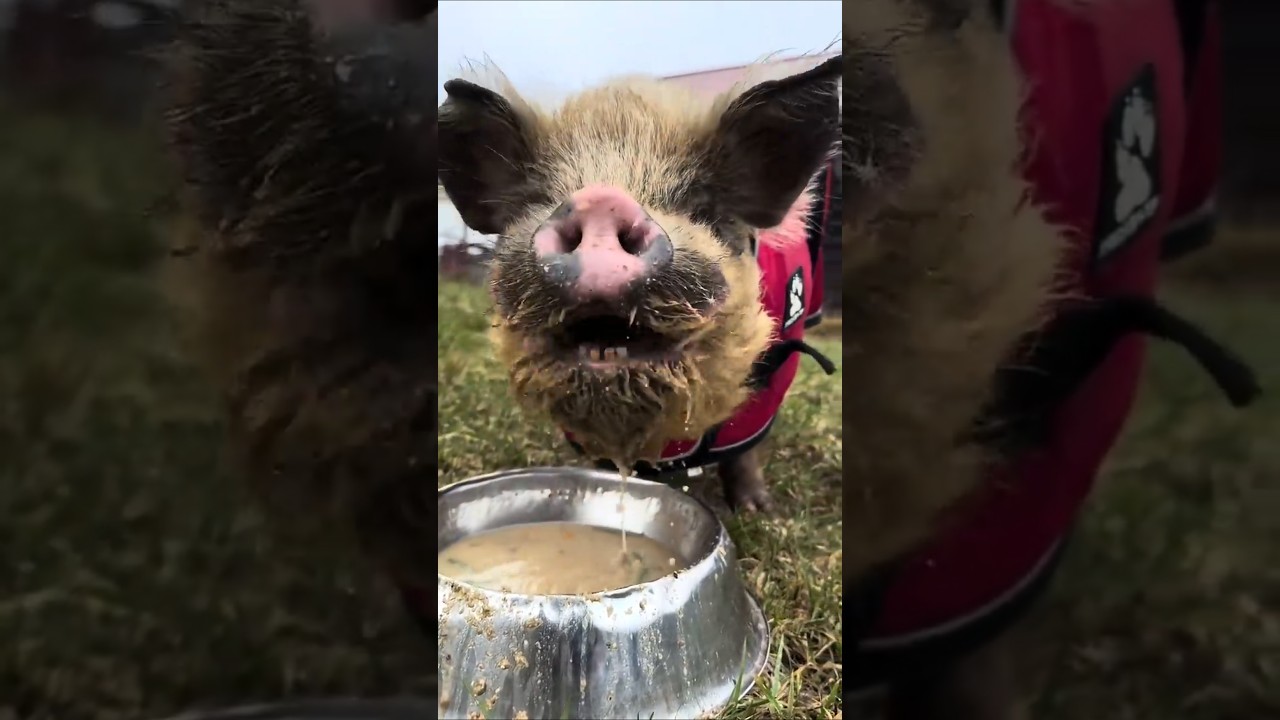
That is a Kunikuni pig.
A Kunikuni pig.
Kunikuni. He's my wing pig.
Your wing pig?
You guys have a wingman, I got a wing pig.
Wow.
Hi, buddy.
Looks like a gentle giant.
He is.
And actually, this is one of the smallest, if not the smallest, breed of pig in the world. Wow. So Kunikunis are a very rare breed. This is a heritage breed, so this is an endangered species, but an endangered breed big pig.
How much does he weigh?
So he, uh, just weighed him yesterday, he was 204 pounds.
Oh, like a regular human being. We can easily take him on the plane if you need transport somewhere. Oh wow. What do you guys think about transporting some pigs? Why not? One pig? Okay, we could take one pig.
Oh, look at that.
Whoa, he gave me his— he gave me his paw.
So Kuni Kuni is a lucky one. This little little piggy's never going to market, but he did go wee wee wee all over my home. I bet pigs, kittens, puppies, and children share something in common— none of them come pre-potty trained. You know something about that, right?
I do. 200 pounds.
Yeah, and top out at 300 pounds.
Wow.
Not these boarins, but he is a male pig and they top out at 300 pounds. Um, so he's got another year to, to grow into his body, but It is the smallest breed of pig, or one of the smallest. So although he looks big, put him side by side, shoulder to shoulder, with a hog from a production farm, he's going to be dwarfed. He was on a production farm, but this is a lucky one. I sprung him from that farm. We paid good money to get him off that farm, drove him up from Pennsylvania. This piggy's been to Maine 3 times. He's been to Tennessee on family vacation. So once we amazing animal.
They become part of beautiful, beautiful.
All right, seen thousands of kids, as will these foxes, but in a way that is not stressful to the animals. I have close to 100 animals, so everybody gets time off, obviously. Um, and, uh, we love our animals. They're part of our family.
Absolutely. And you got someone else to show us real quick, right? And then we'll get Wes on his way.
Ruthie says she wants the Pilots to the Rescue back backpack.
Okay, is that your daughter?
My 15-year-old daughter.
Okay, you got it. Wes, would you mind just opening that door there for me?
Thank you, sir.
Wes is talking about, uh, his daughter wants a Pilots to Rescue backpack. So we got these Pilots to Rescue backpacks, uh, you can order them from our website. We got Pilots to Rescue hats, this is a distressed hat. We got Pilots to Rescue shirts. Thank you for everybody supporting us. And purchasing our merch. And we got someone else here to show. Who's this?
So a pig and a parrot go to the airfield.
A pig and a parrot. Now pick up a fox. This parrot's not gonna fly away for the punchline, weren't you? This parrot's not gonna fly away though. Uh, no, no, no, no.
You have the ability to fly too. Are you flying away? No, no. So there are a couple reasons for this. One is that he doesn't know where he is. Um, he knows me We have a great relationship. And so the other is that with captive birds that are used for education, it can be dangerous for them to be fully flighted. So although he can fly, flight feathers are typically trimmed, which doesn't hurt the bird, but obviously birds like to fly. And where should Sydney be in Australia? And that's my message to kids. But for his own safety, if he flies into a window inside inside a building because he sees the forest on the outside, he can break his neck. If he's outside and he flies into a window, which birds often do, it's because they see the reflection of the forest and the sky in the window. So no, he's not likely to fly away from me, and if he did fly, it would be because he got scared by something else. And he cannot fly far. I wish we never had to trim his wings— his, I should say, feathers. Trimming of the wings sounds right.
It would hurt.
But it's like, it's like trimming your nails, trimming your hair. But it does deprive him of the ability to fully fly, which I wish he could do.
Oh, it's beautiful, beautiful.
That's why I wish he was in Australia, which is what his name suggests.
Great. Well, thanks again.
Would live close to where Kuni is from. Kuni pigs are from the island of New Zealand.
Oh wow.
Sydney would live on Australia. Kunis were the pig of the Maori people, and they were brought to New Zealand on whaling ships.
So fantastic.
And they don't know where they came from prior to that. So my pig is a pig of mystery.
Pig of mystery. Well, thank you very much, Chris and Wes. Wes, have a great trip back. Your timing was impeccable.
Oh, good.
Yeah. And we'll be in touch. Yeah. All right, guys. You got it. Have a good trip back. You got it. Take care.
Michael, could I get a picture of you before you take off?
Oh, yeah. Okay. I'm going to sign off now. Michael Schneider. Pilots to Rescue, thanks again everyone for your support. We truly appreciate it, and we'll talk to you later at our next rescue. Bye now.