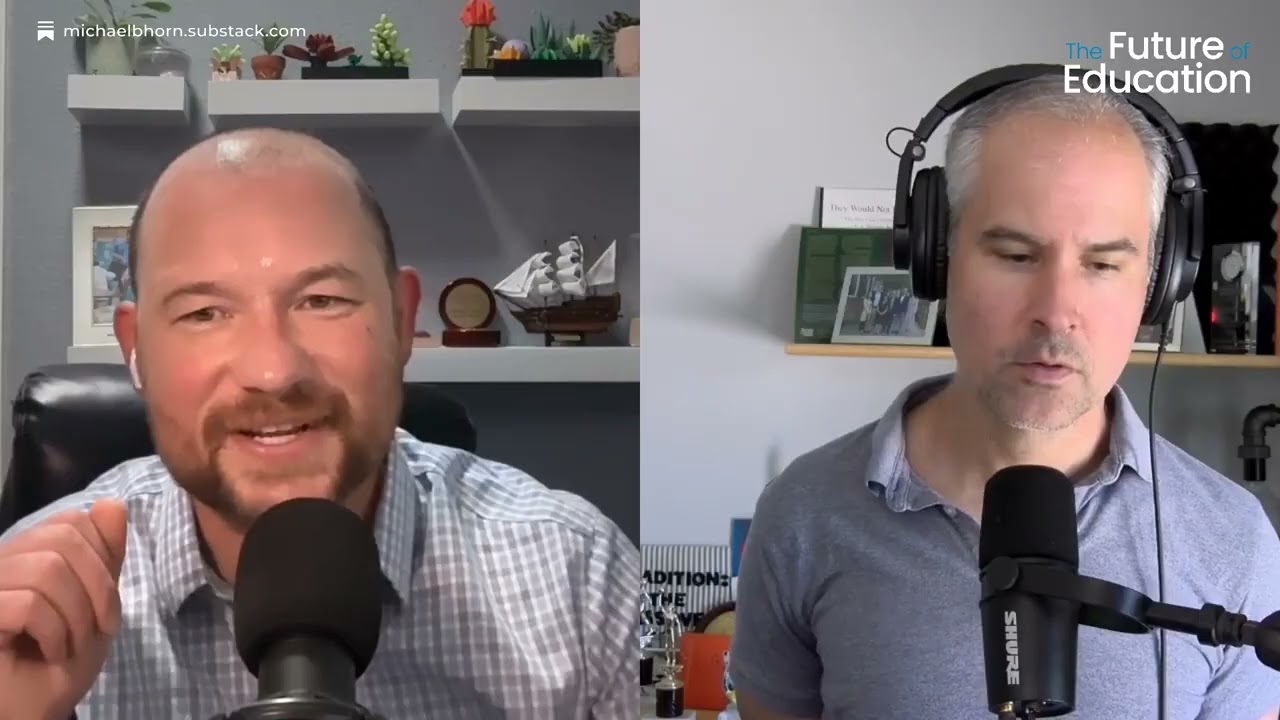
Alpha School, AI and the Reinvention of Education: A Conversation with Joe Liemandt & Michael Horn

In this recorded conversation moderated by Rags Gupta at Whoop headquarters, Michael Horn and Joe Liemandt discuss the role of AI in K‑12 education and how Alpha School’s Timeback model re‑imagines the school day. They argue that AI is now ubiquitous in schools, but its impact depends on the underlying learning model. Alpha uses AI‑driven personalized tutors to deliver mastery‑based instruction in two intensive hours, giving students "time back" for afternoon workshops that focus on motivation, socialization, and life‑skill development. The dialogue expands to cover how anxiety and mental‑health issues in traditional schools are mitigated through Alpha’s Dream Launcher vision‑board process, the 168‑hour project that tracks students’ weekly time use, and reduced academic seat‑time (2‑3 hours per day) that frees up afternoons for purposeful projects. They describe how these practices help students align their passions with daily actions, reducing the disconnect that fuels anxiety. The conversation also touches on equity risks (cognitive off‑loading, cheat‑bots), the potential for AI to raise the floor of achievement when paired with a redesigned model, and the equity implications of scaling such models. Scaling levers such as education savings accounts (ESAs), vouchers, and the upcoming Education Credit Clearinghouse Act (ECCA) are discussed, along with a question from Rebecca Wolfe about state‑level adoption and bottom‑up innovation. Participants express optimism about entrepreneurship: many founders are seeking access to Alpha’s Timeback platform, a 17‑year‑old student is building his own version, and parents’ strong demand is seen as a catalyst for broader adoption. The conversation also delves into Alpha’s for‑profit structure as a means to secure capital for rapid scaling, the transformation of teacher roles (high pay, focus on motivation rather than content delivery), and a data‑driven closed‑loop curriculum that iterates based on mastery metrics and parent oversight. Finally, they discuss the future of schooling as a network of specialized “centers” offering choice, the risk of polarization, and the importance of human relationships in an AI‑enhanced education system.
Chapters
Welcome to the Future of Education.
And now here's your host, Michael Horn.
Several weeks back, the Massachusetts AI Coalition hosted me along with Joe Limon in a conversation about Alpha Schools, the reinvention of learning in general, the role that AI could or may not play in reinventing education, all hosted at Whoop headquarters in a conversation that was moderated by Rags Gupta. Fascinating conversation. We covered a ton and we have a recording of it. So we thought we would repurpose it for you here on The Future of Education. Enjoy the conversation that I had with Rags Gupta and Joe Limont of Alpha School at Whoop headquarters.
What are the skills that matter that we're going to get these kids ready for?
Welcome, Michael Horn, and welcome, Joe Lemont.
Thank you.
We're going to kick it off. And Michael, we're going to start with you. We're 2 or 3 years into this AI wave. Where are we? And how is AI best being deployed in education today? What are you seeing out there?
Yeah, it's— is this on?
Yeah, perfect.
It's interesting because I think there's a couple answers to that question. On the one hand, education, when I started, when we wrote that book, it was thought of as the backwater of technology. It's where you never saw it. It was, if it was there, it was rarely used and so forth. I think we are at a very different moment where, for better or worse, AI is ubiquitous in K-12 schools across the country. Meaning that if you think beyond just a chatbot, or if you do think of a chatbot, It's embedded in almost every product— Chromebook, Magic School, various apps that are being used. The average school district has nearly 3,000 apps that are being used. AI is somewhere in there, to say nothing of the fact of how students and teachers are using it on their own time. So on one level, it's everywhere. And on the other level, I would argue that what matters far more— and I think Joe's going to agree on this— is not the technology per se, but the learning model itself, or the model of schooling itself. And so on the reinvention question of how is AI being used, there are a handful of models, I think, Alpha being one, that are putting AI at the centerpiece and creating truly new school models. And that is a significant minority of the action, I would argue. Most of the AI is being leveraged onto the traditional status quo to either reinforce existing processes and priorities, or frankly, in some cases, the better verb would be to exacerbate them.
I'm gonna pull on that thread a little bit, but Joe, you've been studying this for a while. Where are we in the cycle of deploying AI in education?
Well, I believe we're right at the beginning of it. I do believe it's ubiquitous, but I believe, you know, I believe there is, in all the debates, I believe there is good screen time, there is bad screen time, there is good AI, there is bad AI. And all the concerns right now about it being deployed poorly are very well-founded. You know, 90% of chatbot use in schools is for cheatbots, right? And it's— chatbots are designed for cognitive offload, literally the opposite of learning. And if used incorrectly, we literally are going to have a generation who knows much less than they need to. Now, I also obviously believe there's good use of it and using it correctly. And I believe part of that is, at least, and our whole theory is, you have to re-envision the whole school day from the ground up. It enables this totally new model, and that part of it is just at the start. I've spent a lot of time talking to a lot of schools all over the place, and the first question I ask of them is, our first commitment to every kid is that you will love school. Right? And 3 weeks ago when we did our last survey, 43% of our students said, I'd rather go to school than go on vacation. Right? Like a high bar of loving school. 90-some percent said they love it. And my first question to everybody, and they say, oh, can I use this, you know, Alpha Timeback model? I'm like, are you willing to redesign your school day so that kids love school more than vacation? And my view is, if the answer is no, then using AI to reinforce your existing school system is not going to work. It's going to have the same failure rate of edtech over the last 25 years, which is 95% failure rate or something like that.
Michael, you're nodding your head. It sounds like you agree. And is that what you were talking about earlier when you were saying that AI could exacerbate existing problems today?
Yeah, that's exactly it. I mean, I think in Disrupting Class, though, we got a few things right. We got a few things wrong. We could talk about both, perhaps. But one of the things we got right was layered on the existing system. would not have the effects that people wanted it to have. That when you layer it on into this industrial model, as you described, where time is fixed, learning is highly variable, and we have basically advancing kids based on date of manufacture, otherwise known as their birth year, that you are not going to get the impact that you want. And I think what we missed, frankly, in the book was just how bad that could be, which is what Joe is alluding to in terms of the detrimental impacts.
Yeah.
Sort of incoherence, frankly. Again, those 3,000 apps, like, that's not a good thing, I don't think.
Mm-hm.
We know coherence in terms of curriculum and instruction and knowledge building and so forth is really important. We have a very incoherent, right now, school day. And then I think the second thing that we didn't see coming, frankly, is with the online usage. You, you know, you put the Chromebook in front of the kid, most powerful learning tool ever in front of anyone, And they have a billion other things that they could also be doing that are extremely motivating, distracting, and so forth. And the detrimental impacts of that are real, right? And so there's a lot of research, and Joe referenced it, there's this 5% problem where there's some great edtech solutions, even relatively primitive in terms of the form factor of what you're asking and how someone can input an answer and so forth. get really good results, and only 5% of kids really use them because we haven't actually re-architected the school models to create the feedback loops and motivation where they say, I would want to do that, or that's built into my day and that's the core of the experience in a way that actually moves us past that 5% number today.
So Joe, walk us through how you guys are doing it. today? Like, what is that? I mean, that 2x learning in 2 hours, it's a big statement.
Yeah.
How's that work?
So the first thing you have to— we'll talk about how it works. But the first thing you have to believe is that we've known for 40 years how kids could learn 2, 5, or 10 times faster, right? That it's not the AIs that actually do that. It's the field of learning science, right? And I'm sure we have some Harvard GSE students here, or Stanford, or any of them, where there have been papers written about how kids can do this, right? Where if you have used things like— if everybody had a personalized tutor, if you hold kids to a mastery standard instead of a time-based standard, if you were able to embed things like spaced repetition, right, instead of cramming— all these concepts have been out. There's 10,000 papers written about it. But they all started with, this model doesn't work with a teacher in front of a classroom, right? When you have 1 to 30, you can't do mastery-based learning. You can't make sure that every kid is in the zone of proximal development where they're getting 80 to 85% of their lessons and questions correct, right? You just can't do that with a teacher in front of the classroom model. And the enabler of all of this is with a personalized tutor who sits here and gives you an unending stream of content lessons that enforce a mastery standard at 80 to 85%, kids can learn 10 times faster. And so the way we operationalize it in our school is you come in and you actually have a 15-minute launch, you know, think Tony Robbins for kids and growth mindset and all that. And then they sit down at their computer Right. And they do 25-minute sessions with breaks between them, and they're going to do your math, science, language, reading, writing, right, the all the core subjects. And they're doing 25 minutes at a time, and during that 2 hours, they are going to learn twice as much as if they sat in class for 6 and did homework. And so, you know, and that's all measured by standardized tests. So, you know, one of the first Standardized tests, obviously a lot of debate around them. 60% of Alpha families before they came to Alpha didn't like standardized tests. The day you join, you decide standardized tests are the greatest thing ever because you definitely don't believe Joe when he says, don't worry, your kid's learning, right? You're like, show me the proof, show me the proof. And so we do everything with standardized tests. We're the highest on any standardized test. We're the best academic performing school in the country.
Right.
On every grade level, every subject is top 1%. You know, our freshmen, when we get to high school, we switch from NWEA MAP, which we use, to SATs and APs, right? Our freshman average, right, of SATs is over 1400, right? Our high school is 1550. And so our ability to, you know, score max, to show parents, yes, they get a 5 on Calc BC, they do know this stuff, and it only took 2 hours, right, is the big unlock. And then the second part of how it operationally— you know, as principal, the one thing I can tell you that parents really, really don't like and wouldn't want is us to send the kids home after 2 hours. They're like, you got them all day, you know. And, and that actually leads to what I think, you know, right now nobody believes that first part, and we're pushing out enough data. And I don't know, and all of you, you know, 2 years from now, everybody in this audience is going to be like, okay, that works. Right? We're going to have enough data pushed out at scale and the set will be big enough. Where the real discussion that's going to occur for the next decade is going to be, what are the skills that they should be learning the rest of the day? Right? That this new world's coming. We all don't know what it is. We all are guessing. We're like this, you know, I talk to a lot of kindergarten moms, right? And we're like, 12 years from now, right? What is the world we're getting them ready for? for, right? And he talked about, right, right, he talked about here's the life skills that we've done, here's what we're doing, right? But I believe over the next 12 years it's going to evolve, right? But every parent, and I believe every society, is going to be faced with the decision of what are the skills that matter that we're going to get these kids ready for. And that's what, you know, every department, you know, there's lots of ministers of education Departments of education where instead of what the classic reading, writing, arithmetic is, because that's going to be for all intents and purposes commoditized, right? That you can learn that in 2 hours. They're going to be spending their time saying, how are we getting either my kids ready, if you're a parent, or a population ready, right? How are we getting our society ready for the future?
Michael, what's your take on all this? What would you say? What would Clay Christensen have said about a model like this? What else are you seeing out there, other models similar to this?
Well, so let me just say something that we got really wrong in disrupting class and start there to answer the question, I think, which is we had this notion that it would be disrupting the classroom model within schools. That there would be— so for those that don't know, disruptive innovation, basic idea is relatively primitive product comes more affordable, more convenient, more accessible, simpler to use. People who can't get access to it are delighted with this quote unquote more primitive thing that then gets better powered by a technology enabler. And people flock out to that because they're like, wait a minute, I want that thing. And that's how transformation occurs in sector after sector. Now, when we looked at the US at the time in 2006, I guess we were writing it. I see some of my classmates back there when we started. So there was no non-consumption of schooling in the US. It was compulsory.
Right.
There was some homeschooling, but as Joe said, the problem with homeschooling is the word home.
It doesn't scale.
And so the challenge was like, where are these areas? And so we thought within school there's all these classes that schools would like to offer and can't. And the challenge I think as we saw is that yeah, you can grow digital learning within those environments.
They have.
But it would be subsumed by the rules of the school. So the seat time being the biggest, frankly. And what I think has really changed pretty dramatically. So about 2013-14, this notion of microschools started to become bigger and bigger in the US. And then the big change was education savings accounts, which all of a sudden sends dollars to the families in about almost 20 states across the country now. And these new schooling models, I have a choice. Do I go to the quote unquote free public school?
Yeah.
Give up this money that I can use à la carte on my kids' education? Or do I spend it now on something that's much more customized for their needs, desires, etc., etc.? And I think that is like, that's creating a wave of entrepreneurship. I think it's never been a better time to be a K-12 school entrepreneur than right now.
Right.
The tools, the policy, families looking for other options is, I think, a big opportunity. So I'm like, when I look at the landscape, I think we're going to see more and more of these models I could name half a dozen right now, but the point is we're going to see more come along. And I'll just make one plug, which is in my mind, Timeback might be one of these technology enabler kernels that then powers a whole wave of entrepreneurship depending on what Joe decides to do and how it works. Right. There's a bunch of design questions there, but like that may be part of this technology enabler of a lot more school models that appear.
So yeah, a lot to unpack there. But just as a clarification, Timeback, that's the name of the platform that Alpha's built, right? And yeah. Just talk— yeah, talk about Time Back.
Sure. So back to me becoming principal, I'm a product guy, right? And so 4 years ago, I told McKinsey, who had started the school, you know, I'm in. I believe GenAI is going to be able to get this out to a billion kids. But I have to be principal. I have to go see what happens when 5th graders get in a fight and when parents yell at you and how do we design a product. And, you know, every educator will tell you the key that you need to educate a child is first and foremost, the most important part is you need a motivated student. And then second, you need to put them in lessons of the correct difficulty, not too easy, not too hard. Those are the 2 core elements. Edtech historically has done the second well. Whether it's AI or not AI, you can give people assessment and figure out what they know and don't know and give them lessons because knowledge grade and age grade are 2 totally different things, as you said. And the problem is when the gap between those gets too big is when the teacher in front of the classroom model fails. Right? And so we were able to— our engine is able to do that second part, give kids lessons of the correct difficulty. But if I don't get students to engage, it's useless. This is the 5% problem, right? And so, you know, in McKinsey, you know, when her first commitment is kids will love school. So I come in my first week, I'm talking to some 5th graders, you know, and they're new, and I'm like, all right, Do you love school? And they're like, no. And I'm like, what would make you love school? And they're like, less school. I'm like, how much less?
None.
I'm like, that seems a little light, you know? And so I was like, how about this? If I— would you engage in these apps for 2 hours? Like, no screwing around, like really engage with them for 2 hours if I made sure the other 4 hours were totally awesome, that you loved them? That you would just sit here and do that. And the kids are like, okay, that seems fair. And so literally the number one motivator 4 years in that I can tell you of kids is give kids their time back. And if you give your kids your time back, there's a lot of things you'll read about Alpha. We use lots of motivational models and we've talked through all of them. It's a whole nother talk of extrinsic versus intrinsic. But the single biggest motivator by far is give kids their time back. And so when you tell kids you can learn all your academics in 2 hours and then do what you want the rest of the day, do all the awesome stuff you love, they engage in the apps. And so I went to my team, I'm like, okay, we got 2 hours, let's go take every learning science thing. Dean Schwartz at Stanford's got a book, A to Z, where I'm literally like, okay, we're gonna take chapter K, right? We're gonna implement in the software, right? And we're gonna take all these learning science concepts, put it in, and get 2 hours because that's what we got. And so the whole key of this software is give kids their time back. And then the afternoons are all these great workshops that they love and that they engage in. And I'll give you sort of the most extreme case. It's not Alpha, but it's a sister school that we have in Austin or in Texas, which is we have Texas Sports Academy. It'll probably be announced later this week that we'll have thousands of kids in Texas Sports Academy who are all families under $65,000 who got a voucher. Right, who now next year will be able to access Alpha Academics. But the model there, just as an example, give those kids your time back. The average kid coming into our sports academy is in the bottom 25% academically, right, below $65,000 family income. And their knowledge grade versus age grade, right, bottom 25% in America means if you're in 7th or 8th grade, if you're a middle schooler, you're really in 3rd grade. Right. You need 3rd grade phonics. You need to understand, you need to learn what 7 times 8 is to fluency. And so our students who haven't been engaging, right, our middle school as an example in Dallas is run by 6-time NBA All-Star Jermaine O'Neal. And there are kids who, when you sit and talk to them, they're like, I used to skip school 25% of the time, right? I, right, I, we just get stoned in the bathroom. And now I wake my mom up to make sure we're never late because I got to get my 2 hours in because I'm not going to miss 1 minute of practice with Jermaine, right? That starts at noon if they get through the— get through their lessons, right? And those kids are learning as fast as, right, anybody in the $50,000 high-end private school, right? Because they're motivated, right? That you solve the motivation problem. And so when you think about it, whether it's the Alpha workshops and you hear about all these crazy things on the entrepreneurship one, you know, we have 5th graders launching food trucks and Our middle schoolers, you know, learned Ukrainian and went to Ukraine to train 1,000 Ukrainian refugees on the software and all these crazy great workshops that motivate kids, right?
It—
what really matters is what is that afternoon that's going to get them to engage. And if you give them their time back, they will.
So, you know, let's talk about that access. And, you know, there's this notion of AI and It can raise the ceiling, and there's also the floor, right? Or is it going to raise the floor? Is it going to widen the gap that's out there today? Or could it narrow it? Michael, what's your take?
I think—
gosh, I hate to be a broken record. I'm going to say it depends on the school model again, right? So I actually think it's going to— I think it certainly raises the floor when we rethink the school model. But I think it's going to lower dramatically the floor Potentially because of the cognitive offloading problem that Joe described up front, when we have not put that thought into it. And so, you know, when I talk to a traditional school that's trying to implement an app, I say, okay, like, tell— help me understand your current model. And they have to be able to articulate that up front. And then, like, is there a discrete use where you could use, you know, mirror learning is a great way, AI-powered way to Build literacy skills for young kids. Great peer-reviewed research and so forth. Can you create a dedicated block for that? That's something that's going to raise the floor, right? But again, sort of this unmitigated use without thought and intentionality and design around the model itself, I'm pretty worried about where that goes if we don't— if we're not more deliberate. And I think that's why— and just for everyone here, like, that's broadly, I think, why we have this weird parallel track. where you can have the kind of enthusiasm and excitement around something like Alpha that you have, simultaneously as on Capitol Hill you'll have hearings about banning technology in schools. And so like how to resolve the dichotomy, I think that's what it is, is like you actually have to think about the model itself first.
That's well put. Joe, any take on that? And feel free to weigh in.
I think this whole debate around AI is it can be used poorly and learning outcomes are going to plummet. And the, the only part that I add is it's occurring because the kids are already using it. And so the longer you wait, you know, so we, we have hundreds of kids who transfer in from high-end private schools into, into Alpha, right? And these are coming in from $50,000, best schools in the country, right? And our middle schoolers, right, when they transfer in, uh, on average when they transferred in in August were 2.2 grade levels Right? We have 6th and 7th and 8th graders who can't write a grammatically correct 3rd grade, 4th grade sentence because they've been using ChatGPT to write. They were never taught sentences, right? They were never taught, right, how to build an essay, and they just cognitively offload and have it written, right? And you— the, the academic standards, right, because it's being used by the kids at home and the current system isn't set up to stop it Universities have— Stanford, for the first time in 100 years now, is proctoring tests because cheating is so rampant. When I was there, it was total honor code.
Right.
But totally the culture of what is considered cheating and what is acceptable now— they proct— my daughter goes there and she's like— I'm like, proctors, really? And she's like, oh, Dad, the cheating's crazy. And they won't— you can't go to the bathroom for too long or the proctor's like, because they're doing it, which is, you know, at Stanford. So this whole concept of it's something that needs to be addressed, it's a problem. Now, the second part though, the other side of is it going to raise the ceilings, you know, is it going to raise the roof? I, I believe done right, it's going to raise the floor like crazy, right? And we are going to take— we're going to show, right, that what matters more is not your SES, which is our current system, right? It's all SES-based in a time-based system. It's going to be motivation-based. Right? Like if you take my sports academy guy and then you move them to my gifted school, right, where they're not excited by the motivation, it's not going to work. And so I believe schools are going to have to select for motivation, right? Did you design a school that the kid loves more than vacation? And if you love sports, you're going to want to be in that. Gifted school is one. We have a gifted school just for that data side on the roof. Those are kids who, when you say, what would make you love school, they say more academics. I want Math Olympiad. I— third power hour. Can I have a third power? This 2 hours is not enough, right? And those kids, it's crazy how much, right, on how much they're learning. So we have, you know, I have kindergartners in 6th grade. My 3rd and 4th graders outscore 50% of the high school graduates in the country, right? And they just, right, take to it. And so I believe both sides are doable, right? You can do both, but it's how you implement it.
So let's keep on that track. You know, how does that scale? You know, you talked about reaching a billion kids eventually, right, Joe? And how does that happen, right? And you've tried with publics in the past, right? And how do you see that play out? And then we'll go to you, Michael.
Yeah, and so to his point that he made, which is there's 2 tracks is sort of I see it, which is there's the US system, you sort of have a $100 billion private school market today, right? ESAs, vouchers, the ECCA next year, ECCA, if it was fully implemented, would be like an extra $200 billion that would go to parents to do private school. What is the ECCA for people that don't know? Sorry, the ECCA is a nationwide voucher program that starts January 1st. States are doing it, and you're gonna get tens of billions, hundreds of billions are— every American can take a $1,700 tax deduction if they give it to a scholarship-granting organization. $100 million times $1,700 is what the size of that is. So, the largest— back to your entrepreneur shop, the largest subsidy outside of healthcare in American history, right? And that starts January 1st. And so, the current market's $100 billion, which is still plenty big. It's going to get even bigger. And in those markets, right, and what I see is Parents wake up and say, what is the solution I can buy tomorrow for my kid? Because time's a-wastin'. The urgency is off the rail. Like, for everybody here who's interested in an alpha school, right? When we meet after this, they're gonna be like, is the school gonna be open in May or June?
Right.
I heard you have a summer program. Is that summer program— is it gonna be ready? There's no time. The pressure we have to scale is enormous. There's 50 Alphas that are gonna open up. I'm flying around the country and every city is like this, that every parent who wants this is pushing hard. Now, the flip side of it is on the public school side, you have a different set of issues that I believe we'll be able to show people, yes, it would work. But we're working with lots of states. We're rolling it out to public. There will be public schools in August running on our system, right? But there's also states where we're not running on the public school because they have a rule and regulations— education is highly, highly regulated— where they say things like there needs to be 7 hours of seat time. And I'm like, I'm 2-hour learning. I can't, I can't bridge that gap, right? And so that whole thing, like, I— if, if Massachusetts has 100, you know, Massachusetts has a million kids, You spend $23,000 to $25,000 a kid. We absolutely could build an Alpha-like model that would deliver awesome MCAS, if you want to use your standardized test, MCAS academic outcomes for those million kids. We would have to develop different school systems to have different motivational models. We'd have to have a sports academy, gifted. And we have a Montessori school and a wilderness school and an Alpha, all these different ones. You could totally deliver that. Except— and my team would be up here tomorrow, right? We'd make it— we do a deal where it'd be 100% outcome-based. If we don't deliver it, don't pay us, right? That my team would love to go do that. The problem is they're then going to meet, and I don't know what rules Massachusetts has, but, you know, 7 hours might be one of them, right? And there's a whole bunch of other ones that are going to prohibit or slow down how fast public schools adopt it. And so our answer in the short term of how we get it to a billion kids is we're going direct to the parents who have urgency. And if you want the most extreme example, and if we just sort of keep it among us because it's not really announced, is, you know, we have that kids will play and have as much fun as if they were playing a video game, and they will get to top 1% academic performance, and that will be free to learn for 500 million Kids. Right. And so back to just reach, we're going to be coming up with a lot of things where you have to solve motivation. You can't just do edtech, right? 90% of the solution is motivation. 10% is the edtech. And so you'll see us, right? How do we get reach? How do we get cost? Right? How do we get that out there? But once things like that are out, every parent's going to say, wait, what are they doing the rest of the day? What are the life skills we care about? The whole— what are we really defining as development of a child for the next decade?
Michael, what's your take on that? Do you agree?
I mean, with a lot of that, yeah. I think that we're— unprecedented opportunity. And I think it's largely going to start outside the public system for the reasons just said. And parents are voting with their feet right now. I think depending on how you think about it, but if you want to be really provocative, 50-plus percent of kids are already in schools of choice as measured by where they bought the house or by taking advantage of some form of school choice, private school, charter school, something like that in the country. If you look at certain states, frankly, so let's just take Florida that has probably the longest history with education choice. And I actually like to use the phrase education choice because what you're seeing families there do increasingly is say, I actually want a couple classes at my public school district. I want the world's best tutor for this here. My kid wants piano here. And assembling a la carte.
Unbundling school.
Unbundling school.
Unbundling.
Right.
And so what you're starting to see there, because so many families are opting into these alternative forms that are rethinking education with entrepreneurs driving some really interesting things in these communities, is public school districts are saying, wait a second, we have a choice in effect. We just let this happen or we compete. And so you are seeing public school districts— I've got students here at Harvard who are profiling some public schools in North Carolina, I believe, who have their own micro schools. You've got places in Florida that are unbundling different parts. Like, we are actually the best at doing this in the area, let's make it open, right? And so you're starting to see innovation and so forth. And again, I'm not saying everyone's going to unbundle. That's not the message here. But the message, I think, is you're going to start to see a lot more innovation from all sectors as the pressure ramps up.
The pressure on the traditional bundle.
The pressure on the traditional bundle and parents voting with their feet. I mean, gotten to hear your story. And I think a lot of families have had that where they look at their 5th graders, the homework that they're bringing home, and they're saying, are you kidding? And what happened during COVID Seeing it up close, plus these policy changes, plus this opportunity for entrepreneurship, creates a real opportunity to rethink something that's been very, very rigid in this country for a long time.
And you're touching a nerve because our 5th grader, I think in September, came back with a worksheet or 2. And see me afterwards, I'll show you a picture. And I think that was the straw that broke the camel's back. It was outrageous. And we're in a blue ribbon school in a really good school district. Yeah, so you're touching a nerve there. Let's go to the human element of this. Actually, someone in the audience, Brandon, he said something which is that, he wrote something which is that his current test for AI is does it create more time for human relationships, right? You hear about AI in schools and some of the press out there and you sort of think about this dystopian future of like our kids just plugged in and just like on screens all day and just sort of like, not talking to anybody and so on, right? What is— I mean, how does Alpha handle that? And then Michael, let's go to how do you see the humanity that AI can enable?
Yeah. And so great question for every parent, which is we view— they are on computers for 2 hours a day and all the good screen time, bad screen time, you have to do it. The rest of the day, they are in project-based workshops dealing with humans, right? Adult, right? I believe in 20 years, 90% of parents are going to drop their kids off at a building, and in that building are going to be other kids and adults, right? I.e., school. Now, if we do our job right, what happens during that 6 hours a day, 7 hours a day is completely different than what we all experienced. But socialization and relationship building, right? It's one of the life skills. We spend lots of time, right, as actually developing those skills. You know, in the average high school, you're not taught socialization, you experience it, right?
Yeah.
And when you go into every Mean Girls movie, right, you go in, you experience it. Our middle school program, like the number one, we, our middle school program is get kids ready for high school. And so on the academic side, you sort of dial, what do you want in your ISEE or what's your percentile? But the number one thing that kids care about that they're terrified is not academics, It's the high school social scene. So all our workshops are totally geared about socialization and relationship building because that's what they care about, and that's what they— those are the skills you need. You know, my oldest daughter, who's a sophomore at Stanford, loves academics, you know, introvert. You know, in high school, I just told her guide, I was like, she needs to spend all her time on relationship building and socialization, right? And she got her to write and make a Substack, so she started having an audience. She now has tens of thousands of moms who read it every week. But like, that guide, right, that adult, right, that trusted, caring adult would sit there. It took her 6— her name's Chloe, Harvard grad— it took her 6 months to convince my daughter to send a DM, right, to out there. She just, right, no, right, terrified. But 6 months to finally be able to do it.
Yeah.
And those are the kind of— back to the skills you want as a parent. I'm like, that's the skills that I want kids to develop.
Our kids did a shadow day in New York and gave us a lot of comfort because one of the things, the exercise they had to do was they had to figure out some dish to prepare, but there had to be unanimous consent on what to prepare. And it was the kids had to figure that out. It wasn't the adults actually inserting themselves to do it.
Yeah. No, in high school, back to teamwork and leadership, right? Most people believe the life skills are taught in after-school sports. 50% of America says the place you learn life skills is after-school sports— leadership, teamwork, grit, hard work, right? And for us in 8th grade, one of ours is, uh, we have a grit-teamwork combo, which is all the kids have to run a Tough Mudder adult course and cross the finish line at the same time. And the Tough Mudder is the easy part. Getting a group of 8th graders to cross the finish line at the same time is so hard, right? back to teamwork and socialization and all those skills. And, and, but that's— and, and it does. They have— they spend weeks and weeks and weeks, right, because we have all this time in the afternoon to develop those skills, right? Every school historically has said, we want entrepreneurship, we want all these life skills. There's no time. There's no time. Everybody— every kid in high school who's in the SAT grind and spending all time on the hours and hours of homework, when are you going to teach these life skills? Alpha has half the day for 12 years to fill up, right? We have tons of time, right? We're making up workshops. Oh, let's try this one, right? These are— right, that's what you need. If you don't get time back, you can't fix the current system.
What else to add? Yeah, um, I— so same statement, right? That to me, a good AI tool—
I agree with Brandon—
like, is, is one that actually increases human connectivity, not decreases it. I think that's 100% correct. And frankly, like a lot of the AI tools that are useful are not those that are going to necessarily be student-facing, right? They might be assessment to give rapid feedback. They might—
right? Yeah.
Everyone loves talking about data-driven decision-making in education. The big irony of that is we know from research that if you give data with no ability to do anything with that data and it labels you, it actually kills motivation. It does not increase motivation.
Yeah.
So something that actually is actionable and I can do something to improve performance, that's a dramatically different use, right, of these tools. So I think that has always been true, that technology to actually increase the human connectivity. And when people say, oh my gosh, what's gonna happen in the classroom? Like, I love that you all showed up, but this is not the most human connection like that we can do in a lecture-like setting. It's the individual conversations you all will be having afterwards. it's like the real human connectivity, right? And so these opportunities, whether working in projects, working on a sports thing, whatever, working on the actual thing that you learned in your academics that now is actually relevant to something that you're going to do together with group, that's where I think the real magic happens. And I guess just one last thing, Rags, on this, which is some of our— we had this research around what's the job to be done of why students hire school, and what does it compete with? And what you realize from a student's perspective is they really just want 2 things. They want a place where they can feel successful, and they want a place where, for most of them, that they can have fun with friends. There are a couple exceptions on that one, but most of them, they want to have a place where they can have fun with friends. And the places where you experience success and have fun with friends historically were extracurricular— sports, music, like after the school day. Which I think speaks volumes about how we thought about this. And so to me, the question is, how do you actually make the school day a place where every kid is experiencing success and having fun with friends? And when they disrupt class, right, then now it's actually— this is actually part of the learning.
Let me push you on that, and then we'll go to questions right afterwards. But, you know, we're hearing about this grade inflation, right? We're hearing valedictorians are in remedial math. Right? They're not— the valedictorians in Massachusetts are not being able to finish 4-year colleges, right? So they might feel successful.
I'm glad you said it.
So I should say— So what about standards?
Real success is real progress, right? That's the other part of it. I'm glad you said it, right? That objective yardstick matters. And whether it's the external assessment or frankly, as I produce a real project, having real professionals come in and give me actual feedback. Like real, not my teacher said, pat on the back, gold star, but like real feedback to a real standard. I think the best university— I teach at Harvard, but I think the best from a pedagogical standpoint university, one of the best is Western Governors University. They have— most of you probably haven't heard of it. They educate a quarter million students a year online in a mastery-based system. They have 4 different roles for faculty. One of them is like teaching and working with you and helping you master things and so forth. There's a whole separate faculty member whose sole job is to look at your performance against the standards to see, is this mastery or not? And if you didn't achieve it, you can't complain and say, oh, they hated me because we have a personality clash, because that person assessing you does not know you, right? And so they— and there's inter-rater reliability, there's other people, all also looking at the performance so that you actually have to do something that's excellent and masters. And thank God, because they're training nurses and people who are working in the healthcare system and so forth, and I want them to master it.
Yeah.
You want to say something about standards?
Well, I, I think there's a couple things on standards. One, this is why we use standardized tests. We don't use grades at Alpha because they're made up and subjective and inflation. We literally just take standardized tests and show you your results, right? And Knowledge is just something, how much, and if you don't like your score, you just go back and learn more.
Right.
It's just, you know, they're a reflection of how much you know, right? And so that's one, but the other part just about standards, one of the things that we talk, that people are worried about is because of all these things we do, which are, are Alpha standards too high? Is it too hard for my kid? And one of the things that we tell everybody before they come in is you have to believe this in the alpha world because this is what we believe and, and do, is the key to my child's happiness is high standards, right? I— if you say, I can't build a school that kids love more than vacation if I have low standards. The reason kids want to come, you'll see if you go on my Twitter account, these kids were in all over the weekend, right? They were doing a hackathon and building robots and drones and doing all this stuff, you know. And the reason they're coming in and they like school more than vacation is because they are working with their friends on a project that's hard, that has meaning. That's why, right? They're building an app, right? We have a project— back to character development, you know— where the key— all of our students believe the key to my happiness is contributing to my community. Right?
And so we—
last, last May, my high school students said, hey, can we keep the school open this summer? Because we don't want to take a break, right? And that was— I, I was like, I guess we're open all summer. But they're building an app to convince 100 million teens the key to their happiness is contributing to their community. And they're working with influencers and stuff. And so they, you know, they get all the social status and they love it. And it's really hard. And, you know, once again, if you go to the sports, right, as the model— people— I'm from Texas. Everybody in Texas expects people on the football team to be there in the summer. And the reason they're joined— they want to be on the Westlake state champion football team is it's the hardest thing the kid's ever done. He'll remember it the rest of his life, right? And school's the same thing. If you want to build a school they love more than vacation, you have to give these guys something to work on that they love, that's hard, that's challenging with their friends, right? And that's what we just do all day, right, is that world. And that's when we say we can re-envision it. You can now. And so back to standards, you either need— on the academic side, there are standards, just absolute standards and mastery. Get 100%, right? We have a school, we have a building with 250 kids that gets more hundreds on the Texas STAAR than a school district of 100,000, right? That's what you do with mastery, and time-based systems don't, right? And every kid at Alpha, if you talk to parents, less than 5% of Alpha parents when they come in think their kid can get 100 on the Texas STAAR, right? Just the GT kids, right? 95% of Alpha kids believe it because they've done it, right? And that's the difference when, when you get a mastery-based model, you know, versus a grade inflation, grade-based.
Well, thank you. Um, let's make this more human and let's go throw it open to some questions. A lot of questions. Okay, let's go with this gentleman here.
Um, thank you both for your time.
2, I think, quick questions. Um, who is this not for?
Like, what are the types of kids that this doesn't work well for?
And then the second question is, as far as I understand, it's for-profit, and why? Why not non-for-profit? Yeah, I'll address the nonprofit first and then, and then do who it's not for. Which is the reason we need for-profit is we need scale, right? We need scale, which is if you're nonprofit— I'm a product guy, right? A nonprofit who has a great product burns through its donations very quickly. There's a lot of really good charter schools who I met with who have 3,000-person waitlists. I'm like, why don't you open another campus? They're like, we're waiting on a $40 million donation to open on another campus, right? BASIS Schools, there's tons of them where if you put yourself as a nonprofit, you're basically hostage to the donation base. And fundamentally, education's a trillion-dollar K through 12 in the US, right? If you sum all the donations made to education, it's not enough to scale, right? Capitalism has to provide capital to transform education, right? And you wanna get the Fortnite team to come down It'll be free for 500 million kids, just like Fortnite was free. Fortnite was also the most profitable video game ever built. There's 10 million moms in America who will pay $100 a month for their kid to be top 1% performance when they ask for it. And that money is what's going to fund it. And so that for-profit loop is required. Alpha can get as much capital as we want to open as many of these schools that parents want. And that's obviously a different one, which is— There's also a different part that actually I got from listening to all your podcasts. Thank you. Which was, you can't do disruptive innovation when the competitive product's free. You actually have to come top down. And that's why Alpha is expensive. You need to actually do the Apple disruptive or Tesla disruptive innovation, not the bottom up. And so our view is we are going to get it to a billion kids. But the way to start is at the high end, Right? So that you actually create the funding so that you can do the rest. No, I mean, I put $1 billion in, but that's a drop in the bucket, right? When you talk about a trillion-dollar industry, right? The amount of capital that'll be required. Second, who's it not for? You know, number one, you know, the technology is not perfect and work for everybody, which is, you know, at the easiest part, the language models can't teach, you know, 4 and 5-year-olds how to read. it can't understand, right, what they're saying. And so we have human teachers, right, reading specialists who bootstrap you into reading, right? Once you can read, then I can take you on. The second one for a parent would be, if I can't get you to engage in the app, it's not going to work, right? So if I can't get— if I can't motivate, right, and I don't have you in an environment where you're motivated, then I'm worse than standard school because you're not going to learn anything.
Right.
Hopefully, at least if you're sitting in class hearing it, you would have learned something. And so I have to get engagement. And we measure it. And any parent where engagement isn't working, our guide's entire job is figuring out how to get the kid to engage. But back to what I said, if you take a parent who's like, I want my kid in GT school, and the kid doesn't wake up and say, I want more academics, Right. Even they can be as smart as you want, right? It's not going to solve it. And so you have to— it really is, you have to solve the motivational problem to get it to work. And then you also just then get into the school model itself, right? Where our model, while we have an individualized tutor, right, that gives them academic lessons and personalized learning, if you need a one-on-one human, our model is not built for that. It would, right. If you need a Fusion Academy, which has a one-on-one person, I believe they could use technology, but our model doesn't solve that problem. When you're designing your school, I believe schools now, instead of one-size-fits-all, you're gonna design a school for the kids. And that's gonna influence a lot of different things about how the day is spent and where you spend your money.
Yep.
Sarah, fellow disruptor. Joe and Michael, I'm really appreciative of this work that you're doing. It's so critical. We work in a nonprofit that works to help all schools think about how to make the motivation problem solved, right? We know that kids won't engage if they're not showing up. We've seen results that have shown a 35% decrease in chronic absenteeism, 200% 30% increases in family engagement. I very soon in the future see a way where this type of learning, this like 2-hour solution, will be in all schools. What I worry about is the other 4 to 5 hours, right? If the pond is not ready for this innovation, how can we support schools to rethink what they do with that time? My concern is that in low-income schools we're going to see more control come and less creativity and innovation. So I'd love to hear— I know that's not the specific problem you're working on right now, but I'd love to hear your thoughts on maybe some of the key levers that you see to disrupt that mindset.
Yeah, well, I completely agree with this. I love that you've jumped over the hurdle on everybody's gonna have 2-hour learning, 'cause I hope the rest of you get there real— 'cause once you do, this is all you worry about, right? I believe Alpha has the best learning science team in the world, right? who is building these engines on the academic side, making these work. I believe over the next 10 years, actually, Alpha Corps is what we call our life skills development. That team is actually going to be the ones who we think are going to be inventing the IP that really matters. I believe every Department of Education in every state has to be spending their time, moving their budget to say, this is what the problem is going to be, right? Because these skills matter. And what is the curriculum in the afternoon, right, that's going to deliver it? And I believe that's, you know, back to— we, you and I are over it, and we should sit and talk because we've jumped the, jumped the chasm. But I do believe a couple years from now when we have that discussion, that will be the discussion with a group like this.
So—
Oh, and Michael, you've talked a lot about that, about like, why don't High schoolers or kids work doing community projects in the community.
No, I mean, I think flipping the school day, right, is the way I would think about this, right? And we flipped classroom is what it is, but flipping the school day so that more of this time is spent on these sorts of projects and real-world opportunities. And I would go further, right? I think in this era of AI, everyone says, well, what are we doing for the future? We don't know. But what I think we do know Mm-hmm. Is the closer you can tighten that loop between experience and schooling, so you're getting experience in schooling itself, the more ready you are going to be to jump into work, to set goals, to learn what you need to do to be productive, and maybe most important, build social capital. Because the way people get jobs is through who you know. And we have a mindset of kids, students, who think that, oh, I apply online to get jobs, not realizing that North of 55%, maybe as high as 80% today of jobs are filled by network. That's going to get even more so because right now it's AI applying to AI, applicant tracking systems with AI-generated resumes. You better meet people. And the only way you bridge that gap is through school itself, is to pull experience into it, I think.
Adam, let's go to you.
So maybe zooming out for a moment, if we end up in this situation where we sort of realize some of this vision, and we have an amazing school for sports, and we have gifted school, and we have the school that's for drama and arts, and kids who go there, and the ones who love entrepreneurship.
Do we end up—
maybe there's one for the kids who are super passionate about evangelical Christianity, and the ones who are super passionate about atheism. And do we end up in a situation where we've sort of driven polarization into our society?
I'll take— what do you want to say?
Or you don't get a chance to hang out with the jocks, so the jocks don't get to put on a play. Yeah, that's a great question.
No, I think that's a great one, which is I actually believe that the model— I mean, our high schools are that today of the integrated one. And you have the jocks and you have drama, right? It's after-school activities are this model. We're looking at— and we're not at the scale yet— I literally believe school is going to evolve into a mall where in the morning you are going to have the 2 hours. And then your afternoon is like shopping in a mall. And no, you don't have to do gifted academics the whole time or sports the whole time. And there will be cross— in this case, cross-functional domains that you're going to want to have. You'll have a specialization, right? Because that's what I like, but I want to, you know, whatever is doing that. But you're going to do other things. Our, you know, at our sports academy, they very much are, I'm doing public speaking, right? Now, at sports academy, it's called post-game press conference. Because that's how you motivate a 10-year-old, right? Or financial literacy, right, and entrepreneurship is NIL contract, right? And so you're spinning it for what they like, right? But fundamentally, back to socialization being it, you're gonna wanna have all of those, right? One of the other things I think, schools are networks first, right? They're actually, whether it's a parent network, right, or the kid network, right, of your friends. Schools are primarily a network, right, that then tags on some other things like academics.
I largely agree with that. I didn't expect you to actually say that. So my vision of the future of schooling is much more actually similar, where they're actually community centers in effect, and that different centers of excellence, if you will, are plugging into them that give students choice. But this, like, I'm very skeptical that a single school model scales and educates everyone. But I think principles underlying learning do scale. So the analogy I like to use is rather than thinking about software engineering when we think about the grain size you were just talking about, civil engineering. Which is to say, how I build the bridge in Boston is different from San Francisco with earthquakes. But the laws undergirding that—
Yeah.
Right?
Actually are the same. And we haven't designed systems like that right now. And so the other reason I think this is important is, as a 14-year-old kid, I don't know who I am, right? And so I want to be able to try on these different pathways and identities and not have what I think right now we have, which is huge inertia or friction that prevents me from saying, oh, I'm going to go jump with that group now, right? And how do we break down those barriers? Last thing I will say is the choice to get out, frankly, of the school. I also think it will reduce some of the polarization right now in society because I think we tend to fight in our school communities over the 10% to 20% of things we disagree on. When you look at the actual survey data across the country, we agree on like 70% to 80% of the stuff. And if we can just take some of the friction or the tension out of the system, I actually think it'll do more to to bring communities together than what I perceive the current system, which is more segregated, frankly, by political belief than based on race at the moment.
I've listened to all your podcasts, which is why, and read everything you've ever read. That's what I was gonna say. No, I totally believe it, actually.
Michael, I'll ask, go to you.
Hi, so as a parent, it's very clear that the health of a school, the performance of a school, I think it has a heck of a lot to do with the people who are running the school, the staff. So my question is, what is your model for how you hire people? How is it different maybe from how a public school would hire people? And are these people— this is crassly— are these people making more, less, or the same? Do you have to pay more to get the people you want? Yeah, let's talk about teachers. This is important. Right, they're the adults in the building. They're gonna be here forever, right? Kids need adults to— a caring adult to help grow and develop them. And so at our school, you know, and this back to my background, I was like, okay, why is it so hard to hire teachers and what's the issue? So, you know, a teacher spec is basically a complicated spec, right? You need 5 things generally. One, you have to be a domain expert. I know 7th grade science. Second, you actually have to be able to teach it, not just know it. Third, you have to connect and motivate students. Fourth, you have to deal with parents. And fifth, admin, right? And so that's a complicated spec. Any head in my back business background, any HR director would say that's a complicated spec. So in America, the way we try to solve that is by underpaying them, and then we literally are like, oh my God, nobody applies for these jobs, and we have massive turnover. And any HR, I, I, it just— I'm like, well Every HR director in the world would say simplify the spec and pay more money. So at Alpha, we do both. So the key is those first two, right? You don't need to know seventh grade science, right? And the ten thousand learning science papers how to teach it because the AI does that, right? But you have to be the world's best at connecting and motivating students, right? And we also have a dean of parents role to take the parent side off because I actually was told. This teacher is really great with kids, but they can't handle the parents, so don't promote. And vice versa, where, oh, not as good with kids, but the parents love them, so promote. And I'm like, we will never have that at our school. I want you to be great with 8-year-olds, and I don't care how you are with 30. And so we simplified the spec. We pay more money. So at every alpha, the minimum is $100,000. In cities like New York, it's like $140,000, $150,000. I'd have to check to go get great talent. Go get the talent. And then second, when you, when you talk about it and, you know, the role of teacher, if you talk to, you know, Wendy at Teach for America, right, or whatever, you know, and you say things like teachers became teachers to transform kids' lives, not grade 7th grade science quizzes, right? Every parent, every adult had 1 or 2 teachers who transformed your life. It wasn't because they marked your paper up. It was because they saw you, right? They connected. And they motivated you to greatness, that you were able to— right? They set high standards that you wanted to live up to, right? And that's what— that's why teachers are teachers, right? And that is why everybody who comes to Alpha— we had 80,000 people apply for our jobs, right, last year, because they— that's what they want to do all day, because that's what they do do at Alpha, right? Because they, during the 2 hours, they're taking the kids out for a one-on-one. And they're like, hey, how was the soccer tournament this weekend? Oh, did you lose? Okay, let's talk about— right? And they're connecting with the kids. They spend all their time on personal connection and can take those first 2 roles outside of it, right? And take those off. And so we believe when you talk about it, it's— they're running the afternoon life skill workshops and things like that. I do believe the role of teachers will transform, right, going forward. In our world, it does. but it is a better role for the teachers. It's scary, like any transformation is, but if you talk to all our ex-teachers, they're all coming here because they love the new role. That actually extends to university where we've been starting. The average researcher at university doesn't want to teach his 100 series classes. That's not what they're there for.
Let's go to Stephanie.
Hi.
Stephanie Menard.
committee member in Winchester, and I was curious how you determine your curriculum. Now, something like early elementary literacy can be controversial, but even things like current events— how do you talk about current conflicts in the Middle East? How do you have that conversation in those 2-hour sessions? You know, and you can even expand it to talk about history. You know, how do we talk about the Holocaust? How do we talk about slavery? How do you determine that conversation in those 2 hours? Yeah, no, okay, and I'll take it broadly. So when you talk about how we decide all the fights that are— I'll call them pedagogical— direct instruction versus inquiry learning, all this, literally we just follow all the data. So we have the only closed-loop system in education where our learning scientists take it, put it in, create the lessons, it goes to the kids. We measure how long it took them to get through it. Were they 90% first time right? Then they got— what did they score? How were their standardized tests? And then we improve it. And that just runs all the time. So we can tell you— we have data like— let's talk about memorizing multiplication tables and fluency as an example. Lots of schools have dumped it and said, we don't want that. It's not worth it. Every 3rd grader at Alpha knows it takes about 11 hours to do fact fluency. They're 3rd grade, takes about 11 hours. They also know that if they have fact fluency, 4th grade math takes 30 hours. That's it, right, to get to mastery. And if they don't have fact fluency, it takes 62 hours. Even a 3rd grader knows, I'm going to do fact fluency, right? So we just take all the data and present it. In general, inquiry learning is about 5 times slower than direct instruction. So the kids, if you're giving them the time back, right? Inquiry learning a lot is trying to solve the motivation problem. If you actually just have them do the direct instruction, the kids are like, I'll take that trade, right, to do it quickly so I can actually go to the workshop I really want, and sort of this half-and-half one. And so you're— we— it's all that, just— it's purely database that you present with the kids, right? We have a video game that teaches them fact fluency that takes, instead of 10 minutes a day, it takes 20 minutes. And those they have to do at home since it's more than the 10-minute block. And kids totally do that because it's a multi-user game and competition. About 30% of kids love that. If it goes to 30 minutes, though, they're like, oh, no, no, that's too long. Right? So there's all of that measurement on that. The second one you had, though, is really an important topic, which is what's going into my kid's brain. So the moment you decide, I'm going to have an AI tutor educate my kid, The next question is, who's in charge of it? Who's in charge of that AI tutor and what is going into my kid's brain? And so there's a couple different answers to this. One is every Alpha parent gets to see every lesson that their kid sees, right? And so if, you know, and we use core knowledge, right? And so if you're looking at what we're teaching, It's going to be standard Common Core curriculum with core knowledge overlay of knowledge building. But every parent can look at every AlphaRead article that's done, et cetera. And back to your point of it's 10% they fight about. Like in Texas, there's this big curriculum thing where they're changing it. It's like 3% of the lessons. And so we solve the problem just by letting parents go take them out. We put parents in charge. And I'm like, I'm not here to arbitrate it. Right? And so parents actually get to decide. Now, I still have to get the kid to the mastery standard and be able to pass all the tests, right? That's my responsibility. But parents get that control. I believe that's a broader question, right? We're talking to sovereigns, right?
Yeah.
And every sovereign and every parent is going to have to answer the question, what are the laws, right, customs, right, values, and curriculum I want to put in my kids' heads. So we're actually developing an EDU LLM that every parent and— well, maybe not parent, but every sovereign, right, or every state who has their own version is going to be able to train it for the curriculum they want, right? Laws, customs, values curriculum. And so as soon as the next question you have, as soon as AI tutors are doing it, is what is that? And in our answer It's right now, sort of parents can block it. The year from now answer will be, here's an LLM, you can decide.
In the way that you present, it seems to exist a strict separation between the academic component in the morning and the workshops in the afternoon. The way that I'm reading it, it must be a connection, right? I would expect that in the afternoon they are also building in what they are working and perhaps even discussing what they were learning in the morning. So, so that's, that's part of my question. How do you link both and how do you leverage that? The other question is about the resilience. So I find myself having my daughter with the expectation that everything has to be fun and life is not always fun, right? So how do we teach that the contents are not tailored to them and they have to do them anyway? And that's okay. That's part of the process.
So the second one, which is grit and hard work, and high standards. And at our school, the question you're asking in our school, how it gets answered by a guide, is the best way to teach hard work and grit to the student via calculus or via the Tough Mudder? And there's a ton of after-school— a ton of these afternoon workshops where it's a better place to teach those skills. Because if the kid really doesn't like the subject, There's an eventual point where you run out of gas that you can keep pushing on that. You can get a little bit, but you can't get long-term. And so on that one, the answer is, I believe if you meet Alpha students, it is their resiliency and self-confidence and grit that they have. But it's developed as much through these workshops in afternoon as it would be traditionally in academics. The second one you have, which is, I want the workshops and the academics combined. That's generally a normal standard school view. The problem is our workshops aren't going to be academically based. We're— right? I'm running a Tough Mudder this afternoon, right? It's not discussing— what was the world history discussion? Now, there are a set of seminars you're going to have, but it's going to be a minority of the afternoon workshops, which is, I want to get together and we're going to discuss this book in a Socratic debate. That's going to happen, but that's a minority of the time because they're going to be saying, well, I'm giving a TED Talk, right? I'm working on my TED Talk, right? I'm working on, you know, my public speaking. I'm doing my entrepreneurship. We launched a food truck, and I'm working on all the teamwork because my friends didn't show up, and I have to like do this whole food truck by myself. All of those things. And so there's not that normal connection that you would get. get because we're doing a completely different non-academic curriculum in the afternoon.
Robert.
In Massachusetts, our schools are really good at academics on average, and they're also really good at encouraging high anxiety in our students, especially at the high school level.
I've heard anecdotally that Alpha is really quite effective at mitigating that, but I'd love you to expand on it.
Sure. Anxiety comes from lots of different things, right? But kids working on stuff they love that's really hard isn't anxiety-producing because they love it, right? And so, you know, in middle school, we start with putting kids into Dream Launcher. This gets into like everybody changes, right? You know, Dream Launcher is figure out what do you love, right? Go do a vision board, right? So let's talk about anxiety. The average middle schooler transfers into, into Alpha, right? A high percentage of them are going to be consumers, as we call They're TikTok scrollers. They're Fortnite players. They're caught in the dopamine loop. And you take those people, and then you say, do well academically or you're doomed. High anxiety, mental health problems, very bad. Instead, our job— and if you take those same kids, though, and say, who do you want to be? Or actually, who you are, because they all think they're awesome. Go do your vision board. Go do your Japanese ikigai, for those of you who know. And those are— every kid comes in and those are awesome of who they want to be, right? And whether it's at the Sports Academy where they're like, I'm going to play in the NBA, right? Or at Alpha, they're like, I'm going to go launch my Broadway musical, right? Whatever it is, it's great. Then we make them do their 168-hour project, which is track every hour of the week. You are what you do. And that's where the realization comes in. They're like, well, Mr. Lehman, I guess I'm going to be the world's best TikTok scorer. And the disappointment in their voice because the disconnect between between those 2 things is so large of who they want to be but how they spend their time. And then the Dream Launcher project is— that is our job— is then to make sure we have afternoon workshops where they're figuring out, right, how they can bridge that, right? And, and you— but you do it by engaging them. These kids are stuck on Fortnite and TikTok because we don't give them something better, right? Back to hard things. You've got to go give them a project with their friends that's hard that they want to engage in. And that it's a lot easier than you'd expect, right? I'd love to say like, oh my God, this is the most complicated thing in the world, right? Our afternoon workshops aren't that complicated to get them to do it, right? And so that's how— and then high school is the same thing. Every kid works on an Alpha X project, right? And when your academics only takes 2 hours a day, right, that anxiety goes away because you're not spending 10 hours a day. Kids, when you don't give their time back, they're like, I want to do all these things in high school. I have no time because if I don't study for my AP, I'm screwed, right? Because it's zillions of hours. And you're like, you know, actually, I do have to— we do have a 3rd hour. If you want to be on 1550 SAT, it's 3 hours a day, right?
Instead of 2.
But literally, 2 or 3 hours a day, the kids are working on most of their high school career stuff they love. And that's how you solve that problem, is we put— we create all these mental health issues and anxiety for kids by filling their day end to end Right, where they have no time to do anything, and then have them wake up and say, but I can't do what I want. And right, that sucks.
I think we have time for one last burning question. Who has it? Burning question. We'll go, we'll go, we'll go to you. Yeah, lady over there.
A lot of pressure on burning questions. Hi, I'm Rebecca Wolfe. I recently published a paper with the Hoover Institution at Stanford on how we scale bottom-up innovation in education. And the paper is literally called We Can't Get There from Here. So I can clearly see, Joe, your vision for how we get there from here. Michael, I'm curious, as you listen to Joe, because you've been in as many states as I have over the years, we have been fellow travelers trying to build personalized competency-based systems all over this country. We have not gotten nearly as far as we thought we would. So as you listen to what Joe is proposing for scale, are there hopes for states? Are there hopes? for the system, or do we all just need to send our kids to Alpha schools?
I guess what I would say— I think you've heard optimism in me that this is the time of entrepreneurship that I haven't seen before, and I go back to that. And I would say very clearly, look, we living in Massachusetts are not having that influx at the moment. I am hopeful the more we see models like Alpha come into the scene. there's a few others that are opening up, there are a few others that are already opened up, that that will start to change mindset and push this conversation forward. I don't want to get too political, but I'm hopeful that, you know, Joe talked about the choice opt-in that states, they'll have a choice. I'm hoping we'll opt into that because I'm hoping we won't leave those dollars on the table for those that need it the most so that they can have some agency in those families to make those those same choices that frankly I already made for my kids.
Right.
And I've opted out of the public school system already with my kids because I believe these principles so clearly. So I say that in the sense of like there are some hard choices, I think, in Massachusetts. And the more we see this burgeoning supply meeting this demand that I believe is here, I think we're going to start to see some changes. And so I feel more hopeful today than I have.
Yeah. And back to this, his point about entrepreneurship, I completely agree with that, which is I can't tell you how many entrepreneurs I now talk to who are like, oh, I'm going to build Alpha School for this. How do I get access to Timeback so we can go build it for this? And I believe that's absolutely going to happen. And back to Timeback being available, I have a 17-year-old in my high school who's building his own Timeback that he's going to be releasing. You can follow him on Twitter. With AI, he spends his afternoons, he's like, I'm going to be the best edtech. Entrepreneur in the world, right, to, to be able to do this. And so I, I believe entrepreneurship is, is that way. And the second part is I believe the strongest force in the world is parents' care for their kids, and it's going to blow through all the problems. And I think a lot of the issues of reform before were there weren't 10x better products. You weren't sitting there and saying, you know, you could go to a private school, but it's basically the same as a public school except a little bit better, a little net, right? There wasn't this 2 hours a day, right? I mean, it's just, it's a fundamental switch, right? And they get to do this all day. And so I believe for the first time, right, this is enabling such a different product that the parents are going to be like, I have to have it.
Just to jump on that for 2 seconds more, because I think our criteria often was you heard parents say, oh, that's the best school I heard there was. therefore we'll go there. I was talking to, again, my students who are doing a project this morning, and they were describing a particular school in the Bay Area— I won't name the name at the moment— but where families have opted in, quote unquote, because it's the best. But they hadn't thought about what's that model actually going to look like. Is this the right motivational match, et cetera, et cetera? And so what is still a very good school is drawing in families and students for whom, like, I'm not sure. Right. And so I think the other piece of this is we're going to become more demanding. We already are, I think, but we're going to have more language to help us choose more. And I think tools are going to emerge that help us make those choices more intelligently as well.
Awesome. We're at time, so we'll wrap. I think we can still be around for— the speakers will be around for questions for a few minutes longer. But thank you to the speakers and thanks To you all. And thank you, WHOOP, and the MA AI Coalition for hosting. Thank you all.
Have a great evening. That's great, man.
That's awesome.
That's super awesome.
More from Michael


Theory in the Age of AI: What Changes, What Doesn’t? | Christensen Institute Innovation Summit 2026