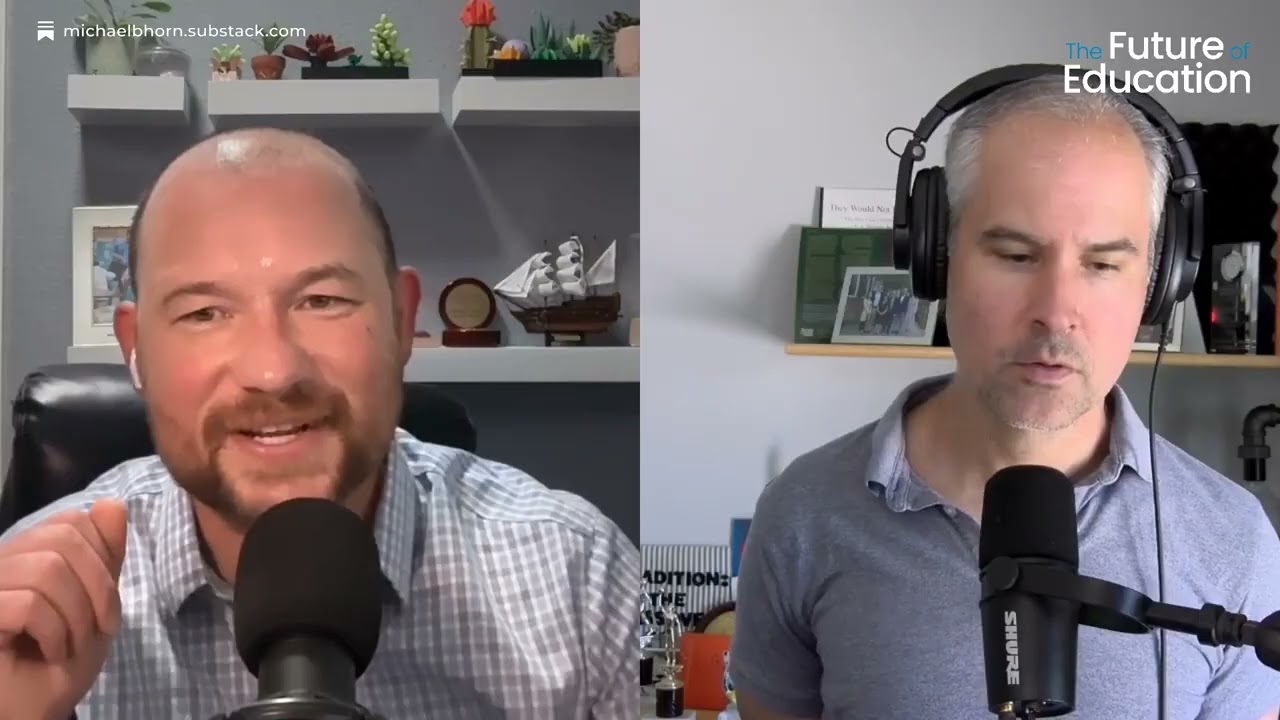
From Reopen to Reinvent with Michael B. Horn

In this hour‑long interview, host SPEAKER B and education innovator Michael B. Horn discuss Horn’s new book From Reopen to Reinvent. The conversation frames the COVID‑19 pandemic as a “forest‑fire” catalyst that exposed the fragility of traditional schooling and opened a window for systemic reinvention. Horn explains how the Jobs‑to‑Be‑Done (JTBD) framework helps diagnose why schools exist the way they do and how to design new education models that serve diverse stakeholders—students, teachers, parents, and society. He introduces the composite characters Jeremy (a low‑income, single‑parent student) and Julia (a privileged, two‑parent student) to illustrate inequities and to argue that the current system fails both. The dialogue explores teacher collaboration, growth‑mindset versus Golem effects, mastery‑based learning, and the need to shift from a zero‑sum, competition‑driven model to a positive‑sum, capability‑building model. Horn draws on examples of autonomous teams (Toyota Prius, Southern New Hampshire University) and the concept of “threat rigidity” to show how organizations can re‑frame crises as opportunities. The interview also covers parental JTBD, the myth of the agrarian school calendar, and practical steps for innovators, including a playbook in chapter 11. Throughout, Horn balances optimism about new possibilities with a realistic acknowledgment of institutional inertia and the need for incremental, stakeholder‑centered change.
Chapters
Stay hungry, stay foolish.
Before we start into today's innovation show, I want to thank our sponsor Zai, boldly transforming the future of financial services with a suite of embedded products and services enabling businesses to manage multiple payment workflows and move funds with ease. Check out Zai at hellozai.com. Let's get into From Reopen to Reinvent with Michael B. Horn. It's a great pleasure to welcome back friend of the show. He's been on the show 2 times before, a magnificent episode that was highly, highly popular. He's a friend of the show, and I've also become friends with him through the means of digital world, the digital world, which is very close to his heart and the work that he does. He is the author of a new book that I highly recommend, not just for somebody working in education, not just for a teacher, not just for a parent worried about their kids and the future of education, but also for innovators out there. There is frameworks in this book that are so useful for transformation and change and any type of innovation initiative. He is the author of his new book, From Reopen to Reinvent. Michael Horn, welcome back to the show.
Thanks so much for having me. It's a pleasure to be here. And it's neat how we've been able to bond over the last several years digitally over not just our shared interest in innovation, but so many other topics. And to be able to geek out with you once again, the pleasure is all mine.
And likewise, man. It's funny because Reading your book, which, by the way, if there's any teachers or anybody who knows teachers or principals of schools or people working in education, tell them about this book. It is so, so useful. One of the things Michael does is he sees it from every aspect, including that of the teacher. And just on that point that you made there, one of the things that happened for teachers during COVID was they bonded in ways that they feel lonelier now that they go back into the workplace. I thought that was really interesting.
Teachers have had just such a remarkable journey during all of this, right? And there's so many food fights over what that journey has been. But for so many of them that got to work with their colleagues, that got to be in the trenches with them on a daily basis in schools— it wasn't everywhere, but in schools where they had a common curriculum and they could collaborate around it to best serve students— I think it was a crucible-type experience. You know, you and I like to think about leadership development as well. And I think it was a crucible experience that really formed them in some way. And, you know, obviously we don't want teachers trapped in the moment of COVID for very long. That was brutal in many ways. But I think some teachers are longing for that connection and collaboration and interconnectedness that they did experience, and not just to throw it away as they, you know, metaphorically close the door of their classroom again to go one-to-many as they have traditionally been teaching.
I thought we'd start, Michael, with the origins of this, because for those people who don't know about your podcast, it's magnificent, the amount of work you do there. But this book, like my pin today that I chose especially, came out of the ashes of the pandemic. And by the way, it's a phoenix for those people who are just listening to us. And the whole idea of the phoenix coming from the ashes was exactly how this book emerged, because it was the crisis that was really an What was the catalyst for you to bring this book to the world?
Look, the pandemic hit, schools let out, they closed, they shuttered, devastation throughout. And in essence, you had this— educators and parents alike started to reach out to me and my co-host of the podcast that I started, Class Disrupted, Diane Tavner. And the two of us started this podcast, Class Disrupted, basically to answer these questions that these individuals were asking. And they were larger questions like, why does school work this way? Why are there so many damn worksheets? Why are there so— all of these questions. And it got us to peel back the layers of the onion, if you will, about why do schools exist as they do and that it's not preordained. It does not have to exist this way. You as a parent, you as an educator, you as a business person who's eventually going to be taking the human capital developed in these schools into your enterprises. You don't have to settle for schools that operate this way based on the emerging evidence around how humans are formed and develop and learn and the needs and circumstances of individual families and communities. We can create much more robust, friendly places that does a much better job of educating and respecting the needs of each individual in the community.
There's a beautiful song, a guy called James Blake, and he does a song with Bon Iver called Forest Fire. It's absolutely beautiful. And I was thinking about the concept, I was listening to it actually, as I was reading the book today. And the whole concept of the forest fire is that, you know, from the forest fires required for certain trees to enjoy their life, to be able to shed their seed, to be able to regenerate, and for this, the continuation of the species. And I thought Have you thought about that in the respect of the book and in the pandemic? Because the pandemic is this opportunity. It's been a forest fire of ways. And as the title suggests, we can just reopen or it is a massive once in a lifetime opportunity to reinvent.
Exactly right. And it's interesting if you look at it through the forces of progress that underpin the jobs to be done theory. This is something I didn't write explicitly about in the book, but it's deepened in me as I thought more about it is, and just for those who don't Essentially, jobs to be done says that there are 2 sets of forces that are compelling you to change behavior or make a switch in your life. One is the push of the current situation. Something's not good enough. You say, my life could be better. And the other is the pull of a new solution. And at the same time, holding you in place, the friction against you making a switch is anxiety around the new solution. What if I can't use it? What if it creates other problems that I haven't thought about? anxieties, and then the habit of the present that the devil I know is, you know, it's just easier to stay with what I'm doing. And what I think is true of the pandemic is that for so many people, it took away that habit of the present. So not only were they able to ask these big questions of people like me and Diane about why does school work this way, and for the first time see it as a thing that they had agency over, But it also wiped away the habit of, gee, we go to school according to this calendar, according to these hours. This is how people are graded. This is how the assignments work, and on and on, which I think has made a certain subset certainly of families far more receptive to alternative ways to do schooling. And I don't know about there, you know, we're in the UK, but in the United States certainly. Yeah. We have many more families who've stayed homeschooling families. We have many more families who have opted into micro schools and learning pods to do their schooling. Charter schools have grown. Virtual schools have grown. Just families saying like, how do I make it work for me? And my sense is that the habit of the present being wiped out eliminated some friction to them making a switch. Now, this isn't for everyone. A bunch of people went back. But even those people, I suspect, are asking bigger questions about, does school have to operate this way? Do I have to settle for it? And I think that's why you see so many constituents being way more vocal when they are unhappy about how their schools operate. And I guess one last thought that I suspect will be interesting to your audience. I interviewed one of the founders of a company called Boundless Life the other day. They set up Essentially communities around the world where you can move and live for digital nomads, they call them. So all these people that realize that they can work digitally from anywhere in the world, now you can go to Spain or Tuscany, Italy, or Greece and live with a group of other people who are also traveling around the world. And they have an education program, a school that is personalized. It's mastery-based. It's based in nature. It's experiential. You learn from other members of the community. And then you could just move to the next digital nomad sort of location. And I thought, what a neat concept. And it's probably something that never could have existed before COVID But now we realize that yes, we want to connect and plug in, but we also want to have all these other experiences and what a neat way to do it.
And we'll come— I love that idea, by the way. It's magnificent. I'm all kinds of thoughts going on in my head now at the moment. What would my wife be on for uprooting and moving?
Well, I was about to say, this is maybe where we finally meet in the physical presence. We both convince our wives to allow our families to just take 6 months, just 6 months together somewhere. That'd be a heck of a good time.
And that's the way, as you talk about later in the book, that's the way to get somebody to change. Just taster, just at the fringe, and then get them used to it and then sell the idea a bit further. We'll come back to that later on. Jobs to Be Done is such an important framework throughout the book. It's a spine of the book in many ways because you refer to it many times. Your previous co-author, Bob Mesta, he has released a new book as well, and that is magnificent work. He's going to be a future guest on the show as well, just for everybody who— he developed the Jobs to Be Done theory with Clayton Christensen. Clayton brought it to a wider audience, of course. Maybe we'll say a quick word on Bob because you and him are great friends and this theory is so essential in all this work and innovation.
Bob is one of those figures that, similar to Clay, right, has changed how I see large parts of the world. He's such an interesting thinker. He himself, as it relates to education, is highly dyslexic. Reading is really difficult for him, but I think that's why he's able to see the world so differently. And he always asks, why does it work that way? And he wants to peel back To figure out, you know, what's the causal mechanism. And he and Clay shared such a deep passion for causality, and that led him to develop the Jobs to Be Done theory. Interestingly enough, before the Jobs to Be Done theory, he's the person, if you're driving along and you realize you need to fill up your car with gas and you can't remember which side of the car your fuel tank is on, there's that little arrow, right? that says, oh, it's on the right or the left depending on the model of the car. Bob Mesta is the person that came up with that arrow to tell you which side the fuel tank is on. But he's been a designer in a lot of different industries, helped a lot of different companies, you know, Apple, Google, on and on and on, right? Create and design products based on an understanding of why do people switch behavior, what causes them. And Jobs to Be Done is really the kickoff point for his method of iterating and designing. And he's been such a formative experience to me. And I've been overjoyed because he's been spending more time in the education space to do some of his research there to understand why do parents change schools, why do teachers make dramatic changes to the instruction that they're doing. And this book was fun because I could bring a lot of those insights into it as a way to say, hey, here's a different way of looking at this and how you might harness this causality to do something better for students and better for your own lives as well.
And just to say, Bob's book is on special on Amazon, in amazon.co.uk. His new book is brand new, out on special. It's like £2 or something like that. Well worth the investment. He covers 5 essential skills for startups, for thinking differently. Magnificent stuff. And his art, Michael, he showed me some of his art. Oh my God. I thought they were photographs. They were unbelievable.
Yeah, it's incredible. His sort of release is to paint and he's painted all his mentors. So Clay Christensen is there, Dr. Taguchi is there, Edward Deming is there, all these people, you know, like he's sort of been the bit figure in all these transformational ideas in engineering and business throughout his life. And he's gotten to be alongside them and be mentored. And now he's mentoring and he's created artwork of them, but many other scenes and all sorts of things. He's just a phenomenal, caring individual.
It's great to be working with people like that. And so great that you co-authored a previous book with him as well. I wanted to bring it back. So if you think of Jobs to Be Done and you think about really the source of your work, because you are really authentic about this work in that you want to make a change in the world. And it was difficult for me to read the way— so I mentioned Jobs to Be Done is like this spine throughout the book. But then there's 2 characters throughout the book, Julia and Jeremy, 2 very different backgrounds. And I thought about how it's almost like sliding doors moments. School can be such a sliding door moment. It can be the start of a downward spiral for one, And an upward spiral for another. Parenting privilege blinds us to many of the challenges that that these people experience. And even saying that, I know many people who would benefit from this podcast won't be listening to it because they won't have the luxury of time to be able to listen to it. And that's one of the huge challenges. Education is the same. As was the case with Jeremy. Maybe you'll tell us a little bit of context for this because this is another key framework or lens through which to read the book.
Was birthed out of our podcast, Class Disrupted, where we, at the very last episode, we created these fictional characters of Jeremy and Julia who are based on real composites of individuals. Jeremy, the individual who has a single-parent household, His mom works multiple minimum wage jobs just to put food on the table, isn't around all that much, and just really trying to make ends meet and isn't a big part of his education. And he enters school without background knowledge, without access to the internet, without all sorts of resources at home that a whole bunch of families probably listening to this take for granted and don't even think about as advantages. And then there's Julia on the other end who comes from a 2-parent household where her parents are very involved in her education. You might say too involved as you read it. But the argument that I'm trying to make is, in addition to seeing the differences, is also seeing how the education system actually is not working for either of these 2 characters from their backgrounds. And that I think sometimes we don't change education because we think, oh, I don't want to screw up what's going to work for my kid, right? It's going to work for them. And what I wanted to do was throw a wrench in that and say, I actually would argue that the education systems we've built around the globe are not really working for anyone, whether it's the rat race of stress that we've created for so many students or the poverty of resources and the sorting that occurs for others. This is not a system that is really fostering the development of the individuals we want to be able to go out and live economically productive lives in a civic country where they're able to have disagreements and navigate an increasingly complex society. And I wanted to paint that in pretty stark terms and play it out at the beginning of each chapter so that you can feel, you can feel, geez, like Julia just got reprimanded for something because she got background knowledge about how to do the assignment before the class, and now she's bored. Is that really the school system we want to be living in? I don't think so, right? I mean, I had this experience. My kids are enrolled in a Montessori school, so they don't have this on a daily basis, but they're enrolled for religious school in a very traditional environment. And on the one hand, my wife and I are like, make them see what it's like for most people. On the other hand, when they come back and they're like, I already can read Hebrew, like, why are we reviewing the, you know, the alphabet for the 15th time? And I'm like, yeah, it makes no freaking sense. We're killing your joy of learning right now, and it does not need to be that way. And, you know, the flip side, I want to make people think about the Jeremys of the world and them coming in totally baffled because they don't have that background context or knowledge for the conversation, perhaps. Or they're, you know, they— maybe they have some sort of health issue or they haven't gotten the food that they needed or the sleep that they require. This is something you and I love geeking out about is the health context and wellness context. And I want to dive— the book tries to dive deep in each of those domains to say, this is relevant to the learners and individuals we're producing, and it's not working the way we've set it up for really anyone right now.
That point about it's relevant, you know, the work We do. And I think anybody who does a— does work of service is that, well, if I can change how somebody else sees the world, I change the lenses they wear, and they live a better life, that will have a knock-on effect, and we'll have a better planet, etc. But I was thinking about the opposite then, if you think about the Jeremy character, and he earlier on experiences, oh, firstly, he doesn't get socialized in the same way. He doesn't understand the importance of a network or how to run a project or even how to work in that world. I thought about a couple of weeks ago, Michael, we had on Joan C. Williams on our book Bias Interrupted, and we talked about how many people of color who come into organizations that are long-existing legacy organizations who have the boys' club, can't get into that club. And that club is so important. And I thought about how the origins of that club can start in school systems at a very young age, because people are socialized to understand that this is important, being able to understand how a system works and how other people work, etc. This was so meaningful for me. And I was— I started to write about it because I write a weekly article somewhat linked to the show. And that was the inspiration for me, was if you can change it here, you can change it at that point later on.
100%. I mean, this is something that I've learned over the years as well. It wasn't something I understood initially, which is to say that there's sort of a hidden code of how you operate in these professional settings that is not taught or revealed to people from certain backgrounds explicitly, generally. And yet if we do not, then to your point, we confine them to stay outside of that club, unable to make that progress or upward mobility themselves. And yes, some of them figure it out. They're able to suss it out, but it's by chance as opposed to being intentional about making sure people know how to navigate those worlds. And that's everything, frankly, from— again, I keep coming to background knowledge, sort of certain turns of phrase or references or language that we use thinking it's universal, And it's not to your point of how do you run a meeting? How do you project manage? How do you yourself upskill and reskill so that you keep driving forward and realize it's not just going to be given to you, right? Sort of the way school works is you sit in a seat and the knowledge is given to you. That's not how the professional world works. And how do we model in school, develop learners and individuals who are able to set goals for themselves, plan how they're going to get there intentionally, do the work, learning in school, doing the work in the work environment, showing evidence in the school environment of what they've learned, reflecting on the experience, and then, you know, flipping back around. That's how we run projects in the real world. And the argument in the book is that as students learn, we need to be intentionally baking in those habits of success and those skills in every single learning experience so that those habits become just that, habits, and they become explicit ones, not just something that was said once, but it's modeled so that through action, you know how to do that. It is how you operate as an individual. And then you can be part of those clubs so that it is not shrouded in secrecy or withheld from certain members of society. But in fact, that's how we all operate and we all share this language robustly. And it doesn't mean we'll all have the same passions or lean into the same things. Not at all. Actually, the opposite is what I argue in the book, but that we will have these shared underpinnings of how we go about the work so that we can have these conversations and not have these exclusive environments.
Just to really hammer this point home, and I used the term boys' club purposefully. So for those ladies listening to the show, we have a 50/50 split on the show. I'm using that purposely because that is still the way it is. Many, many cases, a boys' club, and it still exists there. If you have heard that show Bias Interrupted with Joan C. Williams, you'll know what we're talking about here. But one of the other things I just wanted to emphasize was an example. My son the other day says to me, oh, why are we Why do we have to learn the times tables over and over and over when we already know them? And I was like, oh, you know them. So you've done your homework. And I said, I explained to him that, well, if you automate that, so it becomes, you don't even have to think 7 times 7, etc., then you can build on that. It's a foundation to build upon. But then I thought, while reading your book, I thought of that instance because it happened serendipitously during the point of reading your book. And I was thinking to myself, you think about a Jeremy character, somebody who's less fortunate or less privileged. Firstly, they're not having that conversation with a parent. Maybe their parent's working. Maybe their parent has no idea that how important that is. They don't know why you would learn the 7 times table. Maybe they had a crappy experience in school. So school plays a different jobs-to-be-done role, perhaps it's childcare, as you mentioned in the book, that has a dramatic effect on the Jeremy character because they can't relate. What the heck has this got to do with the real world for me?
You just spoke to the importance of social capital, which is one of the things I say schools need to be doing more intentionally as well, because the ability to navigate college, to know that something is important, why it's important, why Do people go to maybe job fairs or whatever it is, right? Why do they bring a resume as they do so and it's printed on nice paper? That's a historical relic perhaps, but things of that nature that we just do, you don't know it unless you have someone in your life who has lived it intentionally. And so all of those things I think are so important to make explicit. And then back to the times table point, Explicitly connecting the relevance of what you're doing so someone understands why this is important and develops that deeper understanding, I think, is important so that they can answer the question of why. And your answer to your son is exactly right. If you develop automaticity and fluency with this, because some people say, well, we don't need to learn the times tables anymore. No, you do. How you do it, I will say that there's a variety of ways to do that. Actually automating it is really important so that when you're doing a more complicated procedure, your working memory capacity doesn't get gummed up on this entry-level foundational stage and you can do the higher-order stuff. Now, here's the flip side, which is I hope a parent reading this, and maybe your son has already developed that automaticity or fluency with it, I hope that they can go into the school and not settle for the explanation. Well, Some kids don't know it yet, therefore they all do, because that boredom has a price as well, where your son can't work on the things that really light their— you know, they already understand this, they've already mastered it. We know that many people drop out of schooling or become disaffected to learning, lose that intrinsic motivation, that curiosity, because school consistently sends the signal, well, you're bored, too bad, deal with it. We all— all the rest of us have. You don't have to settle for that in this world of technology and the ability to personalize learning. And wouldn't it be an amazing thing if your son could work with another child who perhaps was struggling with the times table and he could develop some leadership skills, some empathy skills, some ability to teach? And by the way, would have to explain it probably some different ways from how he had learned it. So that would get further cemented, a whole bunch of skills in that. And then to have the other experience, or maybe he starts doing a deeper project with the multiplication tables connected to the real world, or he starts doing division, whatever it might be, so that he's engaged and it's not just passing time. And the message is, deal with it. We— that's something we settled for, you know, 60, 70 years ago. It worked well enough in the— in an industrial era. It just doesn't cut it in a knowledge-based economy where we need to be developing every individual to their fullest potential. And all your listeners who are parents don't need to be settling for it. I keep coming back to, there was a guy during the pandemic, he came over and he was in our kitchen and he was talking about how his kid already was in, I think, first grade and had figured out the phonics and reading and so forth, and it was just bored out of his mind. And he shrugged and he goes, well, I guess that's the way it is. What a terrible answer though that has to be from schools. And so, I hope a major message is You can push your schools to realize that there are better ways to do this and not leave folks unengaged and that they're continuing to develop their full selves. Whether again, it's your son maybe tutoring someone else and working on that part of their character or learning some other knowledge or applying it in a real-world context.
Beautiful, man. And I want just, if anybody's teacher out there or knows a teacher, This isn't teacher bashing at all. Michael has huge empathy in the book for teachers and actually is like almost jobs to be done from a teacher's perspective as well. There's a huge amount in there, and we'll come back to that in a moment. I just wanted to stay on this, um, because it's so important, the words that we utter to a child in the early days of their development, because even a child in a privileged position still struggles. There's many kids that struggle. And there's the opposite to the Pygmalion effect is an effect called the Golem effect. And I just wanted to share this with our audience. It's a process where superiors such as teachers or managers anticipate low performance from a subordinate, like a student, for example, or somebody that works for them. And they predict a certain behavior as a result. So imagine a Jeremy-type character, Now, I'm going to quote a part from Michael's book that I found very meaningful. It said, it's one thing to preach about growth mindset or grit to children. But it's a different thing to model it as a parent. Do we? Is it do as I say, not as I do, for example? Because our education system, Michael says, does the opposite of modeling it, instead of fixing labels to students, sorting them into static groups and signaling that their effort does not matter. This is because in today's system, time is held as a constant, and each student's learning is variable. And we totally get it. As a teacher, you have a curriculum to deliver, you're measured on that curriculum. I can't wait for these 3 students, Jeremy over here in the corner, who's dragging us back. I have no idea what's going on in his family life. All I know is he's struggling. Tick. I label him, I put him in a box, and the Gollum effect sticks into place. Fast forward years later, he's working in a dead-end job. He might not even have a job. And we see him as the dregs of society, but it can be fixed. And that's one of the huge goals of Michael's work.
Love everything you said. And the only amplification, I guess, that I could possibly offer is just on that part about how the system systematically undermines these things that we want people to embrace. And we'll talk more about this, as you said, but it's through no fault of anyone in the system today. It's, you know, people don't act in stupid ways because they're stupid people, but because the organization, the resources, processes, priorities of the organization compel you to do so. And the school system that we have constructed decades ago at this point, no one here was working in it when it was built this way. is one where the time is fixed and the learning is variable. So you must get through this content in this 3-week unit, and at the end of it, we give a test and we move on. And to your point, some people do great and they get labeled, and some people do badly and they get labeled. And meanwhile, the teachers, because they know growth mindset is critical— intelligence is not fixed, it's important to keep working at something, grit, perseverance, right, until you really have mastered it, effort. Is critical. And yet at the end of the 3 weeks, the system says, oh, sorry, doesn't matter what you got. We're giving you a label, C, D, B, A, whatever. We're all going to move on. And so the system undermines it. And actions speak far louder than words. Children watch what we do far more than they listen to what we say. And as a result of that, if we're serious about the importance of growth mindset, grit, perseverance, all these habits of success, I call them. Others would call them character skills or social-emotional learning and so forth. Then I argue fundamentally the system has to change where the Jeremys of the world get the opportunity to keep working on something so that the teacher says through their actions, I believe in you. I believe in your capacity to learn this. It's going to take effort. You're going to fail sometimes, but failure is not an end place. It is how we learn by continuing to make repetitions. It's a step toward mastery. And so that as you experience that and as you work, once you've fully mastered something, only then do you move on to the next concept and so forth. And when you frame it that way, all of a sudden growth mindset makes sense because I have the ability to change my intelligence, my performance through my effort. It's not something that is fixed and given from on high. All of a sudden, yes, effort did matter. It meaningfully changed what I worked on. And by the way, what I was struggling with at one point, as I start to master that material, it's quite likely that I'm going to start to accelerate as I hit other material. We are all jagged individuals in terms of our profiles and where we excel and so forth. And so, Therefore, the teacher need not make that judgment about the Jeremys of the world and say, oh, that's just the slow child over there. No, once they start to fill in those gaps, they might start soaring, and then they might hit other places where they're limited. And the Michaels of the world, me, right, I might soar someplace early on because of the entering background experiences, and then I might struggle when I reach some— reach something else that's more conceptual, perhaps. And so I got to spend time with it. And for those high flyers, you don't want to label them as high flyers either. You want to label it as you are a high flyer because you're capable of putting in that effort yourself. Because in life you hit snags and you want to have instilled in people that effort and working hard and figuring out how you learn and how to crack the puzzle are all desirable traits and skills. And so that's the big shift I think that we need to make. in this education system is from the sorting function that schools play to a guarantee of mastery for each and every single child. And we can do it in today's world, but it does require a very different system.
Beautiful, man. Beautiful. And we'll come back to that again. I wanted to come back to it because I love this idea of where you can make these changes earlier on, in a kid's life that will have dramatic changes, not just on that child's life, but on society later on. One of the things that came to mind was competition, keeping up with the Joneses, right? So keeping up with the Joneses leads to consumerism, has environmental impact. Like, whether we think that way or not, that's what happens. Because it's like, oh well, we have to be doing that, and we have to be going on the holiday, etc., etc. And there's a quote by Lao Tzu that I loved: be content with what you have, rejoice in the way things are. When you realize there is nothing lacking, the whole world belongs to you, right? So one of the most liberating things I had, because I didn't always think this way, I used to have that kind of almost envy of other people's success and, you know, why not me and all this kind of stuff. And when you let go of that, it's so liberating. And you actually let in so much more better things as a result of all that. And I say that to say how competitive the school system is. It sets up me versus them. For example, Jeremy looking at Julia, jealous because she's so good in the class. She's been able to answer her questions. She's supported by her parents, whatever it might be. And there's a quote here. You say people develop at different rates. They have different strengths and weaknesses, which means they have what some called jagged profiles. That's because students have different working memory and cognitive capacities, background knowledge, social and emotional learning states, and contexts. And this is why customizing is crucial to meet this reality and help every child fulfill their human potential. It's vital we do not sort students out of the pathway. Too soon. Now, we've covered some of that, but I thought you might build on the competing aspect of the schooling system.
So a major argument underpinning the book is that the current system is zero-sum, where for every winner, there's effectively a loser in the education system. And it's built on this mindset of scarcity of opportunity, that there's only a limited number of seats in the lottery, if you will, to be won. And therefore, we've got sort out all these other individuals. And one of the big arguments in the book is that this zero-sum mentality is found in very few places in society. It's not in fact how the real world operates. Capitalism, when it works well, is predicated on a positive-sum system that me developing my comparative advantage benefits you. It makes the pie grow larger for all of us, and the rising tide lifts all boats when it works well. And so that positive-sum system, I argue, is one that we ought to have in the education system as well, by which we— competition is fine, but competition on a very narrow metric where there's winners and losers is not healthy. It reduces us to a very narrow development of our humanity, and it is not in fact equipping or empowering people with the skills, knowledge, and habits that they need to be successful in life. And we can do it in a dramatically better and different way. And from my perspective, a large part of that is I may conclude that some field is not for me, but then start to lean into something else where my strength is and really develop and build that passion over time. And I say build that passion because I don't I don't believe we're born inherently with passions. It's something we build over time through working with something. And yes, where we're good at something, you know, there's a good positive feedback loop, but we need that time and space to figure it out. And it's not always overnight. I was even just looking at something on Twitter recently where a successful, I believe, entrepreneur who's great at coding said, thank goodness I didn't get sorted out of this class. early because they struggled initially with, with the field before it clicked, and then they were able to do some incredible things. Our traditional education system, however, would conclude after just a year that that person was no good and sort of unambiguously repeatedly send the signal, you're not meant to do this. They just needed some more time. And if you had that speaking to you, you should be able to take that more time to develop yourself. Because life truly is not lived as a very narrow race on one metric. We are all trying to compete to be the most unique versions of ourselves that can contribute value to society at large. And when you view it through that prism, you realize it's not just the admission or the test score that matters, but instead a deeper development of your, of your social network, your knowledge, your habits, your skill sets, your ability to problem solve and think creatively and so forth that will truly help you make a contribution to that wider world. And by the way, the intentional connection of all of those experiences, as you said, to that outer world so you can understand where there's a meaningful contribution to be made.
And Michael, I thought there about like, so you're not Pollyannish about the fact that this is difficult for teachers as well, the speed at which they need to deliver the curriculum. Time's ticking, you know, I have to move on to the multiplication, whatever it might be, or division. I need to move things on here because I need to deliver the curriculum. I thought about that again on a personal level. I coach my kids. My younger son is only young, he's, he's playing sport, and he's only got into sport And New Zealand rugby team, well, you know, people will debate or not, but they're the best rugby team in the world. But one of the things they do is they play by weight and size, not by age group. Because if you think about some of the beasts that play rugby, prehistoric-looking creatures that play the sport, that you have that against a kid who's small The kid will be discouraged and think they're terrible and leave the game because of fear. But later on, many, many players who become some of the best players ever for New Zealand accredit that to the fact that the system allowed them to develop, and they developed confidence, they got through it, and they found a place for themselves later, later on. And that's, again, just to mirror that back to this, this echoed back at me the whole time. But as a coach, I know how frustrating it is for the better players and like kind of going, oh, Freddie dropped it again. Oh, he can't pass. He's terrible. And you're kind of going, guys, you're gonna have to learn to develop the patience to bring another player with you. Just like you said in the classroom, teach the guy how to do it. By teaching him, you'll get better at it, etc., etc. It's not easy though, because you're under time pressure, like kind of going, I gotta do my coaching session before The end of— I have 40 minutes left, and I don't have the time to put into little Freddie here who's struggling. So it is difficult, but we'll move on because there's a really important framework. And I said to you at the start of our session today, if you're an innovator, there's so many beautiful templates that Michael uses, because as he worked with Clayton Christensen and wrote Disrupting Class in the past, It gave you, Michael, these beautiful lenses through which you see the world. And one of them was how you frame change. And many of our audience work in change. They're transformation consultants, they're heads of change, heads of innovation, heads of transformation, they're CEOs. And oftentimes, I've done it myself. It's like, we're dinosaurs here, the sky's falling down. Let's move. Come on, we're gonna die. And as a result, you raise the corporate immune system. It is on hyper alert. And you talk about threat rigidity. And this is a beautiful term developed, I think, by Clark Gilbert. And again, one of Clayton's previous collaborators in the past, future guest on the show as well, also wrote Dual Transformation with Scott D'Anthony, who's been on the show a few times. And really looking forward to— I hear he's a great character, great voice as well. So maybe you'll tell us about this.
Clark will speak miles better to it, I suspect, than I will when you have him on. But his fundamental work basically showed that when there was a threat in the environment, some discontinuous change of some sort, it could be disruptive, it didn't have to be, that it was critical for an organization to call it as such. to say this is a major threat because otherwise the organization would not allocate resources to combating that threat and designing something to respond to it. So that was important. But he also noted that if you left it in that threat framing, what he called threat rigidity set in. I've sometimes thought of it from like an animal kingdom perspective, which is to say if the cat stays with its back arched, Then it just stays paralyzed looking at the predator looking at it, right? It was important. And if you do that, let me just say what happens. What he found was that organizations then marshaled a top-down command and control response where the elements of their business model or their organizational model became even more locked and rigid. And you double down on the existing ways you resource the problem. the processes you use, the priorities and profit formula, and on and on and on. And in point of fact, when this discontinuous change happened, as we know from studies of disruptive innovation and so forth, you need to do something very different in the way you've structured your organization. You need to take the new technology or the new situation, circumstance, whatever, and approach it very differently with new resources, processes, priorities, because your prior ones They have capabilities, but they also show your disabilities, which you're unable to do in that organizational model. And the only way he found that you could do that was through 2 actions. Number one, reframe the threat as an opportunity and say, if we were to do this, what would we create? And the only way he found that you could do that effectively was to hive off some autonomous team. separate from the parent organization or way of doing things that could just take this blue sky approach to it? What if we were to go, you know, do this? And his example, his studies were the internet coming to newspapers and the disruption that ensued. And as he likes to tell the story, he literally, it was the only time in his research where he saw a 1.0 correlation. Those organizations that had set up an independent entity were able to embrace the internet and come up with a novel strategy and thrive in this new world. Those that did not, negative one, right? Could not get out of the innovator's dilemma. Autonomy was critical. Now, the level of autonomy you can debate and think about, that's where dual transformation that he developed came about from. But having some autonomy and freedom to rethink the processes, priorities, and resources of the organization were vital. And so the argument as you turn to schools is, yeah, pandemic, COVID, learning loss, all threats. And those schools, frankly, that have left it framed as a threat have marshaled top-down responses where they've just doubled down on how they've always done school. I mean, it's eerie, by the way, reading his doctoral thesis and then just substituting the word schools for newspapers as you do so. And the big push that I make as a result is, yeah, it was important to frame it that way so we could get resources so that schools could marshal a meaningful response. But if you leave it in that threat framing, you're just going to replicate what's always been there and not in fact reinvent and create something new. And that's why hiving off a team of educators to rethink the enterprise, in effect, is so critical and viewing it as an opportunity to do, hey, maybe we've always wanted to do something that would embrace growth mindset more than we have. Maybe we've always wanted to do something, right, that would be more asset-based as opposed to focus on someone's weaknesses, whatever it might be. Now you have the chance to do that in this new environment.
There's a challenge with the innovation team, the autonomous team as well, that they don't become a silo in their own right as well. I wrote about this before. I thought about the— if you remember Dances with Wolves with Kevin Costner, and he had this outpost, and I was kind of going, that's how some innovation teams end up like this outpost in the middle of nowhere. And then they go native and they become an entrepreneur in their own right as well.
Which can be good or bad. Just for one second, can be good or bad depending on the purpose. I think the really important work that Clark Gilbert has done with Scott Anthony, as you mentioned, Dual Transformation, is how do you connect those outposts, if you will, to the mothership through what they call a capabilities link? Or, you know, Michael Tushman and his work around ambidextrous organizations and so forth. That's really what they're all working on is like, how do you create those outposts but make sure there's still a connection back? to the mothership so that you can leverage what the mothership brings in terms of resources and purpose and the know-how that is or is not relevant to what you're doing now.
Man, we're only on chapter 1. I was way too overconfident as ever. Let's map this. Let's bring it to life with a couple examples. So we'll use the brilliant example you gave of this, of this creating an autonomous team, the Toyota Prius, and then map it to Paul LeBlanc and how he actually used it in an education framework as well. That'd be really useful for our audience who are innovators and then our audience who are guests to listen to about your book and reinventing education.
You bet. So, you know, the classic story of Toyota is that in 2001, when they wanted to create a hybrid, automobile. So one that had the combustion, internal combustion engine, but also would move into electronic power, electric engine powering the automobile. All of their competitors designed their cars within their existing silos and functional departments and the way they had mapped the assembly line. Toyota took all those people and put them in a heavyweight team, so relatively autonomous, and gave them the freedom to say, We don't know what the hybrid car ought to look like, but bring your functional expertise and you figure it out. And if it means eliminating your department because you figured out another way, that's fine. We're glad for your insight. The loyalty is to the best hybrid vehicle, not to the traditional ways of doing things. And so these experts came together and created a really elegant car called the Prius, where, you know, you step on the brake and it creates electricity to power the battery and on and on and on. And so it's a very different architecture. And after doing that for 3, 4 generations, they were able to codify what they had done and then bring it back into the mothership in that particular case. So it's not a story of disruption, but a story of reinvention. And Southern New Hampshire University, Paul LeBlanc did this in his university when he took over in, I think, 2003. The university was all but failing. It had been declining in enrollment. The financials were in tatters, but there was this sleepy little division of online learning over in the corner. And Paul being well acquainted with Clay Christensen, they were actually basketball players together, a little-known fact, they played recreational basketball together. He knew that he ought to hive it off from the core university as an independent entity with the freedom to rethink how they did enrollment, how they did marketing, how they did the learning experience itself, how they connected individuals into the workforce and on and on and on. And they created a very different looking university from the traditional bricks and mortar one. And it just took off. As of us speaking, I think it's over 180,000 students are now enrolled in that online division. Southern New Hampshire, I think, has the budget of $1 billion or so on a yearly basis. So very financially successful, very successful at enrolling students, very successful at helping them be successful and get jobs. in the market. And by the way, that's benefited the core as well. And then Paul, during the pandemic, took the opportunity to hive off again a little team to say, let's reinvent the brick-and-mortar experience itself because they had all these insights around the time-variable learning fix that we were talking about earlier, the competency-based or mastery-based learning. And he wanted to combine that with the coming-of-age experience that happens on a brick-and-mortar campus. And how do you create something that's far more affordable that does both of those things? And so, they created Something totally new that they relaunched then out of the pandemic at a fraction of the cost of the traditional university. And again, it's that autonomy, that ability to say, bring your functional expertise, bring these insights, but have the freedom to rethink how we use and educate students. And just brilliant how Paul has done this trick a few times in his career. And by the way, not every experiment has worked. Every time he's spun something else, Autonomous. I'm teaching at Harvard this semester. He's going to be a guest and I can't wait to ask him about the failures, but they don't all work is the point. That's okay. You want just shots on goal because, and the only way to get them in a viable way is to have that autonomy.
And the point I think is often missed is when you take the shot on the goal, you often learn what not to do. And that's learning. That's actually, that's gold.
And that's our argument, right? Is that failure is a step to learning. It is not a destination in and of itself.
Yeah, it's such an important lesson as well. I'm conscious of your time. Michael's going to do a talk in Abu Dhabi for the state nonetheless, so a very important trip. But I really want to do, in case we don't get to do a part 2, cater for the teachers, because you do talk about from the parents' perspective, you talk from the teacher's perspective, from the educator's perspective, You dedicate a whole chapter to starting with the end in mind, which is essential for any transformation. What do you stand for? Who are you? What are you trying to achieve? All those type of things, which is where jobs to be done theory becomes really important. But from a teacher's perspective as well, COVID was a very difficult experience for teachers as well. Many people might think, oh, well, you know, they were at home and they were teaching, it was easier for them. They had connection, as you say. They felt more bonded with their fellow teachers than ever before. But when they got back in the classroom, it was very, very different. And this is the kind of forest fire concept that I had in mind is that, well, there's an opportunity in that and it needs to be seized.
And I'll say, look, some teachers had that bonding experience. Some teachers, I think, felt incredibly isolated and cut off from their students and Fellow teachers. It just depended on the school so much, right, and what they did. And the— but the point that I try to make, and again, there's the fictional teacher in the book that had this experience and had these experiences of teaching differently and grading differently and so forth and assessing differently. And they say, gosh, why can't we do that in the traditional school? And they start thinking about how do we create an independent team where we might be able to rethink these precepts and, and do it in a small way at first, but then grow. Over time. And as I like to say, success is the greatest deodorant in sports and it's the greatest attractor in every other field. People want to be part of a successful effort. But the big argument in— there's a couple big arguments, but one, just, I'll name 2 of them. One is if you look at the research on motivation and what adults want out of an enterprise when they're working in it, We systematically ignore all those things with teachers, and we need to create a profession where they're able to connect not on a once-a-day basis with their colleagues, but really a real-time basis where there's much more co-teaching occurring, many teachers working together with many students so that I can, as a teacher, lean in on the areas of strength that I have and bounce off you who has another area of strength, and we can cover for each other. Create a more flexible environment where maybe I have to take a day off because I'm sick, but my students now can keep learning because you're still there, on and on and on. So I think we just need to create a much more— I argue for team teaching, co-teaching as a critical part of the reinvention of the teaching profession. And then second, I argue that teachers should not be the final arbiters of grades for their students because it puts them in this adversarial relationship with the parents and the students where they have to judge them, that subverts student performance. Carol Dweck writes that students will sabotage their own performance when they realize that their coach who's trying to help them is in fact judging them. That's exactly what we have in schools today, and it's unfair to the teachers, I argue. And there are other ways we can construct this, where teachers don't have to be the ones grading their own students. They can just unabashedly be that coach, instructor, facilitator person that's trying to make sure that you and I succeed as individuals and let another teacher be the grader to say, have you reached the bar yet? Or, and this is important, back to the mastery-based positive-sum framing, you just need to work harder at it until you've truly mastered it and then you can keep on trucking away. And I, as the teacher, get to find other ways to connect with you and help you and support you through that journey. And so ultimately I'm arguing we need a way more supportive, flexible teaching experience that's capable of creating a much more robust web of support as well for students.
Yeah. And I thought about again how that mastery-based learning then impacts people in organizations. Most of my work is corporate education, I create courses, etc., for corporates. And many people will try and dodge those sessions, right? And I never ever judge that because they could have had the worst cases of learning in school. And it's— they're dreading it because they're thinking it's going to be the same type of thing again. It has this knock-on effect in many, many different ways that we, because of our own biases are just totally blind to most of the time as well. Just in the interest of time, I'd love to turn to the parent as well, because parents have many different jobs to be done when it comes to education as well. Again, it depends on if you're Jeremy's or Julia's parents. It depends on what— even within those different categories, many, many people have different types of things to be done. And you say, given parents' conservatism Advocating for radical changes or innovations for other children can backfire. It's better to position the changes you want to make in terms of why they will help each individual parent make progress for their children, as that parent defines progress. Framing a change as an answer to a parent's quest for progress and leading with why, as opposed to how or what your proposal will help, is crucial. But to do so well requires understanding what jobs parents have as they approach schooling themselves. And this reflects exactly back to an organization. You start with the why, not with the what and how, because that causes all kinds of conversations. Maybe we'll share this and maybe some of the jobs to be done from parents as you see them from a high level, Michael.
So, and you've once again done a brilliant job of extracting the big idea from the chapter and the argument around parents. But, you know, it's the funny part of the book, I would say, is that the first half of the book is these big radical ideas for how schooling should work relative to how they are today. I would argue they're not in fact radical if we want to develop each individual, but relative to how schools work today, they are seen that way. And then the second half of the book is basically be incremental though. Don't do something that would violate a parent's quest for progress in their own right. Because it will backfire, because it will not work. If you innovate to someone as opposed to innovating with them, it's not going to grab hold. And so the big idea is to understand that parents have jobs to be done in their lives for which they can choose to hire schooling. And their jobs range from help my child escape the trouble that they're in. They're having a problem right now. I want to help them get out. Help my child be educated in a group of like-minded individuals, help my child develop their whole self, their social and emotional self. I'm less worried about the academics, but I really want to develop the whole child, or help me follow my plan for my child. This is often centered around the university conversation, but it's more deeply felt, a sense that I want a better life for my child than perhaps I've had access to. I feel like I know the steps that they need to take to get there. You can agree or disagree with any one of those. It's not the point. It's how those parents are living life. And because of that, a big argument is you need to position the change efforts around what they will view as good or bad in that circumstance. And that also those circumstances and jobs are fluid. At one point, I may be all about helping my trouble my child escape trouble. The moment that's been solved, then I'm in a different job to be done, right? And so those are very fluid circumstances in point of fact. And this is based on a lot of research we did around why parents choose to switch schools for their kids. And it's held up remarkably well during the pandemic when that rate of change has increased Significantly. So, I feel pretty good about the findings. The what you do about it, I think, is you really need to understand how that's manifesting in your community and design very intentionally around it. And as you said, it goes back to the Simon Sinek, you know, wisdom of start with why, and then we can figure out the how and the what. Jobs to be done is much the same. It's like, let's understand the causality of what they're trying to achieve. And then we can figure out, okay, how do we help them get there with the experiences that they need? And then the what is, how do we snap those things together to actually deliver on that? And, and I think a big takeaway from that is a one-size-fits-all school system that caters to every single desire and circumstance and so forth is in fact a pipe dream. We need to recognize that customization for parents as well, just like we need to for students.
I'm going to be really selfish here and squeeze every little last drop I can. So we have a few minutes left, but I just want to say to our audience, if you are working in the field of education, if you're a consultant working in the field of education, you have to look no further than this book. Michael offers a comprehensive framework in chapter 11, a playbook, what to do. So the start of the book is Raises the questions and the challenges and the jobs to be done, offers you frameworks of how to do it. And then 11 goes, here's what you do. It's, it's everything you need to reinvent. And I wanted to just share totally interesting fact alert, but also that raises many, many questions, which was we take so many things for granted. For example, why is the school year structured the way it is? Many people think, well, probably from an agrarian time, it was because, oh, I needed the children during the summer to be able to harvest berries or something like that. But you looked deeply into that and you went right back to the origins of it. I'd love you to share this because it raises some really interesting questions.
This is a fascinating one for me, which is that the agrarian calendar, as you correctly cite, that we call that because we think it's based on the farming cycles. When you look back at the history and then when you step back and do a moment's reflection, you realize it doesn't add up at all because harvest is of course in the fall, in the autumn, and planting season is in the spring. That's when you would want the kids around to help on the farm to do the bulk of the work. And in point of fact, initially those students who were in rural farming communities went to school in the summer and the winter, and they stayed home in the spring and the fall. So our agrarian calendar is based on no such thing. In fact, it is based on that predominantly in the cities, in fact, that upper-class families started pulling their children out of schools because they wanted to go to cooler climates during the summer, be by the seashore, be in the mountains. And so in point of fact, there was a lot of empty seats during the summer, and that as this education system became more calcified and developed and regulated, labor unions and policymakers effectively codified that as summer vacation. And so, this is not actually the way it has always worked. It's not some received wisdom from on high that kids should be not in school during summer. And while at first, I confess, I come to this because I have very fond memories of my own summer and jobs I held and interests I got to explore, the argument I make is it's actually really stressful for a lot of parents to figure out what do I do with my kids? And a lot of parents don't even have the ability to ask that question because of the environments and resources that they're in. And what if school was a much more flexible venture that offered a year-round opportunity for many more people and took all those extracurriculars and so forth that I loved learning during summer, those areas of passion, and actually built it into the fabric of school itself? What would we then create? And so, I think it's a great example of just Saying, let's question what we thought we knew about how, you know, why school is the way it is, which allows us to rethink, does this way of operating make sense for our current time? And the broader lesson, as you know, is that's innovation in any field. If we see the struggling moment for someone that this is just not quite working for them, well, does it actually in fact have to be this way? Can we build something better that allows them to make progress?
I have so many more questions to ask you, but I just think that's What a beautiful way to finish it. And I know you have to pack to go and speak to everybody in Abu Dhabi as well. So Michael, for people who want to find Disrupting Class podcast, they want to find you for consulting, for keynotes, they want to find all your books, including children's books that you've written with your wife, where can they find you?
michaelbhorn.com. My website is the easiest way. You can follow me on Twitter @MichaelBHorn. And then once you're there, you'll find the Linktree and all those other things about me. But the last one would be my Substack newsletter, Michael B. Horn, The Future of Education on Substack. So you can follow my exploits and explorations and my own conversations with folks like you.
It's always a huge pleasure to speak to you. And we have an amazing project that we're working on in the background that I'll reveal in a couple of months. And Michael will be back on the show for that. I'm really, really looking forward to it. Michael, you've been instrumental in putting that together as well. I'm really grateful for you for that. I'll reveal what that is in a little while. But for now, it's always a pleasure to speak to you. This magnificent new book, and don't forget, I have a copy up for grabs of From Reopen to Reinvent. Michael B. Horn, thank you for joining us.
Thank you, my friend.
Don't forget, you can win a copy of From Reopen to Reinvent Recreating School for Every Child by Michael B. Horn. Just sign up to the innovationshow.io newsletter and you will be in the hat to win a copy of that book. Before we finish, once again, thank you to Zai, boldly transforming the future of financial services with a suite of embedded products and services enabling businesses to manage multiple payment workflows and move funds with ease. Check out Zai at hellozai.com. See you very soon.
More from Michael


Theory in the Age of AI: What Changes, What Doesn’t? | Christensen Institute Innovation Summit 2026