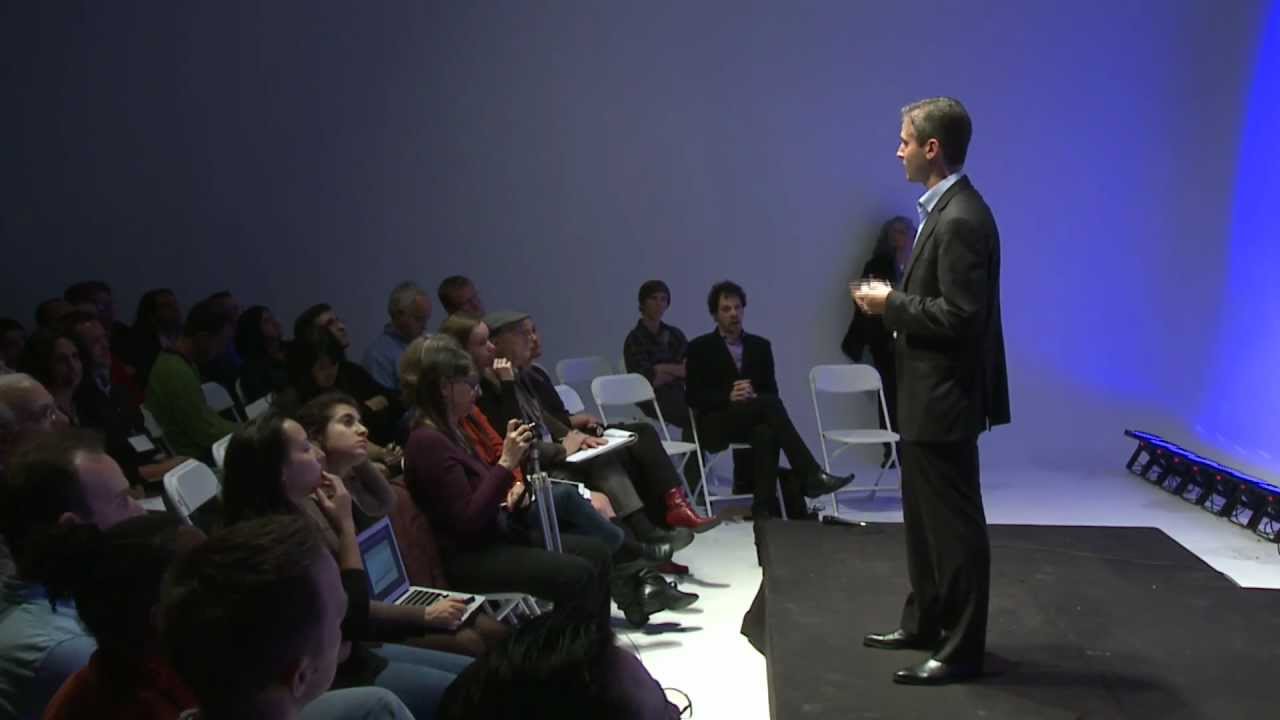
In this TEDx talk, Michael Horn recounts his path from public‑policy work after 9/11, through Harvard Business School and a class with Clayton Christensen, to co‑authoring Disrupting Class and founding the InnoCite Institute. He frames a national talent paradox: record unemployment alongside millions of unfilled jobs, a problem traditionally solved by higher education. Horn argues that universities are in crisis because they combine three incompatible business‑model archetypes—solution shops, value‑adding process businesses, and facilitated networks—leading to soaring costs and unsustainable growth. He predicts that many institutions will collapse or merge unless they adopt disruptive innovations. Online learning, driven by the internet, offers a scalable, affordable alternative that enables competency‑based education where time varies and mastery is constant. He cites Khan Academy’s individualized pacing and BYU‑Idaho’s data‑driven outcomes as proof points, and highlights the potential for personalized, evidence‑based instruction. Horn concludes that a student‑centric system must accommodate diverse student goals while delivering education at lower cost, arguing that this shift is essential to match workers with the millions of job openings and to revitalize the nation’s economy.
Chapters
Thank you. It's a real pleasure to be here, not just with all of you, but with so many friends who are dedicated to transforming our education system into a student-centric one that's fit for the 21st century. It's become my life work as well. In a way that wasn't preordained by any means. On the heels of 9/11, I had the good fortune of getting to work with David Gergen for a few years, the presidential advisor and now commentator, basically getting to sit back and think through the big public policy challenges facing our nation at the time and the world in general, getting to write about it, study, think, talk to experts in the field, and so forth. And after a few years of that, I went on to Harvard Business School thinking, I really want to do something about these challenges, create organizations, entities to solve these problems and actually bring value to people. And as is so often the case, our lives are not by any means linear. And while at the business school, I had the great fortune of taking Professor Clay Christensen's class, the father of disruptive innovation theory. And it totally transformed the way I saw the world. It allowed me to see why so many transformations that were happening around us had occurred, why they had formerly seemed so mysterious, and they didn't seem so counterintuitive anymore. And taking these theories, Professor Christensen and I collaborated on a book called Disrupting Class, where we had the opportunity to think through how do we apply these such that we could actually change the education system. And out of that, I created this organization with him and another colleague called InnoCite Institute, a nonprofit think tank dedicated to applying the theories of disruptive innovation to solve problems in the social sector. And so, much by accident, I was back into public policy, but now with tools at my disposal to help explain and create meaningful change with the entrepreneurs here today and others to actually move forward into this student-centric system. And I want to talk today about one of these major challenges facing us as a nation right now from a public policy perspective, which is that we're at this really strange time in our country's history where we have record-high unemployment in a generation, millions of people looking for work, and yet at the very same time, We have lots of employers who say they have over 3 million job openings, and yet they can't find qualified people to fill these openings. Just think about that for a second. Millions of people looking for jobs, and millions of jobs with employers that say they can't find people to fill them. It's a really strange paradox right now in our country's history. And in the past, what we would do when we had this talent mismatch is turn to our traditional institutions of higher education to help solve these problems. But just as we would like to do that right now, our traditional institutions of higher education are literally going through a crisis of their own. For many of them, their business models are fundamentally collapsing at a time when we need them to be expanding access and doing a better job of preparing students for this world, they're actually limiting access, or in some cases, even rolling it back. And in the absence of huge infusions of cash, they tell us, they can't solve this problem. And so what I wanted to do is just first start off and talk about, through our theories, why we see this business model fundamentally breaking right now, and then go into something that we think can actually really solve this problem, and along the way have some huge benefits for learning and improving the situation, not just for the country, but for those individuals as well, which really should be the ultimate point of this as we create a student-centric system. Now, stepping outside of higher education for a moment, we basically see that there's 3 generic types of business models in the world. And I apologize for a little bit of jargon, but the first one is what we call a solution shop. This is basically where you bring unstructured problems to experts who solve these problems with their vast amounts of intuition. McKinsey is a classic example of it, but if you went back before the Industrial Revolution, what you'd see is that actually solution shops dominated our economy. You used to have people that— craftspeople that you'd bring these problems to that would create pots for you. They'd create barrels, horseshoes, your shoes. These were all done by craftspeople in solution shops. The second type of model is what we call a value-adding process business. Forget about the name, but basically what happens is we take inputs, we add value to them through a consistent process, and we ship them out as outputs. Jiffy Lube is a classic case of this, but we see it all the time, and it actually— It's a good example. was the thing. This force was what drove the Industrial Revolution through factory models, with the power looms that powered the factories in Lowell, Massachusetts, and dotted the landscape in manufacturing and so forth. The 3rd type of business model is what we call a facilitated network business. This is basically where people come to a network and exchange things. You put things in, in the case of telecom, you put information in, other people are taking it out. Facebook is a classic example of a facilitated network business, and really what's interesting is a lot of the economic growth in this country right now is being driven by these network businesses. And what's underlied all of these tectonic shifts from solution shops to value-adding process businesses to these network businesses has been this process of disruptive innovation. This is where A process by which complicated, expensive, inaccessible, deeply centralized things, such as these minicomputers with their punch cards that cost a couple hundred thousand dollars to own and could only serve a limited few, are transformed into things like desktop computers that are far more affordable, simple, convenient, accessible, decentralized, and can bless the lives of many more people. This process has transformed the computing industry. It's transformed the way many of us do taxes, with the apologies to the accountants. It's transformed literally how we communicate. But what's interesting in all of this is that universities haven't really been disrupted by these same forces. And the reason is, actually, if you peel back layers of the onion here and go back to the beginnings of Harvard, What you'd see is that Harvard in the beginning actually looked a lot like a solution shop. You basically, when you learned, you learned from tutors in very one-on-one settings with a lot of intuition at play. When they added research over time, that's a classic solution shop, right, with experts solving really difficult problems. And then as the rise of the Industrial Revolution came along, they borrowed from the factory model system and instituted classrooms and lecture halls. Basically under the theory that we'll ship in students, batch them up, add value to them through a lecture, and ship them out the other side, forget about whether it added real value to them or not. And then of course we've always had network businesses in universities through alumni associations or career organizations or even study groups today. And the result of this is that the modern-day university looks like you combine the operations of McKinsey with a Jiffy Lube with a Facebook. And crammed it into one. 3 completely incompatible business models, all functioning in the same place, and the complexity to manage all this, you can imagine, it's astronomical. And as a result, costs have just skyrocketed over the last several decades. Tuition has gone up 10% year over year over year in our colleges and universities, and costs have increased even faster. Historically, the way we've solved this problem is just plug the gap through alumni donations or endowments, but of course those crashed with the recent financial crisis, or by getting government subsidies, but those are drying up as government funds are increasingly having to go to healthcare and pensions and prisons and so forth. And there just isn't that money for education anymore, and the business models of a large percentage of our universities are just collapsing because the costs themselves are not going away. Not only are they managing 3 fundamentally different businesses in-house, but they have what Andy Rosen of Kaplan calls Harvard envy, where everyone wants to be the biggest and best in the world. And so whenever Stanford builds a new gymnasium, you can bet that UC Berkeley will be building one soon too. Because you've got to compete along that. You've got to have the best dining hall, you've got to have the best research, you've got to have the best sports team, you've got to have the most majors, the most courses. It all adds cost and decreases productivity and makes it fundamentally untenable. Now, some colleges will be able to play this game. I suspect the top 5% have the wealth to do it. But there's some 4,500 accredited colleges in this country or so, And I'd bet that out of the other 95% of them, I wouldn't be surprised if in 10 to 15 years, half of them were gone, collapsed, merged, were acquired, because it's just unsustainable at this point. And yet, at the very point that our country needs to train people better for these opening jobs, to get them back into productive lives, to allow them to find the path that makes sense for them. And what's doubling up on this crisis is also an opportunity, which is we're seeing a disruptive innovation come along in the form of online learning, which basically allows us to affordably, in theory, and scalably reach millions of students with an education now for the first time in really focused ways that can educate them. And it's growing like crazy. By 2014, we project that 50% of all students in post-secondary education in the United States will be taking at least one online course. The number's already at 31%. It's just growing year over year right now. And fundamentally, new organizations are coming around this to use this disruptive innovation to transform the higher education landscape. And it not only has potential benefits for the business models, but also for the learning models and the way we help match talent with passion and opportunity. And so, for example, right now this is what our system currently looks like. It's a factory model teaching system, right? Borrowed from the classroom of the Industrial Revolution, where time is highly vari— excuse me, time is fixed, but the learning is highly variable. But powered by technology, we can move at scale to the competency-based learning system, where It's flipped around, where you move on once you've actually mastered a piece of material, and time becomes the variable so that learning can actually be the constant. And we can actually see through online learning now in pretty sharp detail why this makes sense, because students learn at incredibly different paces. This is a screenshot from the Khan Academy, which is a— created by Sal Khan that offers thousands of free lectures on math and science topics and assessments and quizzes in Los Altos, California, a school that's using it, that shows these different paces. The student in blue started near the bottom of the class in the beginning, and by the end was actually the third from the top. Not only that, we can start using these systems to actually drive data to radically improve Our outcomes. This is from BYU Idaho, where they used it to dramatically boost learning outcomes once they started to employ the learning sciences to dramatically shift the curve. And not only that, we can use it to get data so that we can actually personalize learning, to get the right learning experience at the right time, and use these randomized control trials all the time to radically bolster our knowledge of how this will all put— come together. Now, that's the exciting part of it, but I'm not saying at all that the result of this is that every college or university will look the exact same. I'm not saying that at all, because the reality is that we all, for those of us who've chosen to go to college or university, go for radically different reasons. Some of us go because we really want to study and master a particular skill or craft and so forth. Others of us go because we want to gain access to that network, get that credential, get that path forward in life in that direction. And you know, for some people, the job that they go to college for is to turn themselves from animals into adults. And I think we can all agree that that's a good thing too. Now, I had the good fortune of going to Yale for my undergraduate training, experience and had the grassy green quads and beautiful buildings that people say typifies the American post-secondary experience, even though about a third of students actually have that experience today. And I'm not saying that some of those things will go away and so forth, but what I am saying is that for Yale to increase the size of its class by 200 students, it would cost half a billion dollars to do it under the current business model. And when we have a problem with 3 million job openings and record unemployment, that's just not going to cut it for moving forward into the future and transforming our system into a student-centric one that can deliver the right experience for the right student when he or she needs it. And that's something I think we can all get behind. Thank you so much. Thank you, Michael.