Francis Rodino interviews Mike Michalowicz talks about his new book, "Get Different"
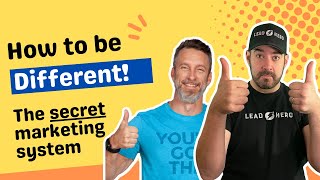
In this interview at the Trades Growth Summit, entrepreneur and author Mike Michalowicz discusses his latest book, Get Different, which re‑imagines marketing for trades‑based small businesses. He explains that his motivation stemmed from observing an over‑reliance on client referrals and the risk of being at the mercy of customers for lead flow. Michalowicz introduces the DAD framework—Differentiate, Attract, Direct—as a simple checklist for creating marketing that cuts through today’s overwhelming noise. He argues that the modern market is saturated with homogeneous, “white‑noise” marketing, especially as larger roll‑up investors begin to commodify mom‑and‑pop trades firms. To survive, small businesses must deliberately stand out, whether through visual cues (e.g., Geek Squad’s distinctive uniform) or linguistic re‑branding (e.g., calling himself a “hedge‑fund technologist”). He stresses that marketing is the first customer experience and must be authentic, tailored to a target audience, and provide a clear, reasonable next step. Michalowicz advises owners to experiment with low‑cost marketing tactics themselves before hiring external experts, using failures as learning opportunities to refine a plan. The conversation ends with practical resources and a reminder that a perceived weakness (like a hard‑to‑spell name) can become a branding advantage.
Chapters
Foreign.
Welcome to the Trades Growth Summit. I'm super excited to welcome Mike Michalowicz. So Mike Michalowicz is very well known in small business circles and he's a world famous entrepreneur behind three multimillion dollar companies. And he's the author of yes, Profit First, Clockwork, the Pumpkin Plan, Fix this Next, and his newest book, Get Marketing that Can't Be Ignored. So in Get Different, Mike reinvents the way marketing is done. Mike's books are staples when it comes to small business ownership and entrepreneurship, and they are absolute must reads for trades businesses and the market that we're looking at when it comes to running and growing your business. So, Mike, what an honor to have you. Thank you for supporting this event and for supporting our wounded veterans at Help for Heroes.
Francis, it's a joy to be with you. So thank you for having me. And I hope what we discuss today will be of service to the folks listening in.
So let's get stuck in. So, okay. Profit first and Pumpkin Plan are two of the most talked about books in the communities that I'm a part of. We network and are involved in conversations across social media. And those books are always coming up as you know, these must reads. So I know people are very excited about that. But, you know, really get different is a new way of looking at marketing. Okay. And I just wanted to really ask you what motivated you to write this book at this time?
The impetus behind it was occurred about seven years ago. Remember, I was surveying audiences, live audiences. Now with COVID it's more virtual. But I was asking the same question repeatedly. And something hit me. I was asking people, what's your source of business? Really, just to be curious. And I started seeing a consistent trend that most businesses are dependent on client referral. It means my clients talk well enough about me to other people that they're going to send business to me. To the degree where some businesses said 100% of my leads are through client referral and boastfully saying that. And I was on that bandcamp too. My prior businesses was mostly client referral, like, this is great. And then I had this epiphany that if we are dependent upon our clients to refer business, we're dependent upon them. We're at the whim of the customer marketing us. And the day they decide to not do that, we're in trouble. So we should respect and appreciate client referral. But we have to realize that's the icing on the cake. We need to build the cake. The cake is controllable lead Flow, it is throttle able, meaning we can decide when we need to amplify it. And I also realized this. Perhaps it's the most important thing. When our clients are marketing for us on our behalf, that means they believe in us so much that they are taking the responsibility to market us. They're putting marketing on their back and carrying the load. It's, there's helicopter parents for kids. This is helicopter clients for us. We need to break free of that. We need to respect what they're trying to do for us and amplify it. If you or me, if the services we provide is better than the competition, better than the alternatives. And that's what our clients are saying by marketing us, we have an absolute responsibility to get the word out. So with that realization seven years ago, I started to compile all this research and started assembling the book. And this book is a, it's a rallying cry to get out there and market. Because if customers love you, other customers must find you. It's your responsibility. And then it's a methodology on how to do that. Exactly. It's the steps.
Cool. And in the book you talk about the DAD framework, differentiate, attract and direct. And before I'd love you to talk about that framework a little bit. But before you do, can you, can we put it into perspective? Like why is a framework like that so important now as opposed to some years ago? The reason I ask is biz trades. Businesses, you know, they're not necessarily used to marketing themselves in new ways. Right. In innovative ways. They have very much referral based and have built their businesses off that.
Right.
What's changed in the world that makes the DAD method framework essential?
Well, there's amplified noise, meaning if you rewind merely 100 years ago, marketing was 1, 1 millionth of what we see today. Literally. You can look around the area in right now there's marketing. You know, you're wearing on a hat like that wasn't back then on your shirt. You know, we have it all on our desk. There's, there's this constant feed of stimulus. The other thing that's interesting is there is these rise of roll up. So if you're in the trades, if it hasn't happened yet, it likely will soon that an investor group comes in and they start assembling rolling up businesses and make them into a bigger package and they back with marketing. So you start seeing these large companies commoditize what used to be a mom and pop type of business industry. And I'm not against those large companies but what I found is typically there's a degradation in quality of service and, and quality of care. These larger companies, they have a different master. They got to pay the investors as opposed to the owner. And that's radically different. An investor is in for the quick financial gain, typically. An owner is typically in for a passion of their heart and longevity, financial longevity, which is a different game. And so if you start seeing roll ups, if you start seeing larger organizations come in, you have to stand up and speak loudly because you're providing, providing a higher quality of service to your customers and they're going to, they're going to respond to what they see. The other thing is if you're a small business owner, you, you simply care more. So like I said earlier, this is a responsibility to have people take, take notice. This is the old Goliath versus David or David versus Goliath scenario. And so what I want to do with this book is equip you with the stones. Like, you don't need to be powerful, you don't need a massive marketing budget. You don't need a marketing budget.
You don't need.
You just need the right way to wing those stones and you'll take down Goliath. But more importantly, you'll be of great service to your customers and prospects.
I'd love to elaborate on that a little bit because my burning question for you was really about how can a service business, which is typically very easily commoditized, Right. And it's very, it's ultra competitive. Say you're selling boilers, water heaters, and your product is the same as the next business. Right. And the consumer is typically looking for the most cost effective price. Right. And they have the Internet just gives them all of this choice at a touch of a button. What are some ways that a trades business with the products or services that they offer can differentiate them? How can they get different?
Yeah, And I'd argue customers actually don't look for price unless they see it's the same as everyone else. If we're interchangeable, your service and my service is identical, then the right decision is lower cost. Point. So the first thing to do is to not make ourselves a commodity. I'll give you a story as an example of how I experienced it myself and then give you an application where we can use this tradesman. My first business was in computer systems. I was a computer guy and there was millions of computer guys competing against me. I'm in New Jersey, the northeast corridor of New York. The United States is very concentrated with, with with population. And therefore there's a lot of competition. And I would say even in a small radius of, you know, 50 kilometers within my house, there was a hundred notable competitors and we all looked and acted the same. I would wear a suit that was one size too big. I looked like a human scarecrow. I had all the credentials on the planet. I had all the certifications to prove I was better. And I'd argue compared to what I knew about my competition, I was better in many regards. But better is not noticeable. For example, if you and I were in competing businesses and we do boiler repair and I answer the phone in two rings, Francis, you answer the phone in one ring, you are unequivocally better. You're 50% of the time people spend on the phone waiting for it to be picked up has been addressed by you. But do customers notice? Oh, they don't notice. They only judge us on a very few surface level things or one or two intimate details once they have an experience with us. But it always starts with marketing. And this is important if for anyone listening, and I invite you to write this down, the only experience a customer will have with you until they experience your business is your marketing. It is that first impression. And they know nothing about you until they experience you. So marketing is that important. It is the experience until they have the experience. So you have to market differently. And this is the key thing is as commoditized as an industry is, there's an opportunity to stand out. So I'm this computer guy. I'm competing against a hundred other computer guys and all of a sudden one day this company comes in and kicks my butt nine ways to Sunday. It was coming called Geek Squad. Geek Squad. If you haven't heard of them in the uk, these are guys, you know them. Are they in the uk?
No, they're not in the uk, but I do remember of them in the.
US in the US they started in Minnesota, they came to the east, they blanketed the country. They were not better. In fact, I would argue they were technically inferior to most of my competition, inferior to my work. They didn't respond faster, but they wore flood pants, black pants, white socks. They wore glasses with tape in the center, and they wore a narrow tie. They looked like the prototypical geek. And that was different. Customers noticed they got tons of business. They got extraordinary notoriety as a result. Today they were acquired by a company called Best Buy here in the US today it's a $1 billion. 1 billion with a B billion dollars. My company did not get that Valuation and the founder, Robert Stevens. When interviewed, he said that the more boring an industry, the greater the opportunity there is to stand out as tradesmen. I challenge us to do what no one else does. And it could simply be a costume change, that is marketing the way we present ourselves. Be the only one with the pink trucks or be the one, the red carpet service, who actually carries a red carpet. And you roll it out as you walk up the driveway and you roll it into the house, the customer. Those, all those elements are forms of marketing. And those are just two, just off the cuff examples. There are countless examples. The shame is most people, and this is there for the opportunity, revert to the mean, the norm, the average. What's the five best practices in the industry? Well, client referral. You gotta do your social media ads and have a good website, maybe a trifold brochure. My gosh, that's the white noise. That's what everyone's seeing. That's what we're saturating on. Do something different in your marketing and that will catch the attention of the customer.
Absolutely. And customer experience then, as you suggested, becomes a part of your marketing as well. Like the speed to the lead and how you delight them. And sometimes that can be a bit ignored as well. And Mike, can you take us through the DAD framework a little bit, give us a taster of, of, of how it works?
Totally, totally. And I'll dig into some of the biology too, because I think it's important to see how our brain or the human mind processes information. So D.A.D. is an acronym, but it's really easy to remember because you need to check off these three elements. Any marketing that you consider, any marketing you look at of your competition, always ask yourself, does DAD approve? If you can check off these three elements, you gotta pass. Your marketing is most likely to be successful. If you miss even one, your marketing is crippled at best. So first, D stands for differentiate. Differentiate means to do what we've talked about already, what the others are not doing in our marketing. The reason is, and here's the biology is the human mind becomes habituated to a stimulus and therefore starts ignoring it. Meaning if I've experienced something once and it was irrelevant and is likely to be irrelevant again, and our mind therefore ignores it, a blink. I mean, within 1/10 of a second we're like, oh, not relevant. Anytime you receive junk mail and you see how quickly you just throw garbage out, you don't even open the envelope. That's habituation handled. And it's called the reticular activation. Reticular formation at the brainstem.
But.
One example in more current times is I received an email that said, hey, friend. In the beginning. Never received one before. Caught my attention because it was different. I started reading it and I'm like, hold on, this is not a friend. What friend calls me friend? They don't even call me by my first name. And I was like, this is smarmy marketing. Since then, I've probably received hundreds, thousands of emails that start with hey, friend. I've deleted every single one. I've never looked at them. They go right to the spam box. That's how quickly our mind becomes habituated. So the key is in your marketing, do what no one else is doing. Be the first to do it. There's a lot of ways to grab you to do this. Simply look outside your industry. I just gave you a tip. Geek squad dressed differently. Ask yourself, is anyone willing to dress differently in our industry? Is anyone doing it? If not, it's an instant marketing opportunity. Most people won't do it because they don't have the courage to do it. There's this other mechanism that plays on and our mind is wired to comply and fit in, that we need to be in a part of a community. And that exclusion from a community is extremely painful. And if you go back to the cave dwellers day, exclusion from a community meant certain death. And our reptilian mind still feels that emotion. So we're like, oh, this is bothersome or confrontational. We have to overcome that to understand that marketing is a responsibility. If your service is better than your competitions, you're responsible for other people to discover you. So you have to defeat that fear. Stand out. The second element in the DAD framework is a for attract. Whatever our message is, it must speak to the community that we're targeting to serve. So you first have to go in knowing who am I serving here? Different for difference sake is ineffective. And I'm not about outrageous marketing, confrontational marketing. I'm about marketing in a way that is extremely noticeable and extremely appropriate for the right target audience. So I can come on this show with you as you're doing your summit and say, hey, you know what? I should come on in a Bozo the Clown costume. Because then everyone's gonna pay attention to my presentation. And the reality is it won't work that way. Everyone would notice for about 1/10 of a second. It's a blink test. But then the next part of the mind is once it opens up and says, I should consider this, we instantly start evaluating and continue to Evaluate. Is this a value for me? Is this appropriate for me? And they see, oh, here's a clown. They're like, no, no, this guy is not a fit. And he's likely a murderer, because all clowns are murderers. So the question is, differentiate, but also be attractive. I love what geek squad did they dress as geeks, which is the superhero of fixing computers. Who doesn't want a geek? So it was attractive. It was inappropriate for other people. They take their business way too seriously to ever consider someone in costume. But for the majority, we worked. So the attractive factor is something that attracts the audience you desire and maybe repels the others you don't. But make sure it's attracting your target audience. And the messaging must be according. The last element of the dad is direct. Direct is giving this prospect specific direction to take. Now, here's the key. It needs to be reasonable. Direction. It can't be unreasonable. If you were looking to buy an automobile and I have a shop or a store that sells them, and you come into my store, I can say, hey, Francis, could you give me £100,000 and I'll find the perfect car for you, your dream car. You'd be like, that's outrageous. No, but if I said, hey, Francis, would you be willing to give me your cell number? I have a lot of inventory that may match your needs. Different lots. I'll take pictures and text them to you, and we can hone in on your dream car. Is that appropriate? Likely, yes. There's still a transaction there. I now have ability to communicate with you. And the goal, of course, on the sales side is to move you toward that final transaction where you get your dream car and I get my commission. And the goal is to do it safely and efficiently. But it must be reasonable for the customer. We don't want to flip the other side. It's a little bit of a balance here in the direct stage. You don't want to do the other side, where simply you come to my. My shop and I. And I say, hey, you're looking for a dream car? Yeah, great. Walk around and if you see something, tell me. If you don't, I'm around. It's like, okay, that's that constant browsing. The modern manifestation of that is on website. Go to a website and it says, like, you know, here's our company. We fix boilers and so forth. And there's a button that says, learn more. That's the worst button to have. The whole reason I came to the website was to learn more. You should say, book a Consultation, get the free evaluation, give us your phone number, get put onto our priority response list by give us in your cell. But do something that's a reasonable action that gets closer to the transaction. The summary, dad, is a checklist. And any marketing we consider simply ask yourselves, does it differentiate, does it attract and does it direct? You cross off all three. I mean, if you check off all three, the likelihood of your marketing to be successful improves by a multiple.
That's, that's. It's so important more than ever that these business owners take ownership of their marketing. Right. I think that there's a. Yeah, there's a lot of people out there that think that, well, you know, I never learned marketing or business fundamentals in the trades and it's actually for someone else to do for me. Right, yeah. And they shy away from it. But it's so important for people to actually take ownership and do it themselves and learn these methods and methodologies. So just, you know, to maybe finish off this interview session. What would you say about, you know, business owners that perhaps they don't think that they're a marketer? Yeah, right. What.
Yeah, that's a great point. There's a risk of using an outsider. There's a benefit. The risk is it becomes homogenous. So I can hire a social media expert to promote my plumbing business on social media who also promotes other plumbing businesses on social media, and therefore there starts to become this homogenous marketing which causes white noise, which therefore the reticular formation habituates it and ignores it. So common approaches are very ignorable and an expert in marketing will typically use a common approach they use so implicitly there's a risk. Now the benefit, of course, is that they have a skill set that we often don't have. They know how to place ads or whatever the platform is. The key is the authenticity. Back to you. So I am not for or against outside experts, but what I absolutely mandate is that we are first true to ourselves and understand and determine how we want to distinguish ourselves. Then it's upon us to hire an outside expert and give them guidance around our parameters. Or, or if we want to carry the load of the effort, we can and should maybe just do it ourselves. In fact, I encourage in the very early stages of the get different process that owners do the marketing themselves. I have as a resource 100 different marketing things you can do on your own. They cost nothing, some near nothing, and they may be wild success for you or they may be flops, but they start building the muscle, the Biggest mistake I see people going in with is they haven't been marketing successfully. And now I say I'm going to do it. And they go in with a marketing plan. And I'd argue that's a mistake, because implicit to plan is commitment. This is what we're going to do for the next year or three months or whatever the timeframe is. Get different is about marketing experiments. What we're talking about here is let's go in with an expectation for failure and some success, but an expectation of learning throughout. And when we learn what doesn't work, we avoid or improve. When we learn what does work, we enhance and amplify. Then once you find what's working, now we have something that is representative of a plan or should be used in a plan. And that's when maybe we bring in an outside expert or we delegate some elements in the house, but we gotta make sure it's true to you. For me to start dressing like a geek for my business back then would have been inconsistent with me. But I did find another thing I could do. Once I saw what Geek Squad did, I looked at the community I was serving now as a B2B business to business assigned a hedge fund. I, I did one simple different thing, and it was a game changer for my company. We used to be the computer guy. We said, we're computer techs, computer guys. I realized that was the commoditized term. I simply just changed the label. I served hedge funds. I would call myself a hft, a hedge fund technologist. It's interesting when you make something an acronym, it seems even more official. I just made it up. And I met with this first prospect and he said, what makes you different? I said, well, as HFTs, he said, I'm sorry, what's an HFT? I said, as a hedge fund technologist. He's like, you're a hedge fund technologist. They exist. You're one of those. I'm like, apparently so. And he signed up on the spot. The price was no longer relevant. I was the exact same guy. And I felt I was always capable and I was serving the community. I got more and more capable, but I wasn't much better. But I was finally different and I was no longer commoditized. Price was no longer part of the game. It was that simple of a different move. I think we all have that opportunity available in front of us.
Yeah. And maybe, you know, the resources that you're providing actually can probably help business owners really dive a little bit deeper under the surface. Because people are just looking at what they can see in front of them. But actually maybe you know, to find that authenticity that you talk about or that point of difference. You know, these exercises, training the muscle with these tools and your books can also help them to discover that.
Yeah, I hope so.
And thank you so thank you so much for joining us, Mike. You know, I just want to, I hope everyone will buy the new book Get Different. I read it. It's incredible piece of work. And to learn more about Mike and to get access to his treasure trove of entrepreneurial tips, you can visit www.mikemicalitz.com.
Good luck spelling that. Just one little add on to get Different. Often our weakness can be our advantage. My last name is so difficult, I set up a adjunct website called Mike Motorbike, as in a motorcycle. Mikemotorbike.com is even easier because that's easy to remember. They'll get you there and you'll see how I used Michalowitz, that weakness and actually to my advantage.
If you go to mikemotorbike.com mikemotorbike.com Mike Michalowicz, thank you for joining us on the Trades Growth Summit. Good luck with your future endeavors. Keep on changing the world. Love your energy and your contribution. Have an amazing day and thanks on behalf of all of the trades community and help for heroes here across the pond.
Thank you, brother.
See you later, Mike.










