Hey! Small Business owner, this is for you. - Mike Michalowicz
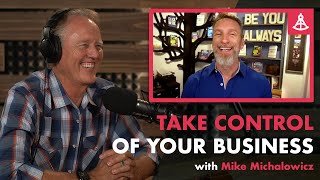
In this Optimistic American interview, host Paul Johnson talks with serial entrepreneur and author Mike Michalowicz about the mindset and tactics that help small‑business owners thrive. Michalowicz shares why optimism and a sense of personal agency are essential, especially during economic downturns, and explains how his experiences of early success, collapse, and recovery shaped his belief that entrepreneurship is a learnable discipline. He revisits key ideas from his books – The Pumpkin Plan and Get Different – describing practical frameworks such as prioritizing “best” customers through client‑cloning, the DAD (Different‑Attractive‑Direct) marketing model, and the importance of speaking to the four core buyer motivations (health, wealth, love, happiness). The conversation also covers how to reframe recessionary periods as opportunities, the priming effect, and the value of disrupting industry norms and habituated marketing noise. Michalowicz offers concrete steps for entrepreneurs: identify and amplify top customers, ask them what you do right, focus on benefits rather than features, brainstorm outside one’s industry, and deliberately break “industry rules.” He concludes by directing listeners to his website (mikemotorbike.com) for books, PDFs, podcasts, and additional resources.
Chapters
Hi, I'm Paul Johnson with the Optimistic American, and I'm here today with author Mike Michalowicz. We're going to talk about entrepreneurship. You know, all the great things that are going to happen over the upcoming decades. It's not really going to happen with government. It's going to happen with those people who are creating new product with entrepreneurs. They're going to be the people who come up with driverless vehicles that wipe out the DWI industry and reduce deaths on our freeway or come up with cures to cancer, for that matter, extending human life. But entrepreneurship demands that we have a sense of agency. And that doesn't matter whether you're somebody who's working on big, huge global issues or cleaning carpets or cleaning pools. Having that sense of optimism about the future is absolutely key, and that demands that you have your sense of agency. Now, in Mike's books, he does a series of things that I think are very important. The first one is especially the Pumpkin plan. It gives you a great introduction to the leadership skills that are necessary in entrepreneurship. But the book Get Differently, which is its most recent, really, is a checklist of great ideas as to how you can make certain that your business is getting noticed. Now, again, if you believe that these concepts that we're focusing on are important, trying to get agency, being optimistic, entrepreneurship, if you would push that subscription button, it cost you nothing. We're not going to bombard you with ads or anything else.
We.
What we are going to do, though, is it helps us continue our work in getting great authors and other people who believe that optimism is important for America. Now here we go on our show to try to talk a little bit about hope. Mike, I'd like to welcome you to the Optimistic American Show. Thanks for being on with us today.
Paul, it's a pleasure to be with you. Thanks for having me.
Thank you. All right, so I have read almost all of your books. I think they're exceptional. We're going to recommend a couple of those to our audience here when we get done. But I want to start with this. All of them have one similar theme, and that's it. You seem to have a real passion for entrepreneurs. Why is that? What. What is it about them that drives you?
Well, they are me, and me are them, I guess. I. I've been an entrepreneur my entire life. I think the driving piece, though, is I had early success, which inflated my big fat ego, and then I collapsed just because I was so arrogant and highly ignorant and lost all my money, had to restart. It was that moment that. That brought me back to a grounded reality and. And the understanding that entrepreneurship is a discipline that we can master. There. There's an art, but there's a lot of science to it. And I endeavored to figure out, you know, the science. And I'm. Honestly, every book I write is I'm trying to serve myself. I'm trying to learn. And I. I own businesses today. I deploy in my own companies. And I think if it can serve someone else, I have the duty or the responsibility to share. And that's why I'm so passionate, and that's why I write what I write.
Yeah, I think there's no doubt also, and I've actually read some of this from you. The big problems that we have today. I served a lot of time in politics. The big problems that we have today that are going to move mankind forward, it's going to be done by entrepreneurs figuring out the driverless car or how to cure cancer. It's going to come to the private sector.
Someone once told me, I can't remember who to attribute it to, but they said, wherever you are in this moment, look around you, and chances are, anything you see was created by an entrepreneur. Now, if you're out in nature, that's the ultimate entrepreneur, Mother Nature, but she figures out some amazing stuff. But if you're in a business space or you're home or traveling, everything we experienced was created by someone who had an innovative idea and took the risk of manifesting it.
All right, so one of the concerns. I speak to a lot of entrepreneurs. I'm sure you do as well. I hear from a lot of them this sense that they're losing their sense of agency. They're watching all the bad news about recessions and all the terrible things that might happen, and some of them are becoming paralyzed. What are the things that you think that an entrepreneur can and should be doing, regardless of what state we're in in the economy?
I think first to realize how we behaviorally respond to circumstances. And there's this thing called the priming effect. And what it is, is what we immediately see. We put a disproportionate significance in good or bad, and we see this in our own business. I speak with entrepreneurs like, how's business going today? And if a big deposit came in, they said, business is crushing it. The next day I visit them and they have spent all that money. I go, how's business going? Or it gets miserable. It's the end of the business. We are highly influenced by what's happening in the moment. And so we see in the news these horrible things going on, and they are. But in the big picture, it's just a small drop. It's not necessarily foreshadowing what the future beholds by any stretch of imagination, in my opinion. As entrepreneurs, I think what we realized too is that kind of like a waterbed from the 70s, you push down this side and you pop up on the other. As we experience depression or challenges in one side of the economy, that means there's going to be a lift somewhere else. So as much as we see challenge, I think we have to say, where is the opportunity within this? How can I be of service within this? How can I leverage this to my advantage? I think all indications are, I think actually the government announced, the federal government, that we are in a recession, two consecutive quarters of down gdp. I think we're seeing some of the trickle effect in small businesses. The people I serve already and who knows how go. But a recession is also a massive opportunity. This is where a business could perhaps acquire new customers because another business is going out of business or decides to retire early. I think there's. We can do things called upstream looks, where instead of looking at how, how do we preserve the few customers we have, we can look at how are new customers upstream, how are they entering the market, how can we serve them in a new way? I think if we just prime ourselves saying this means opportunity, we can come out of this recession and choose not even to participate in it. Honestly.
I said this in the past. One of my top five business books that I've recommended in the past have been the Pumpkin Plan. One of my real loves of the pumpkin plan was your discussion about customers and how to try to make certain that you're identifying the customers who you really love. I almost remember it as saying that the ones that make you smile when you answer your phone, you have to treat differently than those that you get depressed by when you look at it. Can you explain that concept a little better?
Yeah. So we give preferential treatment to the people we like to work with more. It's inherent to human nature. So in that example, when the phone rings and the caller ID pops up, if it's a name you like, if it's someone you enjoy working with, you're going to jump on the phone, you'll probably have a positive attitude, you'll give them preferential service inherently, even though we're told, or many of us believe, that all customers should be treated the same. But when that other customer calls in, the one who never Pays you on time. They're always complaining, they're difficult to deal with. You put in a voicemail. Do you wait till the end of day hoping that you have to talk with them? At least now, in this moment, that is a form of preferential treatment. Well, we need to leverage that to our advantage. If you're prioritizing your best customers, we should actively seek out our best customers in the pumpkin plan. I call it client cloning. And what we do is we pursue our best customers and we interview our best customers and ask them, where can I find more people like you? Not in those words necessarily, but where do you hang out? Where do you congregate, Your favorite podcasts? You go to different events. Who do you else do you work with? What you'll find is birds of a feather flock together. So ask your best customers where they go. You're going to find a pocket of them. Now, it requires, Paul, a discipline of getting rid of your worst customers. Now, I'm not saying these are bad people, by the way. I'm just saying they're a bad fit for our organization if we have the discipline of removing them. It opens it avails the space to take on more good customers. I'll give you one more tip. When you have identified your best customers, ask them what you're doing right. If this is a like a Jedi mind trick, because your best customers won't tell you what you're doing right, they'll tell you how they judge you. As an example, I used to have a computer business. We did computer services. I asked my best customers, what do we do right? They said, you respond very quickly to our issues. And what they were saying is we observe how quickly you respond to our issues. The one thing you're doing right is the. Actually, the one thing you must amplify. Do that better if you want to be the best in the industry. Do what you're doing right better, and the word will get out on a magnificent scale.
Yeah. And I know that you know the. I've used that book in a number of business businesses that I'm in. And it is very oftentimes the case that you'll find you're spending 80% of your effort on the 20% of the customers who are mad at you or that you don't like because they're not a right fit. They don't fit right into your organization. If you can start to focus more on the people who you do align with and start to trim out the people who don't quite work for you or you don't work for them so that they can move on to someplace where they can. It relieves a whole bunch of your time to go spend on the things that matter that will help you grow your business.
That's such a perfect application and observation of the Pareto principle, the 8020 rule. And you're 100% correct, or at least 80% correct, right, according to Pareto. And I think there's another application of it too that I've observed is profitability. Those 20% of customers they're taking 8% of your time typically result in negative profitability. They are costing you to be of service to them. But the 20% elite customers where you spend very little time currently, if you start focusing time on them, those elite 20% are yielding at least 80% of your profitability. So focus on the few who bring the most value to your organization. Amplify your focus on them, even just a modicum. If you spend 10 or 20% more time catering to your best customers, you'll see the amplitude. It's like an exponential factor on the profitability. They'll start scaling your business. And I'm kind of repeating here, but those lower hanging clients, especially the very bottom eaters, if you will, they're costing your business and just by removing them from your company amplifies your profitability.
All right, so your next book, or last book, I guess I should say, that I know of, was Get Different Now Get Different. What I loved about it is I sat down and took notes out of that just because it had a thousand good ideas for marketing. But that was a transition for you, moving from the kind of the general business concepts specifically to marketing, at least from my perspective. But what caused you to do that? Why did you put such a big focus on marketing and how to market differently?
You know, I'm very lucky, Paul, that I have enough of a readership that I get a regular stream of inquiries, but also feedback. And the common feedback that I'm looking for is what do I do now? So these are for people that have benefited perhaps from my other books or from just books in certain genres, but where they stuck. And. And once I hear a rhythm or a pulse around a certain subject, I'm like, okay, this is what I need to investigate Now. I didn't hear about the need for improved marketing for small business this year. This goes back five or six years. It takes me about five years to write a book. I write books in parallel. Yeah, I'm writing books in parallel. So I have a new one coming out When I started, about seven years ago now. So what I noticed about five, six years ago, prior to the release, was that small business was getting, was, was, was having difficulty competing in marketing since the advent of social media marketing. And that has now become buried with big buyers. So if you're running ads on Facebook five, six years ago, it was affordable and you got return. But now the big sophisticated buyers are in there and it's no longer the wild west. You can't just pan around, you're going to find gold. So these businesses said, we're frozen, we don't know what to do. And I want to get back to the core essence of what makes marketing effective. So I outlined the framework. If you're doing the common approach, your common noise, you're invisible. How do you differentiate? Differentiate is great to get noticed, but is it attractive? That's the second phase because listen, I could dress like Bozo the clown for this interview and everyone's going to notice, but then they're not going to pay attention. Like who? What's Bozo doing here? So it's got to differentiate, it's got to be attractive, speak to the audience's need and then it's got to tell them what to do next. I call it the direct. That framework, dad, or the dad framework, is the methodology for effective marketing. It always has been. I just wanted to reconstitute small business owners in that approach as opposed to going after the big money spends that we hear is the effective approach, but it no longer is.
By the way, that simple concept of dad can make people think that that's all the book has. There are so many ideas in this book. I highly recommend people to get it, to look through it because it just in every single medium that you can think of. You made great suggestions about how to think about getting to dad so that you can be noticed as a business. So we focus a lot here on the idea of agency and specifically meaning. Meaning we just got done doing a the book on Viktor Frankl where he talks about that it comes from love, it comes from what you create and it comes from struggle. Which business can give you all three. What I've seen in business is that, you know, if you focus on, I'm a carpet cleaner, nobody really cares. But if you focus on the idea of what the customer cares about, which is my children who are crawling on a floor where cockroach particles are being ground into the carpet and other toxins are breathing in, all of a sudden the customer cares. How do you, how do you use meaning? As part of your marketing message.
Yeah. So as a great observation, I believe buyers, customers, we all only buy one of four categories. Health, wealth, love, or happiness. And in that example you share with the carpet, the parent is buying health of their, for their children. Like that's a big thing. They're not buying the feature. Right. They're buying the benefit. So what I suggest is that we need to identify the core benefit that the customer is receiving and ultimately ask your customers, when we deliver our service or product to you, what's the emotion that brings about and why does it bring that emotion about? I worked with the Chimney Cleaners association of America and they had a huge problem in that they were having a difficult time drumming up business. And it was pretty obvious why. Because no one knows they need their chimney cleaned. You don't see like a dirty chimney unless you stick your head up the flue. And once the service is rendered, you can't tell. But everyone wants, no one wants a clean chimney. Everyone wants a roaring fire, a safe roaring fire. Especially in Phoenix when you have those cold winter days like we do here in Jersey. So what we did is we changed the messaging to warm fires, roaring fires, celebrations in front of the fireplace, cold winter days here in the northeast. And that started to resonate with people. The key element here is you need to speak. Their lingo is usually the benefit. We build connection with each other when we have a common voice. You see, I, I can paint pictures in your mind and you can paint pictures in my mind if you use my language. I remember hearing a story of a real estate agent who used to say, this has, you know, three bedrooms or four bedrooms, you know, two and a half baths. They change the lingo to say to the customer, what would amaze you about a house? What is your dream house? And they said it's the views of the mountains or it's the, it's the fireplace. Then what they would start doing is in their ads they'd say the, you know, life changing views of the mountains, roaring fireplace for cold winter days. They didn't hit the features. They started speaking to the benefits. They attracted far more customers and better qualified customers.
Yeah, it's a thinking about things in the language of the customer. I think that's a perfect way to put it. What were those four items again though? I like that.
Health, wealth, love and happiness. Those are the four buying categories. And if you're not serving one of those, or at least speaking, you're always serving one of those, but you got to speak to that, you know, the views from the house was happiness. But for some customers, it could be a form of safety too. They want to be away from the city because they feel that the urban environment is too dangerous or something. So understand what you're selling, the views, but also position under one of those four categories.
Now, you mentioned something in the beginning which was one of your struggles. Many of the entrepreneurs that I talk to, they face struggles and oftentimes the fear of those struggles make them think that they're not going to be able to get through it. My view is every entrepreneur who's been a success has some vulnerability in their past or some struggle in their past that they've had to deal with. Is that true with you as well?
There's no question about it, Paul. I mean, that is truth. Yes. So. So if there was no struggles for any of us, we'd all be doing it, right? It was just drinking water, everyone be doing it. But there's no. If someone says, hey, I can drink water, no one's blown away by that. But if someone says, hey, I can deliver a custom made sign to your home in three days, that's remarkable because very few people do that. The only way to be part of the very few is to get through the process of figuring out how to do it. And that's what the struggle is. What I think it was Einstein who said, and I'm paraphrasing, when something goes wrong, you simply found a way not to do it. Congratulations. The entrepreneur journey is full of that and there is no way around it. I will tell you this. I have struggled with analysis paralysis. When I got too deep into the struggles, I went into industries. In the past, I've been in manufacturing, services, technology. I've been in many spaces. And when the times I struggled the most, I noticed I was worrying about the struggle, overthinking it and frees me up. I was too hesitant. Often, especially in the early stages of business, the best way to go is simply go forward, even without knowing, because you will learn as you progress.
All right, so what's the most important advice that you could give to entrepreneurs?
Don't replicate the industry. So maybe this all ties in together. We talked about getting different. We talked about the struggle. I'll tell you one thing about not knowing everything about your industry is you don't know the industry rules, which these rules are made up. There's no Bible saying this is how the business must run so you can disrupt it. There was a bank here in New Jersey called Commerce bank that said this is back when bankers hours existed in the 70s and 80s, you couldn't get in after 4:00 on a weekday. One day they would extend it till 5 just to give business owners opportunity to rush to the bank. This one bank said, why don't we replicate fast food restaurants and be open 24 hours with live access? And they modified it. Instead of giving out happy meals, they gave out dog bones to people to come with their family pooch. So whatever the industry rules are, if you are willing to bust them, you may bust the wind industry wide open. Commerzbank sold for over $1 billion to TD bank because they were simply willing to defy the odds.
Wow. Yeah, it's a. You know what I liked about your last book on get different is it not only talked about how to differentiate your product, the product itself, but it also talked about how to differentiate your marketing. I love the little story that you gave about you helping the realtor and saying, okay, well tell me how people advertise. And they kind of went through step one and step two and step three and they finally came to and we all put a sign up in everybody's yard. And you said everybody puts a sign up in everybody's yard? Yes, everybody puts a sign up in everybody's yard. And so you came up with the idea of creating a windmill. Right. It's utilizing the same concept, but just a little differently. A lot of people think they're not creative enough to do it. But in your book you gave some advice on, on how to come up with those ideas. Could you maybe just expand on that a little bit?
Yeah. Well, you started out with the perfect starting point, Paul, is first we have to find out what the common approach is, because that's the thing we need to disrupt. And you can always disrupt it in two, only two ways. One is the method. So do the same thing everyone else is doing, just in a different approach or the medium. If everyone's doing signs, why don't we do an email or a blast or a billboard or something? That's an alternative. So medium or method. So first you figure out what's the common approach. Whatever the common approach is, consumers achieve what's called habituation very quickly. Habituation is where you hear something that you've heard before and you deemed irrelevant in the past. Therefore our mindset will never be relevant again in the future and we actually ignore it. It's a subconscious level. Right outside New York City, where I live, they had a problem with ambulances on an emergency run to save someone, killing someone. They Were hitting people walking across the street because we couldn't hear the noise. The sirens are wailing. But I became habituated. I've heard that siren in the past. Not relevant to me. I'll keep walking. And people are getting crushed. That's why they had to disrupt the method by changing the chirps and burps and honks and so forth. So it disrupt people's habituation pattern. So what we need to do as small business owners identify the common noise. Second then is just do a brainstorm yourself. Write down what does no one do and there's no one do's is probably an option. Secondly is get people outside your industry. If you talk to people in your own industry, we circulate the same five or six ideas over and over again. Becomes very incestuous. We need to do is get outside our industry. You know, if you're in real estate, go to a cleaning conference, a cleaners conference for that carpet with a cockroach in it and say, hey, how do you market? And then peel those ideas and introduce them to your market. You may be the first to do it. Another one is if you've colleagues just start brainstorming. The more outrageous the idea is, the better. Not that we're going to do outrageous ideas, but you know, getting different is not again about that bozo the Clown, but it will incite ideas that we can refine down. In that story you shared, that real estate agency, I'm still in touch with them. What they did was everyone had those sandwich board signs and the fancy ones had a post based sign. So we said, okay, that's the two things not to do. But we still wanted to sign a property. So we bought these garden windmills, kind of like a, well, a windmill but a small one and with a spinning, you know, that spinning fan and we put the sign on it and that was enough to disrupt the habituated pattern. It was no longer a high, low siren whale. It was now the chirps and blurps that caught people's attention. They continue to do it. Here's the best part. The competition will rarely replicate different because they're afraid to do it. There's an internal resistance to standing out and there's a whole reason why. So once we do different, there is a life to it, shelf life. It will burn out. Ultimately people will have the courage to replicate it. But once you find something that's working, milk that cow all the way to Sunday. Just keep doing that until people start replicating. And then again challenge the industry norm with something New yet again.
All right, Mike, we have a few more minutes. Would you mind telling people who are listening we where they can go to get the book? Also, I know you have a lot of PDFs that came with that. I thought they were really great handouts. If you could talk about that and then if they want additional help, where they might go for that.
Yeah. So I think the starting point is my own website. The book is there, get difference there. Plus with other work I've done, all the resources are there. I'll tell you a different way to get to my website. My name is Mike Michalowicz. No one can spell that. And while I have the domain, I have a shortcut. It's Mike motorbike.com it's a nickname I got in grade school because it rhymed. I've never driven a motorcycle and it's the only G rated nickname I've had my entire life. So I bought Domain. The other ones are pretty profane. So if you go to mikemotorbike.com you'll land on my site. You'll see all the content from my books. I used to write for the Wall Street Journal. I have podcasts. You can learn from that. Plus, I think you'll also see just in the way I've designed my own site, how I've deployed this methodology and perhaps are things that you can copy from there.
Mikemotorbike.com all right, Mike. Thank you so much, Mike Motorbike. I appreciate that. We'll remember that. Mike, thanks for being on the show and we appreciate the great input you've given to entrepreneurs today.
Paul, this has been a joy. Thanks for having me.
Thanks. Thanks for joining the optimistic American Show, Help Us Grow by subscribers subscribing to our channel. If you enjoyed the episode, please leave a like and a comment. There is so much more that we have planned. We can't wait for you to embark upon this journey with us.










