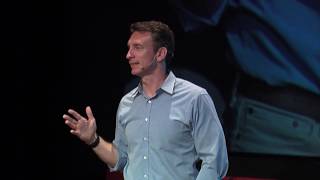
In this TEDx talk, Mike Michalowicz opens with a vivid 1935 story about Orson Welles racing an ambulance through a snow‑bound New York City to make it onto a Broadway stage, framing it as an early "productivity hack". He then describes the modern productivity trap: as we become more efficient, we take on more work, leading to endless sprinting and burnout. Seeking a solution, Michalowicz turns to nature, studying bees for four years and discovering two core principles that make a beehive extraordinarily efficient. The first principle, "protect the queen," means every bee safeguards the queen bee, whose egg‑laying is essential for the hive’s survival. He argues every organization—or individual—has a single "queen bee role"—the core function that must be protected above all else. He walks the audience through a practical sticky‑note exercise to identify this role, using examples from airlines, doctors' offices, and personal relationships. Once identified, he introduces a hub‑and‑spoke model to map all other tasks, measure the time they consume, and delegate or eliminate those farthest from the queen bee role. By focusing resources on the core function and shielding it from distraction, businesses and personal lives can escape the productivity trap and operate with the efficiency of a beehive. The talk concludes with a call to protect the queen bee role in every facet of life.
It's hard to imagine on such a beautiful day like we're having outside today that in 1935, December, wintertime, new York was in the grips of what historically became the coldest winter of all time. And this one particular night in December, right before Christmas, this ambulance was racing through the city of New York, lights flashing, sirens blazing, and the guy on the gurney, Orson Welles, who became one of the most prolific entertainers of modern times. They were trying to get across town, and they had about seven minutes careening around traffic, literally jumping on sidewalks. Orson Welles wife was in the passenger seat screaming at the driver. Five minutes. We have five minutes. Go, go. And Orson was just laying there placid. Three minutes. Three minutes. With one minute to spare, they pulled to the entrance, not of a hospital, but of a Broadway show. You see, Orson Welles jumped out of the gurney and said, I'm ready. Walked in and. And started to entertain the audience. Orson Welles figured out the ultimate productivity hack, how to navigate New York. You know how you think about New York? It's a grid. You have to travel. Like, you have to figure out what the hypotenuse is of New York City streets to navigate around it. But the ultimate hack in 1935 was there was a loophole in the law. You could use an ambulance, you can commandeer it for any purpose, including this. And if we fast forward, I guess we can say that Orson Welles is the godfather of productivity hacks today. I suspect we. You use countless ones just like I do. I used focus, software, brain music, and a tomato timer to figure out how to become more productive as an entrepreneur. But I found there's a trap with productivity. Perhaps you've experienced it too. The more productive you are, the more work you can do. And the more work you can do, you take on more work and it becomes this perpetual trap of sprint through your work, sprint through your work, sprint through your work. It's exhausting. About five years ago, I said, I can't take this anymore. I need to find a better solution for myself. What I did was I set out to find the most efficient organization in the world. I mean, obviously some organization out there has to know how to run efficiently. And if I could just take their secret and use it for myself, I could get out of the productivity trap. And I found them. Or I guess more accurately, they found me. It's not a human based organization. It's bees. One day, I was in my garden. I loved our presenter earlier today, Robin, thank you for sharing about organic farming. I love gardening. I was out in my garden. And all of a sudden a bee gives me the sting of a century. And after quite a high pitched yelp, I look over and I see the bee's nest. Something I didn't see three days ago. You see, bees can grow explosively. They can grow their hives explosively because they're extraordinarily efficient. I spent the subsequent four years studying what beehives know and how they apply to organizational efficiency. I want to share with you this morning is that there are two things that beehives follow, two rules that they adhere to. Rule number one is called protect the queen. Every single bee in a beehive knows that the most important part of a beehive is the laying of eggs. So see, if there's not eggs being laid, bees have about eight weeks of a life expectancy that if there's not eggs being laid, the beehive after eight weeks will be eradicated. Therefore, there must be constantly laying eggs. And there's one bee that plays that role. She's called the queen bee. So every bee knows protect the queen so she can lay eggs, and only if she's protected, then the bees go and do their primary job. So some collect nectar, others will go and defend the hive from gardeners, and others will go and actually cool or heat the hive by flapping their wings. Rule number one is protect the queen bee role, the role of laying the eggs. While as I looked at countless organizations, I found that every organization or us, even as individuals in our own lives, we have a singular queen bee role that must be served. But if we're distracted in doing everything, we're not laying the eggs or the foundation for growing efficiently. So let me first tell you how you can find in your own business or in your own life, the queen B roll for your organization. What we'll do is we'll use this handy dandy chart up here or writing system. This is my first attempt at this, so work with me if it fails. But what I want you to do is use sticky notes. You know, those little notes that you stick on your computer monitor. And we're going to grab six of them. And what we're going to do is document all the things that are important in your role within your business or within your life. Now let me before I draw this out for you, let's think of an example. I flew here on United, and contrary to popular belief, United's queen bee role or primary function is not to beat their passengers senselessly. Surprisingly, the the role is to actually transfer or move us Safely, to transport us safely from one spot to another. It would be absurd if you were sitting on the plane and the captain opens the door and comes out, throws on an apron and walks down the aisle and says, coffee or tea? It would be insane because the captain, his job, her job is to make sure the plane's primary function is served. Protect the queen bee role, fly safely. Doctor's offices, the same thing. Maybe that's the example we'll use up here. A doctor with a new practice, they have multiple functions, particularly when they're starting out, that they could do on these sticky notes. When we do your own job. Think about it. A doctor's office maybe has to write up bills. The doctor has to conduct examinations. If you have a doctor's office, you have to file paperwork. Your patients, you need to check people in. That's a check mark, believe it or not. Check in. You have to call the insurance company and settle insurance claims. You surely need to do a pre examination of your patients. Now, when you look at the functions that you do in your life, your business, if you own a business, what the primary functions you have as an owner, write down the six most important. Then we're going to use the method of deduction to figure out what the queen bee role is. If we look at a doctor's office. Let me pick red. Now, if we look at a doctor's office, checking patients in, check in isn't their primary function as a doctor that can be assigned to somebody else calling the insurance company. Sure, the doctor can do it, but the function of laying eggs, the queen bee role is not insurance. The someone else can do that. And then we look at the four that remain. The four most important tasks that this doctor's doing. We say, well, the doctor doesn't need to do the filing work or the billing. Someone else can do that. Now, it leaves us with two options. If you look at the examinations or pre exams, a doctor really should be concentrating on examinations because that's the one function only they can do. Just like the queen bee role, the queen bee is the only bee that can lay the eggs. In every organization, there's certain talent, Usually the owner of a business, sometimes the most highly paid, most technical people that are facilitating the core function of that organization. That's the role that needs to be protected. Everything else can be assigned out. Yet productivity tools have us doing everything. What is your queen bee role? Take six sticky notes and you can figure it out. Once you identify it, you tell everyone in your organization, this is what we need to protect and your first job as a colleague of mine is to make sure I'm doing this in the doctor's office. The second you see the doctor walk out and check you in, say, you know, can I see your insurance card? There's something wrong with that doctor's office. The second the doctor is sending you a bill and calling you saying, hey, your bill hasn't been paid by your insurance company yet. What's going on? There's a problem with that doctor's office. The doctor just does exams. And a truly efficient doctor's office will have like three or four examination rooms per doctor so that we can put a patient in each room and the doctor can do their examination, render a prescription, do the examination, render the prescription, do the examination and render a prescription. And only when that's happening is a doctor's office running super efficiently. So for our organizations, for our own life, what is your queen bee role? Then once we've identified it, we need to go and set out and protect it. And what we're going to do is a hub and spoke model looks something like this on a piece of paper. In the middle of the paper circle your queen bee role, the most primary, important function of your entire organization. First, doctors offices, I argue it's the examination. Then for each function that we drew out here and crossed out, these functions still need to happen. And right now they're being done by you or the doctor. For each function, draw a hub and spoke. The spoke being the length of time it takes you. So maybe I spend about four hours a week, we'll say as a doctor doing the bills I spend, we'll say eight hours or twice the length of this line doing insurance claims. And you can keep on drawing this that says insurance. Believe it or not, I am not a doctor, even though I write like one. You can do a hub and spoke for all of the functions that you have in your life or in your business. And once you draw a hub and spoke, I want you to realize the further the more time it takes you to do a certain task that's not your queen bee role, the further it's taking you away from doing your queen bee role. And our job is to, as quickly as possible, assign out the things that take us the furthest away from our core function. And when we release this distraction to someone else and transfer this focus here, our business starts to elevate. It's the queen bee role. Every organization has it. So again, run that sticky note process to find what your core function is. One more way that I'VE done this with entrepreneurs when I teach them this methodology. And we use sticky notes around our family because even if you don't own a business, I know you can do the sticky note process for the people that you care and love for. So one more exercise for you to do is think of someone that you care for, someone you love. Maybe it's a spouse, a boyfriend, a girlfriend, Maybe it's a loved one, a child. Write down on each sticky note one of the things that you do that is absolutely critical to supporting that relationship. For my children, for example, it's just saying I love you to my children once a day. I did it right before I came out here. It's texting them. I want to aspire for them to aspire to do what makes their heart sing. So through supporting them and what makes their heart sing. I paid many of the bills at the house and so forth, and I went through this process, and you should too, for the person that you love. Then reach reverse out and say, if I could no longer do two of these things, never again express this to the person I love, what would I remove? And maybe you cross out some of the obvious ones. Then you say, if I could no longer do two more things, what would I cross out? And you remove by deduction those two things that you do to express love. And you come down to the final two. And this is the biggest challenge, because these things, my family is extraordinarily important for me to say to my children that I love them. It's extraordinarily important, but extraordinarily important for my children to aspire to do what makes their heart sing. And what you have to imagine is when you go through this process is you can never again do this. What are you willing to sacrifice? Or reversing the question, what are you not willing to sacrifice? And as I went through this process for myself, I said, if I absolutely had to, I'd never tell my children again that I love them. I do. But I'd never say it again because nothing is as important to me as letting my children. Having my children aspire to do what makes their heart sing. In your organization, there's a function that you're doing that makes your organization's heart sing. We gotta find it. No more. I shouldn't say no more, but productivity has capped us out. I am convinced it'll no longer drive us forward. I think that's an idea that's burned out. I think the new idea is finding the queen bee role in our organization and protecting it with all we got. Thank you very much.