10 Investment Lessons from Warren Buffett's Meeting
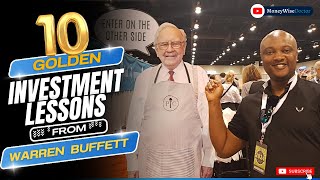
A first-person YouTube report by Ndubuisi 'Andy' Egwim recounting lessons learned after attending the 2024 Berkshire Hathaway shareholders meeting. The video provides ten investor-focused lessons distilled from Warren Buffett's remarks and related observations (long-term investing, moats, management quality, cash flow, avoiding excessive debt, adaptability, shareholder communication, etc.), plus event details and a concluding call-to-action.
Chapters
So I spent eight hours in the same room with Warren Buffett, the legendary oracle of Omaha and one of the world's greatest investors. And this was in us just a couple of weeks ago. To give you a bit of background, Warren Buffett is a legendary investor and chairman of Berkshire Holloway. He's known for his impressive investment record, down to earth lifestyle and obviously wisdom. So he has attained quite a bit of following. When you look at his 60 year record of investing now, he's often referred to as the sage of Omaha. He's not just known for his investment records, but also for his wisdom and his way of life. Now here are a few surprising facts about Warren Buffett. Number one, he bought his first stock when he was just about 11 years old. I mean when people were playing. Two, he was rejected by Harvard Business School. Three, he's lived in the same house since 1958. I mean, when you think about billionaire, you're thinking about mansions and vacations and homes and expensive cars. But that's never been Warren Buffett. He's been living in the same house, bought it for about $31,500, which is a five bedroom house. And one of the most interesting things that though he's worth $136 billion today, over 90% of his net worth was made above 60 years of age. Now don't get me wrong, he was already wealthy at 50, but Warren Buffett accumulated 99% of his net worth above 50. He wasn't a billionaire even at until he was 56. And he says it this way, the biggest thing about money is if you're patient and you wait, you don't have to be particularly smart to do well. Well, I know not many of you are willing to wait till 60 to become a billionaire. So let's jump right in and I'm going to share what I learned attending Berkshire Hathaway conference. Share. That's me to know my heart. Now. Welcome to money wise Dr. Channel. Here we share financial insights and tips to help doctors and healthcare professionals like you make smarter financial decisions. So having just attended the Berkshire Hathaway shareholders meeting, Omaha, Nebraska and usa, I picked up a few things I'd like to share with you. Now there's so much wisdom that Warren Buffett shared, but he was on stage with other Berkshire leaders like Ajin, Jane and Greg, Greg Ebel, of course. He spoke about his late friend Charlie Munger who passed away at almost 100 years of age. And I highlighted a lot of contributions that Charlie made to building Berkshire Hathaway and Of course it wouldn't be complete without mentioning some of his sayings like if they weren't so stupid, won't be so rich. Now, one significant announcement that was made was that Berkshire has sold his entire stake in Paramount and reduced his Apple stake by about 13%. But even though that was said, Warren Buffett assured investor that they still intend to hold a big stake in Apple. There are other things that were discussed including the direction of the insurance business and also how much Warren Buffett's opinion about AI comparing its potential impact to that of nuclear weapons. He also noted that Berkshire is staying away from cyber security insurance due to its complexity. Now enough of that background. Let's look at the 10 top lessons I learned from Warren Buffett. Lesson one, the power of long term investing. Now, when Buffett emphasized the importance of long term investing, he advised shareholders to focus on companies with strong fundamentals and to hold on to their investments for the long haul. This approach allows investors to benefit from compounding, I mean compound growth and to allow it to weather short term market volatility. A very clear example is Buffett's long term investment in Coca Cola, which he made I think in 1988. It's generating about $736 million in dividend income for his company just in a year. Now that's some good income. Now level two, invest in what you understand. Now it's easy to get carried away with the trend crypto, so many things, AI and it's fine if you understand it, but this is not the Buffett way. Warren Buffett stress the importance of investing in businesses that you understand clearly. By focusing on what you understand, you're more likely to be able to avoid unnecessary risk and invest in where you have competence. Example Warren Buffett was reluctant to invest in technology stocks during the dot com bubble. It led to some people labelling him as old and outdated. However, time proved him right. He didn't invest in dot com companies at that point due to his lack of understanding of the tech industry which ultimately saved him from a lot of losses. Of course later he made his massive investment in Apple which is still his largest position even after he reduced it recently. Now let's look at lesson three, the importance of management quality. So according to Buffet, the quality of a company's management team is a critical factor in determining the long term success. Now he suggests that investors look for companies with competent, honest, shareholder friendly management teams. Obviously he praised management teams for his top holdings like Apple. And Tim Cook was there as well as CEO of Apple and also Other Berkshire Hathaway leaders were also there. He praised them. Now let's start. Lesson 4 Be patient and disciplined. This one is non negotiable. If you want to be a long term value investor, discipline and patience is really, really quite key. Now instead, it's better to stick to well thought out investment strategy. When you're taking an investment, when you want to take a position, when you want to invest in common stocks, the idea is to take think about it as something you intend to hold forever. And if you're not able to do that, then it's best to just buy index funds and hold it till you retire. Lesson 5 the value of a strong economic moat. Now, when Buffett highlighted the importance of investing in companies with a strong economic moat, a sustainable competitive advantage that protects them from competitors. Of course, this can include things like brand reputation, patents, network effects or cost advantages. Let me give you a simple example. Apple has a really strong moat in the brand. For an average iPhone user like you, maybe I can't convince you to change your phone to something cheaper, even a better alternative. You just don't care and you buy an upgrade each time. So an iPhone user, if you're listening to this and nodding, I know it's hard to get you to change from Apple. So this in itself in combination with all the subscriptions could lose actually makes Apple quite a good brand. The same with Coke. You're not going to drink something cheaper that you don't know the name just because it's cheaper. So this makes those kind of brands really quite long term plays for investment. Now let's look at number six, focus on cash flow and profitability. Now, Warren Buffett emphasized the importance of cash flow and profitability over revenue growth. He advised investors to prioritize companies that generate consistent cash flow and have a track record of profitability. Now this is bread and butter investment. You have to decide are you going for growth companies, new tech companies who are burning through cash, or one that have actual profit? It's something for you to think about. Now let's look at lesson seven, avoid excessive debt. Now, Warren Buffett warned against investing in companies with excessive debt as high leverage can lead to financial instability and increased risk. He advised looking for companies with strong balance sheets and manageable debt levels. This is understandable. Even Berkshire Hathaway is holding a large chunk of cash. I think their cash reserves is about $189 billion waiting to be deployed. So think about it. Even in your own personal life, be careful with debt. Lesson eight, the importance of ethical business practices. So Buffett stressed the importance of ethical business practices and corporate governance. He believes that companies that prioritize integrity and transparency are more likely to succeed in the long run. I agree with him. Obviously lesson nine is adaptability and willingness to learn. So Ryan Buffett acknowledged the importance of being adaptable and being willing to learn from mistakes. Encourage investors to stay curious and continuously seek knowledge to improve your investment decisions. For example, Warren Buffett did not invest in a lot of technology companies before he invested in Apple. I think about 2016. But he was able to, you know, open his mind and learn more about technology. That's how he found Apple. Now the final lesson. Lesson 10 the value of Shareholder communication. I don't know if this one affects you as an individual investor, but he believes that it's important for management teams and, you know, businesses to communicate clearly with their shareholders. Obviously Warren Buffett himself is quite a good, strong communicator. If you look at his shareholder letters, if you look at obviously his communication, how he communicates is really quite important. So in conclusion, attending Berkshire hardaway shareholders meeting 2024, it was an enlightening experience for me, offering valuable lessons from one of the greatest investors of all time. And There are over 30 to 40,000 people in attendance as well, so. So it's good fun to meet other people who have the same investment philosophy. Now, whether you're a seasoned investor or just starting, this insight from Warren Buffett can help guide your investment strategy and improve your financial decision making. Now, if you found these lessons helpful, don't forget to subscribe to the YouTube channel and hit the notification bell for more financial insights that can help you make smarter financial decisions. Now, which of these lessons resonated with you? Check the comments and leave a comment. Let me know which lessons resonated with you. And if you're interested in getting my weekly emails covering areas like investing for doctors and how to make smarter financial decisions, check the link in the description to subscribe to Moneywise doctor weekly newsletter. Alright, well, thank you for hanging around. Until next week. All right then, bye bye.







