3 Steps to Tax Efficient Investing for UK Doctors — The SCRUBS Method Explained
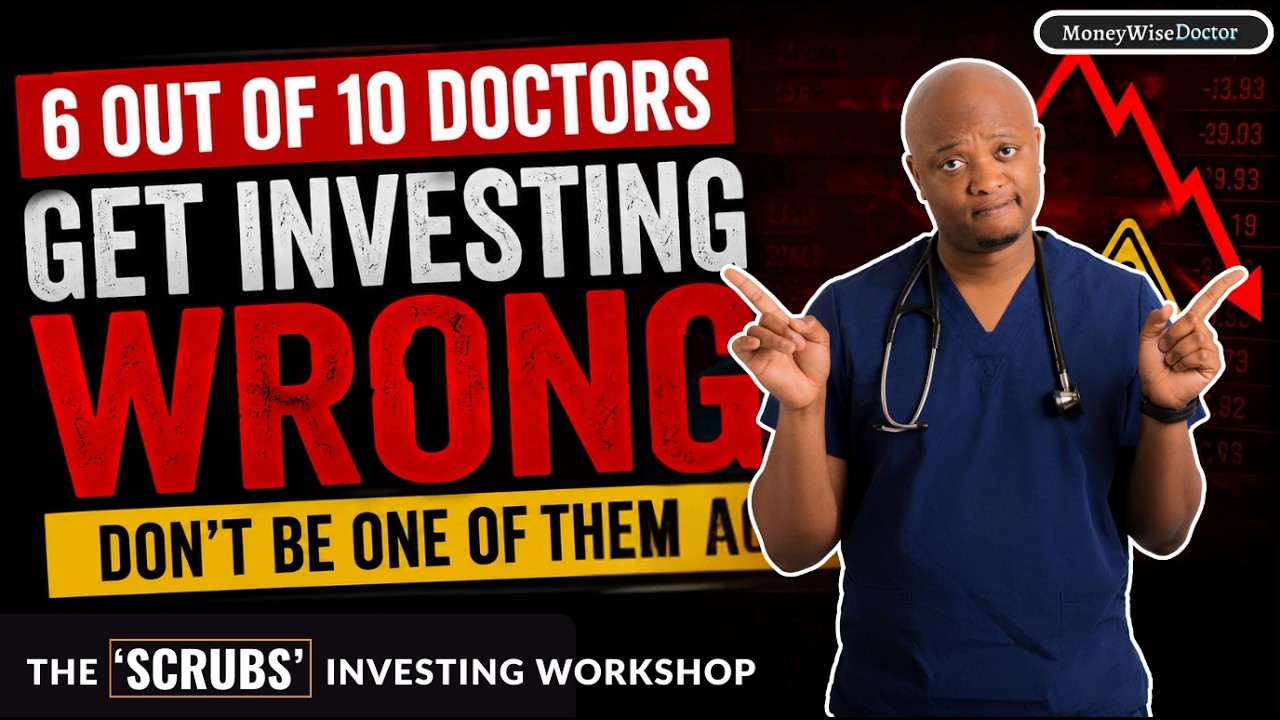
In this 90‑minute‑style YouTube presentation Dr. Ndubuisi “Andy” Egwim, a former NHS GP and author of The Moneywise Doctor, exposes a widespread investing gap among UK doctors and offers a concrete, three‑step framework to close it. He begins by citing survey data (the MedScan scorecard) showing that 60 % of doctors find investing too risky or complex, despite high savings rates, and illustrates the financial cost of inaction through several real‑world case studies (property loss, crypto scam, capital‑gains tax bill, gold‑silver scheme). He then introduces the SCRUBS method – Diagnose, Structure, Automate – focusing on three actionable steps. The first step teaches doctors to diagnose their tax position, highlighting the “60 % tax trap” (loss of personal allowance between £100k‑£125k adjusted net income), the Personal Savings Allowance, and limited‑company pension contributions as levers. The second step explains how to structure investments using the three main tax‑efficient containers available to UK doctors – NHS defined‑benefit pension, a Self‑Invested Personal Pension (SIPP), and ISAs (including junior accounts and family allowances) – and discusses order of funding, contribution limits, and additional vehicles like EIS/SEIS. The third step stresses automation via a Monthly Automated Savings (MAS) system to eliminate behavioural errors, and demystifies index‑fund selection (fund families, TER, share classes, accumulation vs distribution). Throughout, Dr. Egwim balances instructional content with cautionary anecdotes, and concludes by promoting a live, limited‑seat workshop where participants will apply the SCRUBS steps, receive a personal investment blueprint, and access supporting resources.
Chapters
60% of UK doctors say investing feels too risky or too complex. Not 60% of general population, 6 out of 10 doctors. Now these are highly skilled professionals trained to read evidence, weigh risk, make life or death decisions every single day, and yet 6 in 10 of us find investing too complicated to start despite being very hardworking professionals. But this is a different ball game. Now if that's you, You're not alone. Before you tell yourself this is just a money problem, let me show you something. Of the 1,600 UK doctors who completed our MedScan, our financial wellbeing scorecard, 78% said they save money regularly and 61% said they have enough savings to cover 3 difficult months. So the money is being set aside, it's just, it's not being put to work as hard as you are. So I've seen this story for years, doctors who have been saving diligently for a decade, maybe in a regular savings account or even in a cash ISA. They open the ISA, they pay into it faithfully, and they leave it sitting all in cash because investing felt too risky and they were not sure what to do. Sometimes might even be a child junior ISA or junior investment account and it's sitting in cash. Meanwhile, inflation is quietly taking its toll. And for some doctors saving in a regular account, they're actually paying tax on interest, which most of them don't even realize. I see doctors with a SIP, a personal pension, they never invest they're just cash sitting there, or even in an ISA, slowly losing value to inflation. This is not a savings problem, it's a financial education disaster. And the cost of that education gap is massive, and it's visible everywhere in the data we've got. 72% of doctors are worried about their financial position relative to their age. 68% are worried they won't have enough to retire comfortably at 65. Two-thirds, 66%, don't regularly invest in stocks. Bonds, funds, or at all. Smart, hardworking doctors saving, they're worried, not investing, stuck and unclear. Maybe you've tried to invest yourself and you got burnt. A clear example is a GP in our community prior to attending my masterclass last year, prior to even seeing any of my content. He had lost over £100,000 on a property deal that quietly collapsed. Another NHS consultant lost over £40,000 to a crypto scheme. Another SaaS doctor is facing a £24,000 capital gains tax bill That's completely avoidable. But nobody told her that she could have invested inside a tax wrapper. Another example is a resident doctor who lost more than £3,000 in a couple of weeks chasing gold and silver from random tips on a WhatsApp channel. So for you, you might be on the other side. You've never really started. You've listened to podcasts, you've attended the free masterclass, watched YouTube videos and all that stuff for years. But every time you open an investment platform, the fund names look like a different language. They sound like Greek. So you close the tab. You tell yourself next week. Next week becomes next month. Next month becomes next year. And before you know it, another decade has gone and you've lost that opportunity to compound. It has slipped by. Whichever group you are in, whether you are in the group that is investing without understanding or you haven't started, we all know that doctors are really hardworking, but the truth of it is that without a system, you probably end up in the same place. Now, if you're new here, I'm Dr. Andy Egwim. I'm a former salaried NHS GP. I'm the author of The Moneywise Doctor, which is an Amazon bestseller on personal finance and investing, and In the last 21 years I've been investing, and over the last couple of years I've taught over 4,000 doctors tax-efficient investing. Doctors, dentists, healthcare professionals through masterclasses, conferences, workshops, and small group coaching. Today I'm going to walk you through 3 steps to tax-efficient investing. 3 things you should do in this order before you start even putting any pound, extra pound, or even dollar into an investment. And along the way, I'm going to clear up one of the biggest sources of confusion I hear from doctors, which is about index funds. Which index fund to buy? Which ETF to buy? It's called investing workshop, 3 Steps to Tax Efficient Investing for Medics. For the first time, I'm running it in this format, 90 minutes live with our team for doctors and dentists who want to actually build the system instead of just learning about it and letting time to just pass without doing anything. Inside, we'll cover how to think about the NHS pension versus your other options, how SIPPs work and when they make sense, how ISAs fit into the picture how pension tax relief works in practice, how to think about your adjusted net income, and how to avoid the common tax-efficient investing mistakes like the one we've described. How looking at children, investing for children, how does that fit to overall plan? How to choose investments sensibly without taking unnecessary risk. You click the link in the description or in the first comment, or you comment "scrubs," you get the link. But here's what most doctors run into. Everyone says the same thing. Just buy an index fund. Just buy an index fund. There's a 17-year-old millionaire on TikTok. He says it. The guy standing in front of Lamborghini on Instagram says, oh, just go ahead and buy an index fund. Your colleague on WhatsApp also says the same thing. It sounds simple until you open an investment platform. You discover 870 options: S&P 500, FTSE 100, NASDAQ 100, MSCI World, FTSE All-World. You see accumulation, distribution, TER, ETF. Suddenly you're not sure what to do, so you tell yourself you'll go back to it later. And before you know it, several months pass, maybe a couple more years, and you miss the gift of compound interest. By the end of this video, you understand clearly exactly which steps solves which problem, and you have a system you can apply straight away. Of course, this is not financial advice. This is education. Don't take any steps without taking proper advice. So earlier I mentioned a few examples. Let's come back to some of those examples I mentioned of doctors who've made these financial mistakes. There was Dr. Rima. GP partner, experienced doctor, brilliant clinically. But for years, every time she received a brown envelope from HMRC, she shoved it under her bed unopened. That's what she shared with me. She told me she had been looking for someone for years to help her understand finances. For more than 15 years. The cost of that avoidance was huge, as you might expect. When she did manage to save, she put it in a cash account and spent enormous energy shopping around for the best interest rates. That's a losing game. Long term, she was losing the game to inflation, and missed out on decades of compounding. Now she feels that she should be stopping work at this point, but she still has to keep going. Okay, Dr. Ola, NHS consultant, had— he was over £100K sitting in a regular savings account because he thought he was being safe, you know, he was afraid of investing. What he didn't realize was that the interest on that account was being taxed at 45% because he's an additional rate taxpayer. He was overpaying around £2,250 in tax every single year for doing what he thought was responsible— additional tax. And Dr. Mo, locum GP, he had actually been investing consistently for about 5 to 6 years. He had built up around 100K in capital gains, but he was investing it through a general investment account with no tax protection instead of a tax-protected account. So when he attended my workshop and learned about tax-efficient investing, and he, he realized— he went back to check if he could sell it— he now saw that he had a £24,000 tax bill. Now, none of them had a clear understanding of how the system works. None of them had the financial education they needed. These are intelligent doctors, right? Today I want to give you that system and that clarity so you understand it clearly, and that could help you avoid these costly mistakes. Now, the framework I'm going to walk you through is from a method I teach in my book in Chapter 6. I call it the SCRUBS method of investing. It's a framework I shared in my book, The Moneywise Doctor. Now, the full SCRUBS framework has about 6 parts. You can read all of it in my book. Basically, I check my channels to get it. But today I'm focused on the 3 steps that directly stop the financial leak and help you to start your journey to financial independence. So number 1, diagnose. You want to find your tax advantage. Number 2, structure your investment. Number 3, you want to sort of build the system before you then automate it. So let's go. Number 1, you want to start with the diagnosis. Where exactly are you in this SCRUBS framework? Okay, before you invest a single pound or dollar, you need to know where you stand on tax. So I've done videos around this, SEPA, ISA, and all of that, because investing without understanding your tax position is like pouring water into a leaky bucket. It's like putting coins into a pocket with a hole. You might not notice the loss, you might not notice it in real time, but when you need it, it's not there, or some of it is gone. Here's what most doctors miss: if you earn between £100K and roughly £125,000 in adjusted net income, you are in what we call the 60% tax trap. I've done videos on it here. Even if you earn less than £100K, there benefits you can miss out if you don't understand your adjusted net income. For instance, if you earn above £60,000 in adjusted net income, you start losing child benefits, okay? And at some point, at £80K, you've lost everything. Now here's how the 60% tax trap works. For every £2 you earn above £100K of adjusted net income, you lose £1 out of your £12,570 tax-free allowance. Start losing that. By the time your adjusted net income hits about £125,140, the personal allowance is entirely gone. Now, the effect is that on every pound earned in that window, you're effectively taxed at around 60%. It feels rough. Most doctors don't even know this is happening. They just feel like their take-home isn't getting any better even though they are working harder, doing some extra sessions. And here's another one most doctors miss. PSA. Okay, if I say PSA to a doctor, the brain goes straight to prostate-specific antigen. But in personal finance, PSA stands for Personal Savings Allowance. If you attended my masterclass in the past, you know this. PSA is the amount of interest you can earn on cash savings before HMRC starts taxing your interest. So if you're a basic rate taxpayer, your PSA is £1,000. If you're a higher rate taxpayer, your PSA is £500. And if you're an additional rate taxpayer, your PSA is zero. So every pound of interest in your regular bank account is taxed. That's why Dr. Lah was leaking about £2,250 a year. He didn't realize his PSA was zero. And one more thing, there's one flag in here. If you have a limited company, through looking work, private practice, or anything else. A limited company can actually be used to contribute directly to your pension. That can reduce your corporation tax. It's a powerful tool for any doctor who has a limited company. But of course, if you haven't got a limited liability company, carry on with the rest of the video and you can still see other useful areas that you could use. So step 1, before you invest, diagnose your tax position. Where are you? What's the best option? What's your adjusted net income? Which tax band are you actually in? Is the 60% tax trap pulling money out of your pocket right now without you even knowing? Is your PSA giving you no protection on your cash savings because you've exceeded it? Could a limited company structure help with your income? Now, there's one lever that fixes most of this 60% tax issue, and that's pension contributions. Obviously, can reduce your adjusted net income. Of course, claiming professional expenses and charity contributions could help. What doesn't help is ISAs. Contributing to ISAs doesn't help to help you come out of the 60% tax trap. That doesn't mean ISAs are less or not great. Whatever gains you make in ISAs, as you know, is not taxable, and the dividends are not taxed. The capital gains are all protected. But ISAs don't fix the 60% tax trap. Only pension contributions and a few other levers do that. So you want to first of all find out what's your situation before you set up a structure. So structure is the next step. So you start looking at building your investment blueprint. So that's a structure. What should you be investing in? Most UK doctors have 3 tax-efficient containers available for them. So that's part of your tax structure. Your NHS pension, your personal pension like your SIP, your self-invested personal pension, and of course you've got an ISA. Most doctors use one of them, usually the NHS pension by default, and ignore the other two. Now the NHS pension is what you call the defined benefit pension. You don't actually invest anything inside it. It's a calculated number based on your years of service and your pensionable pay, of course adjusted by inflation. So there's inflation-linked growth. For someone like me and for many doctors joining the NHS today, the NHS pension age is like 68 years. So that means you have to wait until you're 68 before you can access your NHS pension benefit in full. If you're a doctor who wants more options earlier in life, you want financial freedom, you want the ability to step back from work if you want to, the ability to take a break, the NHS pension is a great safety net, but it's not what gets you there, not if you want to do it earlier. Of course, this doesn't mean abandoning the NHS pension. That's not what I'm I'm saying here. This just highlights the need to create more options. Once you understand your options, the total annual allowance for pension contribution across all schemes— that's both your NHS pension and your SIPP contribution— is still the same. It's £60,000 for this tax year. So if your NHS pension input amount is, say, £40,000, you still have £20,000 of headroom left. So that £20,000 could go into a SIPP, or you could, you could get tax relief on top of the marginal rate. Okay, so you don't want to cross £60k. So if you're a 40% or 45% taxpayer, you're going to get tax relief 40 or 45%. 20% happens automatically, the rest you claim through self-assessment. So here is roughly how it works. If you contribute money to a SIP, the platform automatically claims 20% of the gross from the government on your behalf. That arrives as basic rate relief. If you're a higher rate taxpayer, you claim another 20% via self-assessment. Then there's ISA. 20K a year after-tax money you can invest. The money grows tax-free, the dividends are tax-free, the capital gains are tax-free. And when you withdraw, under the current rules, they're tax-free. Here's something most doctors with families also never calculate. If you and your partner both use up your ISA, that's £40K. That's £40K. If you've got the money, great. Now, if you still have money to invest before you go and do a GIA, if you've got children, they've both got like £9,000 allowance each. So if you got 2 children, that's an extra £18K. That's £58,000. Of course, there's also Junior SIP. Your children could have an allowance of up to £3,600 gross per tax year. Now, for doctors in our Moneywise Doctor community who are using this stack quite properly, been able to grow their finances without having to do too many crazy shifts just to feel like they're moving ahead. Now, the doctors who don't use this system, they accumulate gains inside the wrong container and they lose a huge chunk of those gains to capital gains tax at some point. So the second thing is just about structure. Know your containers, know which one to fill first, and know the right order. And of course, There are other vehicles too. EIS, SEIS, like the Seed Enterprise Investment Scheme for doctors investing in startups. It has its own tax advantages as well. Okay, that's not where to start. So which one to fill will depend on your income, your goals, your risk tolerance, your capacity to bear risk. And that's exactly what we'll walk through in our workshop. Okay, now the next thing you want to look at is automation. So you set the system to run without you if you've got other things to do in life, right? Not monitoring stocks. So step 3 is the one most doctors skip, and it's the one that actually makes the whole thing work without additional stress. It's automation. Investing is not about willpower. I know this from experience after 20 years. It's not about timing the market daily. It's not about logging in every day to check your portfolio prices. You're going to have anxiety. If you're doing those things, you've turned investing into a part-time job that nobody's paying you for. And the data shows that the more you check, the worse your returns get because you're more likely to make an emotional mistake when the market moves. Psychological, it's greed and fear. So here's the principle I teach that I've used, sort of like many doctors have also used. It's called a MAS, Automated Monthly Allocated Savings System. It's direct debit from your income into your tax-efficient investing account, set up once, it runs on its own. Both pointed at broad, well-diversified, low-cost index funds in the right containers. If you don't want to spend any time doing this, this is your approach you could consider. So That in itself could be where to start so that you keep things simple, straightforward, is automated. Now the index question. People say, well, I logged in, I don't know which index fund to buy. Is the FTSE 100 enough, or do you need something more global? What's the difference between MSCI Global, MSCI World Fund, and MSCI All Country World Fund? Is accumulation better than distribution? I get these questions every day. In fact, someone has just asked that in the community. What's TER? Am I paying too much? And here's the one that most doctors get caught out by. Your platform might offer the same underlying fund under multiple different names with different costs depending on the share class. So even when you've picked the right fund, you might be paying more than necessary for the same thing. So identifying apples to apples is harder than it looks to compare it properly. So once you've done step 1 and step 2 properly and you've 2, the fund landscape. And step 3 is what lets compounding do its job without you interfering, without you having to check every day. Now, the doctors who quietly build wealth are not the ones who pick the best stocks. They are the ones with the most boring automated passive investing system. Boring stuff compounds. Shiny and clever things don't often do well, as we've seen again and again. Now, if you've been following along so far, those are 3 steps: you diagnose, you structure, you automate. These are all part of the 6 steps in the SCRUBS method for investing for The full framework also covers things like building your safety net, removing high-interest debt, understanding asset allocation, underwriting your risk with protection so that when the markets fall, and it will fall, you have a strategy in place that helps you to keep sleeping at night without selling your investment at a loss. Okay, now if you're aware of this, or maybe you haven't heard, for the first time I'm going to run this format of a workshop, tax-efficient investing workshop for doctors and dentists who want to go deep on these things with me. Live 90-minute session. It's called the SCRUBS Method: 3 Steps to Tax Efficient Investing Even If You're a Busy Medic. Inside the workshop, you get a live walkthrough of the diagnostic step you can apply to your numbers, a clear picture of which tax efficient container should hold what and in what order for your specific situation, and the other things as well as bonuses like the index fund cheat sheet explaining the main fund types, what each one holds, accumulation versus distribution, and the 3 questions to to ask before you buy anything, plus the chance to ask questions about it all live. So this is not just a masterclass, it's a live workshop where you actually do stuff and you finish with a workbook to take away. So you leave the session with your own personal investment blueprint, or playbook as we call it, not just my framework. Again, my previous masterclass is hundreds of people attend, but this one I'm keeping small. We've done large masterclasses with 700 doctors at the time. They are great for teaching, but this is a workshop. We want people engaged, want real questions, want real questions answered, want you to be able to achieve something there. So I'm capping it at 50 only. Medics, 50 seats only. This is how to grab yours. To get a ticket while it's still available— I don't know if there's still any ticket left now— but if you click the link in the description, that takes you straight to the registration page where you can secure your slot. Gives you access to the pre-workshop resources and also access to the private community where I'll be sharing updates and answering questions before the workshop date. Alternatively, if you comment scrub, someone from my team will share the link with you and you'll be able to go there and register. Now, whether you come to the workshop or not, it doesn't matter. If you have a question before you sign up, or you're not signing up, about what I've talked about in this video or in any of my videos, feel free to leave me a comment here and ask, and I'll do my best to give you a helpful response. And of course, if you've been watching my videos for a while and you're ready to actually build the system instead of just learning about it, this is where you actually do that. I'll see you there. Alright then, bye.







