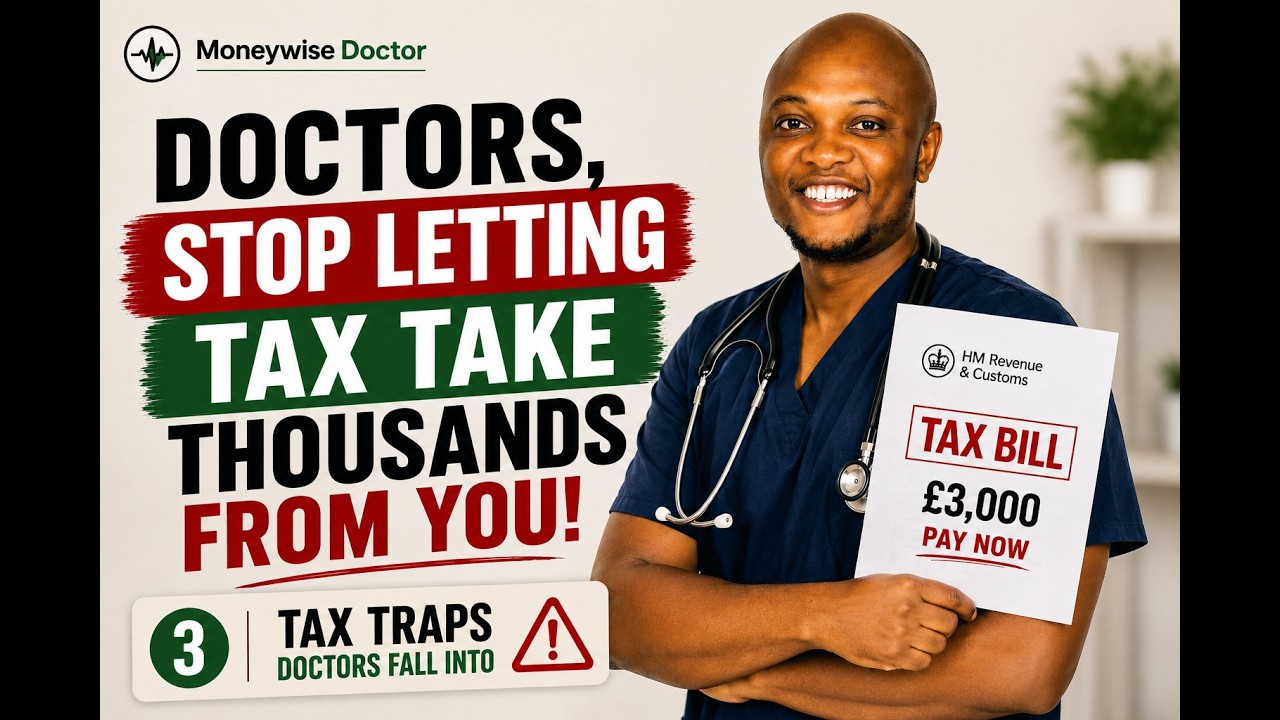
In this educational video, Dr. Ndubuisi “Andy” Egwim, a former NHS GP and founder of Moneywise Doctor, explains why many UK doctors feel penalised by the tax system despite working harder. He outlines three specific tax traps that repeatedly affect doctors: (1) the High‑Income Child Benefit Charge, which claws back child benefit once adjusted net income exceeds £60,000; (2) the “60 % tax trap”, where personal allowance is withdrawn pound‑for‑pound above £100,000, eroding take‑home pay; and (3) the tapered annual pension allowance, which reduces the tax‑free pension contribution limit once income passes £260,000. For each trap he provides concrete thresholds, illustrates the financial impact with real‑world doctor anecdotes, and suggests legitimate mitigation tactics such as increasing pension contributions, claiming professional expense relief, and charitable donation relief. He also promotes a free “Doctor’s Tax X‑ray” scorecard that helps doctors identify hidden tax leaks. The video concludes with a call to action to subscribe, use the scorecard, and share the information with colleagues, while reminding viewers that the content is educational and not personalised advice.
Chapters
Have you ever felt like you are being punished for working harder? I mean, the harder you work, the more HMRC seems to take. 3 days ago, I received a message from a doctor, a consultant in the NHS, that perfectly sums up one of the biggest problems I see among doctors in the UK. He had just received another letter like this from HMRC asking him to pay another £3,000 in taxes despite paying through PAYE all year. Now, this was not the first time it had happened to him, so naturally he was a bit upset. He shared that he was earning about £110,000 gross, £110,000, picking up one or two locum shifts each month to supplement, and he simply couldn't understand why every single year it felt like he was being punished for working harder. Now, along with his message, he sent me screenshots from a discussion he had started in a doctor's Facebook group, a private group, which explained to me why he was reaching out. As I scrolled through the screenshots, one recommendation kept appearing. It made me happy. It says, speak to Moneywise Doctor. Andy helped me. Watch his tax webinars. Have you checked his video on 60% tax trap? Now, I genuinely appreciated that, not because people were just mentioning me and what we do at Moneywise Doctor, but it also reminded me that doctors, we are trying to help each other navigate a financial system that none of us were really taught. We had to figure it out. It also reminded me of something else. This Wasn't an isolated case. Could tell you like 100 cases of doctors, you know, who had fallen into different tax traps. And there are 3 of them. It happens every single year. I'm going to show you those 3 tax traps so that you can avoid them. And doctors don't fall into it because they are careless or because they are so bad with money. It's simply because nobody explained how these parts of the tax system work. And hello, if you're new here, might have guessed, I'm Dr. Andy Egwim. I'm a former salaried NHS GP. I've been an investor for 21 years, and 4 years ago, Tax Efficient Investing helped achieve financial freedom, which gave me the choice to leave my NHS job. Now, over the last 3 years, I've focused on helping thousands of doctors build financial well-being through Money Wise Doctor and making smarter financial decisions and taking charge of their future. I'm also the author of the Money Wise Doctor. You know, it's the UK's best-selling personal finance book, and it was written specifically for doctors. So it's specifically for doctors. Since then, we've helped more than 4,400 doctors better understand investing and personal finance and tax efficiency. Now, before we continue, a quick disclaimer. This video is for educational purposes only. I'm not your financial advisor, accountant, solicitor, and nothing in this video should be taken as personal financial, tax, or legal advice. Tax rules can change and everyone's circumstances are different, so always seek professional advice where appropriate. Okay, now here's one thing that's incredibly obvious. Doctors are brilliant and we're brilliant at medicine, but nobody teaches us how our finances actually work, and that's why we fall into these 3 tax traps. So today I want to walk you through these 3 tax traps that quietly catch doctors every single year, because once you understand them, you can start planning around them instead of reacting to another unexpected, you know, HMRC letter every year. Now before we dive in, if you're a doctor who wants keep more of what you earn and build long-term financial freedom, go ahead and hit the subscribe button. It's totally free. I publish videos like this every week. Now, let's dive in. Tax trap number 1: the High Income Child Benefit charge. Okay, if your adjusted net income goes above £60,000, your child benefit starts being clawed back. For every £200 above that threshold, you lose 1%, and by the time your adjusted net income reaches £80,000, it's completely gone. You have to pay back, okay, 100%. I've done something to help. I've created a Doctor's Tax X-ray scorecard. It's already been used by almost 1,000 doctors to spot areas where they're leaking tax, because sometimes you don't even know what you don't know. So it will take you 3 minutes and it can walk you through different areas that you might not understand that you're leaking tax, and you can identify it. It will give you a score at the end, and then you see some recommendation of areas you can actually improve your tax efficiency. It's totally free. If you want it, just comment X-ray or check the link in the description to download it for free. And I'd like you to come back and tell me your score or what you've done to improve it. Now, one doctor said something to me that I've never forgotten. He said, I'm losing over £3,000 in child benefit, then I'm paying 40 to 45% tax. What's actually left? Now, here's what many doctors don't realize. If if you know you will simply have to repay all the child benefit through High Income Child Benefit Charge, you may decide not to receive the payments, and that's a choice, okay? But you may still want to submit the child benefit claim. Why? Why would you want to do that? Because making the claim can protect valuable National Insurance credits for the parent who isn't working or who earns less. Now, those credits count towards the State Pension. Stopping the payments and, you know, stopping the claim, there are two different, completely different decisions. So unfortunately, many is accidentally stop both without realizing the long-term consequences. So if your household income is anywhere around this threshold, it's well worth understanding the difference and deciding whether you want to reduce it, and I'll tell you how. Number 2, tax trap number 2 is very popular, is the 60% tax trap. This is the one that catches huge numbers of consultants, GPs, locums, and SaaS doctors. I've made a lot of videos around it and written articles. If your adjusted net income goes above £100K, you begin losing your personal allowance. You lose £1 of every £2 of your personal allowance. For every £2 above £100K, you lose £1 of your personal allowance. And by the time you hit £125,140, you've lost the entire personal allowance and you fall into the 60% tax trap. This other GP in our community, Moneywise Doctor community, who was taking on some locums, she assumed her work would naturally mean more take-home pay. She was doing more locums. She didn't realize she crossed the 60% tax threshold. She wasn't earning considerably more despite working more and more shifts. So her take-home pay barely changed. The problem wasn't the locum shift. There was extra pay. The tax was just getting worse. The problem was that she was not understanding what happened once her adjusted net income crossed that threshold. This is why tax planning matters just as much as earning more. So the problem is not earning more, but it's planning more. So sometimes earning an extra pound is not the only smart way we can do. Planning how you earn it in a tax-efficient way. Is really important. Number 3 is the pension allowance taper. If you earn much higher as a doctor, there's another rule you need to be aware of, okay? Especially if you earn much more, your pension allowance can reduce once your income reaches a certain level. I mean, once your adjusted net income crosses £260,000, you start losing some of your pension allowance, and it could drop all the way from £60,000 to £10,000 per tax year. I've seen doctors continue making pension contributions assuming they still had full allowance available, only to discover later that they had exceeded their tapered allowance and created an unexpected tax charge. And then they get this letter. It feels painful. Again, they had not done anything wrong. They simply didn't realize the rules had changed as their income increased. If you're approaching those higher income levels, this is something worth reviewing before the end of a tax year rather than after it. You want to be more proactive. You need to be more proactive about it. So what can you actually do about all those things now? Because some people say things like, oh, should I just stop working extra? Should I just stop doing locums? Should I work less? Should I turn down extra shifts? Should I just, you know, go less than full-time? They are understandable questions, and some people have done all this. It depends on your situation, but this is where I think many doctors get the wrong message. If you've decided that you want a better work-life balance, if that's what you've decided, then reducing your workload might be exactly the right decision for you. But let that be your decision. Don't let the tax system make that decision for you. If you enjoy your work, you're willing, you're able, you're ready to do more. If you're happy picking up some extra shifts, and if your goal is to accelerate your journey to long-term financial freedom, then first understand why you're paying more tax and what you can do about it. Okay? Because once you understand the rules, you can usually make much better decisions. For example, pay a little bit more into your pension and then invest it into your financial future. That's one way to become more tax efficient. There's a big difference between earning more and keeping more. Sometimes one extra locum shift is genuinely worth it. Sometimes it's not it, but you can't make that decision unless you understand what happens to the next pound you earn. And I'm going to show you how. So fortunately, there are several completely legitimate ways doctors can reduce their adjusted net income. For example, Number 1, which is one of the most popular ones we teach about, is making pension contributions. So whether that's your NHS pension or a personal pension like a SIP, Self-Invested Personal Pension, depending on your circumstances, it could help. Number 2, claiming tax relief on your professional expenses. Number 3, claiming tax relief on eligible charitable donations. So these steps could help reduce your adjusted net income before, you know, the next tax year and reduce the tax you pay. The important point is to understand which strategy applies to you. It doesn't apply to everyone. Everyone has their own strategy that works for them because that's how you stop reacting to tax, planning for it and being more proactive around it. So you could pay into your pension and invest it. You could then claim tax relief on professional expenses, and you could also claim tax relief on charitable donations. It's not about earning more, it's about making sure you're not leaking more because it's not just about avoiding tax. No, it's about avoiding paying more tax than you legally need to. And that's a very different conversation. Now, these tax laws, they can feel quite punishing if you don't understand them. You can fall victim to it if you don't understand where the thresholds and the traps are. You can end up working much harder without seeing the financial reward you expected, and you feel like you're working like an elephant and eating like an ant. Now, the good news is that once you know where these tax traps are, you can start making informed decisions instead of expensive surprises. Now, doctors don't usually pay too much tax because they earn more. There are lots of doctors who don't earn that much, they pay more tax. Some earn more, they don't pay as much. You pay too much tax because you don't realize how the rules work. I've done something to help. I've created a Doctor's Tax X-ray scorecard. It's already been used by almost 1,000 doctors to spot areas where they're leaking tax, because sometimes you don't even know what you don't know. So it will take you 3 minutes and it can walk you through different areas that you might not understand that you're leaking tax can identify it. It will give you a score at the end, and then you see some recommendation of areas you can actually improve your tax efficiency. It's totally free. If you want it, just comment X-ray or check the link in the description to download it for free. And I'd like you to come back and tell me your score or what you've done to improve it. Now, every single week I release a video like this to help doctors become more tax efficient, to learn how to invest smarter, on how to improve their financial well-being without taking unnecessary risks. How to take control of your financial future. If you like stuff like that, hit the subscribe button and don't be selfish. Send it to someone else. Share it to someone else. Share it to a colleague so that they can also benefit from it. If you're wondering what to watch next, click the video on the screen now. It's been selected for you by the algorithm as one that will help you.