Big Financial Mistakes To Avoid 2025: NHS Pension, SIPP, ISA, 60% Tax
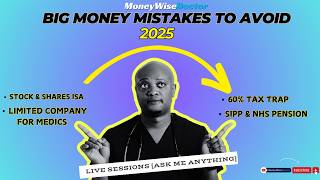
Transcript of a Money Wise Doctor webinar (Jan 2025) led by Ndubuisi 'Andy' Egwim and team addressing tax‑efficient planning for UK medics. Covers use of limited companies (expenses, pensions, director’s life insurance, dividends, shareholders, hiring), pension allowances and withdrawal ages, ISAs/stock & shares ISAs, trusts and inheritance tax, tax relief claims, and basic investing advice and Mastermind offering.
Questions this video answers
£60,000 per tax year.
£20,000 per tax year (ISA overall).
Lifetime ISA: age 60; SIPP: age 55 (rising to 57 in 2027); NHS pension: depends on scheme — mentioned as 65 or 68 depending on plan.
40%.
You can claim the current tax year and the previous four tax years (i.e., go back up to four years).
Chapters
So we'll make a record of the session and then we'll be able to share it. And unfortunately we did not record the previous ones about the isa. This has happened before. Well, going back to limited company. So your limited company is a separate entity and can actually has a corporation tax of about 25%, 19% if your profit is less than 50k. And there are expenses you can deduct from a limited company. One of the biggest one is director's pension. So if you wanted to have a private pension, you can set up what we call a self invested personal pension. So a SIP is actually a private pension. If you're a limited company owner, you can set up your own private pension. The money you put in that private pension is considered tax free. Well, at least at the moment you're putting it in. So if you. Let's give you a practical example. Let's say you're a radiology consultant. Your limited company makes £100,000. Thank you, Chigo. The limited company makes £100,000 in a year, or let's say £150,000. And you decide, look, I want to put some money in my pension. Okay, you can decide on any amount you want. But the maximum the government will allow you to put in your pension in a year is how much? Can somebody help me? How much can the government allow you? I know some of you have been previous sessions. 60k. 60k. That's fantastic. Thank you, Sam. So £60,000 is what the government will allow you to put in your pension every year, tax free. They're not going to tax you on it now, maybe in the future buy and buy, obviously if they can get some of it. But obviously there's a way to make sure that you don't withdraw so much. So 60k means your NHS pension, whatever you're putting inside your NHS pension, whatever you're putting inside your private pension, anything going into pension, you can, you have 60,000 to play about with. Okay? Now if you are a GP partner, GP partners actually pay more in pension because they pay as employers and then they pay as employees and that is tax free. But you can see you are still Nowhere near your £60,000 allowance. You still have an opening if you wanted to. And that's why some people go ahead and open a private pension. Now if you're a hospital consultant, for instance, Ahmed, you're a surgeon, you don't have the same opportunity that the GP partner has. You can only pay one pension. And at your level, I think your pension is probably about 14% or 13.8%. So if your income is 100k, only 13,800 goes into your pension, which is fine. The beauty of it is that that is all tax free. The government does not tax it. And whatever that can go out before tax reduces your taxable income and reduces you, reduces the chances that you fall into that 60% tax trap. Now if on the other hand, you have a limited company and you do private work, the money coming in can go into that limited company while your normal income comes to you as a person, you can then use the money from that limited company and put in your private pension. So that's one thing you can do with the limited company, Sandra. The second thing is you can use a limited company to pay your life insurance. So if, you know, if you've been following me for a while, I'm very hot on life insurance. Because you don't want to leave your family hanging, God forbid anything goes wrong. Now normally you pay the life insurance from your after tax money. So you've been taxed already in your regular job and then you use the money from your bank and pay the life insurance. I said no. If you use a limited company, if you're eligible and use a limited company, that money can come out from before your tax. So the government is counting it as an expense and you can pay your life insurance premiums before your tax. So let's say you're paying 30 pounds, 40 pounds in a year, that's 480, that's a bit of money. It's called directors life insurance or relevant life plan. So you can do that with a limited company.
This could save you several thousands of pounds, not just in your taxes and pensions. Have you fallen into the 60% tax trap as a doctor, healthcare professional, without even knowing? It's crazy. I know you think the highest tax you can pay is 45%, but here how it works. If your income exceeds 100,000, you start to lose your personal tax allowance and by the time you hit about 125,000, you've lost your entire tax allowance. This means you're paying an effective tax rate of 60%. That's not good. You lose a lot of other benefits with it. Now if you, if it's something you've never thought about or you're worried you're not sure how to navigate it, you're in luck because I've written a very clear guide with a 10 point checklist that you can use to avoid the 60% tax drop. One of the biggest one is obviously paying more into your pension. But there are nine other steps you can take. Check the link in the description and download it for free. Let me know if it helps. Let's jump right back into the episode.
What else can you do with a limited company? You pay for consultation. Maybe you had to have a one on one or you had to join a mastermind to help you manage your business better. You wanted to join them, speak to an accountant and they charge you money. Or you spoke to a lawyer. You can do that through your limited company because it could be a business expense. What else can you do with a limited company? I've already mentioned laptop, I've mentioned phone. You can claim all your GMC, MD, all the stuff we've been talking about. You can either choose to claim them as yourself Sandra, or you can claim them as Sandra Limited. Obviously if your tax is 40% and you have a salary job, then you better off claiming as Sandra than Sandra Limited. But if you're like me and you don't have a job or regular job, if you're sort of like a business or you're purely locum, then you can do it all through your limited company. What else can you do to your limited company? If your business involves you, for instance, using an electric car, the government will allow you to actually spend. You can buy an electric car and can claim 100% of it in tax relief. But as long as that equipment is being used for your business. So if you need the car to get to where you're going, need it for your business, you're looking, you're traveling and that's what you use the car for. Obviously if you use the car for anything other than the business, then you need to work out with your accountant how much you pay back as benefiting kind. But the principle is that if you use a limited company, one way to get money out of it is expenses, expenses, expenses. Okay, someone says Sandra. Yeah, director's pension. Yeah, the director's pension. We've got a video on that. Maybe you'll find it later. And shade. So basically, what else can you do with a limited company? Imagine as many things as you can imagine. As long as they are legal and allowable, they are within your, you're using them for your business. I'll give you an example. If I decide to, let's say hire a lawyer or a tax, a tax advisor for my business and I pay them quite a bit of money. Yeah, I could do that through my limited company. Or I decide to. Let me give you a different example. Board meeting. If you have a board meeting. Some people have a board meeting or they have a team meeting, a way meeting. I don't know. Your limited company could be you and your wife and your brother or whoever you've employed. As long as they are doing work in the company, you are the one that will decide what work they do. I know a consultant that has actually employed their son and they work in their limited company because it's a business. Now you can actually deduct that from your expenses. This is just one way to take money out of the limited company. We've not gone into the other ways. This is just one way. So expenses. If you want a list of expenses, then go to my article that that's the number one listed article on our website. Limited company for doctors. So if you Google money wise doctor, limited company for doctors or again, my wonderful team here will share it in the links. So Chigo, if you find limited company for doctors, money wise doctor, excellent. Lovely. So have a read of that when you have the time. But basically there are so many things you can claim with the limited company as expenses. As long as you think it's defensible. It's better to me to use my limited company to claim all my mdu, gmc. That way I'm not writing to HMRC for tax rebates because it's just upsetting. Now they've changed it to paper form which is going back to the stone age. If you watch my recent video, you see that I was a bit unhappy that they changed from electronic. Previously you could claim all your tax relief and had doctors claiming up to 9,000, 10,000 of their tax relief that they've not claimed for years. And you can just watch my video and do it step by step. But HMRC decided to throw a spanner in the wheels and they've introduced a paper copy. So now you have to fill out a freaking form, a P87 form, and then send paper receipts. But I don't want to get upset with HMRC now, but I hope you understand basically what you can expense in a limited company. Is that part clear, Sandra? Okay, yes. But that's not the end of it. There's more. Now, when you've done the expenses, the next thing is sometimes you might be left with money. If you are left with extra money after all your expenses, that's called a profit. Now for some people, bad news is when you make a profit because then you're thinking of how to be tax efficient if you have a profit in a business. Okay, what do you do with it? Can somebody help out? If you have a profit in the business, what do you do with it? Just a regular business. How do you do it? Maybe you can reinvest. You can reinvest. Okay, that's excellent. That's an excellent answer. So you can reinvest it. Okay, But HMRC would say, hang on, before you invest, let's get our own share. Because if you get a profit then it's taxable, right? So you can either invest it. But actually what you're saying, investing, if you have to buy a new equipment, say you make a profit in a business. I think, well, I'm a radiology consultant. I'm working from home. I now need to buy a better, more comfortable chair and table and maybe you need a machine or whatever that radiologist need for their job. I'm not a radiologist. I actually escaped from a radiology training at some point eight years ago because I didn't want to stay in a dark room. I like talking to people, but radiology is a wonderful job. Anyway, I've been in contact with so many radiologists these days in my one on one sessions. But basically, if you decide you love that cruise. Okay, okay, that's fair enough. If you decide that you want to invest in some lighting for your dark room or something else, you could actually take money from that business and reinvest it into the business. So that is now counted as an expense. So it's not going to come out as profit. But if at the end of the tax year you end up with a profit, let's say you end up with £50,000 that you know money to spend, you've not spend it on insurance, you've not spent on life insurance, did not spend it on them, all sorts of expenses, then you need to declare dividends. So that's what happens. I'm an investor in quite a few companies now and I still getting dividends from a company I invested in 19 years ago. So if you have to declare dividends, that means that you, if you are the only person in the company, whatever profit remaining is coming to you. So once you get that dividend, it comes into your own. It goes from Sandra Unlimited to Sandra. So remember, Sandra pays tax, Cassandra pays tax at 40%. So you then have to pay a higher rate tax. So what do you do about that? There are quite a few options. Some people will have more shareholders. The government cannot tell you. If you decide that you want to make your spouse, your brother and your dad shareholders is, or if you had business partners and you wanted to make them shareholders. It's all up to you. Because if you have more shareholders then that profit will be divided between the shareholders. Okay so that's one thing that some people could do. Obviously this is something you need to discuss with your accountant. So if you have more than one shareholder then in that case you end up with less profits and less tax. Okay. Now one other option will be to employ one or two people. You might need an admin. I usually say that if you are earning above hundred thousand dollars, not hundred thousand pounds. If you're anything above $100,000 which is the equivalent of 85k then you might find out that it will be better for you in your life to outsource some things. Employ an admin assistant, pay them some money and that money comes out from your company and that in itself could be a life change. I've got an operation assistant and I've got an. I've always had an admin that helped me do stuff. If you've got stuff that you need to outsource then you can hire somebody and I've seen somebody hire their 18 year old to do admin for them. I don't know how much work the 18 year old does but again it's between you and your employee. Whatever you guys agree on. And that expense could actually come out from the limited company. So these are just so. There are so many ways. It's not usually an easy straightforward question. And part of the thing that keeps coming up, especially in our money wise doctor community part of the things we're going to be addressing over the next 12 months in the, in the Mastermind group is limited companies and how to use them effectively and why is important. The government keeps changing the rules and we try to stay on top of the rules. You play on the rule, you play, you play by the rules but you want to play to win. So that's how the limited company team works. Sandra, I hope that has helped to some extent. Fantastic. So can we jump into the next question?
So the next is from Obeyemi. I think he asked a couple of questions says and a few people have this question actually about stock and shares. I'm interested in knowing about stock and shares. Isa when can you withdraw withdraw the returns? And then he also asked how can you put your income protection in a trust? Is this something your broker does or you have to do it yourself?
Basically I think we should start with the. He said your stock and shares it. Do you mind them sort of like refreshing that question for me?
Sure. It says I'm interested in knowing about stock and shares isa. When you can, when can you withdraw the returns?
Okay, that's good. Should we start with that? Should we do that one first? So basically stock and shares isa, when can you withdraw the returns? Anytime you like. So the difference between Lifetime ISA, if you have a Lifetime ISA, you can withdraw it at 60 years. Okay. When you get to 60 you can withdraw your Lifetime ISA. If you have a SIP, your self invested personal pension, you can withdraw it at 55 years, but from 2027 is going to go up to 57 years. If you have your NHS pension, you can withdraw it at 68 years or 65 years, whichever plan you are in. But if you have a stock and shares ISA is an investment, you can sell it anytime you like, you can sell it anytime you like and withdraw the money. Okay, I hope that answers that question. What's the next one? Can.
How can you put your income in a trust income Trust protection. In a trust income protection. Is this something your broker does or you do it yourself?
Your. If you've got a good, if you've got a good solid life insurance advisor wanting to always advise and all the one on one sessions we did I had today was the main theme coming out is people saying oh, I have life insurance, but it was not in a trust. Let me explain to you as for those of you that don't understand why she's asking that question. If I think you can talk about that, your doctors here, if somebody dies, right? Okay. Then whatever property they have they can pass on to their family. But then there's something called inheritance tax. It's crazy, right? Yeah. There's one powerful example Chico shared in the group of somebody who died and did very well for herself, then passed properties to her family. I can't remember what the value of the house, whether it was a million pounds. And then suddenly they are hit with inheritance tax. And how much is inheritance tax? What percentage is this? Is it? It's 40, isn't it? 40. Thank you. So it's inheritance tax is 40, right. So imagine you leave a house of a million pounds, suddenly your child or while they are grieving you, then they are dealing with trying to raise 40 inheritance tasks, which is 400k. If they're not able to provide that money, of course the government will look for ways to get their money. And that might not be selling the house, might not be outside the options and probably when the government sells stuff, they don't always sell it for the best price because they need their money. They'll sell it to people who are investors who want to buy it at a discount. Now assuming, as if that's not bad enough, your life insurance policy, let's say you've got like 500k in your life insurance policy that your family is supposed to get, that falls into your estate, that should be part of what should be taxed for inheritance tax. Okay? Now life insurance falls into that estate. It's part of what should be taxed for inheritance. That's not the end of it. Labor in the recent budget that was released, if you watch my budget video that I did after the budget was released, they've gone ahead to include your pension. So your pension now is included into your estate of things that will be taxed. So that means that you can work hard, work hard all you can, save all you can, and then at the end of the day you, you move on. And then government is taking more than half of it or about half of it. What can you do? Trust. So a trust is like a different person, just like your limited company and monetary or limited company and it stuck separately from you. We didn't start these things. Limited company goes as far back as 16 something. I wrote an article on the. In one of my first article limited company I mentioned the history of Lim Company. It's many years ago, it's almost 400 years ago. So we didn't start it. The wealthy people have been using it. Now what you could do, they end up with a trust. Those of you who know gross Venom family, they're like the landlords of London. They own property everywhere. The gross Venus, okay, the Duke of Westminster. Now you see that those properties, they can't tax them directly. A lot of properties are held in a trust. So the, the gross Venus, the Dukes are just sort of like directors of that trust. Now you can do it in your own minimum way. Your life insurance can be held in a trust outside your estate. And if you do it right when you're setting up the life insurance, you don't get charged the fee to do that. Obviously if you haven't done it then, then if you want to do it later, you might need to review your life insurance trust, speak to an advisor that can actually help with that and make sure that they can actually sort those things out for you. And if you want to hold anything else in your limited. Sorry, in your trust, then that involves speaking to a solicitor. I have an excellent guide on life insurance and income protection. It's totally free, you can just download it and I cover a session of the, In a session of that guide, I explain something about trust and why and how you can hold your life insurance in trust. So if you haven't already done it, speak to the person who's done your life insurance for you. Ask them if they can put it in the trust. If they say no, then check out one of those specialist insurance advisors or money wise doctor. They don't charge you any money to speak to you, they don't charge any money to take you through the process. So they're available to talk to you for free and they can help you walk through the process because that's their main job, that's their business. Okay, I hope that answers the question.
Yes, thank you.
All right, lovely. Thank you.
So just as a follow up there, the pension one, is there a way to put that one in your trust as well? Okay.
Actually it could possibly be, especially if you are using a limited company. Okay. But this goes beyond sort of like the basic, basic planning. This is part of the program for the mastermind because it's not as simple as just go and do this, go and do that. Part of the mastermind. For 2025 we are bringing tax planning and sort of estate planning experts in one of the quarterly sessions. So yes, you can actually put your pension and quite a bit of your property. Now let me, let me make a confession here. I think those of you in our private community already know this. In 2021 I did a consultation with the tax plan and estate planning, you know, specialist group. They charge me £450 for 15 minutes or so or 30 minutes. That is not the main cost. This is just to sit down and have a chat of which I paid my accountant £100 just to sit into the meeting for no reason, because. But I just like, look, I'm a doctor even though I've been doing finances, but I can't, I might figure out some things I don't figure out. My lawyer couldn't join. Now they figured out, okay, if I can, they can take my property, put it in a trust, then do a will for myself, my wife, and then do what we call ab. So there's ABC share structure where maybe you don't own any of the dividends but you just only control this share and then your children own the, the sorry, own the dividend. That way you're not getting any tax or just don't, don't worry about it. But it was a little bit complicated because my finances are a little bit complicated. It's not like the regular doctor's finances. Okay, so my bill for that was £17,100 just for setting up trust the media company and all that. So those things can be terribly expensive. So you want to make sure that you can do it as cheaply as possible if you need to. You don't need to set up a trust if you don't have to. Just say my side don't do self assessment if you don't need to. There's a clear criteria for who needs to do self assessment. If you don't need to do self assessment, you're an SHO or you're a trainee registrar resident and you have just one source of income and it's not above a hundred thousand and you don't have many other so you can just do your tax relief. You can use our video on tax relief, claim your tax relief but you don't want more complications. The same thing applies to trust. Finances are not that complicated. You can just put your life insurance in a trust and the rest of them will just have to be some good old fashioned tax plan and an estate planning either with an advisor that can help you one on one.
Okay, so the next question is from Obichuku.
Please go.
Please. Can I know about how to claim back tax relief? Also how can I, how can I set up a limited liability company? What is the pros and cons and then what investments can a medic go into? So there are three in one there.
So I'm going to rely on you to give it back to me one by one because my brain is fried. I've been in meetings all day. Okay, Number one is how can I claim tax relief? I think that one we just post the link. We've done two videos and written two guides on how to claim tax relief. Basically you can do it on HMRC website. What to remember is that you can claim this year and last four years so you can claim the current taxi and the last four taxes. So the taxi runs from April 6 to April 5 for whatever weird reason is a historical reason but don't let me bore you with tax history. But basically you can claim from April 6th to April 5th so you can go back to 2020, 2021 tax year. If you don't claim it by April 5th midnight then you've lost 2020, 2021. Okay, so one of the consultants I had a one on one session with had been working in the NHS for 15 years and is now finally a consultant. She's very brilliant. She's done a previous degree. She's not claimed Tax relief Ever. Ever. For. For how many years? As you said, the anointing that. Oh. So basically she's now able to claim it. And I said there's no use chlorine over spilled milk. But now you know, so you claim it and she. She's brilliant. She's obviously has a. She understands. She says she's been following our videos for a while. She understands now what to do. So the next. If you've missed any year, then make sure you don't miss the next few years and also the past year. So you can go back four years. And before I forget, the same applies to pension. If you've not used your pension allowance, which is £60,000 in a year, you can go back three years. Okay. This applies to many other things, including limited company. If you run a company that is outside medicine, I've got a company outside medicine that is recording a loss in the books. You can go back and claim those losses whenever you generate a proper profit. Okay, so I'll take the second question.
The second question is asking how you can set up a limited liability company.
Yeah. This is if you Google how to set up a limited company, or you look at our article on how to set up a limited company. It's quite straightforward. You've done it recently, haven't you? So you can actually talk us through how to set up a limited company. Do you want to give us a general idea?
I just went to the company house.
Sorry to put you on the spot, by the way.
I went to company house and followed it step by step and it was pretty straightforward. Or if you feel like it's something that you may not want to expend the energy to do, or in case you make a mistake, then you can get an accountant who might do it for you for a fee in addition to their. Their fee for providing you the accounting service.
Excellent. And what. What fee did you have to pay? You did yours by yourself, obviously.
Yeah.
How much did you have to pay your fee to HMRC?
£50.
£50? Yeah. So well done. You. You set it up by yourself, obviously. If anyone needs help with that, if you're a member of the moneywise doctor community, you could always ask questions around those things. And you can ask Chigo, who is obviously the group coordinator here. But it's. It's very easy. You can do it by yourself. Hey, doctor, you're smart. But if you need any help. I've set up one limited company, but I've had like four or five that I've got my accountants to Do Purely because I think that it's not a good use of my time to be clicking around doing all those kind of stuff. I could be doing stuff like this or creating a video, analyzing my investments or pick. Or changing my toddler's nappy or something. Yeah, so. So this is basically. Limited company used to be 12 pounds 50. When I said that my limited investment company, it was 12 pound 50. I was shocked when she got told me last week that is now £50. And when it was £12 50, I used to pay my accountants £50. So they'll pay the £12 50 and 37.50 to do the job. But I think now they probably charge about £100. Which I'm still happy to pay basically because it saves me time and they do it properly. But you know, you can do it by yourself. Set up a limited company. What you shouldn't do by yourself. You can, but I don't recommend it is to file your annual tax returns by yourself. So if you have a limited company, just like as an individual you do self assessment. Limited company, you have to file the annual, you know, company's house. You have to every year file your taxes. Whether you make a profit or not, you have to file your taxes. You're not going to get into trouble if you don't pay any tax. But you're going to get into trouble if you don't file your taxes. They're going to penalize you. They've got a penalty they charge. It's small at first, but you know, if you don't pay it, it starts to compound. So if you figure out, if you. If you're ready to do it by yourself, fine, you can fill out the form, file your annual taxes. But again, I use my accountant because they are specialists in that area. They charge a reasonable fee. It's not. It's not. It's obviously the fee they charge me comes out of my limited company as expenses. So these are. These are ways to go about it. Okay. And maybe you should do the third question.
What investments can a medic go into?
This is not. If I. If I wanted to answer this question. One hour is not enough. Some. Yeah, Chigo is smiling. I think.
Who.
Who here was in our investment master class in September, apart from Chigo? Is there someone else here that was an investment master class?
I think I spoke with Mary Jane.
Yeah, I remember. Yeah, this is a lovely bunch. So, yeah, I hope I wasn't too much of a taskmaster, but the first day of the investment master class was five and a half hours. And this was a four week investment master class. We're talking stocks, bonds, index fund, asset allocation, how to determine how much is your risk tolerance versus your risk capacity. How to analyze how to determine how much of your money you should be investing. So what you should invest is not a simple question, but in one word I would say before you invest, first of all, invest in yourself. There are seven things, I don't know if anyone can find seven things to do before you start investing. I've got like I want the downloadable page is the one that we're looking for. So seven things to do. Let me get that out. So you want to make sure you've done those seven things and I'll tell you why I think I found the page. Now if anyone wants it, you can download it totally for free. These are seven things I recommend you do before you even dream of investing. Because I've been an investor for 20 years now. There are years when we make 87 returns. There are years when we make 20 returns at the years when the market is not great. But over the last 20 years I think we've done quite well. And that's part of the reason I was able to leave my salary job two years ago. But you want to set up the foundation properly so that you don't end up selling when the market is crashing. So that when the market is crashing, you are buying. When people are selling, you are buying. When they are buying, you're selling. In terms of what to invest, the number one thing to think about if you've done those seven things, I usually think that depending on your age, stocks is usually a good place to start. By far gives the best return more than real estate. If you are investing real estate as well for diversification. But real estate is, if you're looking at five phase grades stocks, you're looking at 10 years, 20 years. Fantastic. And instead of buying individual stocks, especially if you're not yet trained in how to decide what stocks to buy, you might want to just go for broad, well diversified index funds so you can buy ETFs or index fund. Those ones you don't need any expertise. All you need to do is to make sure that you understand the one you're buying that is broad and well diversified. So rather than buying one company, you are buying a basket of companies. Really I think I'm just going to say it's a basket of companies put together. So that's basically, I think that's as close as possible that I can answer what to invest in obviously there are other things investing, like bonds. You can buy bonds. Bonds are like guilt. In the UK they call it guilt, but guilt is basically bonds. So these are fist income assets. There are no surprises. There's. If you buy a bond, let's say you bought a bond for 10,000 and it's paying you 5%, you're going to be getting 500 in the coupons per year until, let's say, 10 years. Whenever the bond, you know, matures, then you get your whole money back again. But the problem is that bonds are usually beaten by inflation, like beating black and blue, most times by inflation. Inflation tends to skip ahead of bonds. The same thing. Inflation tends to also hammer savings. So if you've saved the emergency fund and you're not about to retire, then you need to be looking really closely at how can I invest in the stock market, Whether it's index funds like buying a global index, or you're buying an index like S&P 500, or a combination of both. Or if you're like me, I invest in individual stocks and sometimes I hold on these six in the whole year. All right. The other thing is you can invest in. Obviously some people bought crypto. If you are one of the lucky ones that bought crypto when it was £100, I hate you. Well, I don't hate it. Congrats. So some people buy that. But I said rather than investing, if you're going to invest in anything that is risky, that you're not sure of how you're going to get your money. But back I usually say to allocate a small percentage of your assets, maybe 10% or 5%. Like today I was in a meeting with a software company. They want me to join as an investor in their company. So I'm not going to take 50% of my money and go into it. Even if I think that they are the golden team and they're going to be the next Amazon, I'm going to go in with maybe 5% or 10% because that if I lose the 10%, not going to be happy. But it's not going to be the end of the world for me. I'll not become homeless or suddenly need to go and pick up a salary job. But basically you need to understand your asset allocation. Yes. Even if you think you don't have a million pound in the bank, whatever money you have to invest, you need to have a strategy and a financial plan. Again this year we are going to put up an investment master class again, obviously for those in the Mastermind already. They already have a ticket for it. We can only unfortunately take 20 people in the Mastermind this year, but for those people in the Mastermind, they'll be able to get on that investment. Master Class, we'll open up the Mastermind on Black Friday. Obviously, some people in the community have actually gone through the back door and claimed some spots in the Mastermind. If any one of you, let's say Chigo, or you, if you've got the waiting list for the Mastermind, you can share the waiting list for anybody who wants to join the waiting list for the Mastermind. Currently there are 140 people on the waiting list. Want to make it as fair as possible. So we'll release it by Black Friday or Thursday night, depending on what my team does. We'll release it so that people who want to join the Mastermind can quickly join. Okay, here's the link to it. I posted it in the charts. Okay, well, I hope that answers your question as much as possible. What to invest is not a question of one minute or one hour. And also, if somebody tells you, invest in this, invest in that, even if they were like, sort of like they could see into the future, sadly, they might not be there to tell you when to sell it. They might tell you, like someone said to me when I bought. Thank you, Obi. When I bought Facebook, or Metas is called now, people were selling it. And when I finished my fundamental analysis, I thought it was a fantastic company. So we bought it. And since then, thankfully, we've more than doubled our returns on it. But it wasn't popular then. And someone, one of our colleagues, a gp, a brilliant GP who was on the investment Master Class, but he knew me before then. He also bought it because he knew I was buying it. And then he said to me that I Wish I put £100,000 into this investment. I said, that's where people make a mistake. Right? You have to do your right asset allocation because. Because it did so well doesn't mean it couldn't have done badly. But then the second thing is that if he knew that I was buying it and I told him, look, I'm buying it when I sell it, I might forget to tell him that I sold it. So that's why you need to understand your own investing strategy, understand your own approach. That's the most important thing. Okay, thank you so much for that question. It obviously has many questions inside the one question that you asked. I'm just going to jump on to the next one now. And after that, we'll take a break.
The next is from. I can see he has his hand raised as well.
Lovely Joel. Yeah, lovely Joel. Good to have you again. I think you were in our mastermind in April. Yeah, yeah, good to have you. How, how may I help you?
Yeah, just a quick one. You're still on the limited company. I work as a psychiatrist with nhs, but I have like a side also where I do a prescribing stuff for ADHD medications.
Yes.
And I'm just wondering, um, you know, since it's a side hustle, what I can take out. I'm thinking of, you know, employing a family member and then some purchases which I think I should put under my office expenses like Hoovers, you know, dehumidifiers and things like that. I believe will be what I used to maintain the office space.
Yeah. Does your, does the money come to your limited company account?
You mean the payment? Yeah, yeah.
For.
From the. Yeah, from the prescription job. Yeah, yes, it does, it does. So it's just like, what's. Because I'm, I'm a bit. I. I'm trying to be, you know, wary, you know, because you explained. The other one you explained was more or less like local, you know, job where, you know, the immediate company is basically what the person is doing. But this is like a side hustle. So I'm not sure what I can. Can I also pay like my bma, my GMC and things like that from. From that as well?
Absolutely, yeah. Because don't forget, you as Joel, you're working in your psych job right now. You as Joe Limited, or whatever the limited company name is, is now doing the side hustle. So it's not just you, you are only a staff in that company. Right. Okay. Now the business has expenses. If for instance, I give you an example, money wise doctor, where did videos, we upload videos, we make videos, we make expenses, we've got a website, we spend almost 20000 on software. Different things. Okay. That is going to come out from money wise doctor's pocket. If it comes out from my personal pocket, is it loan? It's a director's loan, which obviously otherwise doctor has a lot of money is owing me personally. So anytime money wise doctor makes a profit, then I'm going to come out and say, please, can I have some of my money back? So in your case, your business is making a profit already. So your business has to pay its bills and some of those bills might be maintaining the office, if not where the business is going to work. So my being that the business needs a desk or a laptop or a camera or a microphone or the business might need to pay you so you can take a salary. I think that was one of the questions, was it Sandra asked earlier on? So you can decide, okay, I'm going to take a salary of £1,002, sorry, £12,570 in a year. A lot of accountants will tell you that. A lot of business directors, including yours truly, we are one of the least earning people in the, in the country because we end £12,570 in a year. Why? Because that's the most tax efficient salary can take. Why? Some of you know the answer.
Yeah, because that's your, what, non taxable, you know, amount that you can take.
Yeah, absolutely. So that's the non, that's the personal tax. So your business could equally pay you 12, 570 which boils down to 1047 pounds 50p per month. That's where Sandra, that's where that person who gave you that information that you can claim £1047. That's what they were trying to explain to you. Some people don't understand it, so they do it, then they mess up, then they are even paying more tax. So you can decide to take that money monthly or take it at the end of the year.
On to my salary from nhs.
Exactly. So in your case that might not be the right strategy. When I was a salary GP and I had a limited company, so I wouldn't take any salary from my limited company. But if you're not working in any particular job, you can decide to take that salary. But in your case it will go to your NHS job and it will push up your personal tax even further. Yeah, but you can absolutely decide that, look, I need an admin for this job. I've worked in psych, you guys do a lot of paperwork, you write a lot of reports, you know, so you can decide to hire an admin to help with that and that should be perfectly deductible from your limited company. In fact, something funny, right? I've had people who join our master class or mastermind or one on one and they paid it to their limited company because the limited company allows you to actually as a director to pay for consultation. So there are people that in a year they've paid up to £15,000 for consultation. Okay, £15,000 as a company for consultation. That's nothing for most people. Or if you say I've got somebody that are paying £20,000, £15,000 per annum. Of course if somebody was working in even McDonald's. They probably make about that same money. So it's just to make sure that everything is done by the books. If you've given somebody a job, try to issue them an employment letter. If they are not inside the UK then is their business what they do with their taxes? Right. Because they will pay in the country where they are. If they are inside the UK then they have to sort out their nin and pay their taxes. But for instance, if you employ somebody and they are, let's say in Lahore or Karachi, it's not your job. Well, you have to give them the paperwork. But I don't think HMRC wants to go to Karachi or Lahore to investigate their taxes. We are believing that the person is responsible for their own taxes in that country where they are.
Okay, so but can I pay somebody in Nigeria?
I think I'm just giving you an example now. I believe that you can work out that you should be able to pay somebody in Nigeria. I've got stuff. I've worked with people from Pakistan, Nigeria, what's this country? I've worked with people, I've actually been in Morocco. I've worked with people in the uk. I work with people from different countries. Your limited company, I don't think there's any restriction because you can decide to hire somebody as part time or full time was important that they are doing work in the company, you are paying them and that work is determined by you because you're the director of the company. So that's how these things work.
Yeah, I really have. Thank you very much.
No worries. If there's any confusion, again, your accountant is a secret weapon. I talk about the financial dream team in one of the money wise Dr. Rules. So if you don't know about the 10 money wise Dr. Rules, you're probably breaking the rules. So it's not quite as good as most six commandments. But there are ten money wise rules. One of them is building your financial dream team. One of them is your accountant. One of them is your lawyer. You might not, you guys might not need a lawyer as much as I do because sometimes I end up having to go to court to sort out things or taking somebody or somebody takes me. But you, you need an accountant. You might need an advisor. It could be a financial advisor. It doesn't mean that you have to pay some crazy amount. I've just spoken to somebody in a one on one session today who is charged 2.5%. Somebody's charging in 2.5%. I don't really Know what the person is doing. Thank you so much, Judy. I think there's a video as well. Time, money, wise rules. So having those people in your corner like your life insurance advice or my mortgage advisor, those people, I don't see any money. I pay them. I don't see it as a waste. I see that they are helping me to build my financial future and they are part of my team. Okay, so speak to an accountant. If you're not sure, go to moneywisedoctor.com and find one of the specialist accountants there. Okay. Fabulous. Right? Thank you again. Joel. You always ask very insightful questions. Should we take like a 5 minutes break and then come back and finish up so that maybe who wants to drink tea or chai or whatever you prefer to drink? Is that okay? Moderator?
Yeah, that's right.
So what time should we come back?
Should we come back at 18 past or let's make it 20 past?
We are supposed to finish by 9:30. Okay, we'll come back. We'll get it. We'll do it up to 10 just so that we cannot come. Are there many more questions left?
I think we still have 1, 2, 3, 4, 5, 6, 7.
Okay, I can stay till 10. Okay. But don't worry if you're not able to get your question in. There are three avenues. You can ask it in the blog, you can ask it in the YouTube channel. You can ask it. You can, you can email me so Support at Moneywise. Dr. Some one of us will pick up your email and if you, if you've ever asked us a question on the blog or YouTube channel, you will notice that we give a very detailed response. I want to take note of Dami. Dami was missed the last session and he mailed me very early today asking when this session is going to start. So please let's make sure we get his question in. Okay? His hand is raised. Okay, let's come back by 2120. All right, thank you everyone.
Now this is very crucial topic. Have you secured your family's financial future? Many times you're busy as doctors and healthcare professional, that's fine. But if we overlook our life insurance and income protection until it's too late, you're taking a bit of a risk here. I mean, nobody can predict the future. You need to protect what matters most. Think about life insurance and income protection. This is really quite important to protect your most valuable assets. Now if you're not sure about what you need or how to go about it, check the link in the description. I have a free guide that can help you step by step. Let's get back to the episode.
How do I utilize investing in stock and shares? Isaac, I think you've touched on it earlier, but I don't know if she was here.
Yeah, I think we've done a lot of talk about stock and shares isa. What I'm going to do is basically I have an article called stock and shares ISA. So stock and shares ISA, money wise. Dr. I'm going to share it with you. Do you want to ask this? This, if you're here, can you ask your question so we can understand what angle you're particularly interested? Is it how to open the account or. I don't really know exactly because the question is very broad. We can answer it, but I want to make sure we've answered what you really need.
Okay. Good evening, everyone. Hi.
Hi. Good evening.
And my question is how to just start.
How to start. Okay. Yeah. Okay. Basically, I think, yeah, someone did. Someone already posted how to start. I'm just posting our archives on stock and shares. I saw. Then I'll do my best to answer. So number one is before you start investing, to do the seven things you need to do before you start investing again, someone will share it. In the links. There are several steps. This is like saving your emergency fund, making sure that you've actually invested in understanding what you're doing. Not that somebody said put money there, you put money there. So get some financial education, whether it's attending a lesson or a class or maybe reading up on your own. Those are the seven things all together. Getting your financial protection in place, becoming tax efficient before investing. That's using the stock and shares isa. If you've done all those things, then you can open a stock and shares ISA account. The maximum you are allowed to put in an ISA annually is £20,000. So if you invest more than £20,000, it will be outside your ISA. But if it's less than £20,000, you put it through your ISA and it can be on multiple accounts. And also I've met with Investing Gene and I've spoken with other platforms as well. I think we reached out to Moneybox, reached out to a few other platforms. Many of them seem to have some hidden fees. Basically, they're not upfront. Some of them are like trading two 1T doesn't mean they don't charge a fee. But it's also if you're not someone who wants to be trading regularly, you want to be careful trading 212 because they're always pushing their CFD commodities and all that stuff. Investing in on the other hand is not for individual stocks. It's for buying ETFs. So buying index fund where you can buy a broad, well diversified index fund. Obviously investing Gene and all the other platforms. If you use our link, we usually you get a bonus, I will get a bonus, but we don't really care if you use it or not. But if you use it then it's fine because you'll get a welcome bonus for £50. But what I want to say is that if you are new in investing and you're not sure of what to invest, a good place to start would be a broad, well diversified index fund like a global index fund. If you're interested in individual stocks and you know how to pick stocks, then you can buy individual stocks like I do. This is just the short answer. The long answer, like I answered before earlier on was that long answer. Some was four weeks Investment Masterclass, which I said that day one was five and a half hours where we look at stocks, bonds, index fund. What should you be investing in, how much should you be investing in, how to manage your risk. That investment masterclass, we may or may not repeat it this year, but we for sure the Mastermind team, those are going to be in the Mastermind group, the 20 people, they must have that program. It's part of the annual Mastermind program. If we have space, if we have capacity, we might open it up to other people to attend Investment Masterclass. Obviously it's a paid masterclass, but if you, if you want to get a bit more free information around that, read the link I sent to you. You can also look at my videos. I have a whole playlist on investing and I have a whole playlist on ISAs. So I hope that helps. Maybe UD, if you find my ISA video, I think I can find it here. Actually it's one of the more popular videos as well. I think it's number two on our channel. That could also give you a bit more insight into stock and shares. Isa, Lisa, I hope that helps. I'm tempted to say Liza, but I know it's Lisa.
Thank you very much.
No worries. Thank you. I hope that helped. Okay, next please.
I think you've also touched on it with answering Lisa's question. Joseph is asking, can you share more lights on Isa.
Lovely. So Isa again, if you want to learn all about ISAs, there's the YouTube video that I've posted on ISAs right now. You can click on it and you can also look at Money Wise doctor article We've got a very detailed article on all the ISAs, explaining all the ISAs. We didn't explain too much into the enterprise, sorry, into innovative finance. Isa, basically because it's obviously more riskier finance and most people don't use it anyway. But yeah, you can look at the video on ISAs and you can also read the article on ISAs. But if you have any specific question on ISAs, please go ahead and ask me. I would answer it, but ISAs, as a broad topic, it could take us the rest of the evening to go through. Or if there are more people that are really confused about ISAs, go ahead and ask and then maybe we can just do a run through for ISAs.
Dami, are you, are you in? Are you ready?
Yes, I'm here, I'm here. Hi. Hello, doctor, Good evening.
Yeah, good evening. Good to hear from you. How are you doing?
Thank you so much for making sure I joined this session.
The last one, it went very quickly.
Yeah, yeah, yeah, it was, it was. I was feeling really low when I missed the last one. I'm glad I was able to join this. My questions are a bit, my questions are a bit all over the place, but I'll try to conjure them into very cogent small areas.
Okay.
First is about ISAs. I understand the concept of Lisa and even though I have my first house, I still have a lisa. I opened a LISA account.
Yes.
Just for the purpose of retirement. But the, the issue I have with or the. Where it gets confusing for me with LISA is determining how to exactly know what kind of LISA to go with. Because I think there is the cash or stocks and shares ISA lisa, and then there is a cash lisa. And how are we able to or direct or guide our investment or our LISA platform towards one? And which one would you recommend?
All right, this is. I'll do this one quickly. I always prefer, especially if you are not close to retirement. I prefer to go with the stock and shares. Liza, the same way if you had your money in like I spoke to a consultant recently whose child had a trust fund which was in cash savings. And after she's been through a couple of our videos, even before she decided to join our mastermind, she just clearly knew that this was not the right step. And she went to her husband, who is an excellent accountant, and they had to, you know, sort of like after we've been through the whole process, made up our mind that, look, she's going to have to put them in stocks and shares. If you put your money in a Savings isa. It's good for when you're buying your first house. I don't want any stories, but when you're investing for retirement, let's say you're 35, you're planning to retire in the next 30 years. Obviously, if you're just saving the money, inflation is going to make Ms. Mincemeal of it. But if you're investing it in stock and shares, obviously stocks go down, they come up, they go up, they go around all over the place. But the trajectory is usually upwards. If you check any 10 year, 20 year, 30 year period, you can see that stocks keep going up. Why? Because you're investing in companies where people wake up every day, just like you wake up and go to work. People are actually working in those companies and trying to make them profitable and they are growing. So a strategy, obviously, if you're not too sure what to invest in, if you go for LYSA stock and shares, one strategy can be to buy a broad, well diversified index fund. Obviously for me, I buy individual stocks because I know and sit down to do my own analysis. And for some of you who attended the master class that I've also decided to, those of you that join me in September for the investment masterclass, obviously you're now so well trained and if you decide to do individual stocks, at least you know what you're doing, you know your risk. But if that's not the case, if you're a doctor, if you're not sure of how to invest, you can buy a broad, well diversified index fund like the global index funds. I know. For instance, some of the consultants I spoke with recently and even GP said I'm Muslim, so I don't want any fund that has anything that is non halal or has got Sharia. So there's actually funds that cut out to that. So there's a broad, well diversified index fund, but specifically halal. So that's something you could do. Yeah. So that's the answer to that number one question. That's my opinion. Don't take it as gospel truth, but that's how I approach it.
Okay, thank you so much for that. That, that really opened up a lot of light there. I think I, I got more than you said, but thank you, thank you. The other thing is in terms of limited companies, so I've run a limited company for just about two years now and this was what I typed. And I also work as a salaried. So the way my limited company works is I am a director, but my wife is also a Director, but she's not a doctor. And. But my salary job pushes me into the higher tax brackets and as such I am not able to claim any money personally from like as a salary, so to speak. Yes, from my, from my company. But that in almost, it's almost hamstrung me in terms of what I can get from the account. And I know that there is a lot of things and if we go into this, it's probably going to be a whole night's discussion because I think you've also gone into it before.
Yeah, we have already today.
But the summary is the to what level you can claim, is it based on personal knowledge or would you need to have a very good accountant to be able to sort that out? Or is it something that you can do by yourself without necessarily needing to speak to an accountant?
I think it's a combination of stuff. Dami, I understand what you're saying. A lot of doctors actually have struggled with that. With a limited company, a good accountant is good. But you are the director of the company, so you know your business better than the accountant. Even when I'm working with accountants, sometimes I have to direct them. Say, look, like when I wanted to buy an electric car for my company, the accountant had never done it. So I had to explain to him, look, I've checked this thing out, but I'm not going to go ahead and do it till you confirm it because you're the professional. So he went and checked it and came back and said, yeah, doctor, agree. This is actually true, Andy, you could do this, but then it's got to be a fully electric car. If it's not a fully electric car, you can only claim 18%. So is a team work. Remember rule one of the Money Wise Doctor rules. Can anybody remind me of rule one please? Rule one of the Money Wise Doctor rules. Yeah, a bit surprised, but reward is that you are in charge. Basically you are the one. You are the CFO of your life. You are the chief financial officer of your life. So that's rule one of the money wise doctor rules. I know someone UD posted Money wise doctor rules here. Please have a look at it. That's the summary of everything we do. So says I want to say do no harm. Well, do no harm to your finances, maybe. I love it. So one of the money wise doctors that you're the chief financial officer of your life, you can take advice from an accountant, but you have to know enough to be able to also know when you are being led astray or when you're not being led to go as far as you can. So in terms of salary, it will not be a good strategy for you, dami, to collect more salary from your limited company because it's only going to go for down further into the higher tax band. So you need to really, really hone into things like expenses to see are there any expenses you are making out of pocket that you can do inside your limited company. Then your, your wife obviously is a director. I'd assume she's also a shareholder because these are two different things. A director is an officer of the company, may not be a shareholder, and a shareholder may also not be a director. So if your wife is a shareholder, she could also be getting on a director, she could be getting a salary and be getting some dividends from the limited company, both of which you might not participate optimally in because it pushes you more into tax bands. But what you can do as much as possible is to claim every possible allowance that you can legally claim. And there are three tests that HMRC does. They said it has to be reasonable and it has to be wholly for the business you are doing and it has to be exclusively for the business. So if you claim any expense, HMRC wants to see that it's wholly for that business. Number two, it's got to be exclusively for the business. Sorry, I've said exclusively is holy for the business and is reasonable. So if you buy a private jet and say it's for running your limited company, I'm sure HMR should have one or two things to say to you. So it's a bit of a gray area and there's a bit of having to. It's more of an art than a science because if you decide to only go by limited company expenses, the money I paid to my accountant, mdu, mbbs, sorry, mdu, BMA and all that, you end up not being able to actually expense anything from, from a limited company. Then if you go to other the other end, if you use a limited company to do frivolous parties or something that you cannot actually defend, then it's also going to get into a bit of hot water. If HMRC decides to audit you in March in the Mastermind, we are going to be having a class we call Master your taxes is for medics. Basically it's master your taxes and what we are going to be doing there will be limited companies. So basically because the rules keep changing, we're going to be sharing all the rules. Things have changed with the new labor government and everyone obviously out of the 20 people in the Mastermind, we're going to compile a full list of everything everyone has been able to claim successfully. We're going to also look at tax relief, being able to claim your tax relief to make sure that you've cleaned everything you can. And obviously we're going to be looking at every other tax area. Some people call it loophole, but I call it tax advantage. You're going to be looking at things like trust, limited company, ISAs, pension, how to avoid the 60% tax trap is going to be one full master class that we're going to sort of deal with that that will be available for people in the Mastermind. I don't know if we've got any extra capacity. We might open it up. Obviously, we'll have to bring in accountants and specialists in that session, but again, that's likely going to be a paid session. But for those in the Mastermind, in spite of the whole package. All right. I don't know if there's one more. Have you got one more question or.
No, that's about it. That's about it for now. Thank you so much.
Well, thank you for joining and thank you for asking such insightful questions. Again, I appreciated your email and I'll tell you that part of the reason we set up this emergency, because we didn't plan to do two sessions. We've never. Have we ever done two sessions in a quarter. Never. It's the first time we're doing more than one session in the quarter because you and a few other people emailed me and you really wanted to join and I thought was the end of the year, why don't you do it? So, thank you for immediate.
Thank you so much. Thank you so much.
All right, then.
We'll be grateful.
No worries. I think we can take a few more before we. We round up.
Yeah, I think the other ones are mostly yes or no kind of questions. I hope Regen is asking. Still on the limited company. If you work as a trust doctor in the NHS and do not do any private work outside the nhs, can you still pay your dues like GMC BMA from your limited company, which is used for regular E commerce business?
Do you mind. Do you mind repeating that? I'm sorry, I didn't quite get it, but I had ecommerce business. I used to own one of those.
So if you work as a trust doctor and do not do any private work outside the NHS as a doctor.
Yeah.
Can you pay your dues like GMC BMA with your limited company for E Commerce.
So just for more context, is the limited company registered as an E commerce business or is it registered as a medical services business? Just Mary Jane, if you want to clarify, I'm here.
Yes, it's registered as.
It's not registered as it for medical services. It's just a normal. Yes, you, you cannot use it to pay for medical service. I'll explain why. Because basically the company pays for its business expenses. So the same way you cannot use your medical company to pay for your E commerce software. So you've got to separate them. That's why I have like a different company for property. I have a different company for medical. I've got a different company for online services. Okay. Okay. How many more questions do we have?
I think three more.
By the way, Mary Jane, I think I'm owing you a one to one session. Yes.
I haven't fixed it because I'm still listening to the audios. I said I'm finished.
They did the investment master class in September and then we made all the videos and all these available people are still digesting and I love that. I want you to digest it so that when you come for your one on one session which was part of the package, then you have some really good questions for me. Okay?
Yeah.
Yeah. Okay. I'm just going to mention, I don't know, has anyone got any questions around the Mastermind? I mean, I mean what involves. I can see now that we've now got like 142 people on the waiting list, that means some more people joined. I thought I should just explain what it's all about because I'm, I'm thinking that we might be able to open it up maybe Thursday or tonight. For those who are already on the waiting list, I think we should wait till Thursday to not be fair to open it that early. But what the Mastermind basically is, is like what you're getting now. In this session we intend to have like, sort of like a cohort. We already have a free group where people are members. But the Mastermind is going to be 20 people who actually want to take big leaps in their finances. You know, we want to go from being confused about investing, taxes and all these things. Sound like it's magic being able to nail it down and become confident and also start working towards it. So the Mastermind is going to be a group that supports you. I will be in that same group. And it is going to include a four weeks investment masterclass just like the one we did in September where we break down the beginning to the End of investing. I'll share my 20 years investing journey. We'll look at different investment strategy and then you have a one on one session with me. Actually four one on one sessions with me. So. But there's going to be four one on one sessions with me. You don't need this. It's not for everybody. You can still get a lot of the information for free as long as you've got the time to go through it and learn it ask question on the YouTube. But there are people who just think, well I don't want to mess about, I don't want to make a costly mistake just because just one insight, just knowing what to do with your SIP or knowing what to do with your ISA sometimes can save you 10,000. I mean somebody saved £9,600 in tax relief, something they never knew even though they've been in UK for several years or I met someone today who actually has not claimed tax relief at all. They were born and bred in the UK, consultant in the UK. They've missed 19. Sorry, they've missed 15 years of claiming tax relief and now they are claiming. So the investment master class is going to be part of that mastermind then the tax master class is going to be part of that mastermind. In addition to that, you're going to have one on one sessions with me every quarter where you can ask your personal questions in practical things affecting your finances, whether it's investing, tax, insurance, life. Basically about people who come to my sessions and I thought we're going to talk about money, but then they end up maybe going deeper and maybe there's a bit of tears, crying and all that but eventually we'll come to the fact that, okay, why this person is struggling with money or has now gotten into debt despite being a consultant, any hundred and twenty five thousand is because of some limiting beliefs, experiences, background. And then they make a plan and three months later they are a superstar. They've got a plan. They don't become a millionaire in three months, but then they've paid off their debt and then they save the emergency fund in the next three months. And then these are people who've seen transform. By nine months they've started investing and they've got a clear plan. And then there are those of you who come, you not have any depth already and you've had an emergency fund, you fly straight into investing, which is great because then you can take what you learn in that class about risk management, asset allocation, how to pick stocks even when the market is crashing and how to remain steadily investing, how to avoid stocks that are overvalued. Okay. So that you don't end up like people who lose money when the market crashes. So this is all going to be part of the master mind. In addition to that, there's going to be, like, experts, like, not just me. You're going to have accountants, legal advisors, going to have people coming in the same way. There are things we share in the private sessions. They are all legal. But because sometimes you worry that it could be, you know, some people might. It's not misinterpret, per se, for instance, how to get your taxes in order. But you're just thinking you need for the right audience to have that information. Like what I'm sharing now is for the right audience. I don't need to tell, like, somebody in medical school some of these things might not be of use to them. Yeah. So this is all going to be part of the Mastermind. If you get a slot, that'll be great. If you don't get a slot, don't worry. We'll do another one next year. So if you want to make sure you get it, make sure you're on the waiting list or you're not going to get an email from us at all when it goes live. Also, for the first 10 people, we agree they are going to send them a book. So a physical book from my library. So I've got like 256 books on personal finance I've read. This year alone, I've done like 40 something. I enjoy history and personal finance. So I'm going to send you a physical book you can pick from my top 12. I'll send it to your house and you can get it so that you'll be able to join our book club, because that's part of what we were going to do in the Mastermind. And the idea is that by the end of the year, you could have done a couple of books, if not more on personal finance. Right. But I can't send that book to everyone. It's going to be the first 10. And already the first six slots are already gone because people already in the community have taken up the first six slots. And I'm looking at some of them here already. Chigo is one of them, obviously, and a few other people have already taken up the slot. So head over to the link and I'm sure that my team will post it in the chat box if you get the link to subscribe to be on the list. I think Chineye was asking how to Join. So if you could chat her and give her the link to. Directly to the booking directly, then that'll be great. Yeah. So if anyone has any question around the mastermind or you've got any more questions to ask on anything personal finance, I believe we've still got like 10 minutes. Make the most of it. Because I want it to be that when you get into 2025, you actually have the skills and you have the ability to manage your finances, especially with taxes changing jobs for doctors drying up, new labor rules, new tax rules. While you're still trying to figure out the process of claiming taxes, a new one comes in. So I want to make sure that as many as possible, as doctors, we have the right tools. Okay, so I'll take the rest of the questions now.
Okay. So the Next is from Lumsi1 Lomzy is asking. Just a second. Okay. Yeah. Your thoughts in paying off students loan quickly? That's about 50k left.
Wow.
Thinking of working hard to pay it off in the next five years.
Okay.
Wondering if it's a good plan or to just continue paying off a few hundreds. Hundreds every month. That would mean it would take over a decade.
Right. Okay. That's from Roxy.
Did you say Lumsy?
Lumsy. Right. Lumsy was the interest on your student loan.
Hi. Hi. Yeah, thank you for setting up this session. I think there's about 6%, if I'm not mistaken.
Okay.
Which I was so shocked to see. But yeah, yeah.
I mean, it's always a bit of a shock, isn't it, when we find out these things and it's compounding over. Over years, isn't it? Yeah. And what, what level are you working at?
So I'm just. Yeah, I'm locuming. I'm locum gp. That's what I'm doing now.
That's fantastic. Lovely. There are a couple of ways to look at it, really. Your student loan, if the interest is at 6%. So is. Is a low. Well, I'm a bit shocked to be saying that 6% is low because just a few years ago, interest rate was 0.1% and now 6% is relatively lowish. But then there's something we call the avalanche method of paying off debt. We start with which debt is the highest interest rate. So if the highest interest rate is your credit card, for instance, if you got a credit card, 22.5%, you want to pay it off first. But if the highest interest debt you've got is a student loan, then you want to start with that. To pay it down. That is one option. There's also the snowball method. The snowball method obviously approaches it from a different psychological point, not basically the mathematical aspect. The snowball method, how it works is that you go after the smallest depth, so you don't start with your student depths. Maybe if you go like a depth of 1000, you pay it off, then you get some momentum and then roll into a bigger snowball and then pay another higher amount. I'm a big fan of the avalanche method because for a doctor, debt can hold you back from investing. So my suggestion is that if you're working in locum job and you are able to pay off a bit more than usual, then go for it. Obviously, I don't expect it to sort of like break your lifestyle and not be able to do anything else. But rather than paying, let's say, for instance, if you are paying, do you pay monthly?
Yeah, I pay monthly.
Right. Okay. How much would you pay in a month?
So I pay about 350, which is a bit similar to how it was when I was doing salary. I think Sally was probably about 200, I can't remember.
Right, okay. So if you paid 350, if. What would happen if you decide to increase that from 350 to 700? We can actually work that out now. So there's NHS salary calculator. Obviously you can check NHS salary calculator. If you decide to pay an extra £100 or £200 to your student loan, what that's going to do is that it's going to really, really cut down the principle of the loan. So it's £50,000 at the moment and we can actually look at it privately, but it's £50,000 at the moment. But if you decide I'm going to pay an extra £250, I know it's not easy to find extra £250, but if you're able to get an extra £250amonth, what that's going to work out, that is probably going to be about 3,000 pounds extra in a year that you're paying towards your student loan. So that's an extra £3,000. That is cutting down the principal of that loan. So over the Next, let's say 10 years, it's not 30,000 that you'd have paid. Obviously, 30,000 is the additional money you would have paid in addition to what you're currently paying. That loan will disappear by then, because what else is going to do is that it's also going to cut down the interest on the principal. Does that make sense?
Yeah, it does, yes.
So that will cut down the interest on the principal. Student loan is quite large. Basically, I tend to think, well, I look at it almost like a mortgage. So the same way I look at my mortgage, I overpay for my mortgage. I got, I got. I go to the maximum of a payment. If you can afford it, you do it. But I don't want to pay it off today. If you, if you've got like a million quid windfall, then you can decide, you know what, I'm just going to crush the student debt today. But because it's such a large ticket item and the interest rate is not 22% is 6%, what you want to do is to sort of like accelerate the payment in a way rather than trying to pay it off all at the same time. Well, I hope that helps.
Thank you. Thank you very much.
All right, cheers. Can I just say, just in case you guys are not sure, you don't know, I send out a weekly newsletter and I release a podcast every single week and I think I've done 75 so far. So there's a weekly newsletter? Yes. So weekly newsletter should come to your inbox if you are signed up to it is morningwisedoctor.com subscribe or if you want a more fancy link to join, you can go to bigdoctorenergy.com yeah, so that's where the weekly newsletter comes from. If you subscribe, you're going to get a letter from me every week where we discuss things around basically financial issues that affect doctors. And if I release a new video or there was a new budget ruler, just like these tax changes, it comes through the newsletter and sometimes I just share a bit about my own story, what I'm doing. For instance, if you are following the newsletter, the weekend before this budget was released, you might have read in the newsletter that I was selling all my shares that were not. That were not inside an ISA. That actually loan saved me about 7,000 quid, basically because I'd have had to pay capital gains tax. So that was for shares that were not inside an isa. So the next two days, the government released the new taxes and increased capital gains tax. So I would have had to pay at a higher rate. So that's the link to join the newsletter is right there. And for those asking how to join the mastermind, what I might do, I'll just share the link to go directly into the mastermind. For those that are already on the waiting list, fine. You can just use the waiting list as well. Or Trigger or Yudi. Maybe one of you should share it if you've got the link so that I can see someone asking in the comments.
This is how to get financially smarter in just five minutes. Sometimes the difference between making smarter financial decisions and costly, horrible financial mistakes is having the right information at the right time for the right person.
So every week I write the Money.
Wise Doctor Weekly newsletter is an email newsletter packed full with valuable financial insights and updates to help you make smarter financial decisions and avoid costly mistakes. Some of the areas I've been covering over the last 70 weeks include actionable tips on tax strategies, pensions, investing side hustles and several other financial areas. Now join thousands of medics who subscribe to the Money Wise Doctor Weekly newsletter to receive it straight to your inbox. And it's totally free. Don't miss out. Subscribe now using the link in the description and and now let's jump right back to the episode.
All right, I think we can take one more question and then we end from Samuel.
He's asking, is it advisable to salary sacrifice into your NHS pension if your income is less than 100k?
Excellent question, brilliant question. Yes, absolutely. So basically, I've done a video and also a blog on the 10 things you should consider before leaving your NHS pension. Because the NHS pension is a brilliant pension. It's got its downsides in that you have absolutely no control over it and it's dependent on the government nhs. But basically the NHS pension, they can get some allowance, you can get some allowance to pay more into your NHS pension. So if you can pay more into your NHS pension, you can size sacrifice first into your NHS pension. And if you have some excess money left, then you can go into a sip. Now, this applies whether your income is above 100,000 or not, because as long as the taxman is concerned, pension is pension. Whether it's in a private pension or is an NHS pension, or is in any type of pension or salary sacrifice, it all comes under pension. So that's an excellent question, but you need to call your pension administrator. Good luck with that. You need to contact your NHS pension administrator and tell them that you found out I can pay more into your NHS pension. Can they confirm to you how much more you can pay? I think it might be £8,000 if you're a consultant, so you can pay 8,000 more in a year into your NHS pension.
Okay.
Just share the link for people like China.
Oh, this is a very long link. Okay, you sent that's booking directly into the Mastermind. All right, well, thank you, every one of you. I've really enjoyed it. Obviously, this is very interesting and fulfilling for me. I've done it for almost 20 years. Just I did it privately now I'm doing it a bit more publicly again. If you've got any areas that have not been covered, if you've got questions that you want to ask, head about to moneywisedoctor.com you cannot. You can read it on the blog or add the question on the blog or ask it on the YouTube channel. If you ask a question about a limited company on a YouTube channel that is about a sip, I promise we'll answer it just as well. But nothing. Oh, look, you're asking the wrong question on the wrong channel. But thank you for sharing your evening with me and I hope it's been useful for you. I like to get those reviews because it makes us feel good and it makes us feel like we're doing something useful. I'm just going to share a link to some of the reviews we've gotten. If I'm having a bad day, then I open the reviews and read them. If I think, look, I'm doing all this work for free, then I open the reviews, I read them, then I feel much better. So if you want to leave us a review, good or bad, I'm going to share the link and you can give us a review through our review platform. I really, really appreciate it. You can do a video review or a text review. Either way, we're happy to hear from you. And if you permit me or the moderator permits me, maybe we could draw the curtain here and then watch out for your email. I'll be sending you a follow up email. Just a bit of a summary of the discussions. I also will put this video together so that you'll be able to get a copy of the video. It's probably not going to be this week because obviously we're so busy with the whole Black Friday mastermind trying to sort out this coming in and making sure that everybody's onboarded properly. But since we've got your email, you sign up for the event. When the video is released, you also get a copy.
Okay, thank you very much, everyone. All right, answer all the questions today.
Oh, that's. That's brilliant.
Like you said, you can always reach us.
I think we shot them about half an hour. Thank you so much, everyone. Okay, then I will stop recording now. Thank you, Kinsley and thank you, Lisa and Dami. Thank you so much. All right, all the best, guys. It is not 22% is 6%. What you want to do is to sort of like accelerate the payment in a way rather than trying to pay it off all at the same time. Well, I hope that helps.
Thank you. Thank you very much.
All right, cheers. Can I just say, just in case you guys are not sure you don't know, I send out a weekly newsletter and I released a podcast every single week and I think I've done 75 so far. So there's a weekly newsletter? Yes. So weekly newsletter should come to your inbox if you are signed up to it is morningwisedoctor.com subscribe or if you want a more fancy link to join, you can go to bigdoctorenergy.com yeah, so that's where the weekly newsletter comes from. If you subscribe, you're going to get a letter from me every week where we discuss things around basically financial issues that affect doctors. And if I release a new video or there was a new budget ruler just like these tax changes, it comes through the newsletter and sometimes I just share a bit about my own story, what I'm doing. For instance, if you are following the newsletter, the weekend before this budget was released, you might have read in the newsletter that I was selling all my shares that were not that were not inside. And I saw ISA that actually loan saved me about 7,000 quid basically because I'd have had to pay capital gains tax. So that was for shares that were not inside an isa. So the next two days the government released the new taxes and increased capital gains tax I would have had to pay at the higher rate. So that's the link to join the newsletter is right there. And for those asking how to join the mastermind, what I might do, I'll just share the link to go directly into the mastermind. For those that are already on the waiting list, fine, you can just use the waiting list as well. Or Chigo or Yudi. Maybe one of you should share it if you've got the link so that I can see someone asking in the comments.
This is how to get financially smarter in just five minutes. Sometimes the difference between making smarter financial decisions and costly, horrible financial mistakes, it's having the right information at the right time for the right person. So every week I write the Money Wise Doctor weekly newsletter. It's an email newsletter packed full with valuable financial insights and updates to help you make smarter financial decisions and avoid costly mistakes. Some of the areas I've been covering over the last 70 weeks include actionable Tips on tax strategies, pensions and investing side hustles and several other financial areas. Now join thousands of medics who subscribe to the Money Wife Doctor weekly newsletter to receive it straight to your inbox. And it's totally free. Don't miss out. Subscribe now using the link in the description. And now let's jump right back to the episode.
All right, I think we can take one more question and then we end from Samuel.
It's asking, is it advisable to salary sacrifice into your NHS pension if your income is less than 100k?
Excellent question, brilliant question. Yes, absolutely. So, basically, I've done a video and also a blog on the 10 things you should consider before leaving your NHS pension. Because the NHS pension is a brilliant pension. It's got its downsides in that you have absolutely no control over it and is dependent on the government nhs. But basically, the NHS pension, they can get some allowance, you can get some allowance to pay more into your NHS pension. So if you can pay more into your NHS pension, you can salary sacrifice first into your NHS pension. And if you have some excess money left, then you can go into a seat. Now, this applies whether your income is above 100,000 or not, because as long as the taxman is concerned, pension is pension. Whether it's in a private pension or is an NHS pension, or is in any type of pension or salary sacrifice, it all comes under pension. So that's an excellent question, but you need to call your pension administrator. Good luck with that. You need to contact your NHS pension administrator and tell them that you found out I can pay more into your NHS pension. Can they confirm to you how much more you can pay? I think it might be £8,000 if you're a consultant. So you can pay 8,000 more in a year into your NHS pension. Okay.
Just share the link for people like China.
Oh, this is a very long link. Okay. That's booking directly into the mastermind. All right, well, thank you, every one of you. I've really enjoyed it. Obviously, this is very interesting and fulfilling for me. I've done it for almost 20 years. Just. I did privately. Now I'm doing it a bit more publicly again. If you've got any areas that have not been covered, if you've got questions that you want to ask, head about to moneywisedoctor.com you can, you can read it on the blog or ask the question on the blog or ask it on the YouTube channel. If you ask a question about a limited company on a YouTube channel that is about a sip I promise we'll answer it just as well, but not think, oh, look, you're asking the wrong question on the wrong channel. But thank you for sharing your evening with me. And then I hope it's been useful for you. I like to get those reviews because it makes us feel good and it makes us feel like we're doing something useful. I'm just going to share a link to some of the reviews we, we've gotten. If I'm having a bad day, then I open the reviews and read them. If I think, look, I'm doing all this work for free, then I open the reviews, I read them, then I feel much better. So if you want to leave us a review, good or bad, I'm going to share the link and you can give us a review through our review platform. I really, really appreciate it. You can do a video review or a text review. Either way, we're happy to hear from you. And if you permit me or the moderator permits me, maybe we could draw the curtain here and then watch out for your email. I'll be sending you a follow up email, just a bit of a summary of the discussions. I also will put this video together so that you'll be able to get a copy of the video. It's probably not going to be this week because obviously we're so busy with the whole Black Friday mastermind trying to sort out those coming in and making sure that everybody's onboarded properly. But since we've got your email, you sign up for the event. When the video is released, you also get a copy.
Okay, thank you very much, everyone. All right, answer all the questions.
Oh, that's. That's brilliant.
Like you said, you can always reach us.
That's brilliant. I think we shot over about half an hour. Thank you so much, everyone. Okay, then I will stop recording now. Thank you, Kinsley. And thank you, Lisa and Dami. Thank you so much. All right, all the best, guys.







