Dangote IPO: 8 Costly Mistakes Investors Are Making Now
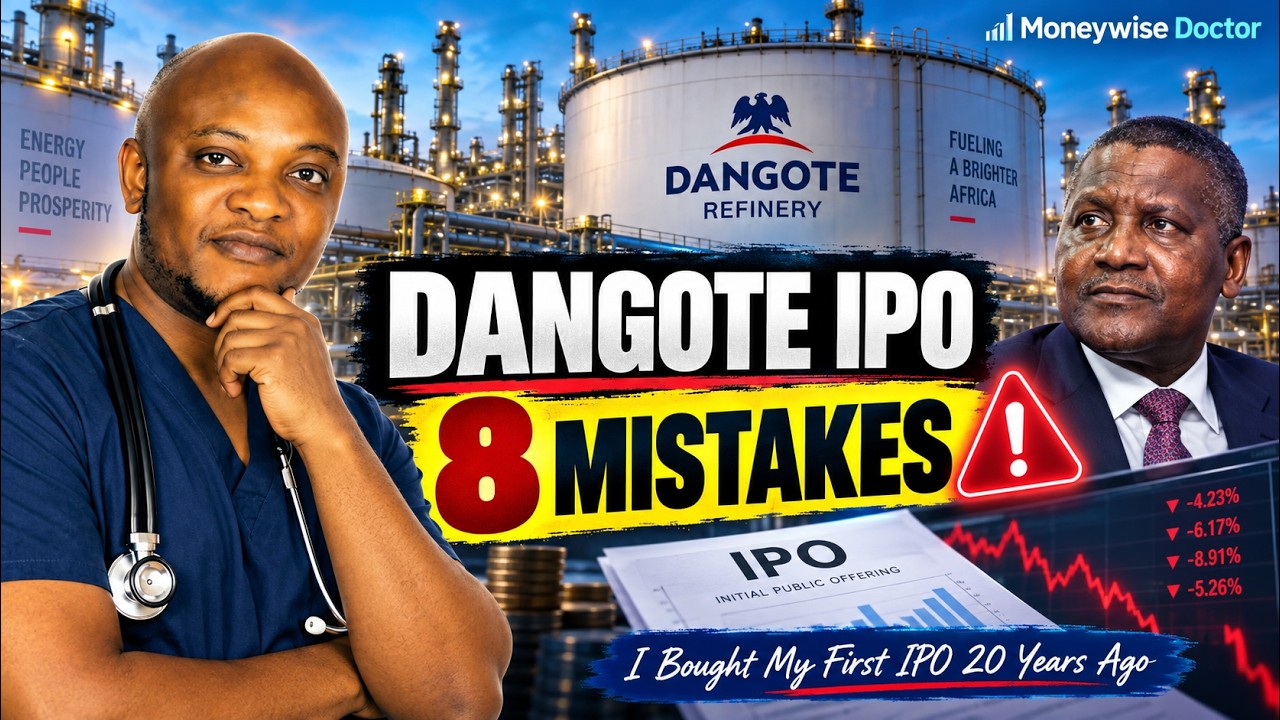
In this 38‑minute YouTube monologue, Dr. Ndubuisi “Andy” Egwim – a UK‑based medical doctor, founder of MoneyWiseDoctor.com and author of The Money Wise Doctor – educates retail investors about the Dangote Petroleum Refinery IPO. He begins by contextualising the hype (claims of 10× returns on a ₦100,000 investment) and his own 21‑year investing history, including a prior purchase of Dangote Sugar shares in 2006. After a disclaimer that the video is financial education, not advice, he outlines eight common investing mistakes that he sees repeatedly, especially in the current IPO frenzy, and adds a bonus “sell‑criteria” checklist. The mistakes cover: (1) rushing in due to FOMO despite a month‑long subscription window; (2) buying without understanding the refinery’s business model, raw‑material supply, margins and debt; (3) conflating low share price (₦525) with cheap valuation; (4) assuming a great business automatically makes a great investment; (5) extrapolating short‑term profit spikes into long‑term earnings; (6) following the crowd/social proof; (7) ignoring currency risk for diaspora investors; (8) treating the investment as all‑or‑nothing instead of sizing positions (the “heartbreak insurance” concept). He then provides a practical checklist of questions investors should answer before buying and when to consider selling, emphasizing risk management, diversification, and the importance of writing down the investment thesis. Throughout, he references his own experience, the prospectus, and the broader Nigerian market context, encouraging viewers to download a free 7‑step guide for doctors and to engage via comments.
Chapters
Right, so Dangote says if you invest around ₦100,000 in Dangote Refinery, within 1 or 2 years you could be talking about becoming a millionaire. So ₦100,000 to ₦1 million, that's roughly 10x, 10 times your money. But at least what you are looking at, if you invest like something like maybe ₦100,000, you know, within 1 year, 2 years or so, you are talking about you becoming a millionaire. I mean, it's quite a claim, and to to be honest, I quite respect what Dangote has managed to accomplish. I have enormous respect for what he has built in African industry. But also, as an experienced investor at my level, at my own little level, I've learned to check the maths. Because the Dangote Refinery IPO is now open, and thousands of ordinary everyday investors are trying to get in. And after more than 21 years of investing, I'm seeing some of the same common mistakes investors make again and again. Some of them can be very expensive and they can be quite costly for your financial future. And I learned some of these lessons the hard way, the long way, in over 2 decades of investing. 21 years now I've been investing. Because 20 years ago in 2006, I bought my first Dangote IPO. I'll tell you a little bit more about it. I was 21 at that point. I was a medical student at that point. I had only about 2 years, just a little under 2 years of investing experience. And that company was Dangote Sugar Refinery. I bought it at 18 naira per share, so that was about roughly 14 cents, 14 US cents at the exchange rate. 20 years later, another Dangote IPO is happening right now as I record this, except this time is a very different business. It's Dangote Petroleum Refinery, so not sugar, not cement, petroleum. The offer opened on Monday, 14th of September. The price is 525 naira per share. The minimum application is just 10 shares, so that's 5,000 250 naira. So that's roughly about $4 to get a tiny piece of this refinery, about £3 sterling or less. And judging by what has happened over the last few days, people are very interested. Now, some investing platforms even struggled under the traffic. Some were said to have crashed, and my social media feed became something else entirely. Apparently, if you applied for 10 or 20 shares, you're no longer an ordinary investor. You're now, you know, Aliko Dangote's business partner. You're in business with him. Right now, okay? So I've seen partner and shareholder Yid Copper, who is a co-founder of Dangote Refinery, is a proud shareholder. And then somebody has even been seen messaging Aliko Dangote something like, partner, how's our refinery doing today? I love it. You can't expect Nigerians to get involved in something like this without adding a little cruise, have a bit of a laugh, okay? And actually, I think there's something positive underneath all the humor and fun. Ordinary people are talking about ownership, not just about consumership now. They're talking about shares and investing. They're talking about investing for the long term. That's a good conversation to have, but let's not miss something here. Owning part of a great business and making a great investment, they are not automatically the same thing. They sound great, but they're not the same thing. And before this IPO opened, I published a detailed 38-minute video explaining exactly how I was analyzing Dangote Refinery, both as a business, as an investment. I looked at the valuation, the debts the company owes, their expansion plans, the currency risk, and other risks associated with investment and opportunities as well. And I also shared how I was thinking about Dangote Petroleum Refinery, especially after 20 years of investing in Dangote companies and 21 years of investing as a whole. I thought a few hundred people will watch it, maybe a thousand people will watch it. I was so wrong. At the time I'm recording this, that video has had about 560,000 views and almost 600 comments. But the most interesting thing wasn't the views. No, not the views. It was the questions like, doctor, should I buy the Dangote IPO? I've already bought. Have I made a mistake? Now, one was, is ₦525 too cheap? Should I wait until at least on the secondary market? Now, one was, how do I know when to sell? And what happens if the price falls? I think I see a few too that were like, can I buy from abroad? So I tried, but there was no realistic way I could answer all those questions properly in the comment section. I'll try. I'll keep, I'll keep looking at them to see if I can finish. But that's why I've made this video now to answer some of those questions. And I'm not going to predict what Dangote Refinery shares will do after the listing. I don't know. Instead, I'm going to show you 8 mistakes I would personally avoid with this IPO, and frankly, 8 mistakes I watch out for with almost every investment I consider before I put a penny of my money. And the first one is particularly relevant now because despite all the excitement, personally, I haven't bought any Dangote Refinery shares yet. Not yet. Now, that doesn't mean I'm not going to buy. It doesn't mean I'm also going to buy. It just means something a bit simpler that I'm trying to convey in this video. I don't have to rush. You don't You don't have to rush. Let me explain. Before we do that, just a quick disclaimer and a bit of an introduction. If we've never met before, I'm Dr. Andy Egwim. I'm a medical doctor based in the UK. I originally trained in Nigeria for medical school, then moved to the UK after a few years where I completed a master's in international health and my postgraduate medical training before working as an NHS GP, or what you might call family physician, in Canada or Nigeria. So about 4 years ago, after reaching financial independence in my 30s, I stepped away from salaried NHS work. So that was my goodbye to salaried work. So I'm also the founder of moneymisedoctor.com and the author of The Money Wise Doctor, which was a UK bestseller on investing and personal finance published in 2025. I've been investing for more than 21 years and that has helped play a big part in helping me build that financial independence and allowing me to say goodbye to paid employment for the past 4 years. So through Money Wise Doctor, I've now taught more than 4,400 doctors about investing and sensible personal finance. And more than 11,000 doctors receive my free weekly financial education newsletter every Sunday. And perhaps most relevant to this video, I've actually invested in Dangote companies before. So I'm not telling you all of this as a theory or to impress you. No, not at all. I'm simply giving you some context so you know that I didn't just read this stuff and start talking about it. And it also helps you decide whether it's worth spending the next few minutes learning how I'm thinking about this IPO. Because this is one of the ones I've been watching very closely. And before we go any further, a quick disclaimer. This is financial education. It's not personal advice. It's not a recommendation for you to buy or sell Dangote Refinery shares or any other investment. Just remember, investments can fall as well as rise, and you may lose some or all of your capital. That's always important to understand. Investments always come with risk. So your circumstances may also be different from mine or whoever else is in the comments section commenting. 7. There 7 steps to take before you even start thinking of investing as a doctor or healthcare professional. Now, this is really important to secure your financial foundation before you start investing. Now, I've covered these 7 steps in a simple guide that I've made available for you in the link in the description. You can download it. It will help you to build a solid financial foundation, avoid common investing mistakes, and also make tax-efficient investment decisions. Start your investment journey the smart way. Download the guide now using the link in the description, and good luck on your investing journey. Now let's get right back to the episode. So right, we've got that out of the way. Let's start. 8 mistakes. Number 1, rushing into an investment without doing your homework. The first mistake is rushing. The Dangote Refinery IPO opened on Monday, 14th of September, and almost immediately there was this mad rush. There was an enormous rush to get in. Some investment platforms struggled with traffic A couple of them briefly crashed and you could almost feel the pressure. It was palpable. People were like, I need to buy now before I miss out. There's that FOMO, the fear of missing out. But here's the thing. The subscription window for the Dangote Petroleum Refinery IPO officially opened on September 14th and will close on October 13th, 2026. That's one whole month. So there's excitement, but it doesn't mean urgency. It doesn't mean you should rush and take a decision before you're ready. This is not a concert ticket where the first 100 people who get through the door get the best seats. You're making an investment decision with your own hard-earned money. And before I put my money into any investment, I want enough time and information to understand what I'm buying and what I'm paying and what could go wrong or right. I mean, the prospectus just came out a few days ago before, you know, just as it was going public. So you're making an application during the offer period, which is 1 whole month. Okay. Not 1 day. Even Dangote's own IPO website uses that same language. It says you can apply for shares and if shares are allotted to you, you become a shareholder. So no need to rush. And sorry to disappoint some of our new Dangote partners, especially those ones checking out trucks and sending him messages. You may have applied, but this is not the same as the final allotment. Okay. But yeah, hopefully you get what you wanted. The offer contains 4.1 billion shares. What eventually happens to applications and allotments is governed by the prospectus and the final basis of allotment. So don't confuse pressing the button quickly with making a better investment. He's not the fastest finger at Who Wants to Be a Millionaire, but you can go ahead and click on the subscribe button now. You can do that one quickly. Now, a lot of this excitement is what is driving the FOMO, the fear of missing out, and I've seen this movie before. In 2004, as a new young investor, I remember under the then CBN Governor Charles Soludo, I was only about 21 then, Nigerian banks were required to increase their minimum capital base from ₦2 billion to ₦25 billion. That led to the ₦25 billion scramble. If you're around, you'll remember. I'm not sure Gen Z can relate. You know, I still remember the atmosphere back then, even as a student, as a medical student. It was like a proper fanfare. Banks were marketing shares aggressively. Many banks resorted to aggressive street-level kind of carnival-like marketing tactics. You could see the custom t-shirts, live musical bands, dancers, and roadshows to sell shares, initial public offerings and additional public offers to raise more money to meet that goal. So there were public offers everywhere. Everyone was talking about stocks. Everyone became an overnight stock market guru. It felt like everybody needed to get in. 20 years later, the technology is different. I mean, some of those investments did well, some didn't do well. But now we have social media apps, Instagram, YouTube, TikTok, WhatsApp, and the rest of them. But look, human psychology hasn't changed much. And only 3 months ago, we saw another extraordinary IPO event with Elon Musk's SpaceX. I actually analyzed SpaceX on this channel before I began trading in June. You can check out the video here on the channel. But what the point is, we are still the same human beings. We don't want to miss out. That's a story for another day. Look, see, I'm not saying Dangote Refinery is the same as SpaceX or even the Nigerian banks of 2005. No, that's not what I'm saying. But the principle is the same. It's the same, you know, marketing campaign, promotions, new companies coming to the market. There are big headlines splashing all over the place. There are interviews. There are bankers, brokers, social media, friends talking about it. Everybody's showing you screenshots and suddenly something happens psychologically. You begin thinking, everybody else is moving. Why am I still here? Am I missing out something? I've already mentioned the name for this thing is FOMO, the fear of missing out. I call my own JOMO, the joy of missing out. I'm not going with the crowd. I'm making a mistake. That FOMO feeling can be dangerous. I mean, one of the advantages you have as an ordinary investor is that nobody is forcing you or pressuring you to make a decision right now. So you take your time, read the prospectus, or ask questions if you don't understand it. Think, ask questions, read the prospectus, think about how much you can risk without putting yourself in a stressful situation. And if eventually you decide to invest, fine. If you decide not to invest, also fine. And if you have already planned or if you already applied, No, I'm not saying you've made a mistake. My purpose here is to help you to understand the process and become even a better investor moving forward because you don't get a bonus. You know, you don't get bonus investment returns for making the decision quickly. It's not fastest fingers. This offer is scheduled to remain open until 13th of October. So don't allow somebody else's urgency to become your urgency. That's mistake number 1. Don't rush. Mistake number 2, investing without understanding the business. So that's probably the number one question I received was, doctor, should I buy it? Well, that's not the first question to ask. You should ask a few other questions first. So before should I buy, you need to ask, what exactly am I buying? I mean, you're investing in a business. A share is not simply a number moving up and down on your phone screen. When you buy shares, you're buying ownership into a business. So yes, all those people joking that they are now Dangote's business partners, technically they are right because once shares are actually allotted, shareholders are owners. So when they get the shares allotted, they are owners, even if that ownership is microscopic. But if you are buying part of a business, you should probably understand what you're buying as an owner. So in this case, how does Dangote Refinery actually make money as a business? Where does this raw material, which is crude oil, come from and how reliably? Can it obtain that raw material? What does it pay for it? How much fuel can it refine? That's its product and other products as well. What can it sell those products for? What does it cost to operate the refinery? If you are buying a farm, you want to know what kind of like production the farm does. Okay, so what debt does it have? The company already has some debt. Okay, how much capital will expansion require, you know, and who are its competitors? And again, ultimately, how much sustainable cash can this business generate for its shareholders? Those questions are less exciting. They are not as exciting as, I'm now Dangote's partner. Okay, unfortunately, the boring questions are the ones that ultimately matter. That's investment for you. Imagine as an example that you own the best bakery in Lagos or London or Los Angeles, and I gave this example in my previous video. It's a fantastic location, brilliant staff, Customers are queuing outside, but then your flour supplier stops delivering. You need flour to make bread. Now you have a problem. You can't make bread, you can't make cake. Your ovens are still state-of-the-art and your staff are still hardworking, the best in the business, but there's just one small problem. Flour, the raw material you need to make bread, is not available. What are you gonna do? Or imagine flour suddenly becomes extremely expensive because of a strike somewhere, whatever is happening. Or policy, your beautiful bakery now has another problem. You either need to increase the prices or your profit margin gets squeezed. It gets crushed. Now, a refinery similarly needs its critical raw material, and that's crude oil. So you could own one of the most technically sophisticated refineries in the world, but crude oil availability matters. Crude prices matter. Refined product prices matter. And crude oil is one of those things that geopolitics can affect. Geopolitics matter. Remember the Gulf War? OPEC policy or war in the Middle East or elsewhere can affect oil prices, and the margin between what the refinery pays for inputs and receives for its products matters enormously. And this can also work in favor or against the refinery. Now, the investment case therefore cannot simply be, oh wow, this refinery is massive, it's quite advanced. The question is, can this massive refinery generate attractive, sustainable cash for its shareholders? That's number 2. Understand the business. Number 3, thinking ₦525 means the company is cheap. This is probably one of the most important investing lessons in this whole video. The IPO price is ₦525 per share. That's roughly $0.40. Okay. And you only need 10 shares to apply. That's like ₦5,250. So ₦5,250, about $4 or £3. So naturally somebody thinks, wow, that's cheap. No, um, that tells you it's affordable. Affordable and cheap is not the same. It doesn't tell you it's cheap. I like to use this example when I teach doctors about investing in our investing deep dive, um, I will teach the doctors in the UK and Canada and elsewhere. And I gave this example in my previous video as well. Imagine I have a cake, a lovely cake, chocolate cake, is worth £100. I cut it into 10 pieces, each piece is equal to £10. Okay, now I give you one, you give me £10. Now if I take the same cake and cut it into 100 pieces, each piece is now £1. If I give you one, you give me £1. Has the cake become cheaper? No, not really. I've simply just made the pieces smaller and more. So shares work in a similar way. Think about it, we are sharing the cake. So that's how shares work. So I'm not primarily interested, I'm not primarily interested in ₦525. I'm interested in ₦525 times all the shares in the company. After the base offer, that implies a total equity valuation of roughly ₦65.2 trillion, okay, or roughly $49 billion depending on the exchange rate being used. And of course, Dangote has majority of this, as he should. Now we're asking a proper investment question, not can I afford ₦525, but At this price, am I happy with the entire business as what it is being valued at? Am I overpaying? Now, affordable does not mean cheap. Again, some valuation depends on assumption. That's also another angle to look at. How much crude will the refinery process? I don't know. We have to make assumptions. What margins will it earn? That's on the profit as well. What will expansion cost? What happens to the debt? How is it going to be paid? What happens to currency? How much of the accounting profit eventually becomes cash available to shareholders coming back to me and you, whether it's dividends or, you know. So if you change those assumptions and you change— that means you change what the business is worth, which is why I wouldn't outsource my entire investment decision to somebody saying my target price is $1,000 or the company is going to 10x, and if you put $100,000, it becomes a million. It's just an estimate. It's not a promise, not a guarantee. So that's number 3. Number four, confusing a great business with a great investment. That's number four mistake. So Dangote Refinery can become one of the greatest businesses ever built in Africa and still be a poor investment at the wrong price. Now that sentence probably explains my own investing philosophy better than almost anything else. I gave this example in my previous video that has now been watched by about six hundred thousand people. Imagine I show you a beautiful house. It's five bedrooms. Wonderful neighborhood, low crime, excellent schools, beautiful garden, you know, nothing needs fixing. You just need to take your bag and walk in. And I ask you, would you buy it? Now, even if you have a lot of money, even if you have plenty of money, you can't answer because I haven't told you the price. What is the price? What do you compare it with? Suppose comparable houses are worth £500,000 in that same area, and I offer it to you for £250,000. Now you're interested. You're very interested. Might bite my hands off. It's like half price, especially if you are ready to buy. But what if I ask for £2.5 million for the same house, same bedroom, same neighborhood, same beautiful gardens? It's now a completely different investment. I might not even talk to me or reply my messages. He might, you know, probably ignore me and walk away, and rightfully so. So that's why saying Dangote Refinery is an extraordinary business. Yeah, it's an extraordinary business. It's great. But that doesn't— it doesn't finish the investment analysis. It starts the discussion. The next question should be, what am I being asked to pay for this brilliant business? You know, you're paying even for the future earnings. Now, a wonderful business can still be a poor investment at the wrong price. That's my point. Mistake number 5 is assuming today's profits will continue forever. That's a big blunder. Most experienced investors won't do that. It's a particularly important one with this refinery because the recent numbers are Extraordinary. In 2024, the refinery reported approximately ₦9.38 trillion revenue, but it recorded a loss, roughly ₦2.23 trillion of losses. In 2025, revenue rose to approximately ₦18.74 trillion. Fantastic. But the company still recorded a loss of about ₦723 billion loss. Then look what happened in just the first 6 months of 2026. The first half, the revenue went up again to ₦19.13 trillion. That's about $13.9 billion. Profit after tax, ₦2.5 trillion. So that's about $1.82 billion. That's impressive. So 2024 lost ₦2.23 trillion, 2025 lost ₦720 billion, and now this first half it makes like a big profit. And yeah, some of the losses earlier are understandable. It's an enormous capital-intensive project that only began commercial operations in 2024. It takes time to commission a refinery, increase the throughput, you know, absorb enormous fixed costs. Yeah, so, and from the company's perspective also, they've done it very wisely. Coming to the public market after the business has demonstrated profitability creates a much easier story to sell for potential investors rather than running losses. Fair enough, well played. But now our brains can make another mistake. We look at that 6 months, we 1.82 billion profit. Therefore, 12 months is 3.64 billion profit. That doesn't work like that. No experienced investment analyst will do that. Fantastic, you say, let's project it to 20 years. No, don't do that. Slow down. Even the prospective-based analysis also says it. Refining is cyclical. Crude prices move, product prices move, demand changes, geopolitics changes, and crucially, refining margins change. So you can't just multiply. The first half of 2026 benefited unusually from really strong, you know, tailwinds that helped to push it. Let's use a hotel, for example. Imagine you own a hotel and it just had the best month in its entire history. The competitors next door had a problem and closed down. Demand exploded. Your customers were queuing around the building. But wait a minute. The month is December, so it's Christmas. And we all know that it's a great season for hospitality industry. Would you say, excellent, every month for the next 10 years will look exactly the same, so let me hire more staff, buy more things, start expanding? Of course not, or you might be out of business really quickly before you can spell hotel. I know they are clearly not the same type of business. I know that. It's just an example. It's not a perfect example, but the truth is that margins and profits are not fixed. They fluctuate and they change. There are ups and downs. And that's the same in most businesses. So you should always ask how much of this performance is sustainable, this first half performance, and how much came from unusually favorable conditions. I mean, there was a war in the Middle East. There was quite a few other things happening. So that's the question I would ask. Okay, that's number 5. Number 6, buying because everybody else is buying. That's a big mistake. Don't follow the crowd. This is slightly different from rushing. This is called social proof. Human beings naturally look at other human beings to work out what to do. If 20 people, let's say 100 people, suddenly start running away from something, even 5 people, you instinctively think, perhaps I should run too. That's how we developed. Our ancestors, you saw a lion, you ran away. You didn't wait to find out an explanation to see if it was a zebra. That's very helpful, but it's less useful when choosing investments. There's no lion chasing you right now, and this IPO is a wonderful Example, if a lion is chasing you, you better run though. You know, people are posting photos and videos saying, oh, I'm partner and shareholder graphics. So calling themselves co-founder and one person buys 146 shares and suddenly, you know, becomes a co-founder of Dangote Refinery. And I love it. I like the humor and everything that's associated with it. But genuinely, I like it. Anything that gets people having fun while talking about ownership rather than only consumption. It's interesting to me, but I don't want to be the party pooper here who comes and spoils everybody's fun. Somebody's got to say it though. There's investing risk we cannot ignore. You start thinking, hmm, look at everybody buying. They must know something I don't know. Most times they don't. Maybe they do, but most times they don't. We've seen that from the previous market crashes. Or maybe they are looking at you and thinking exactly the same thing or looking at others. That's how crowds work, which leads To one of my favorite principles. Don't buy simply because everybody else is buying, you know, but equally don't refuse to buy simply because everybody else is not buying. You know, do your own research and be fearful when others are greedy and greedy when others are fearful. That's Warren Buffett. So do your own research. Mistake number 7 is ignoring currency, particularly if you live abroad. Now let me bring you back to my 21-year-old medical student at the beginning. Dangote Sugar Refinery, if you remember, ₦18 per share 20 years ago. Today, that's roughly, it's roughly ₦70. So if you look at it in naira, oh, that's great. I've gone from ₦18 to, you know, ₦70, almost 4 times the share price. It sounds pretty good until you change it in dollars. That's where things get interesting. When I bought it at ₦18, it was about $0.14. So $0.14 in US dollar. Because the exchange rate was about ₦128. So now if you use an exchange rate today of approximately ₦1,324 to the dollar, depending on what source you're using, ₦70 is only around $0.05. So I made money in naira, but I lost it in dollars. So imagine I bought 1,000 shares, you know, just for illustration. If I bought 1,000 shares back then, that's 1,000 times ₦18. That will be ₦18,000 at the 2006 exchange rate is roughly $140 that I put into Dangote Sugar back then. At ₦70 today, those same 1,000 shares is equal to ₦70,000. At roughly the exchange rate of ₦1,324, that's only about $53. So it's a bit strange, but I like to use the whiteboard to demonstrate it, you know. So from 14 cents to 5 cents, multiply that in thousands or tens of thousands or or millions. So, but it's important to clarify, that's not the total return from owning Dangote Sugar for me because it includes dividends. This number doesn't include dividends or reinvestment or when I bought and sold. It doesn't account for any buying or selling along the way or taking profits and all that. I'm just using this simplified example to demonstrate one thing for you, especially if you live abroad. Currency matters when you're investing. It doesn't mean don't invest, but think about that as well. If you live in UK or US or Canada or Europe, Australia, Dubai, wherever you live, think about currency. Imagine you convert £10,000 to cash and invest it in naira and it does well. It's going up fantastic. But during that same period, the naira depreciates substantially against your, your sterling. When you eventually move your money back into pound sterling, you might start wondering whether you should have just used the original money to organize a very good party with jollof rice, and pepper soup. I mean, have a party anyway. Investing is not everything because if you live abroad, you effectively have 2 exposures. That doesn't mean you shouldn't invest, but you should factor it in. One, your exposure is investment risk, and 2, the currency risk. So that's why I ask 3 questions. Okay. What did I make in naira? 2, what did I make after inflation? And 3, what did I make in the currency I am actually spending or earning? These are things to consider. You know, it doesn't mean don't invest. You could still invest and still get ahead even with that currency exchange, but you need to factor it in. They are not the same question. Now, that doesn't mean you should not— like I said, that doesn't mean you should not invest in Nigeria at all. Nigerian Stock Exchange can do very well. In fact, this year it was one of the best performing so far. It just means you need to consider distance and that all those factors and factor it in. And I said in my previous video I'm clearly— I'm Nigerian. I absolutely want Nigerian businesses to succeed. I want African businesses to succeed. I want the African capital markets to deepen and develop, you know, so that, you know, we can all grow. But patriotism is not a very strong investment thesis. Maybe there's a hedge fund or venture capital or private equity doing that, but patriotism is not an investment thesis. I won't buy an investment simply because it's Nigerian, and I won't reject it simply because it's Nigerian. It still has to earn its place in my portfolio. Again, at the end of the day, when you invest your money, you're hoping to get a return. If not, you could do charity. Mistake number 8 is thinking your only options are all in or nothing. It's not all or none. Now we'll get to something I jokingly call my heartbreak insurance. If you want to learn about it, check my last video. I mentioned in the previous video, and since then I've seen people repeating it in the comments section. And someone even met me at an event in Manchester and said, hey, I'm buying some heartbreak insurance. Somebody even told me they had already bought a small amount of Dangote Refinery. They were calling it heartbreak insurance. Here's what I mean. Sometimes you find an investment or an opportunity, you genuinely like it, but you think it's great. You like the business, you like the prospects, but the valuation, it seems overpriced. And investors, sometimes we convince ourselves we have only 2 choices. Either you put a huge amount in or you do nothing. If you do nothing and then you see the prices keep going up and going up and going up times 10, times 20, You might start having a bit of heartbreak, a bit of pain. You think, oh, I should have done something about this, you know. And if you do it and then you lose money, you might not be happy. So there's a space in between. Sometimes I might take a tiny position, small enough that if I'm completely wrong, you know, my financial future is not endangered. Might lose a bit of money and that's it, life goes on. Or maybe it doesn't do that well, but it should also be enough that if the investment performs spectacularly, maybe it goes times 10 or something, um, like Dangote claims he might do, then you're happy, you're participating. And if the share price later falls to a valuation that you consider more attractive, then you might consider buying more. So if Dangote says if you put in ₦100,000, you're talking about being a millionaire in 1 to 2 years, maybe you can get some heartbreak insurance so that you don't look back and say, I wish I did. That's your choice. Now, that's something I sometimes consider as part of my own investment process. I'm not telling you what position you should personally take in Dangote's refinery. I have absolutely no idea what the share price will do after the listing. But the broader lesson is enormously important. Your conviction about it and your position size are 2 different decisions. So know what you can spare, what you can invest, what you're happy to lose. Because you can like a company without betting the whole house, and you can be excited without risking your family's financial future. That's my point. So those are 8 mistakes to avoid, but there's a bonus I've left for you if you've come this far. I mean, if you stay with me this far, there's a bonus mistake to avoid. You've earned it. Okay, now one of the comments underneath my previous video— there's been more than 500 comments there now— um, one of the comments was asking, if you're investing for the long term, when do we actually sell? I've been investing for over 20 years now, so I think it's an excellent question. But I'll begin with one step earlier. Before you buy, what would make you change your mind about this investment? Suppose my case for owning Dangote Refinery depends on high refinery utilization, or reliable crude supply, or healthy refining margins, or their debt is manageable— so manageable debt— or successful expansion— they're planning to double their, you know, their production— or strong sustainable free cash flow. What if those things happen? What if they don't happen? At what point is my original investment thesis no longer true? What will make me change my mind? I mean, I like writing down things before investing because investors possess an extraordinary superpower. We can rewrite history inside our own heads. When the investment goes up, then you think, yeah, I always knew. I knew this company was amazing. I should have sold my car, my house, and bought more. When it crashes, you now say, don't worry, I was always a long-term investor. You might think, well, I didn't think this investment was going to work out anyway. That's not analysis, that's rationalization. So before buying, write it down, you know, write it down. Say, why am I buying? What am I buying? What am I paying for it? What needs to happen for this to work? What could make it wrong? How much money am I comfortable putting at risk? What is my Horizon. How long do I need to wait? Am I happy to wait for this money? These are important questions. They are more important than asking Dr. Andy, Dangote shares are going up after lifting, should I buy? I don't know. Nobody knows with certainty. So why haven't I bought it yet? Because I haven't bought it till now. Why haven't I bought Dangote Refinery shares? It's very simple, and I've already said it earlier on, because I don't need to rush. The offer remains open till October. I can take my time to study the prospectus a bit better. I can think, I can finalize my own analysis, decide if I want to invest and how much I want to risk in investment. Eh, eh, eh, that's not analysis paralysis. I can hear you saying that, some of you. That's not analysis paralysis. That's what serious investing looks like. And I've done it for 2 decades. So maybe I'll participate in the IPO, or maybe I'll just wait until the shares trade on the secondary market. It's easy and quick for me. At the moment, I'm personally leaning more towards waiting for the secondary market because that gives me more flexibility over when and at what price I enter or exit if I want to. Or maybe I'll just take a little tiny heartbreak insurance position. And again, there's the option of doing absolutely nothing. I'm still making that decision and there's no rush. There's no pressure. The same for you. But what I wouldn't do is to make it because everybody rushed onto their investment apps on Monday morning. and crashed their investment apps. After 21 years of investing, that's not how I invest and that's not how I think about investing. And perhaps that's the biggest difference between the 21-year-old Andy who bought Dangote Sugar as a student and Dr. Andy sitting here today. At 21, one of the questions dominating my mind was, how much can the price go up? How can I make money in this stuff? How quickly can I get my money out? 20 years later, one of my first questions is, what happens if I'm wrong? Okay, that's not pessimism. That's just sort of like calculating and managing the downside. That's experience. Okay, because successful investing, even when you've been successful at it, even if you're Warren Buffett, it's not about never being wrong. You will be wrong. You'll not be right 100% of the time. If I've been wrong a few times as well, But the goal is that your wins should be better and far much better. The goal is to structure your financial life that even if you are wrong, it does not destroy your financial future. So you need to manage your risk, diversification, position sizing, patience, valuation. Do it correctly, understanding what you own and managing those risks. Those things are not particularly exciting. Nobody's making a TikTok video saying proud minority shareholder with appropriate portfolio allocation. That's too long and dry, but that's how real investing works, okay? Not a flashy bling and Ferrari, okay? So there are 5 questions I'm going to leave you with that you can ask before you make this investment or any other investment going forward. So if you are still considering Dangote Refinery IPO while the offer remains, or even if you've already bought it, going forward, you think, do I understand what I'm buying? Not just the story, the numbers as well. The business, do I understand it? Number two, what am I actually paying? Not merely is only five hundred and twenty five naira. No, what is the whole business being valued at? Number three, what needs to go right for me to make money in this business? For it to work out? Is it the profits needs to keep going up? The margins? Is it the expansion needs to happen? Is it the currency needs to be stable or the cash flow of the business? What needs to go right or No new competitors in the horizon. Number 4, what could go wrong? Always look at both sides. Risk and potential reward belongs to the same conversation. Both sides of a coin. Number 5, if I'm wrong, how much money am I putting at risk? How much could I potentially lose? It's simple. And that's the last question. That last question might save you more money over an investing lifetime than almost anything else I've said today. And that, interestingly, is what I learned basically from the response to my previous Langode video. And I thought I'll make this video to answer some of those questions, and I'll check the comments as well. More than half a million people already watched it. But the most useful thing was not the number of views. It was the hundreds of questions and showed me areas where people need a bit of, you know, highlighting some education because underneath any question like, should I buy Dangote Refinery? There's a much bigger question like, how do I actually think like an investor and reduce my risk? And based on the comments, quite a few of you want to learn about investing in a sensible, practical, and systematic way. Not magic money or overnight Ponzi schemes, not guesswork, okay? Or doing like random tum bum tum bum when investing. No. And it's not about will this stock do like times 10 next week or next 2 weeks. No, actually investing done properly, compounding long term. So I'm going to do more of that on this channel because look, I've been investing for more than 21 years and I've had sort of like a lot of insight and experience. People like Warren Buffett had enormous influence on me even when I was 19, reading about him. I even traveled to Omaha recently to the Berkshire Hathaway annual shareholders meeting, you know, as a shareholder in the company. And these are— there are lessons I've learned over 21 years, practical lessons including mistakes, are useful to share, you know, because it's not something you can just read in a book. Because I've increasingly learned that building financial freedom is not necessarily about starting with millions. I didn't start with millions myself. It's about what you actually, you know, managing your risk, growing and compounding over time and protecting what you earn. It's not earning so much, but whatever you earn, how do you grow it over time? And look, if you're a doctor, particularly in the UK or Canada, I've also put my free investing guide for doctors in the description. There's also a pinned comment there. Um, these are 7 steps to take before you start investing, before you even buy any share at all. And if you haven't watched my original Dangote Refinery analysis, you can go watch that next. There's a reason more than 500,000 people watched it. That's where I go much deeper into the business itself. And if you've already applied for Dangote Refinery shares, look, congratulations, Dangote's partner. Hopefully when the allotment is completed, you officially become one of Dangote's newest partners, and excellent. Just please don't phone the man at 7 AM tomorrow or send him a DM asking Partner, how did our refinery perform overnight? Give our partner some time to work and grow the business. Okay, and I'll be looking at the comments, and my team and I will look at the comments. And if you've got any questions, pop them. I'll do my best to answer them. So, but I want you to tell me in the comments: Have you already applied for Dangote Refinery shares? Are you still thinking about it? Are you waiting until the shares start trading? And then, more importantly, what investing question would you like me to? Explain next. Feel free to share the video if you think it will help someone to understand investing better or make better decisions. And, um, thank you for watching. I'm Dr. Andy Egwim from moneywise doctor dot com. Thank you for watching. And if you're just wondering what to watch next, if you click the video on your screen right now, there's the one that YouTube thinks you'll find most useful. Go watch it, totally free. I'll see you there.







