Episode 9. Doc$ & Sense: Dr Ndubuisi Egwim's Personal Finance Strategies for Doctors
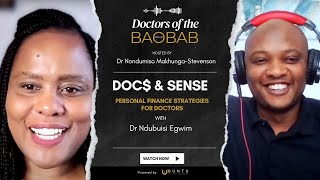
Podcast interview with Dr. Ndubuisi "Andy" Egwim (founder of MoneywiseDoctor.com), a Nigerian-born family physician based in the UK who combines clinical work with personal-finance education for healthcare professionals. Andy recounts his origins, medical training in Nigeria, migration to the UK on a Developing Solutions scholarship, and early side-hustles (blogging, software services, fish farm). He explains his evolution into a finance educator: starting a blog, launching an email newsletter and podcast that reached rapid early traction. He gives practical, actionable advice for doctors: change the taboo mindset about money, pay down high-interest debt, build a 3–6 month emergency fund, automate savings/investments, budget to know living expenses, and consult a qualified financial adviser when close to retirement. He stresses separating charity from paid work, retaining a medical license for flexibility, and using financial freedom to increase agency and reduce burnout risk.
Chapters
Welcome to Doctors of the Baobab. On this podcast, we go beyond the white coat to get to know the doctors that we admire and respect. Join us as we explore the stories behind this stethoscope, uncovering the humanity behind the medical expertise. Whether it's navigating the complexities of patient care, overcoming personal obstacles, or advocating for change in healthcare systems, each episode promises to inspire, to educate, and to uplift. So sit back, relax, and prepare to embark on a journey of discovery with Doctors of the Baobab. It gives me great pleasure today to introduce our guest, Dr. Andy Egwim, who is a seasoned family physician and a personal finance expert based in the uk. He brings a decade of experience in both medicine and investing and is known behind the Brains. Known as the brains behind moneywisedoctor.com which is a top notch platform that delivers tailored financial insights to thousands of doctors, dentists and other healthcare professionals weekly through podcasts, through newsletters, and through blogs. Dr. Egwam's mission is to empower his colleagues to make smarter financial decisions and avoid costly mistakes that could affect their financial future. As an astute investor and entrepreneur, he contributes significantly to the field of personal finance, especially as it relates to medics, leaving an enduring mark on his peers and the wider community. Dr. Andy Egwim, thank you so much for joining us on Doctors of the Baobab and welcome.
Yeah, thank you for the glowing introduction. You can see me beaming from ear to ear.
No on Doctors of the Bear. But we always hype our doctors and our guests because they are really exceptional people. They're really exceptional people. So earlier we were talking about your. Your name and maybe you can share a little bit about the origins of your name and your origins as well.
Absolutely. Thank you for having me, Dr. Nandumisa. So my first name is Ndubisi. So Ndubisi is an Igbo name from Nigeria and it means if there's life, there's hope, which is really powerful name. But after I moved to the UK a few years ago, people tend to call me the short form of my name, which everyone, including my mom, calls me Andy as the first two letters of my name. But Andy has somehow evolved from Andy to Andy, which is also closely related. But I don't spend too much time trying to correct people on how to pronounce my name. As long as they get the paycheck right, they spell it right on the paycheck, it's not an issue.
That's always the important part. I want to go back to Nigeria. And as you mentioned, that is. That is your origin. You are a medical doctor. Can you just take us through your time and your experience, the medical profession in Nigeria up until you decide that you. You want to be an immigrant?
Of course, yeah. Thank you for. Nobody ever asked me that. People always ask me about investing and finance, so it's nice to be able to talk about that sometimes. So I went to med school, obviously going to med school as a teenager, as most people do, and at that point, it was about the same time I started learning a lot about personal finance, investing. I started investing in the stock market. I spent six years in med school in Nigeria. University of Niger. Yeah, I graduated as a doctor, but I knew there was a bit more than that even while I was in med school. I started my first business in med school and had a few things there, but I graduated and obviously started working as a doctor in Nigeria. I think I did that for about a couple of years or thereabouts. And while I was doing that, I had things on the side. I had an online business, I had a fish farm. But I think after doing my compulsory. I don't know if you guys do it. There's a compulsory national service I had to do. So I worked in a rural area as the only doctor in the whole local government. So local government is a bit like a county. And it was very interesting experience, but I thought I wanted to do more and that's how I ended up in public health. Yeah. So I ended up working with the public health NGO FHI3cystic, which I've just discovered that you worked with in the past as well. Yeah. So it was a fantastic experience. And from there I came to the uk. Fortunately for me, I landed something called a Developing Solutions Scholarship. So the full name is a bit long Developing Solutions for Developing leaders from developing countries. So I did a Master's in International Public Health in Nottingham. And after that, obviously the plan was to go back to work in Nigeria or in any other countries, basically. But it turned out that it was quite quick and easier for me to get a job in the nhs, a doctor. And the jobs I got to work back in Nigeria, South Sudan. While I was really looking forward to them, the processing of the papers and everything took so much time. And I had senior colleagues who were in places like WHO saying to me that they were moving to the UK as well. And while I've been lucky to get my UK license, I stayed back. And then, almost nine years later, here we are.
Okay, but that's a very interesting Story, I guess somebody who's also a recent immigrant. A very typical story as well. But I want to go back to medical school because I'm quite intrigued about how a medical student has the vision to start what nowadays people would call a side hustle. Right. When I think back at medical school, you know, the intensity of it and the demands of medical school, most people don't even consider a side hustle. Despite the fact that certainly in my day and current circumstances, in a lot of medical schools, medical students really cannot afford many of, you know, their needs. You know, whether it's food, it's accommodation, tuition, so many things that, that they need. I want to just go back there, just give us a little bit more detail about how you started and how you would advise a medical student or an early career doctor to start thinking about money at that point and not later on when they can't afford to retire.
Yeah, thank you. That's a very insightful question. And it sort of takes me down back basically before medical school. So I think a lot of things that affect how we think about money is affected by our background, the exposures we have. So I was fortunate to grow up in a family where we were morally richer than we were financially rich. I'll say that my family, I was raised by amazing couple, they were really great people, educated, but weren't financially well off. And I know to go to med school we had to borrow some money to pay my first fees. So I knew there was much more than that because I knew my parents were hard working people, they were honest people. So it didn't have to do with hard work. So I got to start reading books like Rich Dad, Poor dad and you know, all those kind of books started opening my eyes to things about principles around how to manage money. Books like the Richest man in Babylon. So by the time I was getting into medical school, I was already thinking in those terms of how to. And before then I was an academic high flyer. I was a senior prefect or what you call a school captain like most medical students are for my secondary school. But then when I was in medical school, I was no longer thinking in one track. I knew that I was a medical student, but I was more than that. I was a medical student and I was a writer, so I wrote for magazines. I was a medical student and an investor. I was a medical student and again an entrepreneur. So that was my approach to it. Most people say, how did you find time to do that? Because medical school is intense. And I'll say, how do you find Time to do anything. You make out time for it. It is important and it forces you to. Just an example is you and I, we've got like work, life, family, different things, but you're making out time for podcasts and coaching and stuff that is really important to you. My experience is that because I started doing that as a medical student, so I was on tv, I was on radio, I did seminars and all sorts of stuff. Had like two or three businesses on campus then, because I studied it back then, it becomes natural for me to be able to combine different roles much later now when there's more pressures, like other things along the line. So for a medical student, I would say first of all, know yourself or any career doctor, understand your capacity, what you can do. Two, don't be afraid to think beyond anatomy, physiology, biochemistry. Don't be afraid to think about the beyond the clinical. You are much more than a doctor and even while a doctor, yeah, you can be an excellent doctor, but you may turn out to be a writer or something else. In addition, and number three, don't wait till you have all the time in the world to explore your gift and talent. You're never going to have time. You can start doing it little by little. Maybe you can start doing like an hour a week or maybe practice what you've got. Maybe if you're singing or whatever talent, just start from somewhere. I think that's more practical than. Yeah, as practical as I can get.
Yeah, a very, very, very practical advice. Now, something that I also shared with you we started up our recording was the mindset, right, the money mindset, more than a doctor.
And even while you're a doctor, yeah, it can be an excellent doctor, but you may turn out to be a writer or something else. In addition, and number three, don't wait till you have all the time in the world to explore your gift and talent. You're never going to have time. You can start doing it little by little. Maybe you can start doing like an hour a week or maybe practice what you've got. Maybe if you're singing or whatever talent, just start from somewhere. I think that's more practical than. Yeah, I can. As practical as I can get.
Yeah, a very, very, very practical advice. Now, something that, that I also shared with you before we, we started up our recording was the mindset, right, the money mindset that doctors have experienced or are known for, which is an aversion to. To money for some reason. There is the mindset that, you know, if you pursue pursuits outside of medicine, it's because you are greedy. You know, you shouldn't be negotiating for money. You know, it's a gift, it's a calling. And so there seems to be this obstacle or this barrier in terms of our mindset as doctors to, towards money. How did you get around that? And how do you advise doctors who are still with that mindset and, and it's a limitation for them in terms of, of their finances. How do you get around that mindset?
Yeah. Dr. Andemi, so I think you've hit a really, really quite key issue. Here is a core issue. Obviously, as a doctor, healthcare professional, a lot of times we're taught, almost trained to think of money as a taboo topic. And you see, I'll give you an example. We've got like administrators or employers of doctors who try to pretend that your skills is not governed by market forces. So if someone calls you say, oh, come on, do this shift or come and do a job or. But they don't want to pay you what is worth because they are thinking is a calling. But here's the thing. So I've been fortunate, yeah. In my financial journey. I'll give you an example. Buying my last car, buying my house, they didn't give me any discount because I was a doctor. Nobody cares about that. And if I have a business or I have an income, I pay my taxes just like everyone else. Nobody really gives me any extra discount. And I agree that being a doctor is a calling and we are quite blessed and quite fortunate to be able to do that. But at the same time, it's also a vocation and you need to live by your vocation. You need to be able to afford. We see situations where doctors, dentists are not able to pay for the services that they render if they have to pay for it for their family. So I think for the younger generation, especially those we've been seeing, we see thousands ofdoctors on moneywisedoctor.com are beginning to think differently about these things. Realize that one, money is not a dirty topic. It's not a taboo topic. Part of the reason why I'm able to take a walk on a Monday morning is also because I've had that level of financial freedom that allows me to be able to determine what I do. And I could still do my clinical roles if I wanted, but I'm not under pressure and I'm not seeing my patients as a source of income or a source of money. And I'll do it for joy. I have more energy and I'm delighted to do it. So I think Doctors need a bit more in terms of trying to change their mindset around money. Understanding is not a taboo, it's something important. You are, what. What's your words in the marketplace and you're. You're doing something that cannot really be paid for. Medical services, saving people's lives, giving people hope. It cannot be paid for, but at least it should be adequately compensated. I think most junior doctors in the UK with the strike and everything going on will agree with that.
Very, very, very interesting thoughts there. But you also raised, or you pick my, my, my brains about the role of society in, in that, you know, just thinking back to some of the times when I was in private practice, it was not uncommon for patients to request services, medical services, services indicate that they cannot afford to pay for them. And we render the services because, you know, that's, that's what we do. But also mindful that this probably is not likely to happen to other professions, to what extent do you think society enables this, this mindset?
Right, so another key question when we think about it. I remember growing up, I had an uncle who was a doctor and he would do all the medical services free, but when he wanted a lawyer or architect, they charged him double because he was a doctor. So he was sort of like, I saw his, his life and I decided, well, he's great and everything, but I decided that if I was going to render services, I want to separate my work and charity. So I give to charity. I've been fortunate. It's not something that we tend to advertise, but charity, want to separate it. When you're doing charities, charity, and one is business, is business. So I've got high professionals I work with, I have mortgage advisors, I have lawyers, I have accountants. And I don't come to them and say to them, well, I'm really sorry, I can't pay you for your services, which are really valuable to me. Can you accept some nice words and kind words of charity? No. If they wanted charity, then they could do legal aid, they could do pro bono, and that's something doctors might need to start looking at. So you can still do charity, but when it comes to basically your profession, your vocation is a business. If you work in the nhs, obviously in the uk, where health care services are covered by the state, you don't bill patients, so that's nice, you don't have to deal with all of that. But if you work in private practice as a doctor, doctor work in private practice as a coach, you, you live by, you're providing value and you shouldn't feel too bad. So the society obviously has given a bit of this impressions that doctors, your reward is, you know, is not here. Your reward is gratitude. But unfortunately that doesn't seem to work anymore. And that's why you see places like in the uk, you see junior doctors leaving to other countries or leaving to other professions and even a lot of strikes now demanding for better wages. So I think it's time for the society to understand that, yeah, doctors, they are really great. They're going to do service for the society and it's not all about money, but they also need to be paid what they are worth to be able to continue to render those services.
And, and I, I like what you said about the agency that also comes with money because there is then that freedom to pursue other interests. Like you said, the charity work that you can do and when you have the financial freedom, you can put aside time without it affecting your finances, your personal finances to do just that. You can donate to the causes that are dear to you without it having a negative impact on yourself financially. Very, very important ins. And thank you, thank you for that. Now you also mentioned earlier that you do writing and you, you do newsletters and so on. Can you share with us that side hustle? What does that side hustle look like? Because somebody might be listening in the audience and thinking of their own talents and gifts around writing or storytelling. What does that look like for you?
Yeah, thank you again. It's very interesting because on most podcasts people want to ask me about what interest rates and investment returns. So thank you for bringing that up. Yeah, so what it is is that after I left a salary job as a doctor and I suddenly had a lot of time and I could decide what to work on, what to go into, and I had to really take out time to think about the next step. And I looked at my life and several years back there had been one or two things that I had always been doing, either when I was a student in secondary school or a doctor or you know, working outside medicine. And I thought, well, I could go into developing software because as a student in on campus medical school, I had software as a service, one of my businesses, I could do that, but I didn't have any passion in that area. I could also maybe I had an E commerce business which I started while I was in residency or what we call training in the uk and it's nice, it's still profitable, but I wasn't getting up every morning thinking of how to sell baby stuff to expecting Mothers. And it's a nice business. I like it. I probably still keep it for now. But I realized that I'd always been writing. I enjoyed writing even back in, I would say when I was in secondary school and I was the school captain, I write stuff and every week people read like the head boys corner. Then when I go into med school, I was also writing, I'll write my thoughts and share it. And I ended up as the editor in chief of a Christian Medical and Dental association magazine back in school. So I realized also while in school, I started a blog in medical school that really took off, did quite well. It was on weight loss and then later writing about personal finance. And I thought, you know, look, I've been investing for so long. I've been in entrepreneurship. I had a lot of friends calling me on the phone to ask advice about, should I buy this, should I sell that? What do you think about tax and all that? And obviously it was fine when I was single, but after I got married, it was taking away a lot of time from my family. So my wife and I, we thought about it. I thought might be best for me to put that advice out there. I put it out in a blog, then people can go and read it. That way they don't have to require my time. But surprisingly, the blog took off. I think one of our articles, early articles hit almost 10,000 reads earlier on. And we realized there are a lot of people interested in this. But I thought, well, the blog was great. But because of my experience of selling online, I knew that anyone coming to your blog, you probably might never see them again if they choose not to come back. So I set up the email newsletter so people can keep in touch. I can let them know when I publish new stuff. I can give them updates. I might not be able to write a big blog every week, but I can tell you what's going on. Interest rates have changed. Have you claimed this? Have you claimed that? And also this is how I'm thinking about investing. So the newsletter grew and took off as well. Obviously when I say took off, it didn't take off the same day I've been writing it for. The 40th episode is going to come out tomorrow. So it's almost a year now that I've been writing the newsletter and then along the line, lots of people. I didn't want podcast and videos and all that, but I kept having people say it'll be nice. I get these emails back from my newsletter subscribers say to be nice to have a video on this to be nice, to have your thoughts on this. And these days people are more attention. It's a bit difficult. Not everyone wants to read a book or read a newsletter. And I said, I'm going to give it a go. So last year, October, So that's almost five months now. So it's roughly four months, October 29th or thereabout. I launched the podcast and within our first few months we hit the 1,000 subscribers. So I thought about it from this point is basically marrying what you are interested in, your genuine interest, your genuine skills, putting them all together and providing them as a service, as a way to serve, you know, your community or your world and finding a way to monetize it to be sure that somebody pays for it.
Yeah, and thank you for sharing that piece of it because I, I do come across many doctors who have so many gifts that they could use to secure their financial future and, and something that they also enjoy, you know, and benefit out of their talents. Now I'm thinking somebody, I'm just thinking maybe somebody back home, a doctor in, in South Africa might say, look, I, I, I'm a salaried doctor, I'm employed, you know, and I have so many financial commitments. I have a car, kids, I have a house, you know, a mortgage that I need to pay at the, there's, there's really more math than there is salary. How, how would you, it's always the case. What advice would you give them to get started? Because I think this is also very typical scenario for somebody who, who is employed. How do they get started?
Yeah, I think that is also leading us down the path of practical getting down the nitty gritty. And I appreciate, yeah, we should talk about that. Obviously, when you're a doctor, people think you have money. You have friends, family, sometimes you have old schoolmates who think you have money. But most times we know that that's not always the case. I think the good place to start will be we've got something we call 10 money wise rules for Doctors. That was how I think about money. Basically. I think the first thing is to pay down debt. You need to pay down any high interest debt. That debt is a killer. It kills your financial future. And you might think, where do I find money to pay down debt? I'll explain in a moment, but focus on if I've got high credit card debts, I need to pay it down. If I've got money, I borrowed as interest rate, some of the credit cards, I was offered them a credit card for my business that charges 100% in interest. And I think this is criminal. It shouldn't be existing. But I can use it because I can use it for my business and then pay back in full. I don't think it's for everybody, but focusing on paying down debt is really quite important and not taking on more like. Unfortunately, people go into debt to impress people who don't really care about them so that they can buy a brand new car, they can buy some fancy watch. So not even going down that path is the first place to start. Before you even go to that point, remember that you are the chief financial officer of your life. You're the one in charge, not the government, not your financial advisor or pension advisor. I mean, moneywisedoctor.com has got great content, but we're not going to come and take over your life and sort it out. If you understand that sort of personal responsibility and start making decisions in that you have agency to make those decisions as a place to start, then you pay down debt. The second thing will be, once you're paying down your debt is to jump into saving an emergency fund. I do promote this quite a lot among junior doctors and even more senior doctors because I come across doctors who. I earn him a lot. I've spoken to an ENT surgeon, earns a lot of money, but didn't have. If he said if he couldn't work for just a month, he's going to go underwater, he's going to run out of money. And, you know, you live in the us, I live in the uk. If you can't pay your bills, bad things happen. If you suddenly can't pay your mortgage, then you can't pay your taxes, what we call council tax here. And you can't, you can't really make your car payments. Your life can change dramatically within a few months, especially if you've got a car payment and all of that. Yeah. So having an emergency fund is really quite important because things happen, people lose their jobs, people become unwell, sometimes people want to take a break. I've had doctors on my podcast and other places who've had like burnout situations or you want to change your career direction. Part of why I was able to suddenly say, well, for the next one year I'm going to work on this project, is because I had that option financially. So after you pay down debt, the next thing is to save an emergency fund. That's where I'll go. I think these are the basic steps to start with, then the next level, which again, I think is rather practical and everybody can do this, irrespective of what financial commitments they have, is to automate your savings and investment. Now, if you're saving for an emergency fund, the same thing is what I'll say. Emergency fund is simply three to six months worth of your living expenses. So if you don't know what your living expenses is, then you need to go back and think about the dirty B word budgeting. So you need to go back. What? Yeah, look into it. You might find out that you're buying stuff you don't even use. You sign up for multiple channels, Netflix and all that. You might not even be a member of the club or you're not going to a club you pay for. So look at your budget. What is the barest minimum I need to survive? If you own a car, Car payment. I don't, I don't own one of those. But if you own a car payment, you're paying car payments. If you own a house, you pay mortgage or rent, your food, all those basics. Think about those things first. If you pay health insurance, fine. If you think about that, then you know what you need per month and then you can calculate three months worth and start saving towards it and do it automatically. So if you set up a direct debit or standing order or instruct your bank that 15% of whatever money comes into my account as income, 15% automatically goes to that account. And I've been doing this for multiple years and I've seen that with most doctors, magically, the remainder of the money is enough for them to manage whatever is left. Yeah, we could go a bit more into that, but yeah, I think that's the general overview of how to start.
Yeah, and a very good, good, you know, succinct, practical steps to, to another situation, of course, is a doctor who may be in private practice getting ready to retire, but cannot afford to retire. Is it too late for that doctor? What can they do?
Right. Like I said, my name is Ndubisi. It means if there is life, there's hope. So I try to offer some hope. But the time to prepare for retirement is not just before you're about to retire. The sooner the better. And a lot of doctors make the mistake of assuming that because they've got like high income that they are fine and they never really start early. The best time to start to plan for retirement is yesterday. The next best time is today. So if you're in private practice or in public practice and you haven't got any sort of like retirement planning, I think you probably might need to be talking to a financial advisor or pension planner, somebody who is qualified has got the right credentials, not just a random person. Best if the person has experience working with doctors as well. And that would be because you're now in a very. You're very close. Now, if you're not yet there but you're planning, you can actually set up your own pension plan by investing 15 to 20% of your regular income. But if you're that close, then I would say the best thing would be to talk to a financial advisor who can help you walk through what you can do. But that being said, there are things you can start doing immediately. One way you can do that is to try to avoid making any expenses on anything that is not really necessary. For instance, when I was leaving my salary job, I decided that if I was going to buy a car, when I say this, since people think we don't like nice cars, we've got a few of them that are quite nice. We try to pay for them all cash, like cash. If you cannot afford to pay it in cash and someone say, well, I can borrow money, I'll say, yeah, if the interest rate is 0.51%, maybe I'll borrow the money and invest the money elsewhere. But at the point you're buying the last car, it was about 10%. Or you think about things like going to buy a big house because it befits your status as a doctor, but you're going deep into debt. So if you're closing towards retirement, you should be actually thinking of how do I cut down my expenses and how do I start investing? Because when you're very close to retirement, you haven't got a lot of investment horizons, so you probably will be buying things like bonds, buying things like treasury bills, things are not volatile, things that can give you an income in retirement rather than stocks, which might go up and down closer to your retirement. But again, this is not professional financial advice. If you're that close to retirement and you haven't got anything saved, you definitely need to be talking to an experienced financial advisor who can help you work out a battle plan.
Yeah, and that's exactly. You know, the importance of knowing when to speak to a financial advisor as well, because there are professionals out there who can assist doctors with certain decisions. Dr. Dubuisa, I want to just come back to you now as somebody who's at least a public profile is the financial doctor. Do you still practice medicine?
Yeah, so, yeah, so I retained my medical license and I say to doctors, if you enjoy medical practice, because some people think they dislike medical practice. But wait till you've got that flexibility. If you've got some income, you've got alternative sources of income, you might actually realize that you really, really enjoy practicing medicine and that's why you went there in the first place. So, yeah, I retained my medical license. I haven't got like a regular job, like go to job nine to five months. But having my medical license means that one. It gives me the option to end as a doctor if I want to. Obviously I need to do a minimum number of clinical sessions per year to retain that license. And I really enjoy doing the job. I enjoy going there knowing that I can decide to come or not to come. I enjoy connecting with the patients and I'm more full of energy when I know that I'm doing one or two days a week. But with your license, you can also do quite a number of things, for instance, medical legal work and advisory work consulting. So having a license also helps with that. I teach medical school. Well, not teach. I'm invited as an examiner for medical school where I am. So I enjoy those bits about practicing medicine. And it also makes it a bit more relatable if I'm dealing with doctors, thousands of doctors on moneywise doctor.com. it is nice to be able to understand what's going on in the system, be part of that system. So I think doctors, if you can practice, but rather than seeing it as a single source of income, look at it as an opportunity to diversify your income and have many options or at least even if you did just one job, invest your money carefully, invest your money smartly and invest your money towards a stronger financial future.
And I think that's a very good point to talk about the so called work life balance or work life integration. Because having many balls in the air can be a bit tricky for us as doctors. How do you manage to keep these balls up in the air without any of them falling?
Yeah, so I think at is in a way, I look at it as my life. Not many. Let me explain it this way. If I wake up in the morning, I took it. I went to obviously drop off my little one. I come back, I do a work, I sit down, I write an article based on my experience, I do a podcast. I have three today interviewing the podcast. And then let's say maybe on Friday or Thursday I might go in and do a clinical session. And then on maybe Saturday I need to travel to speak in an event or conference. I didn't start all of them at the same time. So as a doctor, the way I used to think about it is I.







