From Doctor to Business Buyer: How GMC Motivated Me To Launch A Business
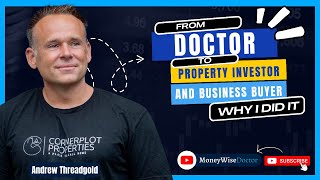
A Money Wise Doctor podcast episode (YouTube video) featuring Dr. Andrew Treadgold interviewed by Ndubuisi 'Andy' Egwim/Speaker A. The guest recounts his medical training (Barts; intercalated BSc in exercise physiology), surgical/urology training, subsequent switch to general practice, and a prolonged GMC investigation around 2010–2011 over completing cremation forms. The investigation (about 18 months) caused severe stress, weight loss, and prompted deep reflection that led him to shift from consumerism to asset-based income strategies — first trading and managing a hedged stock portfolio, then investing in property (first buy: a terraced house in Darlington). The episode aims to show how a professional crisis motivated a career and financial pivot towards property and business buying, framed for doctors seeking financial resilience.
Chapters
All right, so welcome to the Money Wise podcast. And again, we've got a fantastic gentleman today in this video. But first, just as a reminder, Moneywise Doctor is basically a platform for doctors and healthcare professionals, where we deal with how doctors and healthcare professionals can take charge of their finances, go from mortgage to life insurance or investment, pension, talk about side hustles, whatever it is. And every now and then, we get the opportunity to get a doctor who's out there doing amazing and fantastic things in terms of finance or business, or who has some good insight in how to manage money and businesses. Doctors can do. So today I've got an amazing gentleman. He's taking out the time today to chat to us and I think he's got a lot of wisdom and insight. So for me, it's a master class. I'm just inviting you to join me to listen to Dr. Andrew Treadgold. Welcome, Andrew.
Well, that's a very generous welcome. Thank you very much.
Lovely, yeah. So a little bit about Andrew I'm going to. Obviously, I'm sure he'll fill in the gaps. So, Dr. Andrew Treadgold, he's actually a real doctor again, not like Dr. Dre. Yes. He actually went to med school sometime between the 90s and early 2000. He went to med school, I think. You went to bat, didn't you? I did a proper medical degree. So you actually a real doctor, you're not coming into the bath or anything like that. And no dig. Not digging at any particular group. But also between that time, you did your BSc, you did a BS. Well, that's physiology or thereabouts.
Yeah.
Exercise. I was going to say sports. Then you went ahead to. I'm sure you practiced medicine for a while, being in the nhs for about 20 years so far, maybe a bit more. That's longer than myself. And you've gone ahead to do other amazing things, apart from training as a GP and an occupational health physician. You're doing something that I don't see a lot of. A lot of doctors doing. Yeah. Property investor. Not just buy one house and flip it. You're buying houses, you're fixing them, you're flipping them. But more interestingly, you're a business buyer in a quest to buy businesses. So I think for any of our listeners, you agree with me that Dr. Andrew Treadgood is one of the interesting, fascinating doctors that we have.
All right, just a quick one. Something really fascinating has come to my notice and I wanted to share it with you. I've come to see from our YouTube analytics, from our numbers from the back end that 75% of you who watch this channel and listen to money wise Dr. Are, Are yet to hit that precious subscribe button. Well, thank you to the 25% who have subscribed, but I just want to speak briefly to the 75% who haven't. This channel has been a journey of financial empowerment for medics, healthcare professionals, and your support means everything to us. We are glad that you're on this journey with us, but it will mean the world to me if you hit the subscribe button. So I'm here to ask a small favorite. Subscribing to Money Wise Doctor helps us immensely. It helps us to scale up, it helps us to be able to bring in expert gets and helps us to enhance the quality of our production. And overall, this will make this a bigger and a better channel for you, providing you financial education that would help you build a stronger financial future as a medic and help you to avoid making costly financial mistakes. So if you've watched our channel before or read the blog, or if you found value in our episodes, if you like what you're watching right now, please could you hit the subscribe button. Go ahead and smash the subscribe button. It's a simple click for you, but it makes a huge difference for us. Thank you so much for considering this. And in return, I promise to ensure that everything we do here at money wise Dr. Not only continues, but also improves. We are committed to making each episode better, more informative, more engaging and more empowering. So, do we have a deal? Hit that subscribe button and join our community of financial savvy healthcare professionals. Together we can make the journey to financial freedom more accessible and more empowering. Okay, enough of the groveling now. Enough of groveling. Thank you for watching and remember, every click supports us in bringing more value and content to you. Let's get back to the video.
Thank you.
Well, you've missed it. You've missed quite a bit there, really. It's, it's a long, it's a long tail. But I'll try and, I'll try and make it as, as short as possible. So yeah, I went to medical school in, in London, went to Barts, did an intercalated BSc in exercise physiology during that time, qualified from Barts and then did my house jobs and did surgery. I was, I did a, had full surgical training, became a urology spr and then something called MTAS happened which was a medical training and application service and lots of us at the time had to reapply for our own jobs and none of us got the jobs that we were already in. And so lots of my colleagues that were urologists went to be trust sho somewhere else, even though they had training numbers. And I went and did general practice and then after about six months of being in general practice the whole thing collapsed and they offered us our jobs back. But by that point I'd come into general practice. So then I went and did my GP stuff and now I've been a GP now, 10, 12, no more than 12 years anyway. But then to cut to the chase, the reason that I do what I do now is because in, in approximately 2011 I got investigated by the GMC and oh yeah, I presume most of your audience are doctors or in health, so they may understand the, the ins and outs of this. So essentially what happened was it was the day before Christmas Eve, 2011, I think it was, or 2010, something around. It was one of those Christmases and I was in a funeral director's doing a part one for one of my patients because they'd obviously passed away. Yeah, Cremform. And the funeral director came over and said, look, we've got this part two here. We've been waiting for the part two doctor for over a week. His phone's just switched off, the funeral's tomorrow on Christmas Eve and you know, can you do the part two? Because otherwise it's not going to go ahead. So I looked at the form and it was, I think it was a very old person in a care home on end of life with cancer that passed away, you know, as an expected death. So I rang the part one doctor to ask him the questions in the Kremform and the part then the, the secretary said that they're in the Christmas party and not to be disturbed. So then I rang the Part 2 doctor to ask his permission if it was alright and his phone went straight to answerphone, which is exactly what the funeral directors had told me. So I thought, and it's Christmas and it's lunchtime and I've got visits to do and I just thought, all right, I'll do it, I'll try, you know, trying to help somebody out. So I did it. I said, I don't want the fee, not bothered, I'm just trying to help somebody out. At the end of surgery that day, I rang the part two doctor to let him know and before I could get anything out, he went absolutely mental. What are you doing? Nicking my crem forms. This was the kind of thing that he was, he was talking about. So I I tried to calm him down and say, look, you know, I'm just trying to help you out. You know, give. Give me a break. Do you know what I mean? So he said, oh, it's. It's a misunderstanding. It's a misunderstanding. I said, right, fine, okay, whatever. I've got better things to think about anyway. Thought, nothing more of it. So that was Chris. The day before Christmas Eve, we get into January, into the new year, and I get a letter through the post in January from the gmc.
Wow.
You have been accused of filling out cremation forms without due care. Process. Due process. How. You know, it's kind of how do you plead? Type thing. We need a meeting. So I had to go and see the responsible officer and all the rest of it. And ultimately, a very long story short, they investigated me for 18 months. They interviewed all my colleagues, they got requested all my bank statements to see how many 50 quids I was making, because it was 50 quid at the time. Turns out, over a period of about two years, I think I'd done. I think I'd made 350 quid from creme forms. So it wasn't, you know, I wasn't Harold, you know what I mean? And then they went through all my previous cremation forms that I'd ever done. It was abject misery for 18 months. And during this period of time, I'd lost about three stone in weight. And I'd been a doctor for a while, you know, and I was sat actually in this in my office here, and I was looking at the walls and thinking, you know, I've been a doctor for a while. I've got a reasonable standard of living, you know, and the. The MDU had just got off the phone to the MDU and the MDU had said to me, you do know, Dr. Threadgold, that people can get struck off for this. And I thought, what's the point if it's your colleagues that are doing this, you know, what is the point? What am I, you know, why am I putting myself through it? It's such a fragile existence. And then the MDU said, you know, 50% of all doctors that are qualifying now will get a GMC investigation at some time. And it was so stressful. Then in the end, what happened was they concluded the investigation and they wrote to me, and the GMC said, look, we've got evidence that you completed a cremation form without due process because you've admitted it. I said, yeah, I did admit it. Yeah, because I did it. So you've got two choices. You can either accept a warning that will be on your GMC register for the next five years that will detail the fact that you've done. You've been dishonest, basically, because you signed a form and it says, have you asked these? Have you asked the one doctor and I hadn't. So you can either accept that or you can go to a full MTPS tribunal. Yeah.
Know what that is?
Yeah. And the two outcomes from MTPS tribunal are one erasure or two, nothing. Which one do you want to go down? And after 18 months of stress and all the rest of it, I took the warning. I couldn't face it. I was in such a terrible place that I just couldn't do it.
I mean, the impact, I can't even imagine the impact on your mental health. Just sort of your life and your career, your whole life, career, you want hanging in the balance. Sounds reasonable to want to end it all as quickly as possible.
It's. Yeah, but you get into some very dark places, you know, it's incredibly stressful for anybody that's been out there and been investigated by the gmc. It's absolutely harrowing because nothing happens quickly. They set a deadline for a reply to something and then the review for that deadline and the information provided is another three months down the line and you're practicing day to day worrying about making a mistake. So you constantly. It's defensive practice all the time, because the last thing you need is another complaint when you've got this GMC thing going on. The last thing you. So. So your practice is impaired even whilst it's going on because they drag it out for so long and it's no wonder people, you know, kill themselves when the GMC are investigating them, because it's absolutely horrible.
It sounds very harrowing, Andrew. I mean, I've. I've not been through gmc.
Well, I don't know.
There's still time. I've not been to James, but I've had a lot of friends and. Well, not friends, but I've had colleagues basically who have had investigations and I've been sort of followed their story and I've gone on the mtps and it sounds really, really very harrowing. It sounds like the experience no doctor wants to think about, especially if you think about the amount of time you've invested into getting to where you are and the fact that there are no options where to go from there. But what can I say? Seems that out of that difficult experience, out of that really, really darkness came some light. And led you down the pathway where you are now. So tell us a bit about that.
Well, that's exactly it. That's exactly right. So I think I always say that the vast majority of people in jobs, and any job medicine in particular, because they pay you just enough to keep you comfortable, but not enough to kind of give you freedom.
Yeah.
So I was firmly in the comfort zone. You know, I had consumer debt, I had, you know, credit cards and I had cars on finance and all stuff that when you've got a nice income, all the stuff that you put into your lifestyle. I was no different to anybody else. But this really narrowed my focus and it moved me out. It's like having a three lane motorway. In the middle you've got the comfort zone, at one end you've got pain and at the other end you've got, you know, something else. So I moved out of the comfort zone into a very painful place. And that is what made me decide that actually I'd fallen out of love with medicine. Because if your colleagues are the ones that can get you into the gmc, you know, it's not the, it's not the holes in the road that, potholes that you can see coming, like patient problems, it's actually people stabbing you in the back.
Your co passengers, maybe.
Yeah, exactly. And I just thought we're supposed to be in this together. So during that whole period of time, there's a lot of reflection going on. Part of it demanded by the gmc. Actually, one of the things that they made me do is reflect heavily on, you know, the cremation acts and my part in this process and all the rest of it. They really try and, and make you suffer.
There's not a lot to reflect on, on cremation, apart from you must have thought of a lot of things that you wouldn't need in the future.
Yeah, I did. I think I did. I think I did a. It was a 6,000word essay on the Cremation act following the shipment inquiry that I presented to you.
Oh, my God.
Yeah, they make you do all sorts of things. But that whole painful process deconstructed what I, what I knew and what I thought about life and the way life works. And I went from being slowly, it was a very slow process and I'm still developing now, you know, 13 years later or whatever. But I went from having a consumerism mindset where I would pay for things with on credit to enjoy them today. And I changed that into a longer term lifestyle where I now buy assets that Then provide an income. And I use that income from the assets to pay for stuff.
To fund your life?
To fund my life.
This is, this is, this is sort of the echoes of bodywisedoctor.com basically that sort of thinking is where we're trying to get doctors to go. So it seems this GMC investigation got you to the point where you made a radical transformation in terms of your, not just your financial thinking, but generally in terms of your, your, your life philosophy. You went from just, I'm going to get money, pay my debt, I'm going to get money, pay for my car, pay for my house. You got to the point where you started thinking about sustainable, you know, passive income generation wealth. Some people say there's no passive income. I started thinking about how to get alternative income sources other than being fully dependent on your income as a doctor. My thinking is that if that hadn't happened, well, I don't really know if you might have gotten yourself in this direction where you are now, where you buying properties, you're buying businesses. No, it is not something I can say.
Many doctors, no, it would never happened. I would never have done it. And I mean, my first port of call was, my first exit from medicine was going to be stocks and shares. So I did some training and I did, I think a diploma from the Institute of Portfolio Management and I ran my own long, short hedged portfolio for a while. And the point of that was that I was going to prove my track record through my portfolio and then apply for jobs in hedge funds. And I did all right at it. I learned an awful lot about stocks and shares and how professional traders actually trade and not amateur traders like retail traders. But the trouble with that was it was still a single source of income and it was still exchanging time for money. And then long, long story short and many, many books that I read later, we ended up doing some property and we started off with a very small terraced house in a town near here called Darlington. I think I bought it for 47,000, spent about 15,000 on it.
And how long, how long ago was that?
It's getting on for four or five, five.







