How to Choose Your First Index Fund Without Getting Overwhelmed — UK Doctors
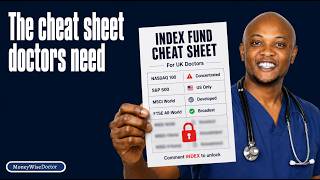
Andy Egwim, a former NHS GP, breaks down how to pick your first index fund by checking four things: what it tracks, total costs, whether it accumulates or distributes dividends, and where to hold it for tax efficiency. He compares index funds to buying an entire league rather than picking one winning team.
Chapters
If you've ever decided you wanted to start investing, maybe that's one of your goals this year, you might have heard the popular online advice, whether it's on TikTok or YouTube, just buy an index fund, just buy an index fund, just buy S&P 500. So off you go, you went, you downloaded the app and you logged in and opened it, you typed S&P 500 and suddenly you found yourself staring at 47 different funds that all look the same, a bit confusing, you don't know what they do. If that's you, this video is for you and I'm going to share a cheat sheet at the end that can help you to understand this quicker without getting overwhelmed. Now, I taught about 4,000 doctors tax-efficient investing, and I see that even very smart doctors struggle with this thing. And it's not because investing is complicated. Um, so they go in and they just get overwhelmed. They don't know where to start. That's part of why they come to my classes. Before they come, they watch another video, then another video, and 6 months later, sometimes they haven't even done a single thing. Maybe it turns to 6 years. And here is the irony. Of course, you know, doctors— you, if you're a doctor watching this, you Obviously smart, you can interpret scans, run cardiac arrest, you know, sessions, make life decisions. I am a doctor myself, so we spend a lot of time studying, but when it comes to investing, we get overwhelmed, okay? We feel like, oh, are we going to make a big mistake? I've been an investor for over 20 years. I'm a former salaried NHS GP, and I'm also the author of The Moneywise Doctor, which was a bestseller on investing and personal finance. In fact, over the last 2 years, I've run about 2 dozen masterclasses, and I've taught 4,411 doctors. Tax-efficient investing. So what I've seen is that choosing the fund is rarely the problem. The real problem is understanding what you're actually buying and how it aligns with your risk and your goals. But by the end of this video, you understand not just what an index fund is and how it's different from an ETF, but you also understand how to think about diversification to reduce your risk. I'll also tell you the 4 things I check before investing in the fund and how to stop overthinking and finally get started. If that's what you're here for, let's dive in. First, what is an index fund? Let's use football. Let's use football to describe index funds. Imagine that I ask you to predict who will win the next Premier League. You could spend hours or days and resources trying to pick the best striker, the best defender, the best manager, the best club. Maybe you're right, maybe you might pick Arsenal, I don't know. Or maybe you're wrong, maybe your star player gets injured, maybe your chosen team has a terrible season. That's a little bit like stock picking, not exactly the same but quite similar. So trying to identify the next Apple, the next Nvidia, the next Amazon, can it be done? Of course. I've had experience investing over 20 years and I've done quite well with it, both individual stocks and funds. Now, some investors do it exceptionally well, but it requires time, patience, research, analysis, boundless patience, and honestly, most busy doctors have neither the time nor the desire to spend evenings building DCF valuation models and reading annual reports. Now imagine instead you bought the entire Premier League rather than trying to predict which one will win. Every club, every player, every winner, and of course, every loser. Now you no longer need to predict who wins because whichever team wins, you own a piece of the pie. You own a piece of them. That's essentially what an index fund does, especially if it's broad and well-diversified. So instead of trying to find the winning company, the ones that are going to do well, you buy the entire basket, thereby reducing your risk. One purchase, you get hundreds, even thousands of companies in that basket. And that's why index funds became so popular since they came out in the '70s. They removed the need to be clever, they removed the need to predict, they removed a lot of human error. You just simply participate in the growth of the businesses. Of course there's risk, but now diversification is reducing that risk for you. Now historically, this has been a very remarkably effective strategy. In fact, over long periods of time, most professional managers, they fail to beat their benchmark index, which means that average turns out to be surprisingly powerful. And when average is combined with low cost, tax efficiency, and decades of compounding, average becomes extraordinary. Now the numbers are all out there if you look at the reports, but why do people still get stuck? Because when you search for index fund, you discover that it's not just one, okay? There are hundreds, thousands, and sometimes they sound identical. You hear things like FTSE 100, FTSE All-World, MSCI World, S&P 500, NASDAQ, Then you hear terms like accumulation, distribution, ETF, index fund, and suddenly your brain says, I'll come back to this later, which usually means never. Or maybe you come back in 6 years' time or 10 years. You've lost that time. But the good news is that all funds fall into a small number of categories, and I've prepared a fact sheet that can help you with that. Now, once you understand these categories, the confusion disappears. I'll tell you how to get it. Now think of investing as moving from concentrated bets to broader baskets. So at one end there's NASDAQ 100, mostly large US technology companies. There's Microsoft, Apple, Amazon, Nvidia. Fantastic when technology is booming, painful when technology is struggling. You're making a concentrated bet by doing that investment. Next, look at things like FTSE 100, largest UK listed companies, the top 100. Banks, oil, pharmaceuticals, consumer goods, but still limited to one country, one market. It's more diversified individual shares were still relatively concentrated by location or geographical location. S&P 500, the top 500 companies, the top largest companies in the US, is broader, more diversified, but still just one geographical location, one country. So many people think S&P 500 is the world. Yeah, it's quite large, it's a big part of the world market, but it's still limited. You know, it's America, but it doesn't have massive companies like Taiwan Semiconductors. Yes, America is a big country and it's powerful, but still one country. Then there's MSCI World, Now you're investing across multiple developing and developed countries. There are thousands of countries. They're like FTSE All-World. They are now looking like a broader perspective. The FTSE All-World looks at both developed markets, emerging markets. There are thousands of companies you can buy with one purchase. Maximum simplicity, usually like large and medium-sized companies, but it's broad. Now the less dependent you, you become on one single country or one sector, one company, The more diversified, the less risk. There are also other categories because some people want to buy thematic funds, thematic funds like AI funds, semiconductors, healthcare, clean energy. So instead of just buying one company that does that, you are buying the index, you are buying like a whole basket. So there are also value-based funds, there are ESG funds, so environmental, social, governance. Of course, there are faith-based investing. For example, I've got like Muslim doctors in our community that prefer Sharia-compliant funds. Now, the important point is this: your investment should fit both your financial goals and your personal values, and of course, your time horizon and your risk.
Before you make any investment decision, this stuff says start by understanding exactly where you currently stand. Most doctors have never had a proper financial health check, not because they're not interested, but because nobody had ever designed a tool that helps to make sense for the specific complexity of doctor's financial life.
So I made one.
It's called the MedScan Financial Health Score. So it takes about 3 minutes. It helps you to look at your overall financial position across 7 key areas, including tax efficiency, pension, investing, debt management, and financial protection.
It gives you a clear score, a breakdown of exactly where you are, where the gaps are, and it's completely free. Takes 3 minutes. If you head over to moneywisedoctor.com/healthscore, .com/medscan, or you can check the link in the description to get it. It's 3 minutes, real clarity, free. So let's look at ETF versus index fund, because that's one thing that some people find confusing, and it's not really that big a difference because the internet makes it sound much more complicated than it really is. There are some differences, but what's the relevance? An index fund just basically describes what you're buying. An ETF describes how it's packaged. Think of it this way: if index investing is the destination, an ETF is simply one of the vehicles that gets you there. So ETF, Exchange Traded Fund, can be traded multiple times. Index fund, maybe once a day or twice a day. So ETFs trade throughout the day like shares, while traditional index funds are usually priced once daily. So for long-term investors, does it really matter? The difference matters far less than most people think. The bigger questions are what What does the fund own? What is inside that basket? How diversified is it? And what does it cost? What is it costing you? And will you be able to stick with it long term? Again, another thing that confuses people is accumulation versus distribution. This is actually more important. Most funds come in two versions. So there's accumulation and there's distribution. You might see ACC and DIST. Accumulation funds automatically reinvest your dividends. You don't see the money coming out. It quietly compounds in the background. Distribution funds pay out dividends as cash. Same companies in the basket, the same investment, just different treatment of income. For a doctor, for instance, investing inside ISAs and pensions for long-term growth, you might want to consider accumulation because it keeps things simple and you reinvest, so it helps compounding to happen quicker. Now, there are 4 things I look out for before I invest in a fund. I'll share them with you. Number 1, what does it track? Is it global or a country like US or UK? Is it a sector like technology or healthcare? Number 2, cost. It could be TER, Total Expense Ratio, or OCF, Ongoing Charges. So this cost can compound over the years and over the decades. They might look small, but costs matter. And don't forget platform fees. They are often more important than many people realize. Some platforms don't charge a fee, so that's great. 3, accumulation or distribution. How are the dividends treated? Is it being reinvested or paid out? Number Number 4, obviously, is tax efficiency. Are you using the right tax-efficient pot like your ISA or SIP? Most people spend too much time trying to find the perfect fund, but what's really important here is once you find what you need to invest in, consistency, tax efficiency, and give it time is the best approach. So the biggest mistake is never investing because you are trying to choose the perfect one, so you spend so much time. Now, perfection Could be expensive, but progress is actually profitable. So what should we do next to make it practical? If you're feeling overwhelmed, don't start by looking for the perfect fund. Start by investing in your own financial education, your goals. Figure out your time horizon, your risk tolerance, your values. Then choose a sensible diversified fund when you learn what you need to do, because the best fund in the world does absolutely nothing if you never invest it. Now I've prepared something special. I've done a one-page index fund cheat sheet that can just give you a quick glance. I can see the different funds, what they do, and a bit of like key jargon buster below here where we explain the terms. So you can download it totally free of charge. Just check the link in the description, click on it, and you can download it. I hope it helps you with your journey. Now, if you need more help around these things, you need a bit more handholding. You want to start investing, but you don't just want to do it alone. You want to do it like with a few other people who really want to get it right. And you need the help of someone who has been investing for years. I'm inviting you to come to my workshop. So we run a Tax Efficient Investing workshop, run a few of them every year. So if you check the link in the description, you will see how to get on to the workshop. I don't know if there are still slots left. I'll be delighted to see you. It takes 90 minutes, you get it all sorted. I know that you've started in the right direction without making any costly mistakes. I hope you found the video helpful. Now, if you're thinking about how the whole system fits together, then I've made a video here on the screen that can help you to look at not just investing, not just index fund, but about your SIP, your pension, your taxes, and how they all fit together to make sure that you're not leaking money. All right, go ahead, go and watch it. It's totally free. Enjoy!







