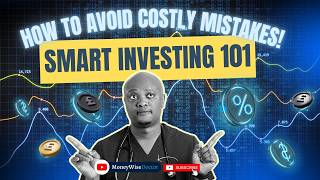
A YouTube talk by Dr. Ndubuisi 'Andy' Egwim (founder of MoneywiseDoctor.com) advising doctors and healthcare professionals on how to manage and reduce investment risk. The video defines common risks (market, credit, inflation, interest-rate), warns strongly against scams and Ponzi schemes, and recommends practical risk controls—diversification, rebalancing, emergency funds, automated investing, and education—plus a multi-week masterclass for clinicians.
Questions this video answers
August 25, 2024
83% (Money Wise Doctor survey)
65% considered investing too risky; 29% were investing
Class size: 20–30 participants; currently four times oversubscribed
Presenter: Dr. Ndubuisi 'Andy' Egwim, founder of MoneywiseDoctor.com, ex-salaried NHS GP; nearly two decades of investing experience
Chapters
If you focus on not losing money, you'll be fine in the long run. When it comes to investing, we often tend to focus on the wrong thing. If you go into a Ponzi scheme or a scam, you're more likely to lose much more than you can even think about or manage. Investing carries some level of risk is inbuilt. I've had a lot of stories of doctors and healthcare professionals who are falling for schemes. If you leave your money in the bank, all your money for 10 years, it may have the same nominal value, but its purchasing power will be significantly reduced. You shouldn't rely on a single type of investment. If you are well, well trained as a doctor, you're a less risky doctor. If you're well trained as an investor, you're less risky investor. Do you find investing risky? Have you ever lost money in the past and know someone who has? I do. You're not alone. A staggering 83% of medics in our recent Money Wise Doctor survey revealed that they had lost money in investments at some point in their career. And in our Financial Health Survey, 65% of medics considered investing too risky to touch and only 29% were investing at all. These numbers highlight a harsh reality. Even highly educated professionals like us can find the world of investment daunting. But in this episode, I'm going to show you how to manage and reduce your investment risk effectively so that you can start investing safely and with confidence. And if you're new. Hello, I'm Dr. Andy Egwim, founder of MoneywiseDoctor.com, ex salaried NHS GP. I founded Moneywise Doctor as a platform to help doctors and healthcare professionals make smarter financial decisions. Now, with nearly two decades of investing experience navigating ups and downs of various stock market crashes and bull markets, I've learned that understanding and managing risk is a cornerstone of successful and long term investing. When it comes to investing, we often tend to focus on the wrong thing. We focus too much on making money. However, this is the wrong approach. If you focus on not losing money, you'll be fine in the long run. And that's why I subscribe to Warren Buffett's two rules of investing. Rule one, don't lose money. Rule two, don't forget rule one. Now, this reminds me of a story of a senior GP in our community who shared a powerful lesson with me during the dot com bubble. He had invested heavily, even taking on extra locum shift, only to see it all crumble when the market crashed. The experience was devastating. Leaving him so shaken that he considered hiding the rest of his savings under his mattress rather than risking a repeat. But he thought, well, termite might get to it. Well, today he takes a much more cautious approach to investing and continually improves his financial literacy. You know about this. In medicine, we manage risk every day to ensure the best outcomes for patients. Every medication has a risk of side effects. Every surgical procedure carries inherent risk. However, this risk can be mitigated by our education, our training, your experience, a system of checks and balances in place. When it comes to investing, managing risk is just as crucial and ensuring the best outcomes for your financial health. Now, without the right approach to risk management, it's only a matter of time before you lose more than you can afford. You might be lucky for a few years, but it's a matter of time. And while all investing carries some level of risk is inbuilt, you need to be extra vigilant about scams and schemes that are not really investment. If something feels too good to be true and doesn't follow basic investment principles. Example is Ponzi schemes. If you already have all those type of risk, then you need to flee as much as possible. People lose money in legitimate investment when they don't manage their risk well and even when their risk is well. But if you go into a Ponzi scheme or a scam, you're more likely to lose much more than you can even think about or manage. No matter how well they are dressed up as investment schemes, avoid them. You could lose everything. Now entering a Ponzi scheme is like going into a mixed martial arts fight UFC with a ferocious opponent who is not afraid to cheat. But wait for it. One hand, your hand is tied behind and you've also got like a blindfold. So you might win by some miracle, but it's stacked against you. Chances are you won't. I've heard a lot of stories of doctors and healthcare professionals who are falling for schemes. They were dressed up as investment. A lot of it has been shared in our community as well. So be careful. Now, today is not about all that. Let's look at legitimate risks that you can encounter as an investor. Number one is market risk. Now this is the risk that the entire market might go down decline affecting the value of your investment. For example, during the dot com bubble, the global financial crisis, and More recently the COVID 19 pandemic, we saw a general market decline that impacted even solid companies with good fundamentals. So if you can afford to stay invested, or better still, if you can invest more during these downturns, like I have done in the there's a chance you come out on top. But remember, this strategy works best if you don't need the money for the next five to 10 years. Retirees or those nearing retirement may want to consider fixed income assets like bonds, which offer lower yields but come with less risk and volatility. Again, this is not personal financial advice. 2. Credit risk. This is a risk that a company or government will default on its debt, be unable to pay, affecting bonds or similar investment. So many people consider bonds to be risk free, but this is often it's due to a lack of understanding. Bonds come in different categories and generally the risk increases with the yield. The highest sovereign bonds may seem safe, but it depends on the issuer. Now, not all government bonds are equal. For example, if you go back to 1910s, you might see that UK bonds and Russian government bonds seem to be all right. But a few years after the Russian revolution, Russian bonds turned to nothing. So. Well, it's different today. But even if today, if you compare UK Treasury, UK bonds, US Treasuries and maybe Venezuela bonds, they're all government bonds, but their risk are not the same. So you have to think about that. Number three risk to think about is inflation risk. So inflation can erode your purchasing power. Even with savings on low yield investment. Inflation is like a future tax on your money. If you leave your money in the bank all your money for 10 years, it may have the same nominal value, but its purchasing power will be significantly reduced. You can't buy the same thing with it. Now. Number four, interest rate risk. This is the risk that changing interest will affect the value of your bonds or other fixed income assets. So this is all kind of related. So now that we have identified this common risk, how do you manage against them? How do you reduce this risk? One of the effective ways to manage risk is through diversification, spreading your investment across different asset classes. Just as you wouldn't rely on a single exam or test to diagnose the patient of a complex long term issue, you shouldn't rely on a single type of investment. This involves dividing your investment. When it comes to diversification, divide your investment among different asset classes. So I'll look at things like stocks, bonds, real estate. The idea is to reduce risk by balancing potential losses in one category with gains in another. Again, not personal financial advice. So it's really important to think about these things. One way to reduce your risk could be rebalancing. So you need to review and rebalance your portfolio. You can do it quarterly or annually, but it's something you need to do regularly before you take any investment risk. Think about an emergency fund. We talk about this so much three to six months worth of your living expenses so that if something goes wrong, you don't have to set up your investments at a loss. Automating your investment decisions, especially if you are buying into low cost diversified index fund with low fees, you reduce your risk. You can set up automatic contributions, you ensure consistent growth and remove the emotional element from investing, helping you to stay the course even when the market is going up or down. So automating it Education is another crucial factor in managing your investment risk. The more informed you are, the better equipped you'll be to make decisions that align with your financial goals. If you are well trained as a doctor, you're a less risky doctor. If you're well trained as an investor, you're a less risky investor. Well, if you're serious about learning how to manage risk effectively and want to dive deeper into strategies that can help you safeguard your financial future, I'm inviting you to join the waiting list for our upcoming investment masterclass I specifically designed for doctors and healthcare professionals to show you how to invest safely and confidently. We can only take a number 20 to 30 in that class because it's going to be a multi week investment workshop, but currently it's four times oversubscribed. But if you want to get exports, dive in and check. So remember, managing your investment risk and making sure you're not losing money is the first thing to think about before you start thinking about making more money. In the next video, we're going to explore other things like how to spot and avoid investment scams, as well as subsequent videos on different asset classes, how to decide on what to invest in based on their risk, understanding the different asset classes, what they mean, which one might be suitable for you and I'll share my own experiences as well and why I decide on what to invest. So this is the one you don't want to miss. If you want to make sure that you're notified, click the subscribe button or head over to moneywisedoctor.com subscribe so that we can email you whenever we release a new useful video or when we find something useful that might be helpful for you. So just like in medicine, preparation and knowledge are key. Stay informed, manage your risk and let's build a secure financial future together. Well, thank you for listening and I hope you find it useful if there's something you don't understand, if there's a video you'd like me to make. If there's a concept you'd like me to explain or just want to say hello, drop me a comment in the box below and I'll be back to return the handshake. All right, then. Lovely to chat with you. Bye. Bye.