MBE-Awarded Doctor: Why Experienced Doctors Make Big Financial Mistakes
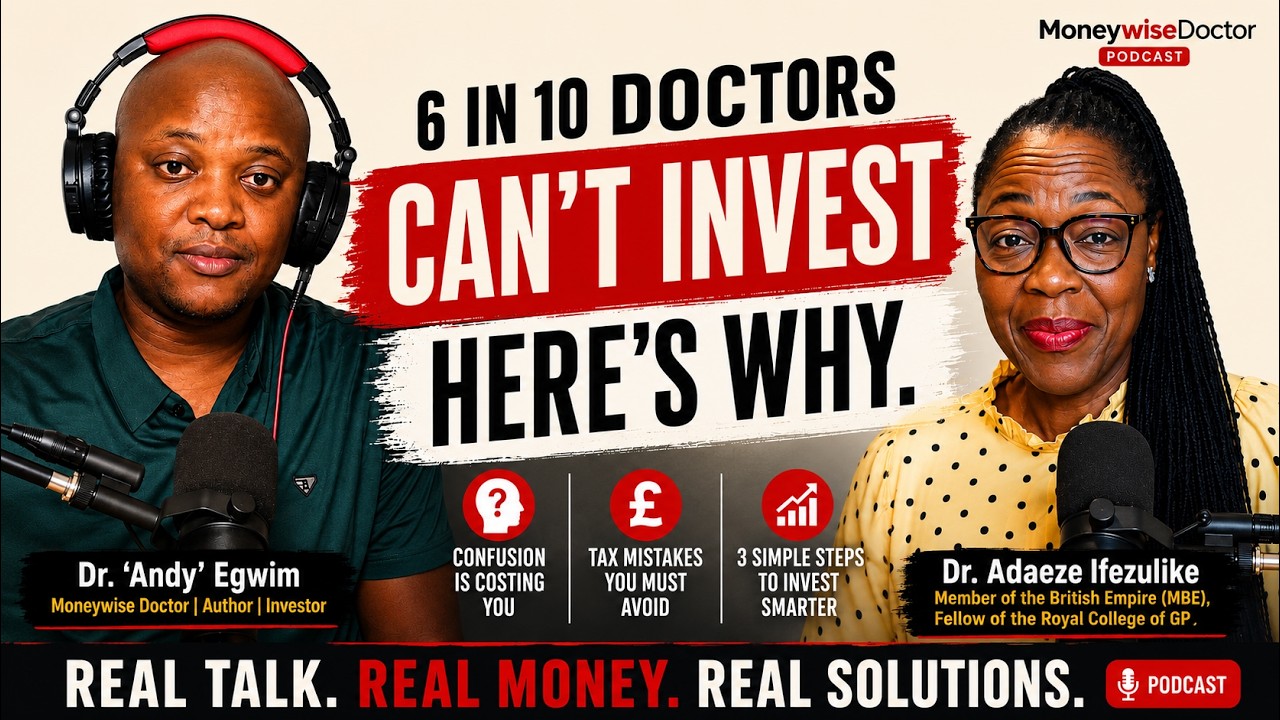
Dr Adaeze Ifezulike, a GP and MBE, discusses why UK doctors struggle with money despite high incomes. A survey of 1,500 doctors found 71% fear inadequate retirement savings and nearly 60% avoid stocks and bonds entirely. She shares how seeing a colleague buy a house in cash sparked her own financial wake-up call.
Chapters
It, it was really a wake-up call for anyone still sitting on the fence concerning their finances. If you're the type that is feeling like you're working so hard but still not making ends meet, never at peace with your finances, then this is your wake-up call to do something about that. Long story short, I ended up getting that MBE from the Queen. It was, it was a huge honor.
About 71% of doctors In our financial health survey at Moneywise Doctor, over 1,500 doctors, 71% are afraid they won't have enough to retire when they get to their mid-60s. Then if you dig in a little bit, you see that you have a very high number saving, over 70% are actually saving money, but less than 60% don't invest at all in stocks or bonds or alternatives. So you see that actually there's a gap between what you know you should be doing and then the next step.
I, I was fortunate fortunate enough to come across my colleague, one of my colleagues. And what had happened was he had bought a house. So I went and the house was so big and lovely, and I'm like, oh, this is a massive house. Hi. You know, I was just like, mortgage-wise, how are you going to cope? And all that. And he said he paid cash for the house.
Okay.
And I was in a state of shock. So I'm like, no, we—
what, are we doing the same job?
I said we work together. I want to know how you were able to pay cash for this house.
So Dr. Deise Ifezulike, MBE member, or actually Fellow of the Royal College of GEP and a member of the British Empire, author, and then author of multiple books, and then speaker. I'm delighted to have had you on my podcast. So if someone were just tuning in and they wanted to know what are they going to get from listening to this podcast, what would you share? What did we talk about?
Uh, one of the main things we covered was it, it was really a wake-up call for anyone still sitting on the fence concerning their finances. If you're the type that is feeling like you're working so hard but still not making ends meet, never at peace with your finances, then this is your wake-up call to do something about that. We spoke about investing, we spoke about the 60% trap, especially for senior colleagues, you know, highly placed doctors. We talked about people coming in newly to the country, where they should start with concerning their finances. I shared a bit of my background as well, which hopefully some people will find inspiring and helpful. And we talked about the importance of coaching, having someone else who has gone through the journey to hold your hand.
Wow, I can't wait to jump into this podcast myself, even haven't been there. And one more thing, we mention about the Insulin Reset, your book coming out, that will— that obviously I've, I've read the draft and I think anyone who is thinking about healthier features, not just for themselves, might be buying the book and giving to other people. Talked about that as well. So delighted to have had you in the podcast. Right, so welcome back to the MoneyWise Doctor podcast. I've got a special guest in the studio today. I'm And when I say special, she's really special. I've got Dr. Adese Ifezulike, who is a GP partner based in Scotland. But other than just being a GP partner, she's also quite a few things. She's a 5-time author. She's written books ranging from children's books to lifestyle books, and she has another book on the way. Dr. Adese is also a Member of the British Empire. So before the late Queen died, she actually met and she became a Member of the British Empire due to her contributions to her community. More interestingly, she has been on a journey of her own on her personal finance, looking at improving her personal finance. And I've been honored to have her in my financial coaching program as part of my mastermind members. So delighted to have you here, Dr. Adaeze.
Thank you. It's lovely to be here. And I'm looking forward to a very interesting discussion.
Oh, it's going to be very interesting. You're not new to cameras. You're not new to microphones. I've been— you've been on camera. You've been— yeah. I know, I know, I'm going to conference where you're going to be a keynote speaker. I'm one of the facilitators in that conference as well. Yes, but, um, this is your first time on the Moneywise Doctor podcast and delighted to have you. If someone were to jump in at this moment listening, how would you describe yourself? If they didn't know you, they didn't get the introduction, how would you describe yourself?
Um, well, I, I guess I'm someone who has many aspects. But basically, I'm a mother of 3 kids, and I've got a husband, um, a doctor, a GP. I'm based in Aberdeen, Scotland. We've been here for about 20, 25 years now, so a long time. Yeah, uh, originally from Nigeria. Yes. So I, I do many stuff, but I'm sure we'll talk about all that on the podcast.
Interesting. I, I think I told you this once when we chatted, that my mom watches your YouTube channel and then says, oh yes, you know, Dr. Ndubuisi 'Andy' said we should do this for managing health, absorption, all that. Exactly. That's the power of content you put out there. You don't know who you're impacting. Like when I wrote The Moneywise Doctor, I thought I wrote it for doctors. Then I started getting feedback from engineers, lawyers, different people. And I've once been to a climbing center and someone said, oh, I read your book, but you call it Moneywise Doctor. It was useful for me. I'm not even a doctor. I'm like, okay. So that's the power of the content they're putting in there. My mom doesn't even live in the UK. Right. So that's brilliant. And then basically you have been on this journey, you've been in the UK for 25 years, but prior to coming to the UK, you were already a doctor. Yeah. Right. So, and you know, as part of what we discuss on Moneywise Doctors, doctors' finances and all that. And so I'm quite interested, we know you now as Dr. Ndubuisi 'Andy' and with everything you do, I mean, someone might think you're a fitness influencer. That's one thing you didn't mention. Oh, that's true. And you're doing food stuff and all that. So, so which is very interesting, but if someone were to look back, what was your sort of like your, your background before you came to the UK and all that? Have you always been sort of someone that does a lot of things? Have you always been looking at your finances and looking at making an impact and all that? How did the journey start?
Well, I don't think my story can be complete without mentioning my dad. My dad was a huge influence in my life. So, um, my dad was a public health physician, so he was a medical doctor. Yes. So as far back as I remember, there was always this healthy lifestyle thing, you know, in the family. And it actually had to do with his own father. So my granddad, who was diabetic, and in those days people didn't really understand the illness. They just knew me and there's sugar problem, you know? So it was all, it was really badly managed and eventually he died from complications. So that had to do with the diabetes. But it brought that awareness to the family that, right, we have this, we— so we all need to make sure we are, you know, engaging in healthy lifestyle to make sure this doesn't come to anyone else again. So my father became a doctor, uh, he was really into, you know, lifestyle change. He was quite sporty himself until much later when he got older, but He could play hockey, he could play lots of sports, he was very active. And he had this radio program. In those days, it was mainly radio, isn't it? You know, how— where he will talk about health and lifestyle and all that. So I came from that background of hearing about, you know, healthy lifestyle. And as a child, my dad, there was always that emphasis of wash your hands, close the door, malaria, this one, you know, so There was a lot of that. And as far back as then, when they're talking about soya beans, you know, the powers of that and all that, we were already being fed soya milk and we hated it, you know.
I can imagine.
Absolutely hated it.
I wasn't a fan myself of soya milk.
Only to now find out later in life that soya milk is this sort of, um, you know, one of those powerful food and all that. But these were things we grew up on which we didn't even like, you know. So we had that background, lots of vegetables and meals and emphasis on your health, your health, your health. So that's my background really. So it's not complete without mentioning him. He was a huge influence on my life, you know.
So what a, what a, what a fitting way, seeing that yesterday was Father's Day. I mean, over the weekend, right? Absolutely. Yeah. Before you make any investment decision this tax Start by understanding exactly where you currently stand. Most doctors have never had a proper financial health check, not because they're not interested, but because nobody had ever designed a tool that helps to make sense for the specific complexity of doctor's financial life. So I made one. It's called the MedScan Financial Health Score. So it takes about 3 minutes. It helps you to look at your overall financial position across 7 key areas, including tax efficiency, pension, investing, debt management, and financial protection. It gives you a clear score, a breakdown of exactly where you are, where the gaps are, and it's completely free. Takes 3 minutes. If you head over to moneywise.com/medscan, or you can check the link in the description to get it. It's 3 minutes, real clarity, free. Yeah, what a beautiful acknowledgement. I mean, nobody we can have to speak, um, you know, Fadas financial conference or the guest speaker somewhere, and we're talking about the impact fathers could have. You weren't saying my dad, I'm sure he was a provider, but what you remember was not that he paid your school fees. What you remember is how he— the influence of how he set you on this trajectory. This is really, really powerful looking at that, um, from that background. Okay, that's a very interesting way to start off. So basically now, after you You obviously were influenced by your dad. If you're talking about being a public health physician back then, I think it was quite a while, uh, people didn't really even know what public health physicians did in the first place. So that means you must have been quite a pioneer. Yeah. In public health in Nigeria. So that influenced your own journey and, um, you ended up as a doctor. You trained in, and, um, did you go to University of Nigeria?
Yes. So I went to UN, UNEC, University of Nigeria, and—
Greetings, Lions and Lionesses.
Yes, I'm a Lioness. Very proud. Proud to be one.
I'm a proud alumni myself. So you went to UNN and you finished as a doctor, but now you, you are a GP, but you've ended up in public health. Yeah. So your work in public health and you're not quite public health, I'll say lifestyle medicine. And so your work is already out there. I looked on your LinkedIn profile and if you're, if you're listening to this podcast, go and check out Dr. Ades on LinkedIn. And one of the things I saw there on your profile was the, the picture of the Queen. So her portrait, our late Queen Elizabeth II, from the royal family, says Dr. Adaeze Ifeazudike was awarded an MBE for services to health inequalities and Scottish BAME. So growing up as a little girl in Nigeria and going to medical school, did you ever imagine you were going to get that kind of like, um, high honor?
No idea. If someone had told me, I would never have believed it, you know, because it to me it seemed like something people, you know, I, I just didn't see it coming, to be honest, you know. So with the background I had from my dad, I went into prevention and public. So coming to UK and seeing so many of our people overweight and struggling with diabetes, hypertension, I just started talking about these things. I would book a hall invite people to come, I'll even feed them. Let's talk about your blood pressure. Let's talk about that. You know, it was just this burning desire in my heart to, you know, sort of sound the alarm. Look at what's happening. You've got to look at your health. All this money we are chasing is good, but you have to be in good health to enjoy money, isn't it?
You know, absolutely.
I was doing all that without even realizing there was something about Onas. I had never heard about it at all. So it practically came out of the blue. It was just a friend saying, oh, Dr. Ateh, all this work you're doing, you deserve an honor. I'm like, what are you talking about? I had never heard about it. Anyway, long story short, I ended up getting that MBE from the Queen. It was a huge honor. And my only regret is that my dad, you know, had passed on 3 years before that. So he didn't live to see that happen. Would have been very proud, you know, very proud.
I'm sure that he would have— yeah, if he's in heaven or wherever he is, I'm sure he, he wouldn't be too surprised, but he'd be very proud because he would have seen the trajectory you were going. And the thing about like doing this kind of work is that you don't know who you're impacting. You probably impact people, but you don't see the chain reaction. Someone sent me a message to say, oh, what you're doing is impacting multiple generations. Someone in the mastermind basically I didn't share that, felt a bit emotional. Maybe one day we'll share that testimonial. So it's breaking from the chains of poverty for many generations, for some of people from our community. And I thought, well, I've just thought we're doing this. You can see one person when you are booking out the hall, you might have about 50 people there, but that the chain reaction might be 50,000 people going from one direction to another. But you brought up a topic. So you said all this money we're chasing. So it's about being healthy enough to be enjoying it. Okay. This is really important because health is wealth. I mean, that's literally my first name, Ndubuisi 'Andy' Egwim. You have to be alive to even do anything. So health, everyone knows Andy now, but the original Ndubuisi, health is wealth. And I kind of like realize a lot of times when we talk about finances, the first thing they think about is how can I make more? Not really about financial wellbeing, how can I make sure that even the one I'm making is not leaking through different avenues? How can I make sure that I can sleep well at night, not worried about financial anxiety? And that includes not making— it's not just about making investments, but making investments that you're always panicking. Yeah. And that also includes not being in deep debt. So basically you talk a little bit about wellbeing. What has been your experience in terms of financial wellbeing and financial growth? I know your dad was a doctor, so I'm sure you guys weren't starving, but he was also not the richest man in the community, I would imagine.
Yeah. I mean, when you have 8 children, that's quite a few. How wealthy you are, it sort of has an impact, isn't it?
Many mouths to feed.
And then, then the extended family as well.
So yes, because a doctor and everyone would think, yeah, as a doctor, everyone would think, oh, he's wealthy. So he has 8 children.
Exactly. Yeah. So let me just start by appreciating the great work you do. You know, I think this is— it's amazing what you do. And I'm not surprised the impact you're making because everyone who has interacted with you can see the passion and the desire you have to help people get a hold of their finances. So, yeah, it's wonderful. And I'm really glad I came across you. Because that has helped my journey as well. So I thank you for all you do.
Thank you so much.
So I already was doing some investing before we met, but I would say I was maybe doing it in a sort of, uh, unconscious, you know, without a clear plan. Let me put it that way.
Haphazard.
Exactly. I knew I had to invest, I knew I should be, but I didn't have a plan, which is what you helped me to, um, navigate, you know. So, um, I think from my background there wasn't much in terms of investing. Obviously my dad was medical, my mom is a nurse, she's retired now. So historically medical people don't know much about investing in, you know, that sort of the way we now know about it here. So I didn't have much about those sort of trainings around investing. I know my dad did a lot, so, you know, he bought houses and things. So that was the idea of— yes, which was— which worked for them, which is fine. So I knew I had to put aside things. I had played the Monopoly game with my kids. So one of the things my daughter keeps saying is, Mom, remember that bus driver who had more money than the doctor? And I'm thinking, yes, because I didn't have a lot of expenses.
Wise girl.
Exactly. So, but the doctor had all these lifestyle expenses, you know. So I sort of began to see that, read books like Rich Dad Poor Dad. And there was another one, The Millionaire Next Door, and so on. Some of those books were really an eye-opener for me. So I knew I had to be doing something, but you can know but not know, if you see what I mean.
I get you. So it's just like you, you talk a lot about healthy living, and your book coming out is about, um, the insulin, you know, sort of like the insulin effect, the impact of insulin, people trying to lose weight. This is something common if you, if you're diabetic or pre-diabetic or from a family who someone is diabetic, you already know this. People trying to lose weight is not working. So people might know, oh, I need to get healthy I need to get fit, but there's no clear strategy. There's no clear approach, and we don't know what we don't know. So what usually happens is that you spend time running around doing stuff and not achieving any real impact. And sometimes that could actually lead to even problems. So it's the same thing when it comes to finances. Like, some people know that they need to, especially doctors. We're kind of like busy. Doctors are intelligent. We are busy. We work hard. But you just wonder why There's so many doctors, I think it's about 71% or thereabout. I can't remember the exact figures of doctors in our financial health survey at Moneywise Doctor, over 1,500 doctors. 71% are afraid they won't have enough to retire when they get to their mid-60s, 65 and all that. And, um, you, you see a very high number, I think about 68% as well, are worried about their financial position relative to their age. Then if you dig in a little bit, you see that you have a very high number saving, over 70% are actually saving money, but less than 60%, um, I think the number was 59%, don't invest at all in stocks or bonds or alternatives. So you see that actually there's a gap between what you know you should be doing and then the next step. So basically for you interested How did you navigate that? Because you've been in the UK, you started obviously saving. I know because we've had a bit of a chat, but you've been saving and all that. What was your financial strategy so far, apart from working really hard and writing lovely books?
Well, um, so I was fortunate enough to come across my colleague, one of my colleagues, And what had happened was he had bought a house, you know, and so I went to visit him, you know, just where we're really good friends and his wife had a baby. So I went and the house was so big and lovely and I'm like, oh, this is a massive house. Hi. You know, I was just like, mortgage-wise, how are you going to cope and all that? And he said he paid cash for the house.
Okay.
And I was in a state of shock. So I'm like, hold on, we work—
Are we doing the same job?
I said, we work together, I want to know how you were able to pay cash for this house, you know. So that's when he, he then told me about ISAs, and surprisingly, I hadn't even known about ISAs. I've heard it, but I didn't know what it meant, you know. So he said, oh, he's been saving, you know, putting money, investing through his ISA account, you know. So when it was time to buy a house, he practically just sold everything and paid for the house. And I'm like, what is this? What is this ISA? Tell me a bit more. So he actually held my hand. I opened an account, you know, and said, okay, we put in some money here and invest in— let's say, you know, he helped me set it up. So that's why I'm saying I knew I had to do something, but I don't— I didn't know the sort of nitty-gritty of the— so he helped me set it up. And so that was my first introduction to ISAs. Just by, you know, coming across a colleague and asking questions. And that's one thing people don't do, you know. Supposing I went away that day and I'm thinking in my heart, see, see, this man is sorry. Welcome, we're all doctors, what's happening now? But I asked, I opened my mouth. And, and, you know, as you were mentioning those figures about your survey, I felt a bit sad because a lot of people are on the other side because they don't have the right information and roadmap. And it's the same with health. You know, there's so many people who are struggling with illnesses they have no business struggling with, but because of that lack of information and a clear plan how to tackle things, you know, it's the same thing with money. So that was my journey. So I had the— I got the ISA account and then started putting in something in it. Even without fully realizing what it was about. And so, and then I came across you.
Yeah.
Yes. Yes. I'm trying to remember how I got to know you. I think, was I seeing you on LinkedIn? Maybe. I'm thinking, hmm.
If I recall, yeah, you were seeing me on LinkedIn because you first messaged me on LinkedIn. And then you saw that I'd messaged you like maybe 10 years ago when I was new in UK. Yes, yes, because then you wrote a book about being a doctor in the UK.
Yes, coming to me or something.
Yeah, and then you, you invited me to speak at your Royal College of GP event, and, and since then, until the day you slipped into my inbox and booked my one-to-one session and then joined my full mastermind. And it's like yesterday, but 6 months has already gone by so quickly.
That's true.
This is really interesting because there are a few things I'm seeing from what you're saying. One, you had your colleague, you went to visit them and you saw, oh, this is where they are. Rather than saying, oh, I'm sure they're doing something else. Oh, who knows, they inherited money. You just went ahead and asked them, look, tell me what's going on here. Look, is it not the same job we're doing? How did you make it funny? And two, you didn't need to have I mean, obviously I know you, I know that you are the kind of person that will learn wherever there is an opportunity to learn. There's no ego, ego there. Um, but you didn't want to say, oh, I don't want him to think that I don't know this stuff because that is also where a lot of doctors struggle. They feel like, oh, I'm a really senior doctor now. I'm a GP, I'm a consultant, so I should know this and I don't want to appear. Because you see this happen in the community, right?
Life, things that you know about.
Exactly.
I'm a learner. I'm a lifelong learner.
You're a lifelong learner.
I want to learn. I will learn. I will ask questions.
You ask questions. Yeah, we say, you say in Igbo language, no yajuja de fusa. Yeah. And if you are listening, I don't understand Igbo, maybe you can help, we can help you in the comments. So if you ask questions, you don't get lost. Okay. And the third thing, which is the most important part, that's the missing link where many people miss out because got like over 800 videos on YouTube. I've run like 24 masterclasses for free. I've had all these doctors attend and sometimes they, after 2, 3 years, you see that, oh, this person has been chatting me about the same thing. They haven't done anything. In your own case, you took a step, you took an action. You didn't wait till you had all the information in the world, but at least you started the account, you started investing. And then now obviously I can fairly say that you have a good mastery of investing. I will say that. I mean, you're not going to run a hedge fund or manage people's money, but when it comes to your own investing, from my interactions, I'll say that you've learnt enough having gone through our whole Investing Academy. But the question I wanted to ask you in particular was how long had you been in UK before that conversation about ISA, before finding out that, oh, there was even something about—
Yeah, I had probably been here 17, 18 years, you know, so quite a sizable amount of time. And that's the sad thing. You can actually be here, so, you know, all your life and not understand the financial landscape, which is so sad. And then people look back, they're like, this person was in the UK for 35 years, still struggling. How can that be when everything is available, you know? And that's where you step in. You're able to connect people, help people connect the dots.
Connect the dots.
The fact that they are earning so much and yet they still seem to not have— it's— there's something wrong if you, especially as doctors, because we always have some reasonable salary, you know. So there's no reason why every doctor should not, you know, have some good savings, good investments going on, and, and not be afraid of retiring, you understand. It's just that missing link. And that's where you as Moneywise Doctor has come in to fill a really important gap that has been there, you know. So I was already in the country for many years before I came across you.
This is, this is really crucial, right? That, that bit of connecting the dots, because lots of times when we share some of these insights, and I've spoken a few medical conferences, I find out that the more senior doctors seem to be hit harder than, you know, sort of brand new doctors, because brand new doctors realize, oh, I don't know, I don't really know what I don't know. So they are— if there's a seminar or something, they're interested. If there's a YouTube video, they're like, oh. But someone who's been in the country for a long time might feel, I already know those things, like, why are you gonna tell me about ISA or pension or investing or saving? You know, and we find out a lot of time you see doctors who have fallen deep into the 60% tax trap In your case, you were one of the people that reviewed my book for me before it went live. Remember, The Moneywise Doctor, when I was still the first draft? So you did a review for me, and I remember that was how you booked the session with me. After reviewing, you thought, I think I've fallen into this 60% tax trap you're talking about. Do you remember that statement? How did that make you feel?
Yeah, absolutely. Yeah, I, I realized that there that there was something I was missing. Yes, my colleague has started me on the journey, but there were still bits I was missing. So, um, and, and you're so right, the senior doctors sometimes struggle. I mean, my husband is a pathologist, so he, when he became a consultant, I was like, I'm earning less money. He couldn't understand how he said he was still, he was earning less, you know, how could that be? But you see, having come to your program and I've understood about the 60% trap and what one can do around that, honestly, that is a game changer. And that's why I was saying, I think I must have mentioned it to you, that anyone, any doctor who comes to the UK, you know, should really either watch your videos or book a session with— you know, we need to start right. I really want the junior doctor, our younger colleagues, to start on the right path, hit the ground running. Because if I had done it that way, honestly, it— you— things would have been so much better for me. But because I did so long, maybe you'd have retired by now. Exactly, like, I would have retired, you know. So yeah, I really think, uh, what you— what you do, it's something every— every of our younger colleagues and the senior ones, you have to be willing to learn. If you found that you're working so and things are still not working, you have to stop and ask yourself, what am I missing?
Yeah.
And then life is usually just with everything, really. Even with health, it's just something missing that you haven't got. And that's why my book, you know, I struggled so hard not to write that book because I actually— but there are maybe a lot of books on weight management and so on. But we're still having— we're still having an epidemic of obesity. To. So I'm like, there's a missing link, you know. There's something I can teach people. I can help them see the light, just like Andy has done for me, you know. So life is about getting the right information and having someone compassionate enough and patient. You're very patient when you work with clients.
I remind my wife about that. I'm a patient man.
I don't know if you're patient with her, but that's—
I'm sure she will confirm that. It's just Father's Day, so she— yeah, I got a few Father's Day notes.
Yeah, good, good.
That is such— that is such a good point, and it's high, high praise coming from Dr. Adaeze Ifezilike, MBE, MRCGP, and many other things. Um, but what, what I pulled out from what you said now, for anyone listening, is that information is already there. You said, like, for instance, in your case, you're writing a book. You kept telling yourself information is already there. Like I've read like maybe 500 personal finance books, history of entrepreneurship. So why would I want to write a new book? Like why? I kept battling with that for many years. I was the guy back in med school who teach my consultant how to invest. So I started investing at 19. So I'm not new to personal finance. I said, rather write a book, I write a blog. But then you get to the next point that information content is everywhere, but context. Is golden. So I'm very much looking forward to your book. Why? Because the information— I'm a doctor, you're a doctor, we can get all the research, but there's a context. Basically, I'm looking at you not just as a woman of color, but you've lived in the UK, you've moved from Nigeria to the UK, and you know what it's like to move to a different place. I saw one of your videos, you were back home, you were visiting, you were eating fresh food, and you were so happy. You were just talking about— so the food is obviously quite different. So there's so much that is in context. That's why we want to hear your voice. The world, if anyone listening, if there's something you've been planning to do and you think, oh, why another book? So when I wrote The Moneywise Doctor, the context was I'm a doctor, I'm writing this for doctors. I've been investing and lots of tax efficiency problems I've seen with doctors. And by then I'd already done quite a few masterclasses and all that. So I knew the key issues like NHS pension versus SIP and all this kind of stuff. One thing I didn't see coming was that this book was going to go and become a bestseller in UK, not just for doctors, it was a bestseller on investing, personal finance, and money management, retirement plan, at least for a brief period. Um, so that sort of speaks to context and that's why I'm looking forward to your book. So let's talk a little bit about your book. Okay, so what was the name of the book?
So the book, the name is Insulin Reset.
Insulin Reset. Okay, you said insulin. Okay, and what was that, the title? What was the subtitle? Because subtitle always tells us a little bit more.
The Insulin Reset, it's around how to help you, um, I don't remember it offhand.
It's okay, it's okay. Like the Moneywise Doctor, we kept like, there were quite a few, we said the Moneywise Doctor. I made this Guide to Financial Freedom, Invest Smarter, Optimise Tax. Before then, we had like 10 different ones. They were like, oh, how to do it. For instance, now if we do it live, I'm sure someone in the audience, if you are listening to this, can you suggest the subtitle for Dr. Dezza's book? Maybe she will see it before the book goes live. So you can say The Insulin Reset: Why You Are Not Losing Weight Despite Working Hard and Eating Right.
It's the 14-day guide to—
oh, there's a 14-day guide.
The 14-day— in fact, one of the people I gave to review said they printed out the guide and put it on their fridge.
Why not make use of the opportunity? 14-day guide. So that means it's not something that requires a couple of years, it's not all 2 or 3 years.
No, no, no, no, no, no, no. It's about information, isn't it, that works for you, that is practical and something you can hit the ground running with.
Working harder without plugging your tax holes is like putting gold coins coins in a pocket with holes. It will disappear very fast. I've read over 250 books on personal finance and business. Not one of them explains specific issues that affect medics like NHS pensions, financial anxiety, investing, student loans, and much more. Hi, I'm Dr. Andy Egwim. I'm the founder of moneywise-doctor.com. For over 21 years, I've been investing and studying personal finance. In fact, 3 years ago, I left my salary NHS GP job after achieving financial independence. Since then, over 1,200 medics have joined our tax-efficient investing masterclasses that are totally free. And much more than that, 10,000 doctors and healthcare professionals have used my content to make smarter financial decisions and avoid costly mistakes. That's why I wrote The MoneyWise Doctor. The MoneyWise Doctor is a step-by-step guide, the book to simplify the path for Confusion to Clarity for Medics, and to help you make smarter financial decisions and avoid costly mistakes that can affect your future. We've already helped thousands of doctors learn how to save smarter, invest tax efficiently, and finally feel in control, in charge of their financial future. Now, if you're ready to gain clarity, confidence, and control with your money, the MoneyWise Doctor Book is now available.
Click on the link below to order your copy now and start your journey to Financial Freedom.
So essentially, the book is to help people understand how— a bit more about how the body works, the hormonal basis for, you know, things like your weight gain, you know, what happens when you eat and what determines whether that thing you're eating is just stored away as fat, you know, or burns as energy. Yeah, you understand. So helping people understand that, and I've used some case studies to explain what each patient was doing, why it wasn't working, and the change they made that worked. You know, I've talked about— in the book I talk about fruits. People worry about, should I be eating fruits? I've heard fruits add sugar. You know, there's a lot of confusion. There's confusion around carbohydrates. So I've addressed how to eat carbohydrates in a way that doesn't affect the blood sugar as much, you know. We talked about smoothies, you know, people often just blend fruits together because they feel it's healthy and they're drinking, or it's actually a massive load of sugar to your system. So we can eat fruits, but it has to be done in a way that supports your system. Yeah. And explaining about the insulin, so one of the people that reviewed my book said she's been hearing about insulin, but they didn't understand what it was. So I've explained that because for you to lose weight, your insulin level has to come down.
Yes, insulin level have to come down.
The insulin inhibits weight loss, you see. So we have to eat in the— of course we have to eat, we are human beings. I enjoy food, I'm sure other people do too. But how can you eat in a way that ensures that you're not walking around with high levels of insulin, which is what we call insulin resistance. There's so much insulin resistance now, and we know it affects your health. You know, it's being found to be behind things like high blood pressure, diabetes, and so on. Polycystic ovarian syndrome. So we do need to work, you know, bring the insulin down, stop that resistance so the body can function well.
You see, this is a mark of a true expert because you, you weren't aware that we're going to be going into your book. I'm sure that's probably why you didn't have like, um, sort of a detail, um, like the details of the subtitle. But I can see the passion and sort of like when I teach about personal finance, you can see I don't need to prepare, but I can see you've already delivered a mini masterclass about the impact of insulin. And you've mentioned PCOS, which obviously is now a polyendocrine metabolic ovarian syndrome, PMOS. It all links to insulin. That is fantastic.
But it's also good because once you get it and you can tackle it, all the other conditions just, you know, improve because they are linked.
So they are all linked by using one stone to just kill multiple birds.
It's fantastic.
Yeah, if you're a bird lover, I will apologize, but it's just a figure of speech, right? Before I let you go, just because I know you're a woman of many hearts and You obviously want to go eat breakfast. But instead, um, yeah, in case for someone listening, it's 3 PM and Ada is just about to have her breakfast. Maybe she will tell us the reason for that in her book. I'm looking forward to getting that book.
And then we covered fasting too because it's really interesting. Yeah, fasting.
Yeah, right.
Um, we're going to link the book whenever it comes out. We can link it to this podcast and so that you can go and check it out, get a copy. For me, I sort of buy books. I have no limit, no budget for books. Like, there's no limit. If I need to buy something, learn something, training, coaching— this year my budget for like education and coaching for myself is over £30,000, like already committed, and this is half of the year gone.
For, for what I want, I will pay and get the information. That's why I want to—
exactly, you came to my mastermind, which is a considerable investment. It's not something you just wake up and walked in. And then I like to hear that when I got the feedback that you feel that it was worth far more than what you paid, it makes me very happy. Right, okay. What I want to get from you is now let's say you're listening to your younger self, um, or your younger self was listening to you, that, um, young, um, girl that moved from Nigeria to the UK, um, 25 years ago. Was that 25 years ago? Thereabouts. So we're talking, this is 2025, so we're talking about like around the year 2000, um, was that '99 or 2000? Yeah. So you moved to the UK. If you were to go back and you have like some advice to give, just think about like what would be the 3 key things. For instance, you've already said for someone trying to lose weight, your insulin has to come down. We've gotten that bit. It's very clear. Okay, so they know this is what I need to focus on. Now, if you are to give some financial advice to Adeze from the year 2000, exactly, what are the 3 things you ask them to focus on?
Yeah, so the first thing I would say is start putting something aside, no matter how little. Don't wait till the money is a lot. And that's what I say to people I mentor. I have a guy who came into Nigeria 2 years ago. You know, still looking for a job, but makes hair and does things, you know, he's very hardworking. I said, I know you haven't got a proper job, but you have to start putting something aside. So I'll say to my junior self, you have to open an iStar account and put something, no matter how small, £50 every month, put something. Because when it comes to money matters, timing is important. You know, doing it over a long period is so important. So start on time, I would say. Yeah, don't wait till everything is perfect. Because one of the things I— my— well, I'll say a mistake is that because my children were in private schooling, so we're paying private school fees. So that was our whole focus. So we sort of said, let's do that and then do this. Yeah, both at the same time, you understand?
Exactly.
When I look back, I'm like, we could have just started then and not wait to finish one project. And yeah, it's the consistency that matters, that, that little you're putting aside. So I would say make sure you have an ISA account, start putting something no matter how little, and don't ever touch it. I said to my— I hope you haven't touched your ISA. Whatever goes in stays there. And then have a plan for black Pax, you know, because that's a big thing, a very important—
I feel like we should have a whole discussion on that. Yeah. Okay, tell me about that plan for Black Pax.
I understand how, of course, we sometimes we are called on to support those back home, and sometimes you're where you are because some of those back home helped you to get here, to get to it. Expectation that you support, that you help people back home, that's fine. But have a think about how much you're supporting them and then make a plan. Let it be part of your expenses and break it down into 12 months so that you know that every month this is your black tax, the amount you're willing to stick to. Because what often happens is that people don't make a plan and there suddenly is a need back home, and because you haven't planned for it, you carry your savings and give them and then you feel bad. You have no rainy day savings. You, you know, it, it, it pains you because you hadn't planned for it. So have a plan for your black tax that every month this is it, and you're not going beyond that. Stick to the amount you have put. Make sure you have a plan, and that will work out. So those are things I'll say to my younger self. I'll definitely be recommending a money coach like yourself you know, if someone doesn't know where to start from, someone is new to the country, because it's, it's a completely different system, isn't it?
Yeah.
If you go to a new system, you have to understand the system. Yeah. But some people just carry that mentality from back home and come. You have to buy a house. Nothing wrong with buying a house, but you, you don't have any rainy day funds, you know. You have no eyesight, you're not putting anything, and you're looking for house like it's the only savior. There's more to it and you might need coaching. I believe in coaching to get the right, to be on the right track.
Wow. Lots of wisdom. These are nuggets for Adagene, if you're listening. Obviously I usually tease you that, yeah, you don't look anything like your age. I just tease you about that. But Adagene, if you were to go back 25 years and you're listening, this is for you. And I think it's not just for someone new in the UK as well. Like you said, you were ndubuisi, almost 20 years before you found out about tax-efficient accounts. Like, we're talking about ISA. For some people, ISA may not be the right place to start. It might be like your personal pension, especially if you're a senior doctor, you have fallen into the 6% tax gap. So basically, understand, I think one of my biggest regrets is I started investing at 19, I started my first business at 22, but I didn't start sort of like hiring coaches and paying for coaching till I was like my mid-30s, like late 30s, like almost after I've achieved financial freedom. I thought I could have gotten there faster because I'll give you an example. You have a coach who has already built a business, the type of business you're building, they've done it for 15 years, they have 6 children. Like my coach is there somewhere in Australia, has 6 children, one of them has additional needs, somehow has managed to do that and still have a global space and stage. You know, people know that he's number one in this area. So I'm not— I don't need him to teach me how to create money. So I want to teach, understand how not to go crazy or lose the balance or lose your family while you're doing all that. The same way someone who is trying to get fit, look well, like you, you're doing so many things. You're a mom, you have 3 lovely children who are doing quite well. So that money in the private school was a good investment. Differently. You just have something by the side. Yeah, I get where you're coming from. So that's number one, basically get the right information, get the right context to start putting something aside. I mean, I opened my first help to buy ISA when I was a master student, University of Nottingham, zero income, just opened this. And when I get a little bit of money from side hustles, I put in to £200 every month. And I bought my first house, my first tin in the NHS, and that was in Cornwall. So it wasn't cheap. And then got married the next month and then brought my wife the month after that. So just being able to put something aside, it might look small, but long-term compounding needs time. So this is so powerful, so wonderful nuggets. Thank you for sharing all those with me. And one final thing, one mistake, if you were to say to say to someone, what was one mistake that if you look back, it's very common you're seeing people making that mistake in terms of their finances that stressed them out? You know, I know you mentioned black tax and I quite like the framework we call AMAS. You just budget everything and have like a system in place and that every now and then something might depart from the budget, but it should not be that every time you're running around, you're panicking. But if you want to say to someone, okay, this one mistake, financial mistake out of everything, is one big financial mistake I've seen people make, whether it's doctors or other people you've coached and all that you've been supporting. What would you, what would you suggest?
Well, so I think one of the key things is to not shy away from, um, shares, making investments because you feel it's something you don't understand. You have to, you know, look into it and invest. Very, very important. I remember hearing this story of a multi-millionaire talking about when he was small and his grandma had taken him to McDonald's. So what's McDonald's for him? They were having a nice meal, then grandma said, oh, I see you're really enjoying this. How would you like to be a part owner in this, to own this?
Oh yeah, powerful lesson.
And the boy was like, how will I own— a little boy like 10 years old— how would I own there? And after they finished eating, Grandma took him to a broker's office. And by the time they left, he had a piece of paper. In those days it was paper showing that he was a part owner. That means he has bought some shares in the McDonald's, you understand? And this was him now, many years later, telling the story and saying that that's what started him on the path to wealth. So having shares is simply being a part owner in a company. We have to keep it simple, which I love you for doing, so that people are not scared about it. If you don't know what to do, ask for help, but don't sit back and say, no, I don't want to, you know, because that's part of what— one mistake, what happened to me, because back home in Nigeria, after we became doctors, I remember there was someone talking about shares and things like that. So I remember talking to one of my uncle, a distant relative, and I said, oh, they taught us about shares too. Today and all that. And this person said, ah, shares that you will not get to your, you know, many, many— you know, the way he talks about— actually discouraged me, you understand? Those— imagine talking to a young person, you, you're putting your ideas into me. So for a long time, I shied away from it because of what that person said, you understand? So I'm saying to people, it's a good thing. Find out how to do it and do it. Because it grows your money rather than you just leaving your money in a savings account. It's actually depreciating. Inflation is happening to that money. You have to make it grow, put it into a company, into companies. And thank goodness, like Andy, you've taught us there are, you know, collection of companies. You don't have to put it just in McDonald's. You can put it in 500 companies.
Yes. Or 2000 companies.
Exactly. So it's, please don't go, don't have, don't, don't make that mistake of thinking that shares are something scary, therefore I won't do them. No. Wow.
I feel like, um, I'm, I'm reluctant to let you go, but I'm gonna have to let you go. I suspect we might have to bring you back, probably when your book is out. Um, because there's a lot, a lot of nuggets here. We are just sort of making the best we can within the hour, but You've shared so much wonderful insights in terms of ownership in business. When we invest in companies, I started investing at 19 and thinking 20 years down the line, since one year down the line is hard. Like when you came to the UK 25 years ago, you probably weren't thinking, oh, 25 years, it always feels like, oh, it's far away. But the alternative is the person is no longer alive, right? So when people say, oh, why am I doing this pension stuff? And like I'm going to wait till I'm 60. Like you, I know one of your goals and I'm sure you accomplish it. I don't think you're going to wait till NHS pension. I'm sure you're probably going to, you know, I want to retire early.
That's the plan.
Yes. And you've already— it's not like, like me, I, I didn't leave my salary job 4 years ago and now fold my hands. I'm still busy, got lots of stuff to do. You're writing books, you're speaking in events, you're supporting your family and soon grandchildren, I suspect. So lots of things. Your daughter is going to listen. Your children are going to listen to this podcast.
They will kill me if I say.
Let's stay safe then. I'm far away. I mean, I'm in Devon and Cornwall. You're in Scotland, but so harder to reach. Yes. And so lots of nuggets here, but I know some people might want to follow you to follow you and find out a bit more about what you do and how you're helping a lot of people to get healthy and live better lives. I feel like that is just one aspect of you. Um, we're gonna have to look a little bit more into your personal branding. And you're talking about, um, health. I suspect there'll be people who read your book and say, I want to work with Dr. Adese. I know you haven't got like, you haven't started anything in that direction, but I know I know this from experience because I used to make content, put it out there, like whoever wants it is fine, they can read it. But there are, there are always going to be out of 10,000 doctors, there'll be 1% who said, no, I don't just want content. I want context. Dr. Ades has been on this journey. She's an evidence. Because if you, obviously, if you're obese and you're trying to tell us about these things, we might like, are you really sure?
Is it working?
But you've even, you're an example of like that sort of like total well-being, sort of 360, physical, mental, spiritual, sort of like emotional. That's your MEP. What was that MEP? What was that MEP? Fit person project.
Mentally, emotionally, and physically fit person.
Yeah, yeah, spiritually fit person for you. So basically you have that overall experience. If someone wants to find you or reach out to you, or maybe in the future you decided, like, um, one of the other doctors I showed you, Dr. Ruth Mashen, who was a former radiologist who had been on my podcast. Later, after being on my podcast, she attributed being on my podcast to kickstarting her own journey. Now she's like doing really well, the health coach. So if someone wants to reach you in the future, they want to find you, they might want to work with you or invite you. I know you speak in conferences, or just sort of want to follow your work, where should we go to look for you?
I think the best thing would be YouTube. So I'm on YouTube. If you just type in Dr. Adese Fesulike, my channel should come up. It's MEP Fit Person, but my name, it's my name, so it comes up. Um, so YouTube is one way. The other way is LinkedIn.
Okay.
I try to keep up with LinkedIn when I have the time, you know, but yes, you can, you can reach me through LinkedIn as well.
Yes. I'm looking at your LinkedIn now. I'm sure we'll share that on the post as well. Okay. Yes. And of course, if in the future there's a site or anything, but LinkedIn, if you go to LinkedIn, you can easily send a message to Dr. Deise on LinkedIn. And then there's also YouTube. You have like any email or somewhere? Is there like a landing page? Pretty sure I've seen a page for you before.
I think for now those are the best places, which is for YouTube or LinkedIn.
YouTube or LinkedIn, fantastic. Well, thank you so much for joining us for the podcast, uh, it's been very, very interesting. And then, yeah, thank you. Yes, it's fun. And if you've been watching so far, I want you to tell us in the comments what really stood out for you, or if you've got any questions around personal finance, financial well-being, tax, investing, pension, or you just want to ask about the insulin, you know, research. Yeah, ask in the comments. I will be more than happy to, to answer. All right then, all the best. Bye-bye.







