Most UK Doctors Are Missing This Pension Tax Relief
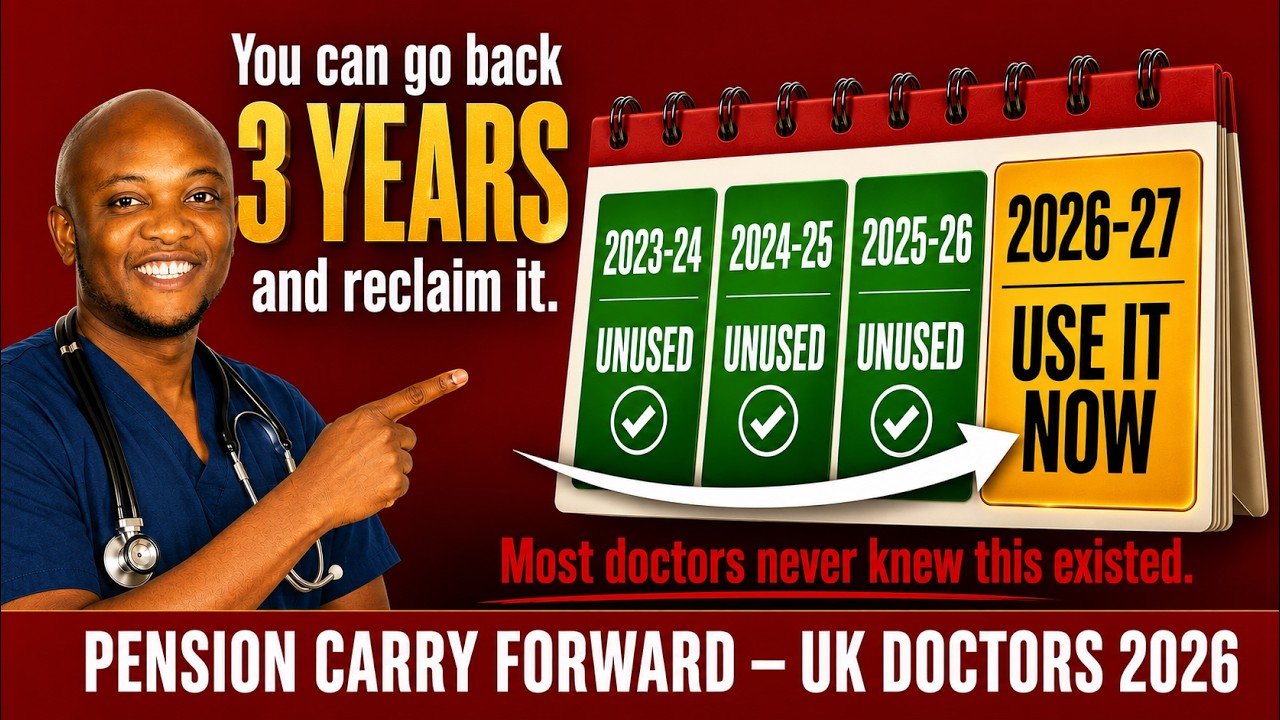
Dr. Andy Egwim explains how UK doctors can reclaim up to 50% of pension contributions through tax relief they're missing. High earners over £260k lose personal allowance and child benefit, but Self-Invested Personal Pensions let you recover relief via HMRC's gross-up and self-assessment. Unused allowance carries forward three years.
Chapters
So £60,000 is the amount you can get into your pension tax-free. If you're currently in the 60% tax trap and you're trying to navigate or maneuver your way out of it, one of the ways you could do that would be to fuck your wife. Many people in the private sector don't realize that people still have defined benefit pensions.
What you get there is what we call pension growth or pension input amount.
Why is it important? I'll show you in a minute. Why does the couple with combined £118K not lose their child benefit? When I said, oh, I used to have NHS pension, he said, oh, you don't look that old. If you're currently in the 60% tax trap and you're trying to navigate or maneuver your way out of it, one of the ways you could do that would be to contribute the excess. A consultant, I think this is a gastroenterologist, where she's just finding that, okay, adjusted net income is around £15,000, so £115,000. And she was about to put £15,000 into her ISA, and she realizes, hmm, hang on a minute, instead of me to put £15,000 into my ISA, as my financial advisor and the random guy on YouTube said I should do, put in an ISA. On the other hand, what she did was to put it in her SIP. So SIP is a Self-Invested Personal Pension. So in that case, she now uses her pension as her primary investing, you know, account. So for a higher rate taxpayer, that does two things for her. She takes the $15K, puts it into her SIP. That brings down her adjusted net income down to $100K. Automatically she gets back all her personal allowance, £12,570, that's back. So she's no longer paying 60% on a portion of her income. That's number one. Now, when she puts in the same £15,000 into her pension, HMRC does something we call grossing up, GROSS. So basically they will refund her the tax that she's paid on that money because she's putting in the money from money that's already been taxed. So basically at the end of the day, she automatically will get 25% net. That's 20% of the money. So what that means is that for the £15K she's put into her SIP, she's going to get another £3,000 on top of it. That's 20%. Sorry, 25%, not £3,000 this time. So that should be around £4,500, I think. Basically 25% of the £15K. And then she goes ahead to get another 25% through Self Assessment. If we use an easier number, which is quick to calculate, use £20,000. Rather than maxing out her ISA with £20,000, she puts it in her pension. Now, when her £20,000 hits her personal pension, remember it's an investing account. Even before she has invested a penny, before she has taken any risk at all with investing, she's going to get back 50% on that fund. Which is amazing. I mean, Warren Buffett, who is one of the guys that influenced my investing journey, he's compounded 26% for many years and he's like a legend. So if you are getting 50% back just by being tax efficient, that's not too bad. And even if you then invest and make another 10%, I don't know how much you make when you invest, obviously depends on your investing approach and your style and skill. But let's say she's just done this 20K in her SIP, she gets another 10K back. Of course, 5,000 will happen automatically on the platform. She doesn't have to do anything to get it. The other 5,000 come through self-assessment. So by doing that, she's killed 3 birds. And again, I usually apologize if you love birds. I haven't found a better saying, but she's killed 3 birds with one stone. One, she's gotten back her entire adjusted net income. That's massive because basically she's dropped her tax level again. From 60% down to around 40%. Secondly, she's contributed money to her SIP and gotten a refund for it. She's gotten a tax refund for it, and then she can still invest that money. So that's really one way to not be leaking money in that direction. So that's at 100K. The next level, which most people don't realize exists— I think there are 3 or 4 people now in my mastermind who were very close is at $260K adjusted net income. Okay, so at $260K, what you lose is your pension allowance. So if you cross $260K adjusted net income, everyone has a pension allowance in this country. That's the amount of money you can put into your pension that you can get tax-free. So you can get tax relief on it. So that means if you put in this money, HMRC will turn the other— they will turn the other way, they'll turn a blind eye, they don't tax you. So everyone has a pension allowance.
If you're a doctor or dentist, here's something I've been thinking about. I don't mind tipping the barrister who gives me a great coffee, or even my barber who is very enthusiastic, as you can see. I'll tip my barrister, I'll tip the waiter at the restaurant. There's one person I definitely don't want to tip, and that's the taxman. Look, I don't want to overpay taxes. I want to pay fair taxes. Look, I'm happy to pay the fair tax I owe, but I never want to overpay taxes. Just because I didn't know any better, or by missing allowances that might eventually cost me thousands of pounds. Unfortunately, that's exactly what happens to thousands of doctors and dentists in the UK every single year. Many UK doctors overpay thousands in taxes without realizing it. Maybe you've fallen into the 60% tax trap, or maybe you're using your ISA allowances without using them properly, or you might even find yourself missing out on pension allowances, or you're missing out on claims on your professional expenses or business expenses through your limited company. If you're not optimizing your limited company, you could be leaving a lot of money on the table. Or maybe your life insurance and assets are not structured properly to avoid overpaying inheritance tax. And the problem is this: no one is going to fix this for you. Not your employer, not HMRC. You have to take charge of your own financial decisions as a doctor or dentist. That's why I've created something simple called the Doctor Tax Efficiency Scorecard. It takes 3 minutes and helps you to see whether you might be missing tax it is, or leaking taxes without knowing it. Now, in case we haven't met, I'm Dr. Andy Egwim. I'm the author of the bestselling book on personal finance, The Money Wise Doctor, and over the last few years, we've helped thousands of doctors and dentists make smarter financial decisions and avoid costly mistakes related to tax, investing, pensions, and overall financial well-being. Look, if you'd like to check the doctor tax efficiency score totally for free, just comment tax and I'll send you the scorecard. I'll send it over to you for free, or click on the link you can see to check it out.
Everyone is allowed £60,000. Previously it was like you could put wherever you wanted. I looked at the history of taxes in the UK, and I think in the '80s at some point, like, directors of oil companies just put a cool million into their pension and get tax relief for it. But was that the Labour government that came in and they had to put like a pension allowance And it just got to the point where it got up to £40K up to 2022, 2023 tax year. The annual pension allowance was £40,000. Um, but in 2020, after 2022, 2023, I think that was in April 2023, it was increased to £60,000. Now these numbers are really crucial and you see them again when we come back. So £60,000 is the amount you can get into your pension tax-free. But when you hit £260K of adjusted net income or £200K of threshold income, but I like to work with adjusted net income. When you hit that point, you start losing your pension allowance. So unlike everyone else, you no longer have the ability to put up to £60,000 in your pension. That could really, really hit you because now the only avenue, your parachute you could have used with this adjusted net income has gone. What that means is that basically they could tax you however they want. Okay. So that's why practical application. If your adjusted net income is at £255,000 or your adjusted net income is, if your adjusted net income is close to £260K, one option will be I'm not going to do any income generating activity, which is not ideal because if there's something you do that doesn't stress you out, you enjoy doing it, you can get income. You could go ahead and get that adjusted. You can go ahead and increase your income., but then you can contribute some of it to your pension. That way you still maintain your full, um, pension allowance of 60K unless you're at the point where you no longer putting any money in your pension, so you don't care if you lose, um, that allowance. Good. So that is just basically starting from here. Starting from here, you are looking at just starting from the personal allowance. You can see the impact and where it affects. And, um, just by going through personal allowance, we've gone through some other allowances. I mentioned the pension annual allowance. And it's £60,000.
Okay, now I'm going to pause and pick up a couple of questions.
I think someone asked, um, why does the couple with combined £118K not lose their child benefit? Okay, and then Andy answered here, Ngazi answered here, because none of them ends up to £60K. Yeah, so none of them ends up to £60K adjusted net income. They might be earning above £60K, but maybe they've contributed to the pension or done some charitable contributions or you know, whatever they had to do, the adjusted income comes down to $60K and below, then they don't have to pay back any. So Dr. Obi said, how quick is it to apply for SIP? Straight away. So what I do is, um, I'll say you can open your SIP the same way you can open your bank account, the same way you can open your ISA account. If you put in any money in your SIP, you automatically get the 20% back. That's 20% gross. I like to say gross versus net. So what that means, if you put in £20K, you don't get 20% of £20K, you get 25% of £20K. I don't know whether it's useful to explain why. It's because HMRC looks at the original money as £25,000. They are taking away £5,000, so they will give you back 20% of £25,000 rather than 20% of £20K. Well, if you don't want to bother with all that, just know you get 25% of whatever you put in your SIP and then you can get the rest through self-assessment. But it happens automatically, not instantly. Because I've had some people say, but I've put in this money, my CIC, they haven't paid me. It's not like 48 hours. Like, no, it's automatic. That means you don't have to do anything to get the 20%, but it may not happen instantly, especially now. So now what I'm going to jump into next is the pension, because this is a really good strategy. Um, in the UK, you're allowed a £60,000 pension allowance. You can put in money into your pension and you get tax relief on it. Now, there are two ways to go when it comes to pension. Um, one, if you've got NHS pension, happy days, brilliant. It's a defined benefit pension, and that pension is being contributed to by your NHS or wherever you work. If you work with the police and, um, I think education, local government, you could get that defined benefit pension. And I'll tell you a little bit about how it's different from the other one. Now, about someone who, when I said, oh, I used to have NHS pension, he said, oh, you don't look that old.. And many people in the private sector don't realize that people still have defined benefit pensions. Defined benefit pension is basically a pension that for most people, like the NHS pension, is a salary for life. So it's not dependent on a pot of money, how much you put into it. Of course, how much you put into it affects how much you get at the end. Now there's a, a formula for calculating pension growth. I'll share it in the group. Is it useful? I'll say you don't have to worry with it. It's usually like B minus A, where B is basically the new pension value at the end of the period multiplied by 16 minus the old pension value multiplied by 16 multiplied by the inflation growth. Okay. You don't have to remember any of that. The simple way will be what you're going to do tonight or in the morning, send a message to your pension admin to say, can I have my pension statement? I say this to everyone at the beginning of the year, and I've only met a few doctors who said to me, I set a reminder on my phone every April 5th. I just send it to my, um, pension administrator because I know it's going to take forever. So I send it to them. When they give you that, then you can work out how much pension growth you've had. So that's for a defined benefit pension like NHS.
What you get there is what we call pension growth or pension input amount.
Why is it important? I'll show you in a minute. Okay, so that's for defined benefit pension. There's no money going anywhere, there's no pot where there's money waiting. Okay, you don't have a pension pot in the NHS. What you have is a promised number, a calculated number that you're going to get. I think, I think a few of us here, um, have gotten our NHS pension, part of it already. And some— I think I've got a gentleman in my mastermind who is a GP, he's retired and came back and started working again, so he's gotten some of his NHS pension as well. So there's no pot. Basically, those coming into the pension pay for those already in the pension. Okay, that's one step. Okay, now if we come back again, there's a different type of pension called the defined contribution. Those of you in the private sector already know this. So defined contribution is basically a pot. What you put into the pot is going to be what you get. So your employer might put in some money, you put in some money, and then it's invested into the stock market or whatever market you invest in. And then if the investments do well, okay, fine, happy days. If it does poorly, you're not going to end up with a lot of money. So that's defined contribution. That is where your SIP falls into. Defined contribution is where your SIP falls into because your SIP is your Self-Invested Personal Pension. Except in this case, you are the one contributing the money, you're the one investing it. Of course, except you want the platform to invest it for you. So that's your SIP. Your SIP is basically defined contribution. So I don't know how many of us know about the McLeod judgment. This is a— it's caused a lot of havoc recently. There's remediable pension savings statement. So it's basically like a specialized document is sent to the public sector pension scheme members like the NHS. If you are affected by the McLeod, they call it McLeod-Sargent judgment. That's the full name. McLeod-Sargent Judgment Remedy. So it provides revised pension growth figures for 2015 and 2016 to 2021 to 2022. So all the way from— so that's 6 tax years. Um, is allowing members to calculate and correct their annual allowance tax position due to being moved back to legacy schemes. So what has happened here is that someone, um, basically took the government to court in terms of the way the pensions were handled. And felt that it was a bit ageist. Okay, so members affected are being sent letters. So have you gotten any letter at all? You know, it's usually like, um, have you gotten any statement at all? No, I haven't, not yet.
Okay, good.
But what you realize that this is a specialized situation, isn't it? But the question now, what's happening with McLeod's, that if they revise your pension group, if you thought your pension group was 40K and they'll come back and say, oh, we're really sorry, Andy, We owe you some money. So they give you an extra £20,000 pension growth. That pushes it to £60K. So automatically that could push you over your tax, your annual allowance. So in that kind of case, you can either estimate it, you can calculate it ahead of time with an estimation, and there are services that do that, or you can wait for it. If you wait for it, what happens in your own case, Andy? If you wait for it, the tax year ends, so you could miss out the opportunity of using up your pension allowance. So that takes me back to what I call carry forward. So even if you miss the opportunity of using your pension allowance, pension allowance in particular, you could still do something about it. For all the previous tax years, basically the last 3 tax years, if you've not used up your full allowance. You can use up those allowances, you can bring them forward, that's carry forward. Example, I'm going to use, um, Ian as an example. Ian, what's your job role? What do you do? I am a consultant surgeon.
Excellent.
Okay, so I'm going to use Ian as an example. Let's say Ian is working and, um, Ian has had a pension growth and basically up to £50K and then he finds out, oh, he wants to put £30,000 in his pension.
Why?
Because he's already gone above the adjusted net income. So what could he do? One, he could use up the extra £10,000 left in the tax year. Again, remember, don't be caught out. That means he can't put up to £10,000. He could put maybe, I'll say he could put around £6,000 and then get like, um, £25,000 on £6,000, or she could even go as high as £7,000 and get 25% on it just to use up that £60K. That's one. But now let's say the previous tax year Ian only had £40,000 in terms of his pension input amount. So he's got another £20K unused allowance because the previous year was £60K. So Ian could also use up that £20,000. And you can do this back 3 years back to get the full unused pension allowances, right? If you're worried that you're going to miss that particular tax year, I wouldn't worry too much about it, especially if you were a consultant back then. Prof, I know you were a consultant back then. Um, that tax year was only £40,000 allowance. Most people didn't have any wiggle room to use their SIP or anything, because if you're a senior doctor at that point, if you're a very senior consultant, most likely you would have used up most of your pension growth. Now when you get your pension statement, again, that falls into that McLeod period as well. But when you get your pension statement, then you can figure out how much of it has been used.
Okay, so before you make any investment decision this tax year, start by understanding exactly where you currently stand. Most doctors have never had a proper financial health check, not because they're not interested, but because nobody had ever designed tool that helps to make sense for the specific complexity of doctor's financial life. So I made one, it's called the MedScan Financial Health Score. So it takes about 3 minutes, it helps you to look at your overall financial position across 7 key areas including tax efficiency, pension, investing, debt management, and financial protection. It gives you a clear score, a breakdown of exactly where you are, where the gaps are, and it's completely free, takes 3 minutes. So if you head over to moneywise.com/MedScan, or you can check the link in the description, to get it. It's 3 minutes, real clarity, free.
If you've got any outstanding allowance, you can make use of it. So that's for the situation where you have unused allowances. A practical example usually helps. Let me give an example of, um, I think it was Rob. So Rob was, um, a private— so he's a surgeon in the NHS but also does some private work, also does some medical legal work, expert witness and all that. So what did Rob do? Basically, he set up a limited company for his private work, and I'm going to come to that in a bit. Limited company or his private work. The other income comes from his NHS pension. Now, his NHS pension growth was £45K, right? So he's got £15K, but he wants to invest £50,000. Okay. Obviously he wants to do it in the most tax-efficient way. He could put it in his ISA, but he realizes what you've got to start with first of all is your pension. How old is Rob?
I can't remember.
I think, was it 49 or thereabouts? I'm not exactly sure. So he goes ahead and uses up his entire allowance left for the tax year. So he puts in about $12K or thereabouts. So he uses up that allowance. That's gone. He wants to invest $50K, mind you.
Okay.
Now the previous tax year, he's got like $40K pension growth. So he has another $20K. And of course you can put in about $15,000 or thereabouts. So that's £15,000 plus £12,000 he's used up now. So that's £27,000. Then he goes back again, another taxi. So by the time he rolls up all his unused allowances, he's able to pretty much get up to roughly about £35,000 to £40,000 of unused allowances, which he could then put into his pension pot and invest it without any penalty from HMRC. Okay, so that's basically the rule of carry forward. Another scenario, in my situation, let's say I've got a business, I haven't got any employer or anything like that, I'm my own employer. If I wanted to put in £120,000 now into my pension, I've only got £60k allowance. So let's say I have an employer pension, so limited company or director's pension, I could actually put in £60,000. So I don't get any tax relief. Remember, you're only getting the tax relief on the pension because you've paid tax on it. But if I'm working through a limited company, I haven't been taxed on that money. You're going to see that when we get to the B structure. I haven't been taxed on that money. If I put in £60,000, HMRC doesn't give me the 25%, which is fine because they're going to deduct it from my ex— my corporation tax. So before I pay corporation tax, I have to deduct that £60K, but I still want to contribute another £60K. Let's say last year I was only able to put £5,000 in my pension, so then I could use up another £55,000. So I'm getting closer to my £120K, and then I could go back the previous tax year as well. So these are a few different scenarios where you could use the pension, not just as a defence for the 60% tax trap, You can use it for a defense against losing your annual allowance, your annual allowance as at 260K adjusted net income. You can use it as a defense for not losing your personal allowance of £12,570. You can use it as a defense for not losing, you know, having to pay high income child benefit. So that's why the pension allowance is really, really important. Okay. Now I think we've pretty much done most of allowance. So I'm just going to run through the rest of the allowance and then we'll take some questions.







