NHS Pension 2026 — Should UK Doctors Opt Out? The Honest Truth With Real Numbers
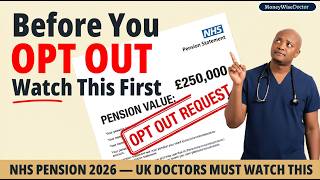
In this 2026 video Dr. Ndubuisi “Andy” Egwim explains why many NHS clinicians are opting out of the NHS defined‑benefit (DB) pension and why that decision can be financially costly. He outlines how the NHS DB pension works, its key advantages – guaranteed inflation‑linked lifetime income, high employer contributions, inflation protection, no investment risk, death‑in‑service/ill‑health benefits and tax efficiency – and its main drawbacks – reduced take‑home pay, lack of investment control, retirement‑age uncertainty and scheme complexity (annual allowance, McLeod adjustments). Andy argues that for most doctors the pension remains a strong financial foundation and recommends keeping it while supplementing it with a self‑invested personal pension (SIPP) or ISA for flexibility and earlier cash‑flow needs. He also introduces his free MedScan Financial Health Score tool and promotes his Moneywise Doctor resources (newsletter, free course, book). The overall message is that doctors should understand the pension’s guarantees, combine it with other investment buckets, and avoid the common mistake of opting out without a proper replacement strategy.
Chapters
If you find the NHS pension confusing, this video is for you. The NHS pension scheme has been described as one of the most generous pension schemes in the UK. So here's the question: why are hundreds of thousands of NHS professionals choosing to leave it? Doctors, dentists, nurses, physiotherapists, consultants, GPs, allied healthcare professionals. In fact, according to NHS Business Services Authority data, more than 221,000 NHS staff opted out of the NHS pension scheme around late 2025, and in just one month alone, thousands more submitted opt-out forms. Now here's the part many headlines miss, and I know this from my experience helping thousands of doctors and medics through Moneywise Doctor. Many people are opting out without fully understanding what they're actually giving up in the NHS pension, and that decision could quietly cost you tens of thousands of pounds. Sometimes it could be hundreds of thousands of pounds over your whole career and retirement in terms of taxes and pensions. So if you've ever wondered, is the NHS pension still worth it in 2026? Should I opt out to improve my take-home pay now? Could I do better investing privately? Should I use a SIP instead of my NHS pension? That's a self-invested personal pension. Or is the NHS pension still one of the financial foundations available to doctors? If that's what you've been thinking about, then this video could help you to think about it clearly, understand it well, and avoid a very expensive mistake. Now, for those of you who are new here, I'm Dr. Andy Egwim. I'm a former salaried NHS GP. I've been an investor for about 21 years. I'm the founder of moneywisedoctor.com and author of The Money Wise Doctor book, which became a bestseller in retirement planning, investing, and personal finance when I published it in December 2025. 4 years ago, I left my salaried NHS GP role after achieving financial independence following several years of investing. Since then, through multiple newsletters, masterclasses, community educational programs, we've helped over 10,000 doctors and healthcare professionals make smarter financial decisions and avoid costly mistakes. And honestly, one topic creates more confusion than anything— the NHS pension. Now, before we continue, quick disclaimer: this video is for just financial education only. It's not personalized financial advice. Please, if you need help, speak to a regulated financial advisor before making any major decisions. Right, now let's slow this down and actually understand what the NHS pension is, because most people don't fully understand it. And when people don't understand something financially, they often either ignore it, fear it, or leave it, especially if you're a busy doctor. Now, the NHS pension is what's called a defined benefit pension, DB, defined benefit. That means it's not based on your investment returns. Is not based on how well the stock market performs. It's not like a DC, Defined Contribution Pension, and it's not dependent on whether your investment fund manager beats the inflation or beats the market. Instead, the NHS pension promises you a guaranteed inflation-linked income for life. So it's adjusted based on inflation, and it's based mainly on your pensionable earnings, your years of service, and the rules of the scheme. So those three things. Now Now that is very different from a private pension or a SIP, and I have that as well. A SIP, which is basically Self-Invested Personal Pension, is a defined contribution pension. And even if you've got a personal pension, it's the same rules. You contribute money, you invest it, it rises and falls with the market. So that's a personal pension, is defined contribution pension, and your retirement is dependent heavily on your investment performance. And some workplaces, that's what they've got as well. Both of them have advantages, but they are not trying to solve the same problem. And this where many doctors get confused. They think it's either this or that. Compare the NHS pension to investing in an ISA or SIP and think, well, maybe I could get better returns myself. Maybe, but that comparison is incomplete if you don't understand how the NHS pension works, because NHS pension is not just about returns, it's about guarantees. It's not an investment in itself. There's longevity protection, there's inflation protection, there's security with the NHS pension. So before you make any investment decision, this stuff here, start by understanding exactly where currently stand. Most doctors have never had a proper financial health check, not because they're not interested, but because nobody had ever designed a tool that helps to make sense for the specific complexity of doctor's financial life. So I made one. It's called the MedScan Financial Health Score. So it takes about 3 minutes. It helps you to look at your overall financial position across 7 key areas, including tax efficiency, pension, investing, debt management, and financial protection. It gives you a clear score, a breakdown of exactly where you are, where the gaps are, and it's completely free. Takes 3 minutes. If you head over to moneywise doctor.com/medscan, or you can check the link in the description to get it. It's 3 minutes, real clarity, free. Now let's look at the actual benefits of the NHS pension properly, because honestly, many doctors underestimate how valuable it is. Benefit number 1: there's guaranteed income for life. So this is probably the biggest strength of the NHS pension as a defined benefit pension. Once you reach the pension age, the NHS pension pays you an income every year for the rest of your life. That's salary for life, not for 10 years, not until your investment pot runs out. Potentially, even if you live another 20, 30, 40 years, the NHS pension will continue to pay. And this matters more than many people realize because one of the biggest financial risks in retirement is not dying early, it's living longer than expected. And running out of money. Nobody wants that. People are living longer these days. Obviously, medicine keeps advancing, the average life expectancy is rising, and many people underestimate how much money they might actually need over retirement. That's why they don't start investing. The NHS pension removes a huge part of that uncertainty. Think about it like this: if you try to buy the equivalent guaranteed inflation-linked income privately, like an annuity, it will cost an enormous amount of money. That's why many people still consider the NHS pension one of the strongest retirement foundations available for doctors and healthcare professionals in the UK working in the NHS. Now, number 2, benefit number 2, employer contributions. This is massively underestimated. Many NHS staff focus only on what is taken from their payslip for the pension, but they forget how much the employer contributes into the scheme. Currently, Employer contribution rates are over 23%, I think 23.7%. Now, technically, you don't own that contribution like a private pension pot, but economically, it reflects the value of the scheme. And when someone opts out completely, they are effectively walking away from one of the most valuable employment benefits available to them. That's a huge decision, a courageous one, and not in a wise way. Benefit number 3: Inflation protection. One of the biggest silent destroyers of wealth, obviously, is inflation. £100 today will not buy what it— the same thing £100 bought 10 years ago. You probably need more. Your pension being linked broadly to inflation matters enormously over long retirement periods. This is one of the hidden strengths of the NHS pension that many people underappreciate. Benefit number 4: there's no investment risk. Yeah, I'm an investor and I have to take investment risk. This is a huge psychological benefit for you if you're in the NHS pension. Property markets fall, crypto could collapse, stock market could go up and down, investments go through cycle, but the NHS pension does not care about what the stock market did this year or last year. Your retirement income is backed by the government, not by whether Nvidia or Tesla or Bitcoin performed well. That stability matters, especially later in life. Benefit number 5: Death in Service and Ill Health Benefit. Now this is another area most doctors underestimate, especially those pulling out of the NHS pension. If you become seriously unwell and cannot continue working, enhanced ill health retirement may apply. And if the worst happens, eligible dependents may receive lump sum benefits and some of the ongoing pension and some financial support. Now for doctors with families, children, or dependents, this matters enormously. Benefit number 6: Tax efficiency. Now this becomes especially important for higher earners. Pension contributions reduce your adjusted net income, your taxable income, and for doctors caught in the infamous 60% tax trap between £100k and £125,140 in adjusted net income, your pension is a powerful tax efficient tool. So your SIP can actually work here as well, beautifully alongside your NHS pension. And this is a very important point, I want you to understand it clearly. I do not personally think most doctors should leave the NHS pension in favor of using only a SIPP or a SSAS or even whatever pension, private pension you use. I think that's often a big mistake. Obviously you have to make your own choice depending on your goals and, you know, plan. But I think the SIPP is excellent if you combine it with the NHS pension, especially as an additional retirement investment. Tax efficient, it helps with tax efficiency, it can also reduce your adjusted net income. And give you more flexibility and investment control. So for example, you may stay inside the NHS pension but also contribute to a SIP strategically, particularly if you're approaching the 60% tax trap and you're about to lose your tax-free allowance. So if you want more control over that, how that pension is invested, you could use a SIP to use up your annual pension allowance of about £60,000 now for this current tax year. So for many smart doctors, the NHS is not the NHS pension versus SIP. Is understanding how they complement each other, as long as you don't cross over the annual allowance of £60,000. Okay, now understanding how to use those is much better than opting out of the NHS pension. Now there are a few downsides with the NHS pension. It's not perfect, of course. Number one is reduced take-home pay. It's the reason many people opt out in the first place. Now the NHS pension contributions reduce your net pay, okay? And during a cost of living crisis that hurts of many families, okay. It's quite difficult, especially when mortgages are rising, childcare costs are high, inflation is squeezing everyone, and taxes already feels quite aggressive. So I completely understand why many doctors feel frustrated opening their payslip, but short-term pain does not necessarily equal long-term bad value, okay. And that distinction matters in your decisions. Number 2 downside of the NHS pension is obviously lack of control. Some people dislike the fact that they cannot choose how the NHS pension money is invested. You can't take it at an earlier age like a SIP. With a SIP or ISA, you may choose stocks and shares, ETFs, index funds. You can choose bonds. Even with the SIP, you could invest in commercial property or other investments. But the NHS pension does not give you that flexibility. For people who value investment autonomy, that can feel quite limiting and frustrating. Downside number 3 of the NHS pension, obviously, is retirement age uncertainty. It's a big emotional issue for many doctors. For many members of the 2015 scheme like myself, pension age is linked to state pension age, currently around 68 for many people. And even while I'm no longer an active member of the NHS pension because I no longer work in the NHS, I'm still a deferred member. That means I can still access my pension at 68, but it creates some level of emotional resistance to the scheme. I understand why if you have to wait that long. One doctor said something to me recently that stayed with me. He said, Andy, I don't want to finally enjoy life when I'm almost 80. I don't even know how long I'm going to live. And honestly, I think many doctors quietly feel the same. Now, this is where I think many people misunderstand retirement planning. Staying in the NHS pension does not necessarily mean you must work till 68. It doesn't mean you have to work until you're 68. I left the NHS when I was still in my mid-30s. This is where the bridge planning comes in and is incredibly important. Your NHS pension may provide long-term stability flexibility later in life, but your ISA investments, your SIP may help create earlier flexibility. That is why I believe every doctor should think in terms of multiple financial buckets, not just one pension. So your NHS pension is one bucket, is long-term, okay? Your ISA is one other one, your Lifetime ISA, your ISA stock and shares. Your SIP could be another, and of course cash reserves. If you've got property or business income or investment, All this creates optionality, and optionality is one of the most underrated forms of wealth. It's not just about objects or buying a Lamborghini. Many doctors are not actually dreaming of yachts or private jets. They simply want to be able to choose if they want to do fewer sessions, less burnout, more control, more family time, and the ability to say no. That is freedom for most professionals anyway. Now, downside number 4. Of the NHS pension, because we've got to look at it both sides. Complexity. The NHS pension scheme is not intuitive. Honestly, many intelligent doctors still find it overwhelming. The annual allowance calculations, McLeod, pension growth, tax charges, scheme transitions— it can feel incredibly confusing. Unfortunately, confusion often causes people to disengage emotionally from pensions altogether. Now let's briefly discuss McLeod and the infamous brown envelopes because this caused huge anxiety for many senior doctors. Very simply, there was a legal ruling that parts of the move into the 2015 scheme created age discrimination. As a result, pension years were moved back into older schemes for many members. For some people, this was beneficial overall, but it also created Confusion, recalculation, tax complications, annual allowance issues, delayed statements, a lot of confusion and stress. Now, one of the biggest misunderstandings relates to annual allowance tax charges. Many doctors think, but I only contributed £15,000, why am I getting taxed? I didn't cross £60,000, which is the annual allowance, because annual allowance calculations in defined benefit pension schemes are based pension growth, not simply contributions. That's where much of the confusion comes from. Now thankfully, the annual allowance increased from £40,000 to £60,000 a few years ago, which has helped many doctors significantly. But complexity remains one of the biggest emotional downsides of the NHS pension scheme. Now let me answer the question, the big question directly: should you opt out of the NHS pension? Honestly, for most doctors, probably For the overwhelming majority of NHS professionals, the NHS pension remains one of the strongest financial foundations available, especially if you value security, inflation protection, guaranteed income, longevity protection, and tax efficiency. Now, of course, there are exceptions. Some people may leave medicine entirely, emigrate permanently, or have severe short-term cash flow issues, or have unusual financial circumstances, but for many people, opting out completely is often a reaction to pressure rather than a careful, thought-out, long-term financial strategy. And this is where problems begin, because many doctors who opt out never properly replace the pension, even with investments. So they improve their take-home pay slightly, temporarily, but never consistently invest the difference. They worsen their tax position and that can become extremely difficult and expensive in the long term. Now personally, I think for many doctors, the smartest approach is keeping the NHS pension even if you're no longer contributing to it. But while you're there, keep it while also building investments outside it. That may include ISAs, your SIP, may, may be through your index funds, cash reserves, or other assets, even property. Because the NHS pension gives you the stability, and investing outside the NHS pension gives you the flexibility and optionality. One protects your future old age, the other helps you buy back your freedom earlier on in case you want to stop working earlier. And that combination can be incredibly powerful. Now, before we finish, I want to say something important. I don't think the real problem for most doctors is lack of income. I think the real problem is lack of a financial financial structure, an efficient financial system. Nobody teaches this stuff in medical school. Tax efficiency, investing sensibly without taking unnecessary risks, pension, retirement planning, ISAs, financial independence. Most doctors are trying to figure this out alone while simultaneously trying to survive a medical career that is already stressful. So if you feel overwhelmed by pensions, please understand you are not alone. Honestly, some of the smartest doctors I know struggled with this as well. This is just exactly why I started Moneywise Doctor. The books, the content, and everything is to help, to help doctors to think more clearly about their finances, not just to earn more, because earning more alone does not automatically create financial freedom or independence. Structure does, clarity does, intentionality does. So here's my final In my view, the NHS pension is not perfect, not by any means at all, but it's still one of the most valuable financial assets available to UK doctors and healthcare professionals working in the NHS. And for many people, the smartest move is not abandoning it, but understanding how to use it properly alongside investing and long-term financial planning, maybe with your SIP and ISA and other, you know, assets. Now, I genuinely love to hear your thoughts. Are you still in the NHS pension? Have you opted out? Are you considering using a SIP alongside your NHS pension? Um, drop your thoughts and questions in the comments below because I read them personally. And then if you want more help understanding your finances, financial well-being as a doctor, whether it's around investing, pensions, ISAs, financial independence, and smarter money decisions as a Medic. Make sure you subscribe to the Moneywise Doctor Weekly Newsletter. You see the link in the description. We email about 10,000 doctors and healthcare professionals every week, and it's quite widely read. And if you wanted a deep dive into all these topics, I've created a free financial well-being course for doctors. It's totally free. You can actually jump in and watch it totally for free. If you look in the link in the description or in the comments, you see the link to to the course, you can go ahead and watch it. It doesn't even require an opt-in. It's all out there for you to watch, and I hope you find it helpful. All right, to the next video. Cheers!







