SIPP Pension vs ISA vs NHS Doctor's Pension
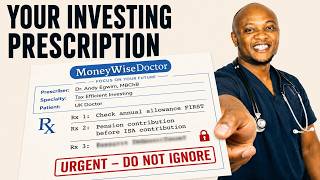
Dr. Andy Egwim shows doctors how to choose between a SIPP, ISA, and NHS pension. A 56-year-old GP earning £118k could save thousands by putting £20k into a SIPP instead of an ISA, thanks to tax relief that cuts through the 60% allowance cliff. SIPPs offer flexibility and earlier access at 55, while the NHS pension guarantees income with no investment risk.
Chapters
What if I showed you a perfectly legal way to increase your money by 20%, 40%, or even 60% before you've even bought a single investment? It sounds too good to be true. Not through stock picking, not crypto or anything like that, not property, not market timing. This is without taking any additional investment risk. Would you at least want to understand how it works? Most intelligent doctors would. Now, before you rush to the comments, I'm not talking about investment returns here. I'm talking about tax relief as it relates to your pension. And there's catch. Not everyone qualifies. Not every doctor should do it. And in some situations, it could actually be the wrong thing to do. That's exactly why understanding this clearly matters, because the difference between doing it correctly and doing it incorrectly could be worth thousands of pounds, sometimes tens of thousands of pounds. It could be a costly mistake. Now, this is money you could have invested, money that could have compounded, money that could have actually brought forward your financial independence and help you either to retire early or at least to have options. It's nothing shady. It's nothing exotic. It's nothing HMRC doesn't already know about. I've used it myself. In fact, many doctors already have access to it. They're just not using it correctly. If you're new here, I'm Dr. Andy Egwim. I'm a former salaried NHS GP. I've been investing for 21 years. I'm the founder of Moneywise Doctor and the author of the bestseller on investing and personal finance, Finance on Amazon, The Moneywise Doctor. And over the last couple of years, I've had the privilege of teaching more than 4,000 doctors and medics tax-efficient investing in masterclasses, workshops, and all that. And one thing I've learned is this: doctors don't usually have an investing information problem, they have a clarity problem, because nobody teaches us this stuff. We learn a lot of stuff, but not this one. Nobody explains tax relief, NHS pension, SEPs, ISAs, and investing all together, how it fits together. Today I want to walk you through one doctor's story, a GP, that illustrates exactly what I mean. Then I'm going to explain what a SIP actually is, who it's for, who it's not for, and how it sits alongside your ISA and your NHS pension to help you to invest in a tax-efficient way. By the end of this video, you understand the system clearly enough to at least ask the right questions. So if you're interested, come along for the journey. Stay with me. Now, a GP reached out to me on LinkedIn after watching my video here titled SIPs vs ISA. She found me on LinkedIn, sent me a message, She was a 56-year-old earning around £118,000 in adjusted net income a year. And so she had about £20,000 that she wanted to invest. One pot of money. She just needed to make one decision and she had one chance to use it efficiently. She had spoken with an advisor. She had read some things online on YouTube, and the recommendation was straightforward. Just put the money in a stock and shares ISA. At first glance, that sounds perfectly sensible. I like ISAs. I use ISAs. In fact, I think if you're going to invest in the UK, you should probably look into ISAs. But when I heard the rest of our situation, I found myself asking a different question. By then, she had already invested the money through the advisor's firm's ISA. The question was not, is ISA the good option here? It was, is it the best next right move for her? Because those are different questions to answer. Now, the answer takes us into one of the most misunderstood areas of personal finance. Especially for doctors. That's the SIP, the Self-Invested Personal Pension, or any personal pension. Now, quick disclaimer before we go further: this video is for education only, is not for personal financial advice. I don't know your full situation. I don't even know what your pension record is like. I don't know your annual allowance position. I have no idea what your risk tolerance or capacity to bear loss is, your family situation, your income plans, or when you need to access whatever money you're investing. So don't just watch this and rush off and move money around. Watch it to understand how it really works so that you can make the best, um, moves when you start asking questions going that direction, because this is one area that doctors are rarely taught anything about. Okay, now talking about this GP, here's what made me pause and think. The ISA wasn't necessarily the problem, and the advisor wasn't necessarily wrong. An ISA is one of the best investment wrappers in the UK. Yes, tax-free growth, tax-free withdrawals, the dividends are tax-free, there's flexibility, Simplicity, all good things. The problem was that nobody appeared to have looked at the bigger picture because this GP was earning over £100,000, not £60k, not £40k. She was earning around £118k in adjusted net income, which means she was sitting squarely into one of the most painful tax of the UK system, the 60% tax trap. Now, you already know this if you've been following my channel, that if your adjusted net income crosses £100k, you start to lose your personal allowance. And for every £2 you earn above £100,000, you lose £1 of your tax-free allowance, of your £12,570 tax-free allowance. And the result is that part of your income can effectively be taxed at 60% because by the time you hit £125,140, you've lost all the tax-free allowance. This is why some doctors work harder, do extra sessions, then wonder why they don't feel much better off. The money is leaking before they ever get the chance to even touch it or invest it. Now, here's where that becomes interesting. Pension contribution can actually help to reduce your adjusted net income and bring you out of the 60% tax trap. And if this GP had explored a pension contribution before using the ISA, the outcome might have looked very different. Same £20,000, same discipline, potentially the same investment, but different wrapper, different outcomes. That is the point of this video. It's not ISA bad, SIP good. It's not as simplistic as that. It's just that sequence matters. So before we go further, let's just look at SIP. What is it? It's basically Self-Invested Personal Pension. Of course, you can have a personal pension which a wealth manager or advisor or pension company manages. But I use a SIP. I do DIY investing. So SIP is basically Self-Invested Personal Pension. It's a pension wrapper that gives you more control over how your pension money is invested. So different from the NHS pension. But this is where many doctors get confused. A SIP is not an investment, just like an ISA is not an investment. A SIP is basically the container. Think of it like a suitcase. Inside that suitcase, depending on the provider, you may be able to hold different things. You might be able to hold index funds, you might be able to hold ETFs, might be able to hold investment trusts, shares, bonds, and cash. And with some providers, might even be able to hold commercial property. But the SIP itself is not the investment. The investment sits inside the SIP, okay? Just like in your ISA. The same is true of an ISA. An ISA is not necessarily an investment either. It's also a wrapper. Because when you say, I'm going to invest in my ISA, no, it's just a tax wrapper. That's why saying I invested in an ISA is a bit incomplete. The better question is, what did you invest inside the ISA, and was the ISA the best tax wrapper for that money at that point in your life? Because the wrapper determines the tax treatment, and the tax treatment can change everything. This is really something that is important to understand. Now again, it's important to see why SIPPs can be really, really powerful and why you should understand them. The big attraction of a SIPP is obviously tax relief. It can be massive. For a basic rate taxpayer, if you pay £80 into a pension, HMRC I'll say as £20 and £100 goes into your pension. For a higher rate taxpayer, additional rate tax relief may be available through self-assessment as well. So you get the 20%, can claim another 20%, obviously for a higher rate taxpayer. For additional rate taxpayer, it could even be higher. And for someone caught in the 60% tax trap, pension contribution may also reduce your adjusted net income and potentially restore some or all of your personal allowance. This is why I opened the video talking about 20%, 40%, or even 60%. Again, this is not an investment return. The investment hasn't done anything yet. This is just basically the tax system actually helping out here. This is why tax-efficient investing matters so much, because if you save tax before the money is invested, you're already starting from a stronger position. That makes sense. It's maths. Okay. Now let's go back to our GP who obviously invested this money already. She was earning around £118,000 in adjusted net income, basically. She had £20,000 available, she put it into a stock and shares ISA. Now obviously she's a higher rate taxpayer. The ISA might grow beautifully over time, it might be invested in a low-cost index fund, whatever she's invested in, it might be well diversified, it might be sensible. But if that £20,000 has also gone into a pension instead and invested in the same things, 3 things might have happened. First, her adjusted net income may have come down. So potentially from £118,000, it could come down to £98,000. If structured correctly. Secondly, she may have restored her full personal allowance. That will be worth around an extra £5,000 in tax saved. Third, she may have received pension tax relief on the contribution. Again, as a higher rate taxpayer, it's 40% gross. So when you combine those effects, the net cost, basically looking at that £20,000, it dramatically looks much more attractive than putting it in an ISA. This is where the difference can be worth several thousands. In some cases, it could be as much as £12,000 difference. But again, the point is not everyone should use a CIP instead of an ISA. The point is that the order matters, the sequence matters. You have to think about these things. The same investment in the wrong wrapper at the wrong time can quietly cost you a lot of money, thousands of pounds. Okay, so basic enough. If you've made this mistake, I don't want you to feel bad. The other taxi is coming, you can lend it. This is the part that many doctors miss. That GP was 56 years. So when people say 'But pensions are locked away for years.' Yes, that's true, but in her case, the money wasn't being locked away for 30 years because basically she was already eligible to draw it. She was already at an age when pension access was available, basically, because it's 55 now. So your SIP is basically— you can access it at 55. And of course, it's changing in the future. From 2027, it will be— 2028, it will be 57. If she was younger, that would be totally different. If you are 32 and you need the money in the next couple of years, the SIP may be completely inappropriate. In fact, you shouldn't be investing money you need in the next couple of years. If you're saving for a house deposit, school fees, an emergency fund, maternity leave, relocation, or anything you might need soon, a SIP may not be the right place because basically it's pension. In fact, if you need the money in the next 1 to 2 years, that money should probably not be invested in the stock market at all. That is what I believe. It may need to be in cash basically, or even sort of like short-term, you know, sort of like debt, things like bonds or treasuries. A SIP is usually retirement money. So yes, a SIP can be powerful, but only when they match the purpose. Good. So does that mean every doctor should go off and open a SIP? That's not what I'm saying. Absolutely not. You need to understand these things clearly. This is where TikTok, social media often gets people into trouble because someone hears tax relief, pension contributions, extra £12,000, 60% tax trap, and suddenly decide, oh, I'm going to rush off and go on a platform and open one. It might be, it might not. It depends on your situation. A SIP is simply a tool And like every other tool, whether it helps depends on the job you're trying to accomplish. So let's look at it. Who might a SIP actually help? Who might it suit? One, a high earner, especially if your adjusted net income is over £100K and you're being pulled into the 60% tax trap. That's a way to come out. For some doctors, pension contributions can be one of the most powerful tax planning tools available. That's exactly why this lovely GP, Her situation caught my attention. However, you must check that you still have unused annual allowance so that you don't exceed the annual allowance and incur a penalty from our friends at HMRC. Two, if you're a locum doctor or private doctor working through a limited company, particularly if you don't have access to NHS pension, a SIP might be great. If you're operating through a limited company, employer pension contributions into a SIP can sometimes be very tax efficient because the company may be able to make pension contributions as a business expense. But this subject to rules and circumstances. 3. Doctors not in the NHS pension scheme. So if you don't have access to NHS pension or workplace pension, a SIP may be one way to build a retirement saving with tax relief, especially if your workplace pension is not that fantastic. 4. Doctors already in the NHS pension who have unused annual allowance and want to build additional retirement assets outside the NHS pension scheme. Because despite what many people think, NHS pension versus SIP is often the wrong way to look at it.? For many doctors, the answer is NHS pension plus SIP as long as you have headroom in terms of your unused annual allowance. It's currently £60,000 for this tax year. So these are different tools, they do different jobs. Now let's look at SIP versus NHS pension. Just look at them, their differences. This is one of the most misunderstood areas of personal finance for doctors, and sometimes it feels like comparing apples versus oranges. So you don't just compare— they're not apples for apples because the NHS pension is a defined benefit pension. What that means is that you're not building an investment pot. You're just building an entitlement for future income. So it's salary for life. In return, you receive some remarkable benefits. One of them is a guaranteed income for life. Two, inflation protection, death in service benefit, ill health benefit, and you also get the employer contributions. And perhaps most importantly, no investment risk. Your retirement income is not dependent on whether the stock market happens to be up or down. when you retire. A SIP works a bit differently, very differently. A SIP is a defined contribution pension. You can access it earlier at 55, basically 57 from 2028, while the NHS pension for me is 68. You build the pot, you choose the investments, the value can rise and fall, the value can rise, it can fall, like any investment. So you're carrying investment risk. So you gain the flexibility and control over the underlying investment, but you also gain the responsibility. So the NHS NHS pension gives security. Obviously, for someone like me, NHS pension will be 68 years, but the SIP gives flexibility and control, 57. The NHS pension is a defined benefit. The SIP is more like an invested pot. The NHS pension is not usually something I suggest to people to casually opt out of. In fact, if you are thinking of opting out of the NHS pension, please watch the video somewhere here on my channel about the NHS pension so that you can understand what you may be giving up. Just search for it on the channel. I made a video about it. A SIP may sit alongside the NHS pension, not instead of it. That distinction matters. But now let's look at something really crucial, the annual allowance, because currently the annual allowance, how much you can put in your pension tax-free, is £60,000. And here's another point many doctors miss. The pension annual allowance is currently £60,000 for this tax year for most people, but that allowance covers all pensioning period for the tax year, not just your SIP, not just your private pension, not just your NHS pension, all pension impute. So this can include your NHS pension growth or your pension impute amount, your workplace pension contributions if you're doing anything else, employer contributions, personal pension contributions, SIP contributions, everything. This is where many doctors get caught. They hear you can put £60,000 into a SIP or into a pension, then they forget about their NHS pension that they may have already used a significant part of that 60K allowance. So some doctors may also have unused allowance for previous years that can be carried forward. So that's something to look at. It's called carry forward. You have to look at the carry forward rules. If you haven't used allowance, that you haven't used up to £60k from the previous years, you can carry it forward as long as you are registered in a pension scheme in those years. You do also need enough relevant earnings to make these contributions, and you need to calculate what your allowance actually— how much you've used. This is why I always say don't guess, check first. Make sure you've checked Poyzma on use allowance where's my headroom? Just like a doctor or healthcare professional in medicine, you check before you prescribe. In finance, the same thing. Before you rush off to invest or to use a pension, check if you still have allowances. Now let's look at SIP versus ISA, because this is another area people try to compare, and I've made a detailed video about that here as well. It brings us back to this GP that we're talking about, because the real question wasn't, is SIP better than an ISA? I've done the comparison, head-to-head comparisons. You can check it on the channel here. But that question is too simplistic. The real question was, what should come first? Because an ISA, yes, gives flexibility. You can access the money whenever you want, and the growth is obviously tax-free. Withdrawals are tax-free. But a SIP gives you significant tax relief on the way in. The money grows largely sheltered from tax while invested, but it's only when you withdraw it. So withdrawals are taxable as income, but you also have a 25% lump sum you can take under the pension rules, tax-free. And access is restricted until the minimum pension age, which is currently 55, right? Rising to 57, 2028. So is the ISA better? Obviously for flexibility, and the SIP may be better for tax relief and long-term retirement planning. Neither of them is automatically better. It depends on what you're trying to achieve. So the question is, what job does this money need to do, and how soon do I need it back? Because if the money is for short-term access, maybe 5 years before your retirement age, an ISA might be better. If the money is for retirement and you are paying higher or additional rate tax,, a SIP could be quite compelling. Now, if you are in the 60% tax trap, a pension contribution may be especially powerful in helping you to come out of that tax trap. But if you might need the money soon, locking it into a pension, that could be a mistake. You don't want to be stuck. Which is why when someone asks me, Andy, especially in the masterclasses, should I use a SIP or an ISA? My answer usually is, it depends. But what does it depend on? These are some of the the factors we already talked about. What's your age? Your income? Are you in the NHS pension or another workplace pension? Are you a consultant, GP partner, salaried, or locum working through a limited company who can contribute from the company into an employer SIP? Are you trying to retire at 57 or 67? Does flexibility really matter to you? What's your tax situation? Are you already caught into this— in the 60% tax trap, or have you lost high income child benefit charge? Because without context, you can't really answer this question properly. So this is why the GP story matter, because I like content is everywhere, but context really matters. She did something sensible. She used an ISA, she invested, she took action. But the question was not, was the ISA good? The question was, was the ISA the best next step for her? That's where many doctors lose money, make costly mistakes, not because we are reckless, not because you're not intelligent, not because you're bad with money, but because you've made the right decision but in the wrong order. And a good decision in the wrong order can be expensive. The investment may be exactly the same, the wrapper can change everything. So it's really important to pay attention. She didn't have an answer problem, she just had a clarity problem. So this is where I teach doctors using a simple sequence There are 3 steps from a method I called SCRUBS method. I wrote about this in Chapter 6 of my book, the SCRUBS method. So step 1, diagnose. You work out your adjusted net income. Are you above 100K? Are you in the 60% tax trap? Are you affected by high income child benefit charge? What's your pension input amount? What other— how much of your allowance have you used in that tax year? Okay, this is where you start from before you do anything. Do you have any carry forward unused allowances from previous years? That's number 1. Step 2: Structure. Decide which wrapper comes first. Got NHS pension, SEIB, ISA, Lifetime ISA, all of them before the General Investment Account, Limited Company Pension contributions. The right order depends on your situation. Then step 3, obviously invest. So if only after you've diagnosed and have a structure, start thinking about index fund, ETF, what investment goes into which wrapper. Most doctors start at step 3. And that's usually the problem. They ask, I get this DM and email all the time. What should I buy? What should I invest in? Before asking where should I put the money, ask yourself what problem is the money solving? So this is really important. So it's not just about investing, it's about getting it in the right order. Now, if you've been watching my content so far for the last few weeks or even for, for a couple of months, some, some of you have been watching my content for years, you know, we've talked about index funds, we've talked about ISAs, We've talked about SIP. We've even looked at scenarios where we looked at buy-to-let versus investing in index funds. We looked at pension mistakes. We talked about all of that. But at some point, the pieces need to come together. So you're not just consuming information, you need to sort of take it to the next level. So that is why my upcoming workshop, this is what it's about. It's called the Scrubs Investing Workshop: 3 Steps to Tax Efficient Investing for Medics. For the first time, I'm running it in this format, 90 minutes live with our team for doctors and dentists who want to actually build the system instead of just learning about it and letting time to just pass without doing anything. Inside, we'll cover how to think about the NHS pension versus the other options, how SIPPs work and when they make sense, how ISAs fit into the picture, how pension tax relief works in practice, How to think about your adjusted net income. And how to avoid the common tax-efficient investing mistakes. Like the one we've described. How— looking at children, investing for children, how does that fit to overall plan. How to choose investments sensibly without taking unnecessary risk. You also get our great resources including the Index Fund Cheat Sheet that explains what each fund actually holds, what terms like TER, OCF, OCR, accumulation, distribution, what they all mean. And also you get to see how you can build a simple investing system, your investing playbook, that you can actually stick to with a workbook that you fill live in the workshop and you can take it away. So we look at also scenarios, real cases, real numbers, real people scenarios like the one we just explained. Now it's not stock tips, it's not hype, it's not also regulated personal financial advice. Just practical doctor-specific education. Our previous masterclasses have had between 250 to 700 attendees, but this one is different. I'm keeping it small, 50 seats only, and it's for medics only because this is a workshop, not a masterclass. We need people to be engaged, working live, asking real questions. Now, if you want a ticket, there are two ways to grab a ticket. One, if you click the link in the description or in the first comment, or you comment "SCRUBS," you get the link. Someone will send it to you from my team. That takes you straight to the registration page where you can secure your seat, get the pre-workshop resources, and join the private workshop community ahead of time. And hey, whether in the workshop or not, if you have any question around SEEP, ISA, NHS pension, or doctor finances, feel free to comment below and I'll do my best to give you A very helpful response. Now, this GP in this video didn't have a tax problem, she had a clarity problem. She didn't have an information problem, she had a clarity problem. If you recognize yourself in her story, even part of it, then this workshop, the SCRUBS workshop, is for you. Once you understand the system, decisions become clearer. Not always easy, but clearer. And clarity is where better financial decisions begin. All right, I'll see you there. Take care. Thank you.







