The 7 Steps to Tax-Efficient Investing
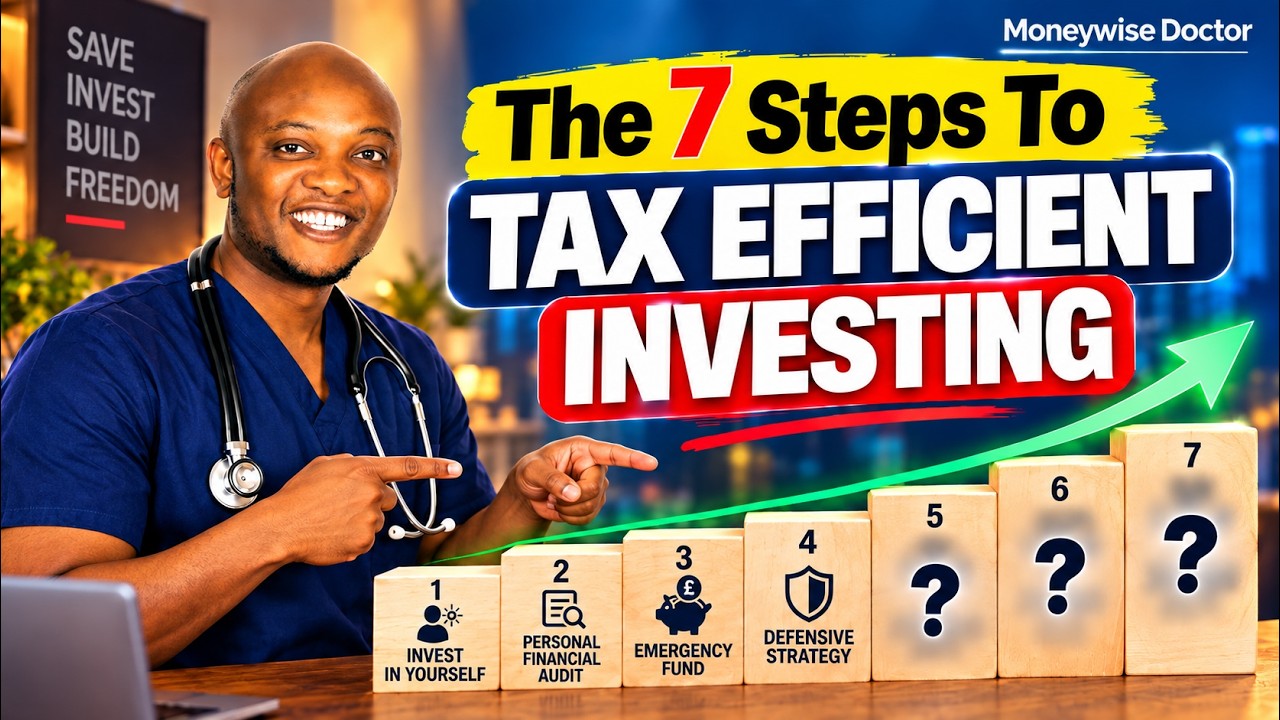
Dr. Andy Egwim walks doctors through the SCRUBS framework: six steps before investing, from building an emergency fund to shielding from taxes. Most investors ask "what should I buy?" first, but you need to verify you're financially ready.
Chapters
Have you heard one of those stories about millionaire investors who lost almost everything because of one or two terrible decisions? Or maybe it's just a professional like you, like a doctor who put far too much money into an investment, lost all of it, and suddenly had to start picking up extra night shifts just to rebuild again. Look, I've had dozens of nightmare stories like that, and sometimes I'm not hearing them secondhand due to what I do at Moneywise Doctor. Most times I'm speaking to the person affected, They've either sent me an email or sent me a DM, or they're sitting in front of me or in a live masterclass or in one of our communities, and they're telling me exactly what went wrong. Now, investing always involves risk. You cannot completely eliminate that. Investing in itself has to involve risk. But there are things you can do before you invest a single pound, a single dollar, or even naira that can dramatically improve your ability to survive when things don't go according to plan. Look, after more than 21 years of investing, writing a bestselling book on investing and personal finance in the UK, and after teaching more than 4,400 doctors about investing and tax efficiency, there are 7 things I believe every new investor should consider before they start investing. 7 of them I'll show to you, and if you stay until the end, I'll give you a free checklist I've made containing all 7. Actually, you don't even have to wait. You can skip now to the description and pinned comment and download it. And also the explanation around it. Download it, it's completely free. If it helps you become a better investor, it's done its job. Now, there's another reason I'm also making this video because over the last couple of weeks, something rather unexpected happened on this channel. I made a video analyzing the Dangote Refinery IPO. Now, more than 800,000 people have already watched it. And beneath it, the video, I've received hundreds and hundreds of comments, more than 800 comments so far. I get things like, doctor, should I buy Dangote? Oh, this video was very eye-opening, but which shares should I buy? What international shares should I invest in? And someone said, I've never watched an investing video this long, but this actually will help me to understand things clearly. Can you teach me how to invest? And I understand these questions, okay? Because when most of us first think about investing, we immediately ask questions like, what should I buy? Should I invest in property? Should I buy shares? Should I buy shares in UK, US, Nigeria, or wherever? Should I buy Bitcoin? Should I buy gold, land, or is an index fund better? But look, after 21 years of investing, I think that's the wrong first question to ask. And that's where people start making mistakes that could cost them money. Before you ask, what should I invest in? Ask, am I actually ready to start investing? Have I built the foundations? And that's what these 7 steps are about. In fact, I actually have a framework for the first 6. I call these SCRUBS. Yeah, SCRUBS, just like doctors and dentists wear scrubs. You wear protective clothes. Okay. So it's like the coolest doctor's way, and I'll explain it to you. Yeah, you know, I've got a medical background, so this bleeds into my investing as well. If you're new here, I'm Dr. Andy Egwim. I'm the founder of Moneywise Doctor and moneywisedoctor.com. Everything we discuss here is financial education, not personalized financial advice for you. And before we start, apparently there's a step before step 1. Okay, there are 7 steps, but the first step before step 1, hit that subscribe button. In fact, this channel has been on a ride for the last couple of weeks. And our subscriber base has quadrupled. I'd love for you to be a part of what we're building here. And I promise I'll keep making videos that you'll find so useful that you ask, why is he making this for free and not selling them? Okay. So we'll continue to provide the value for you, but hit the subscribe button so that YouTube knows to send you the videos when we make them. So let's jump in. Number 1 is the safety net, S, in the SCRUBS framework. Before I start thinking about investing, I need to think about safety. Let me get something here to point. So what happens when life happens? When things don't go to plan? Do you have a financial safety net in place? Are you about to invest your last penny? What happens if your car breaks down, your boiler packs up, you lose your job? I mean, don't pray for these things, but you have to plan. You have to prepare. You suddenly need to fly home because of an emergency, family emergency. You have an unexpected medical bill. Life is life. These things could happen. We've seen them happen with doctors as well. So where does that money come from? Now, I know someone is already saying, especially if you're Nigerian, probably people say things like, God forbid, it's not my portion. And absolutely, we pray for the best, but we plan for the worst. Because here's the problem. Suppose virtually all your spare money is invested in shares, then an emergency happens. And unfortunately, if it happens during a market crash, and market crashes do happen, I've lived through 3 major market crashes. If a market crash is happening and your investments are down 30%, you need the money. So now you are forced to sell at a loss, even though these are solid companies. And something that might have been a temporary fall in value becomes a permanent loss for you because you had no choice but to sell your stocks or even index funds. I've lived through 3 major market crashes as an investor, and one thing that helped me enormously was this: I wasn't under any pressure to sell, especially in the last 2. In fact, if I desperately needed that money during the crash, I might have crystallized those losses and I had to start again. So in fact, the last 2 were very helpful for me because I was buying at a discount. So before investing, think about keeping aside money for emergencies. And the next question I often get is, okay, Dr. Andy, how much is the emergency fund? How much should I keep aside? Like, there's no magical number, but here's a simple way to think about it. In my book, I described the number. I said, work out your essential monthly expenses, not everything you spend money on. That's in chapter 2. The things you genuinely need to keep your household functioning, compulsory bills, Mortgage or your rent, electricity, water bills, food, because you've got to eat, right? Essential transport, childcare, necessary family support to support your family, and so on. So people often tell me, my expenses change every month. Yeah, of course they do. So look backwards, take the last 3 months and calculate an average. Okay. Include, including the family support you have to send. Okay. Or even better, take the last 12 months, add up all the essentials, divide it by 12. Don't skip this bit. Don't skip it. In fact, once you know the monthly figure, you can start deciding how many months of expenses you want to save to have available. For some people, 3 months might be reasonable. Okay. For somebody that is self-employed or you're running a business, you're working irregularly or with some unpredictable income, you may feel more comfortable with 6 months. Okay. There's no universal number. The principle matters more. Okay. Your investments shouldn't have to be sold to rescue every financial emergency. If not, it didn't give it time to breathe and compound. I see people jump straight into investing without doing some of these things. Now, sometimes it ends painfully, especially when the market goes down. So safety first. Now we are still looking at the SCRUB framework. The next one is C, clarity and confidence. Okay. So A is for apple, B is for ball, and C is for clarity. Because clarity is what builds confidence. The more clear you are on stuff, the more you can be confident about it. And the more genuine understanding you have, the less dependent you become on the 16-year-old dancing on TikTok while pointing at 5 stocks that are apparently going to explode next week, or the random guru telling you to buy this and it will go up. Confidence is not, my friend bought it, so I'm going to buy it. It must be good. It's not, everybody's talking about it and There are viral videos about it, so I must invest in it. And it's certainly not this person on social media claimed to have made times 10, 10x their money. No, confidence should come from understanding. Okay. Before putting money into an investment, can you explain in reasonable, simple language to a 10-year-old, what exactly am I buying? How does it make money? How, what, what could make it more valuable? Okay. What could make me lose some or all of my money? What are the fees I'm going to be paying? Are there some hidden fees there? Can I get my money out when I need it? Okay. And what role is this investment meant to play in my overall financial goals? Is it long-term, short-term? Is it money that you need for retirement in the next 20 to 30 years? Or is it money you're hoping to use in the next 3 years to either buy property or relocate or do something else? Those are pay school fees. Those are very different things. Might even be sort of like think about what the money is going to do. And that might mean that you might not even need to invest it if it's short-term. One of the greatest risks for a new investor is putting money into something they don't understand because everybody else appears to understand it. And that's one reason I've spent so much time explaining and analyzing the recent Dangote IPO and even the SpaceX IPO that came out recently. It's not to tell you buy or don't buy. It's not that simple because your circumstances are different. But first, let's look at the questions that come before that decision because education doesn't remove investment risk, but it helps reduce the risk of making decisions you don't understand. Just like being a doctor doesn't remove the risk of operating on a patient, but it reduces the risk. It doesn't remove it, it reduces it. Now, R is remove expensive debt. It's one important thing if you live in places like Canada, US, Australia, UK, you know, consumer credit economy. Sometimes debt is incredibly easy to acquire. Once you've got a decent paycheck, credit score, people practically could chase you down the street, metaphorically, trying to lend you money. Credit cards, personal loans, car finance, buy now, pay later. And lots of people fall into that trap. They fall into the trap. And I've spoken to doctors who've been caught in this cycle. They start using a credit card. They don't pay it off completely every month. The interest starts compounding and another card arrives and another card arrives, another loan arrives. And sometimes they're using one card to pay off the other card and gradually they're going backwards despite earning good money because they're paying high interest on this thing. I quite remember clearly while I was writing this book, I spoke to a senior doctor who was earning about ₦150,000 a year. He had earned very well for years, but by the time we spoke, he was in serious debt and at risk of losing his home and his job. In fact, some of his creditors even contacted his employers and he reached out to, you know, to get some guidance. I asked him, so where did the money go? Did you invest any of it? Whereabouts? He said holidays, watches, clothes. They had a couple of cars or 3 cars thereabout. And some of it were not valuable when you tried to sell them. An interesting question was not for him at that point, can I afford this? Back then it had become, can I afford the minimum payment? So with this credit system, just pay the minimum. And most people fall into that rather than paying off monthly. Okay. Those are very different questions. And the financial pressure for this doctor eventually affected more than his bank accounts. It affected his marriage, sadly. So let's make this mathematical. Imagine you've got a credit card that is charging you 27% interest, and you're simultaneously searching for an investment that might make 8%, 10%, even 12%. Think about what's happening. You're virtually guaranteeing somebody else that you pay them 27% while hoping somebody else gives you 10%. The math is not mathing. I've genuinely seen versions of this, and most people don't even think about it. They don't even know how high their credit card interest is. Somebody tells me, Andy, I've put £20,000 into this property development my friend is doing, and they're going to pay me 10% a year. Okay, fantastic. Then we discover they've also got about £20,000 or more sitting on credit cards charging 25%, 27%, sometimes 30% plus. That makes little mathematical sense to me. I don't know what you think about it. Tell me in the comments why people would do that. Now, an important qualification. Not all debt is the same. And I'm not saying everybody with a mortgage must just quickly rush and pay off before investing. Sometimes that's not even the right move. No. A mortgage at a relatively low interest rate, maybe 3%, 4%, 5%, is very different from an expensive revolving credit card debt of 27% and above. And student debt can also be different. Again, for those who have student debt, we are talking particularly about expensive consumer debt. In fact, here's some homework for you now. If you have a credit card balance, go and check the interest rate. Not the minimum payment, okay? The interest rate. Just tell me in the comments. If you've got a credit card, tell me in the comments what is the interest rate. I want to find out. Tell me. You may be surprised if you check this, and lots of doctors are surprised when they find out. Because paying off expensive debt can sometimes be one of the best financial returns available for you before hunting for the next wonderful investment opportunity. Right. We've beaten that horse sufficiently. probably to death. Let's go to number 4. So number 4 is the U, underwrite the risk. Okay? Okay. Underwrite the risk. Now, this is one of the slightly unusual ones. Okay? People in insurance will know exactly what underwriting means. Essentially, we are asking, which risk am I prepared to carry myself and which one should I pay somebody else to carry? Okay? So you pay car insurance, house insurance. So now you pay your indemnity insurance for your practice. Let me make this ridiculously simple. Imagine you've got a secret machine sitting in your house. It's legal, but every year this machine prints £100,000 for you legally. Before anybody gets excited, £100,000 is printing for you. So the £100,000 pays your mortgage, it feeds your children, it pays the bills, it funds your holidays. You even pay tax on it. It builds your investments. Now imagine if somebody says to you, look, there's a possibility that that machine could stop working. You don't know when, but it could. Would you insure it if it was possible? Probably, because you're a sensible person. Well, for many professionals, particularly doctors, you are that machine. In fact, more precisely, your ability to earn an income is the machine. We spend years building and learning and understanding them. We protect our phones, our cars, our houses. Sometimes even the washing machine, but the asset that we spent years learning and building, producing most of the income, it gets very little protection, no attention. So what happens if you're unable to work for 6 months? And I've seen doctors this has happened to. What about 2 years? What happens if you are diagnosed with serious illness? It's not like I haven't seen dozens of doctors who this has happened to. And if others depend on your income, like your family, what happens if the person dies? Sadly, I've seen doctors become seriously unwell. We've seen situations where, as colleagues, we've come together and contributed money to support the doctor's family, which is nice to do, but that doesn't go very far. And sometimes a doctor dies unexpectedly, and the financial protection simply wasn't there. Again, something I've talked about on my channel here. Now, it's not something pleasant to discuss, but I've got to be practical and realistic because pretending is not a financial strategy. Now, this doesn't mean that everybody needs to buy all the insurance policies available. Absolutely not. The question is, what risk Could completely derail your financial plan, and which of those risks are you comfortable carrying yourself? And which one should you transfer to an insurer? Is it life insurance, income protection insurance, critical illness cover? These are different tools for different risks, and of course, I can't cover them in this video. But I've actually made a free guide explaining the basics of this insurance financial protection. I'll leave the link in the description. You can download it totally for free. Before chasing investment returns, think about protecting yourself against the events capable of wiping out years of progress. Okay. Right. So number 5 is B, build your investing blueprint. Now we'll start getting closer to investing, but please don't randomly start buying things because somebody on the internet said, let's buy Dangote IP or SpaceX IP or Bitcoin, or this, this particular stock is going to blow up or this property or land or whatever. No, before investing, write down your own investment blueprint. Start with a very simple question. Why are you investing? Seriously, why? Because you can just enjoy your money, but why are you investing? Is it, I want more money? But that's not a financial plan or strategy. Question is, is this for retirement? Is it for a house? Is it for financial independence? Is it for your children's education? Is this something like a project 5 years away or something that is 30 years away? Because the destination helps you to determine The vehicle. Now suppose I'm leaving today from Manchester and I want to go from Manchester to London. I could drive, I could take the train, I could fly, I could go on horseback, but that's not very practical. Okay. Or bicycle. Now, but arguing about the best vehicle before establishing where I'm trying to get to would be a waste of time. Investing is similar. Money you need next year, maybe for a mortgage payment or down payment, may need to be treated differently from money you don't expect to touch for 30 years or maybe 18 years for your child that you invest in. That's a baby now. Don't choose the vehicle before choosing the destination. And your blueprint should also consider 2 things people frequently confuse. Risk. So there's risk tolerance and there's risk capacity. So that's capacity to bear loss. Risk tolerance is essentially how much volatility can I emotionally stomach? Okay. Some Nigerians will say I get mind. So if I've got like, um, no, no, risk capacity is totally different. Again, it's not about how much, you know, psychological this thing can withstand. It's about your financial capacity. So you might emotionally love taking risk, you're a risk taker, but if losing that money means you can't pay your next year's school fees or house rent, your capacity is very different. So build the blueprint first, understand who you are, how you want to invest, then choose investments that fit it. And now the final S in the SCRUBS framework is shield from taxes. That's the final S. And this is the one people routinely ignore. Chapter 5 of my book is called Clamp the Tax Bleed. There's no need overpaying taxes. You pay what you're due. The exact tools depend on where you live. In the UK, for example, we have ISA, we have pension, we have SIP, we have SSAS. Other countries like Canada have TFSA, tax-free savings account. US and Australia, they have their different tools as well. But here's why this matters. Let me give you an example with 2 doctors. Imagine Dr. Ola and Dr. Mo. So Dr. Ola and Dr. Mo, they both invest for years in exactly the same thing. They've done quite well. They eventually make up to £100,000 in capital gains. Okay. So they They've done really well over several years. So same gains, same amount. Both are very delighted and they don't stop. They don't stop telling us about how well they've done. But one held the investment in a taxable account. The other one held it in an eligible investment, either an ISA or pension, whatever. One may potentially have a significant capital gains tax, likely above £20,000, while the one on the other hand ends up paying zero. I mean, if you're a high rate taxpayer, the capital gains tax in the UK is 24%. With the same £100,000 gain, but very different amount ultimately kept. If this happens over 10, 20, 15 years, you're playing a very different game. That doesn't mean everybody should start using an ISA for everything. We've literally just spent this video discussing why personal circumstances matter. And I've made videos comparing ISA versus other products like SIP and pension and the rest of them, other accounts. So don't only ask what you're investing in, ask where are you holding it. Investment selection matters, what you invest in, but tax efficiency matters too. Because ultimately it's not about simply what you make or how much you make, it's how much you get to keep. Now you're ready for number 7. Okay. That's a bonus in the SCRUB framework. Let's recap SCRUB. S is for safety nets. C is for clarity and confidence. R is for remove expensive debts. U is underwrite the right risk. B is build your blueprint. And S is shield from taxes. So those are 6 things and you've noticed something strange. We've got all the way to number 6. I still haven't told you what to invest in. Yeah, that's deliberate because now you can ask, you can ask number 7. Number 7 is basically what will you invest in and how much? That's when you've done this whole scrub. So finally, what am I actually going to invest in? Is it going to be shares or property? I've seen people talking about investing in whiskey casks. Why? I don't have to invest in everything exotic. I already know my game. So a diversified index fund, an individual company, do you invest in startups or land? But even at this stage, there are actually 2 decisions. It's not just about investing. It's like, it's not just about what will I own, it's what will I own and how much will I own? You don't have to put all your eggs in one basket. Okay. These are not the same decision. How much you own and what you own. You could do all the research and conclude this is an extraordinary company. It's fantastic. But that doesn't automatically mean therefore I should put 100% or 80% or 90% of everything I am investing into it. I've recently been using a phrase on this channel and it's caught on and people have been using it, you know, back in the comments, heartbreak insurance. Sometimes you look at an investment and you think, well, I don't know exactly what's going to happen here, but if this thing goes absolutely ballistic and I own none of it, I'll be Heartbroken, right? Fine. So maybe you decide to have a small position so that if it does well, great. If it doesn't do well, that's not the end of the world. But the fact that you want exposure doesn't tell you how large that exposure should be. So you need to think about it. You could own little, you could own more. I've had a time when I went in 15%, 20% of my portfolio, 15% most times on a particular stock because I had the conviction. But you have to think, is this for me? And even if it's for me, how much am I going to invest? In it. And that's fine. Just come up with your own approach based on education and clarity. So after 21 years of investing, this is one of the lessons I wish more investors understood. You can have the conviction, but it doesn't have to be the same as your position size. So conviction and position size are completely different reasons. You might think this company is undervalued, it's going to do well. I'm investing in these stocks or index fund or property. It doesn't mean everything goes into it. So it's not, you have to invest in this. This share is going to explode. No, it's not. You need to buy this before it's too late. And if that's what you're looking for, this channel is not for you. Okay? We do sound investing intelligence here. So don't start with investments. Start with yourself. Okay? Want to look at everything. Tax efficiency. Do I have a safety net? Do I understand what I'm doing? Am I carrying expensive debt? Let's just be sensible about these things. About wisdom. You know? What risk could derail my financial life? Have I protected the downside? What's my blueprint? Am I investing tax efficiently? And only then you then think, what deserves my money and how much am I prepared to put at risk? Look, I've put all 7 of these into a completely free checklist for doctors. It's called the 7 Steps to Take Before Investing. It's totally free. You can download it below. And in my next video, I'm going to answer the most obvious question people keep asking. It follows this one. I think you're going to find it really useful because once you're ready to invest, something funny happens. Everybody suddenly has an investment idea for you, especially if they haven't done any investment themselves or have no money. There are going to be people suggesting to you, oh, land banking. Oh, buy property in this country, Dubai, UK, Nigeria, different places. Buy shares, buy Bitcoin, gold, whiskey, even palm oil, other businesses. So how do you decide which opportunities deserve your money and those you can happily ignore without even thinking about it. I use a framework I call the REST framework. So that's REST, 4 letters. R for risk, effort, stress, and time. Risk, effort, stress, and time. And I've used that for years. I'll show you exactly how to use that in the next video. Until then, if you're not sure what to watch, there should be another video appearing somewhere here on your screen. Apparently YouTube's algorithm, which is very smart, Thinks you like it. Let's see if he's right. And if this helped you, darling alone, share it with somebody else you think it can help, or share it with a group or your WhatsApp group if you think it's going to help them. Darling alone, all the best. All right then, cheers. Bye-bye.







