THE BEST ISA STRATEGY FOR TAX FREE SAVINGS IN 2024?
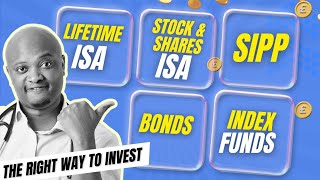
Live-recorded Q&A with Ndubuisi 'Andy' Egwim (MoneywiseDoctor) addressing ISAs and tax-aware saving/investing for doctors and healthcare professionals — especially those near/above age 40. Key points from this chunk: Lifetime ISA (available to 18–39) offers a 25% government bonus up to £4,000/year (max £1,000 bonus); Lifetime ISA contributions can be made until age 50 and accessed from age 60; Cash ISA recommended for emergency savings (tax-free interest); Stocks & Shares ISA is a tax wrapper for investments (no capital gains/dividend tax inside an ISA); total annual ISA allowance is £20,000 across ISA types; Junior ISA allowance mentioned as £9,000; suggested emergency fund of 3–6 months' expenses and example allocations of the £20,000 allowance. The speaker gave tentative figures for the savings allowance (£1,000 for basic rate, £500 for higher-rate) which should be verified elsewhere.
Chapters
You can't just take out your money anytime. Even if people are shouting, they're running around, they're saying stock market is crashing or is booming. You're quiet and you're confident. You know exactly what you're doing with your plan. You don't go around and sell your stocks when the market is crashing, when people like us are rushing in to find bargains and find deals, I prefer to have a longer emergency fund. You invest your money how you like it. If you're a doctor or healthcare professional and you're worried about investing and you get confused about investing and since you worry that it's risky and you worry that you lose money, but you know that you should be investing and you don't understand concept, when you hear things like ISA stock and shares isa, it gets you confused. Then you want to watch this video. This video is a live recording of a live Q and A session with almost 100 doctors and healthcare professionals with burning questions around investing, Lifetime isa investment that doctors could do even above 40 years of age, as well as how to avoid the dreaded 60% tax trap and much more. So if you're interested in those topics and you like to hear the answers we discussed and the questions that we addressed, then you want to dive into this video. And if you are new here, I'm Dr. Andy Green, founder of Moneywise Doctor.com. i'm an ex salary GP, an entrepreneur and investor and a MoneywiseDoctor.com we help doctors and healthcare professionals make smarter financial decisions.
Dive in for someone who is over 40. A friend of mine just came into the country and she was like, oh, she said about Isa and all that and I said, oh, I know that once you are 40, you can't do ISA. And I couldn't give her an answer on what else she could do to save money, you know, for mortgage. That's one.
Okay.
My own personal question is, what's your advice if you're over 40 and you want to invest. Yes. And you're just starting out.
Okay. Those are all. Thank you very much. It's very, very, very relevant questions. I. I understand. That brings joy, isn't it? Yes. So let's dive into the first one. Your friend. You're right. Your friend cannot open a lifetime isa. But they can assess every other Isaac once you cross 40. And for some of us in the community, you already knew I had my birthday on Sunday and my wife did this surprise birthday party for me, but I'm not yet 40. But I'm getting closer to 40. But in this country and in many places, once it turns 40, like every, some doors start to close. So if you're close to 40, you want the lifetime ISA, you need to do it as quickly as possible. I've popped in the link, a video on isa, very detailed, very comprehensive video on isa. And I also put in an article we've done for isa, lifetime ISA that I can look at. But to answer the question for your friend, they can very much assess every other ISA apart from the lifetime isa. So basically, the lifetime ISA allows you to save money in a special account. So a special account, the lifetime ISA account. So that's Lisa, you can save up to a maximum, you can save any amount you want, but the maximum amount, the optimum amount that gets you the best bonus is £4,000. So in a year, if you can save up to 4,000 pounds, the government to give you a bonus of a thousand pounds. So that's the maximum bonus. Obviously, if you save zero, you get zero. If you save a thousand, you get 250. So basically it's 25 of whatever you save in that account. The government is going to give you sort of like that bonus, but it's only for two purposes. It's for buying your first house and for saving for retirement. So if you haven't bought your first house, you're saving towards your first house and you're less than 40. Your best bet, open a lifetime ISA. I used, when I was buying my first house many years ago, I used one called Help to buy isa. So that's an old one, it's been phased out. So a lifetime ISA is an option for you. And lifetime ISA is even much better. So if you can save up to the maximum amount, you get that maximum 25%, I can do for multiple years, four years, five years. Whenever you're ready to buy your house. And a really good thing that works for couple, you can actually open an account for yourself and your spouse. And, you know, you can get a 1000, your spouse will get a 1000. Unfortunately, Lifetime ISA is for people between 18 to 39 years. Once you cross 40, you can't open a Lifetime ISA. Obviously, a few things I tend to suggest to people to be aware of if you decide to leave the country, because I've got like two consultations this last week from doctors in Canada that were in uk. So if you left the. If you leave the country, the lifetime isa, you can't use it anymore, really. If it's already open, you might be able to still put in some money in it the rules obviously would depend on whatever your provider does. And the second rule is that lifetime ISA, you can't really putting more money after 50 years of age. So you can put in money until 50 years of age and you can assess it from 60. So from 60 years of age you can start assessing the money in the lifetime isa. I thought I'll use the opportunity to cover lifetime ISA in case anyone has any questions around it. Now your friend is above 40, can get lifetime ISA, but there are other ISAs they can get, they can get the cash ISA. So the cash ISA, you can use it to save money. So basically if you wanted to save your money in this country, especially in the, for those of you, I think most of us here from the uk, so if you are saving money in an account in this country, you might not know it yet, but I've had consultation where people just realize that oh, they saved this amount of money, they got interest and now they have to pay tax. So there's a savings allowance in this country. It's changed. I think it changed earlier April this year. I could double check the numbers, but I think it's about £1,000. Interesting. If you are on a basic tax rate and then £500 if you're on a higher or additional tax rate payer. Now this, this seminar is not for tax. Tax is a whole different discussion. I've had different talks about it. But the point of it is that if you save money in your account and it cross you get interest above 500 or 1000 depending on your how you pay your tax, that interest is liable for tax, you have to pay tax on it. So what do I usually suggest if you want to save money for your emergency fund? Because that's why I think you should save, you should save for emergency fund and think about investing the rest. But if you're saving for a project, you're saving for emergency fund, you put it into a cash isa. So if you've got a pen and paper, you can write it down or you can look at the article I've posted in the group, you can put into a cash isa. So a cash ISA is basically an account that you can save money and the interest you get is tax free. That's one option for your friend. The second option in terms of ISA, again ISA is basically individual savings account. I look at them as tax wrapper. Just think about as a tax protection. Now the second option for your friend will also answer your question, your own personal question about investing. And that's the second ISA which they call stock and shares ISA is by far my favorite isa, obviously because I use it for investment and also it's tax free. Now, the stock and shares ISA is if you have, if you're planning to start investing, I'll say before you invest in any other platform, if you're planning to invest any money, whether it's bonds or stocks or index fund, just make sure it's inside the isa. Why it should be inside the isa. Always think of ISA like this. Think about it as a tax wrapper so it covers whatever you're doing. Let me give you an example to bring it home. Two years ago, I think was it 2022 when we took a position with Meta Meta Facebook shares. We bought Facebook shares. It was selling for far less than what it is now. I think it's almost doubled since then. Now, normally a normal basis, if you make any money through an investment or trade, even if you go to work in this country, you have to pay a tax on it. But now, because that investment was done through an ISA account, whatever profit we had made from it, if you decide to sell it, that profit is not liable to a tax. So again, if the company pays us dividends, so we heard some companies that pay us dividends, if he pays us dividends, those dividends are not going to be taxed. You don't need to declare them for tax. Now if on the other hand you invested that money through a general investment account or through any other way that is not through an isa, then the problem with that is that you need to declare it in your self assessment so that it can be taxed properly. If not, you're not paying your taxes. So that's basically the advantage of isa. So your friend can still open lifetime, sorry, stock and shares ISA and a cash isa, and those will still be all right. I mean there are other types of ISAs, but I think they're a little bit outside the scope of this discussion because they're for specialist type of investment for investing in startups like scis and the rest of them. But if you remember the ISAs, the basic ones, there's the cash ISA, there's the stock and shares ISA and there's the lifetime Isaac. And if you say, because at the moment your friend cannot assess the stock and shares isa, I'll say, possibly, sorry, your friend cannot assess the lifetime isa. I'll say they could take advantage of the cash ISA to save and the stock and shares ISA for investing there is innovative finance isa, which most times is not, it's not for people who are starting to invest, it's usually for investing in businesses, startups, it's a little bit more risky. There's also opportunity for more reward. I don't know if that's beginning to scratch the surface of your question.
Yes, yes, it's been. All right, so what you're saying is, for the second one now, you put, if you want to invest, you open the cash and shares, cash and stock, isa, and from them you can invest into any company you want to.
Spot on. Exactly this. This is usually difficult for people to get. So people say, should I invest in stock and share that? No, no. Stock and shares, ISA is not, is not an investment. It's just a wrapper that you can put in the money. So, well done. You got the point. You can put in your money and then from there you can either invest in individual companies like I do, or you can invest in index funds, which is basically, you're buying like a bunch of stocks in a basket. Have we've done some videos on index funding.
Okay, so the advantage is that you're not going to be taxed if you put it inside the cash. All right? But if you go directly to buy the S and P, you will be taxed.
That's exactly the point. So if you buy. Well done. So if you buy bonds, stocks, index, whatever, bonds you will be, you won't be taxed on capital gains, but you are taxed on your income bonds. The different discussion, I think we have a whole session dedicated to bonds in the master class. So bonds is a different discussion altogether. All right, well, I'm glad I've been able to answer that question. But something really key and important to mention is that ISAs you have a maximum of £20,000 per year. Because we've had people who wanted to invest more than maybe I've had people who come into consultation, they want to invest quite a bit of money. And the maximum you can put through an ISA is £20,000. So there are many ways to hack this. Some people will have an ISAAC for their wife, have an ISA for their husband, have an ISA for their kids. Kids can have the one we call Junior Isaac, which the maximum is 9,000. So in a family of, let's say four, with two adults, two children, that means you can get a total of 58, 000 pounds allowance for ISA. I know some people say, well, I don't really have 58, 000 pounds to invest. That's fine, it's good to learn it now. And when you have 58,000 or 100,000 to invest. @ least you know where to go with your money.
One last thing. I'm so sorry.
No, carry on.
Do you still get the 25% on the cash ISA and on the stock and shares?
No, there are different instruments all together. So in lifetime ISA, you get 25 in lifetime ISA cash. But there's lifetime ISA stock and shares. But lifetime isa, the one you're saving for buying your first house or retirement, you get 25% government bonus free money. But in stock and shares ISA, you don't get 25%. You, you invest your money how you like it. So in stock and shares isa, you put in the money in the wrapper, you invest it in cash ISA, you're just saving your money. But in lifetime ISA, you can get 25 bonus. If you ask me, then there's a reason why lifetime isa, you can't just take out your money anytime. So that's the downside, because most time people think about the £1,000 in cash ISA, you can take out your money anytime you like. You're not going to get a 25% bonus, but you can take out your money anytime you want. Whereas in life parameter, the one you can only get below 40, you can only use the money for buying your first house or when you retire. And by that I mean at 60 years of age. So you can get it earlier than NHS pension. Does that, does that help?
So very much. Thank you so much.
Yeah, I'm sorry, you will not be getting the 25%. Right, okay. Should we go with the next question? I think it's Muhammad. Right, okay, Mohammed, sorry, Before you jump in, for anyone who is still a bit confused about the isa, I've written a very detailed article from last year. I think it's been visited by thousands of doctors. You can go to. That article is on the website. Have a proper read of the ISAs. If that doesn't work out, then check the YouTube channel as well. There's ISA. If you don't understand anything, even after reading it, write me a comment in the website on the YouTube channel. Ask your question. We'll do our best to answer it as comprehensively as possible. Okay, Mohammed, please go for it.
Hello? Yeah, so one of the. I have like two questions. So one is like, for example, if you have already bought your what a home and you want to, like, you have plans to like, shift to another area.
Yeah.
And so what you can do, like, you can open the account for your wife so that, that can be helpful. Is it like, does it Work like that.
Okay, so let me make sure I got it correctly. Mohammed. So if you already own a home yourself.
Yeah.
You want to move to another place? Do you mean another country or another location inside the uk?
Inside the uk, Another location, yeah.
Lovely. So, yeah, this is very common and I've had that situation in the past as well. So you've already bought a house. That means you effect you're no longer a first time buyer. So you're no longer eligible for the lifetime I saw for buying your first house. But your wife, if your wife has never bought her first house, did not contribute to the buying of that first house, her name is not on the deed, she's not contributing to the mortgage. So in the eyes of the law, in the eyes of basically the government, she's considered as a first time buyer. And some mortgage advisors who say, no, she's not a first time buyer because she's living in the house. But that is not true. That's why you need to have the right market advisors. If your spouse and this is husband or wife or has not bought their first house and their name is not in the document, she might still be in a position to utilize the lifetime I saw. So what I usually say is open it anyway. If you don't use it for your house, you can cash it out at 60 years of age. Does that, does that help?
Yeah.
So who is next? Next is Onyedika, please.
Thank you so much. I'm going to ask some questions about the lifetime ISA and stock isa, but I think you've clarified that. So just to also say if I have a lifetime answer for my for buying a house, I can also do a stock and share ISA as well.
Absolutely you can, you can have both. A lifetime isa. You can have a lifetime is a stock and shares as a cash ISA. All the ISA, as long as you've not crossed £20,000. So £20,000 is the maximum that you're allowed to put in the ISAs before you have to pay tax. Yeah. So you can have more than one isa. In fact, now that you brought that up, I think it's a good opportunity to teach something. What would what we could do. Sometimes people say, how much should I put in my ISA? I usually say you've got £20,000. Think of it as a pot or a pie. First of all, you want to save your emergency fund. For those of you who have already followed our previous video on 7 things you need to do before you start investing, I'll share this video. So you know, you know that one of the things would usually say would be to save your emergency fund before you start investing. So that's. That's one of the things you need to do. I'm going to share that here, first of all, one minute. So those of you who haven't watched it, you have the opportunity to watch it.
I can find it and share.
Oh, thank you very much. Right, so is in the link now. So basically, if you've got 20 cake on the sidewall, I want to save my emergency fund first. So what is the emergency fund? I think Chigo was on the podcast and she did an excellent description. So that's three months worth of your living expenses before you invest. Don't rush to invest. Even if you're coming to the master class, don't get excited. In fact, it's part of what we're going to teach, the things you need to do and make sure you've done it before you start investing so that you are a safe investor. You don't go around and sell your stocks when the market is crashing, when people like us are rushing in to find bargains and find deals. So those seventies are really important. One of it is your emergency fund. So that's three months to six months worth of your living expenses saved in a. In an account where you can assess it easily. So that account, I tend to suggest a cash isa, not your regular bank account where they give you a funny interest and then also taxi on it, use a cash isaac, you save it there, that's three to six months worth. Obviously, if you've got a salary job and you've got NHS pension, you've got all those things, you might want to save three months, that's fine for a start. For someone like me, I haven't got a salary job, I'm not on the nhs, but I'm not on any of this stuff. So I prefer to have a longer emergency fund. So if you have an emergency fund, let's say for instance, that your monthly expenses, just a rough number, say it's £2,500 and you wanted to save three months worth of the emergency fund, so you need £7,500 saved up in an account where you can assess. Doesn't happen that let's say your car has a problem, something comes up, or you suddenly lose your job and you need three months period before you start your next job. I mean, we're not praying for any of those things, but emergency fund is just there to cushion you so that you're not shaking if things go wrong. And part of the reason why I was able to step away from my salary job two years ago was having a good emergency fund by the side. I knew even if I start something by then I hadn't launched Money Wise doctor. I thought even if I start something, if it had not started generating income, I'm fine for the next few months. And for the first one year we didn't bother too much with any income or anything on money wise doctor. So that's emergency fund. So if you have an ISA, you have £20,000 allowance. 75 is going to emergency fund. And I don't mean 75 for everyone. I'm assuming that your monthly expenses is 2,500. Obviously for you to do that you need to then go and look at your monthly expenses, really check what your budget is for real. £2,500 times three, that's 75. You still have another, let's say is that 12,500 left. So you can decide, okay, for this, £12,500 left because I've not bought my first house or even I want to save for retirement, I'm going to put £4,000 into a lifetime, Isa. That's if they are less than 40 years. So you've taken 75 into your cash, Isa. You've taken 4,000 into your lifetime, Isa. And how much do you have left? About 8,000 or thereabout or 8,500 pounds. You can then decide that this amount of money, 8,000, is what, what I'm going to invest in, whether it's stocks, shares, index fund. That way you can utilize your whole isa. Now for someone like me or for someone like you, depending on yourself. If you have emergency fund and you've not used it the next year you might not need another emergency fund and the next year again might not need another emergency fund. So you can just leave the emergency fund where it is. But because you have another £20,000 tax free allowance, you, you can then decide, say, oh, for this year I'm going to put 16,000 into my stock and shares, Isa. And I'll put 4,000 into my lifetime Isa. Or you can decide to put all in stock and shares, isa. I mean again, these are just numbers depending on your situation. It doesn't mean that if you haven't got 20k you can't invest. No, that's silly. If you've got a hundred pounds, that could be your plan. It could be investing 100 pounds every month for the next sort of, you know, till you get more income. Yeah, but I hope it's clear. I hope, I hope, I hope it's very clear to everybody.
So what I'm saying is that for all the answers you have a total sum of 20,000 maximum per year.
Spot on. That's it.
Okay, and then one more question before the next person asks.
Okay.
I've been looking at property for private residence and at the same time looking at property for rentage for business. And it seems as if seeing a cheaper one for rentage at this point, being a first time buyer is advisable to buy a house for business first before buying the one for your private.
Right. I'm just going to say today's seminar is mainly about stock market and all that. We've had seminars on property and the rest. But I'll answer your question quite quickly. I think it's always better to. In my own experience, I'd already bought where I lived first, then known how to live there before I rented it out and then bought another one. So I always think it's better option to buy where you live first. And some banks will not agree to lend you money if you, if you tell them that I want to buy a property and I'm renting. Obviously if you register a limited company for buying a house, like we call it special purpose vehicle and SPV is a limited company you can use to buy a house, then banks can lend that company money. But as an individual, some banks will say no. But again, let's probably leave property for another discussion. For now I want to sort of like focus on stock market and stock and shares, bonds and all that. Well, I hope that answers your question.
Yes, yes. Thank you so much.
Good. Okay, should we crack on next? We've got about 15 minutes left.
Next is Sharma.
Thank you.
Sorry if I didn't get the name right.
Thank you.
No, actually got it. Pretty right.
Lovely. Dr. Sharma?
Yeah.
Yes, hi. Sorry, I just had a question about tax relief on these ISAs. Of course there's a situation where a person needs to bring his annual income below 100,000 and I just went through your blog saying that the SIP is the best option getting out of it. If you are between 100,225. Are there any ISAs that can bring your adjusted net income below 100,000 or is SIP the only way we can do that?
Yeah, thank you for bringing that up. Thank you very much. It's something that we get to most people ignore because a lot of time we are focusing on making money but you need to think about how to optimize the money you've made to make sure that you're not paying half of it in tax. I think you're referring to the blog. I think that blog hits number one on Google. It's called how to avoid the 60 tax trap. Is that the one you're referring to?
Yeah, yeah, yeah.
Okay. That's, that's, that's because you also lose.
Your child care tax benefits if you go across 100,000.
It's horrible. Should I. Do you mind if I just explain it to everyone? Just because some people might not understand it, they haven't done the homework like you. Have you read the blog?
I'm pretty sure a lot of people have, but yeah, it's a nice one.
Thank you. So, the 60 tax trap. Basically, a lot of people don't understand that in the UK think that the tax is at 20, then 40, that is 45. But unfortunately, especially for doctors, healthcare professionals, once you start earning above a hundred thousand, well, the actual figure is a hundred thousand and four, one hundred four thousand or thereabout. I think I specified the actual figure. Once you cross that amount, if you end every, every two pounds that you earn above a hundred thousand, for every two pounds extra you earn above 100, you lose one pound of personal allowance. Now write personal allowance down if you don't understand it. I'll explain it in one sentence. So basically what it means is that if you're a consultant or GP or even your junior doctor or even a nurse, whatever you do, you are in above a hundred thousand and it's coming to you as a salary. For every extra hundred pounds, every extra two pounds you earn above a hundred thousand, you lose one pound of your personal allowance. So effectively, by the time you're earning, your earnings get up to 125, 140. So 1, 2514 to 125, 000. Basically, by then you'd have lost all your personal tax allowance. Why does that matter? In the uk, everyone has a personal tax allowance. That means that if you earn money below that amount, you don't pay any taxes on it. I just wanted to explain it so we can use that opportunity to answer other questions. So if you earn money below the personal tax allowance, you, you don't have to pay any amount, any tax on it. Can somebody tell me what's the personal tax allowance? How much is it? 12, 750. Thank you. Thank you. So very close, both of you. So it's 12, 570. Thank you, Alyssa. And I don't know. Was that Joel? So it's what 12,570 is anyone who earns any money less than 12, 570-is- not liable to tax. So even yourself, when you earn money for the first 12, 570is fine, there's no tax on it. But once you cross 100,000, then you start losing that personal allowance. So that basically, effectively you're being taxed 60% when you compare it to the rest of the population. Now doctor, Dr. Herman's question is, how can you avoid that 60% tax trap? Because once you get into that tax band, you don't just get taxed more, you start losing things like child benefit. All sorts of things like really, really nonsense starts to happen. So the biggest way, and Dr. Sharma, this is now your, the answer to your question, the biggest way is pension. So why we say pension is because you are allowed to put up to £60,000. I mean a couple of years ago it used to be 40,000, even last year. Now the government allows you to put £60,000 into your pension, tax free. Obviously when you start pulling the pension in the future it could be taxed, but again there's a way to withdraw it that you don't get any tax. So pension is the biggest way. So if you take, you don't have to put 60, 000 in pension, you put as much as you can, any money you don't need, straight away into your pensions, whether it's your NHS pension or is a self invested personal pension, that's sip. So that's one way. Now.







