Believing I Have No Sin Self Deception Series 18 – Purity 1107
M.T. Clark explores the self-deception of claiming "I have no sin," using 1 John 1:8 to show why denying personal sin contradicts Scripture. He traces how the 19th-century Holiness movement taught Christian perfection, and explains that believers can experience victory over outward sin but must acknowledge ongoing sin until glorification.
Chapters
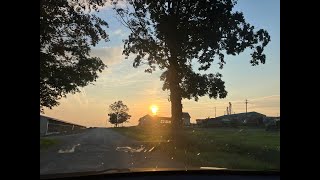
To see today's photo, go to mt4christ.org or follow me, M.t. Clark, on Facebook or Twitter. Good morning. Today's photo of the setting sun over the Allen Waite Farm with a less than clean windshield filter comes to us from yours truly as I drove down the last leg of my trip up to my countryside home in Easton, New York last evening to officially begin my 2-week vacation. Yesterday was a hot one in upstate New York, and even though I was blessed with a relatively easy last day of work at my 9-to-5, my spirit, or the Spirit, convicted me of the need to be a good steward to what the Lord has had provided me with at River House, causing me to decide to mow the lawn down by the river and take care of a few other household responsibilities after my day job. Before I could have peace about going on vacation. The temperature was about— was around 90 degrees. The lawn was thick, and the work was truly a work of patience, endurance, and prayer. While I have been known to experience the heights of ecstasy over joyfully stewarding my property in the past, yesterday's mowing session was a struggle that required a steady stream of a reliance on the Lord's strength and blessing. While I listened to worship music as I worked, the heat was draining, and even though I had moments of joy, most of my, uh, yard work session was spent calling on the Lord to help me to complete it. At the halfway point, I stopped the mower to top off the gas and was severely tested when it initially refused to start. After 3 failed attempts to bring the engine back to life, and with thoughts in my mind that I flooded it I was overcome with a moment of hopelessness and perhaps a demonic taunt that the mower wouldn't start. But because I was convinced and determined that I must get 'er done, I took a deep breath and paused and restated my intention to myself, or the enemy, that I was going to finish this last task before vacation no matter how long it took. And then I did what we should always do, uh, when we are being tested. I called on my Heavenly Father for help.
So I took a— oh boy, I just scrolled way away from what I was reading.
So I took a long deliberate pause and then I prayed, God, make it— please make it start, or something along those lines. And pulled the pull string again. The engine showed the faintest hint that it was thinking about starting, and I said, "Thank you, Lord, for starting the mower." And what was a whisper of a hint of the engine starting puttered until the engine was resurrected and roaring to life, to which I proclaimed, "You are a good, good Father, Lord. Thank you." While that wasn't the end of the struggles with the lawn, the front end of my property was particularly dense and required more prayer for strength and patience, I had the certainty that I would be able to accomplish what I was set out— what I set out to do eventually. And I did, with much toil, sweat, and the Lord's help. This is just another example of what walking in the Spirit can look like. A seemingly mundane or commonplace task properly becomes a place where we can commune with and rely on the Lord. When we put our faith in Jesus, God is with us always, so we should spend our lives abiding in his presence and drawing from his love, peace, strength, and wisdom. The Lord's continual presence is a truth of our new lives in Christ and an integral part of our victory over the lies of the world, the flesh, and the devil. And that brings us to our current series on self-deception, where we have decided to investigate some of the ways we deceive ourselves by walking through step 2, deception versus truth of the Steps to Freedom in Christ, uh, to see what ways we may have been deceived by the world and ourselves, and in what ways we have wrongly defended ourselves. So we present the second of the ways to deceive yourself, uh, today. Uh, number 2 is saying, "I have no sin." The scripture reference for this point is 1 John 1:8 in the New King James. Version, the Word of God says, "If we say that we have no sin, we deceive ourselves, and the truth is not in us." Or as—
yeah, so that's, that's the verse.
While I refer to yesterday's first item on the self-deception list, hearing God's Word but not doing what it says, as the free space of the bingo card of the Steps to Freedom in Christ, because every person I have led through the steps has admitted to it, today's item is one of the few check boxes from step 2 that is rarely checked off, and I don't recall anyone ever admitting to saying they have no sin. However, as infallible human beings, we have no limits on our ignorance or pride, and this item makes the list because, as hard as it may be for us to imagine, there are people out there who will say they have no sin. Like the rich young ruler who pridefully and ignorantly proclaimed having kept the law from youth, there are apparently some people who believe they have arrived at a Christlike state of sinlessness. This phenomenon is shown in the history, uh, in, in history, uh, in the history of the Holiness Movement in the 19th century, where certain Protestant denominations preached that Christian perfection, a sanctified state that enabled one to be free of outward sin as well as evil thoughts and tempers was possible. Although I can testify that freedom and victory over many areas of our outward sin is both possible and something we should pursue with diligence, the mistake that is made here is that one would contradict the Word of God by saying they have no sin. The Apostle John tells us clearly, if we do that, we deceive ourselves. Yes, we may stop sinning in many areas of our lives, but if we understand the full measure of what sin is, we should never come to the conclusion that we have no sin.
Sin not only includes thoughts and actions that are disobedient to God's word, it also—
it is also a sin to not do all the things that we know are good, that we sh— that we know we should do. Perfectly all the time. If we unders— if we understand it, the one thing that should never allow us to ever proclaim that we have— are without sin is our limited knowledge. We do not know everything, and we do not know the Lord's will for our lives perfectly. So, if we are honest, we should agree with the Word of God and never say that we have no sin. Our attitudes, actions, thoughts, or the things we fail to do would testify against us. So strive for sanctification humbly and celebrate your victories over sin that you experience, but, uh, never make the mistake of saying you have no sin. Because of our ignorance, shortcomings, actions, failures, thoughts, pride, or inaction, when we say we have no sin, we are lying to ourselves or others, and that qualifies as sin. Gotcha. So think deeply and see that while we can be getting better all the time, we have to admit that we won't be free of sin until we are glorified and the Lord's kingdom comes into full fruition. Today's Bible verses come to us from the Quick Scripture Reference for Counseling by John G. Cruis. This morning's meditation verses comes from the section on Affliction, Discipline, Chastisement, and Trials. Today's verses are Psalm 119:71 and 72, and the Word of God says, "It is good for me that I was afflicted, that I may learn your statutes. The law of your mouth is better to me than thousands of gold and silver pieces." Today's verses fall under the fifth point of our Counseling Reference Guides resource section on Affliction, Discipline, Chastisement, and Trials, and that Point is the psalmist— number 5— the psalmist was thankful for affliction, for it taught him to keep God's precepts. Today's verse— verses are the second of a trio verse couplets from Psalm 119 that our reference guide uses to illustrate this point. Continuing the theme, today's verses are the atypical admission that comes from proper reflection that is often associated with the higher abilities of perception by one who was educated by the wisdom of the LORD and a few lessons from the school of hard knocks. For the most part, it is hard to appreciate suffering. Some would deny anything of value coming out of the bad things they experience. And while others may agree that they have learned things from the afflictions they have faced, not everyone in this group would tell you that their sufferings gave them a heartfelt desire to learn and obey the LORD's statutes. However, the psalmist proclaims that knowing the Lord's law, his instruction, is of inestimable value, and that his afflictions helped him to realize it. His suffering sent him to seek the Lord's help, and within his word he discovered the wisdom of how things really are in life, and he considered it to be priceless information. He undoubtedly learned that when he chose to sin, he chose to suffer, And his afflictions gave him the desire to avoid future sufferings, some of which he realized he could avoid by knowing and applying God's wisdom to his life. So, let's seek the Lord's wisdom and apply it to our lives to avoid affliction where possible, and to be comforted and strengthened when it inevitably comes to us. As always, I invite all to go to M.t. Clark.org where I always share insights from prominent Christian theologians and counselors to assist my brothers and sisters in Christ with their walk. Today we continue sharing from A.W. Pink's The Holy Spirit, and we're continuing to share from chapter 16, The Spirit Working Faith. And today's section is called Saving Faith is the Work of the Spirit. And so if you want to see that saving faith is the work of the Spirit, go to M.t. Clark.org and you'll see that resource at the end of today's blog post. As always, we encourage a lifestyle of Christian discipleship because the Lord is with us at all times, and it is good to know his instruction and his precepts and his statutes because they do reveal how things really are in life and what ultimately will matter the most—our relationship with the Lord. So we encourage faith in Jesus Christ and living according to the Word of God. Little by, you know, and trying to be sanctified, trying to be free of sin bit by bit, little by little, but at the same time we should realize that, you know, we're not—
we are far from perfect, and to say we are without sin, we do not have sin, would, you know, would be deceiving ourselves. So, So that's that.
We encourage people to experience their freedom in Christ, and if you don't know what that means, we usually recommend that you check out our discipleship classes that are on our podcast and YouTube channel for Victory Over the Darkness, The Bondage Breaker, and Freedom in Christ. Those are all works by Dr. Neil Anderson that are based on the Word of God, and we just happen to find them life-transforming.
So That's why we decided to get trained and offer those— get trained to teach them and then teach them and lead people through the Steps to Freedom in Christ to resolve their personal and spiritual conflicts.
So if you've never done that, we recommend that as well.
And you can find more information by going to ficm.org or anywhere that Neil Anderson's books are sold. Yeah, and obviously we also recommend knowing the Word of God and having a personal Bible study, you know, or a spiritual daily practice every day, because it'll change you from the inside out. Our minds need to be renewed by the truth of God's Word, and so we actually have to sit down and read it.
We encourage Bible study on the podcast by offering our topical Bible study, a little show we call Bible Study with the Sincatis, where we discuss topical—
a topical study every week that Arthur authors and, you know, causes us to think and to share about how we do this thing of living as a disciple of Jesus Christ. So, well, it is Saturday, it is my vacation, and we're going to have a great day. I'm not sure what the day holds, but I am with my wife, and I'll be— and the Lord is with us, and we'll do our best to enjoy it and to enjoy each other's company, come what may.
So it's my prayer that anyone listening to this has a great day as well. And, uh, so let's pray. Lord God, Heavenly Father, thank you for another day in your kingdom.
Lord, we thank you so much, uh, for the freedom you've given us, for the help you give us, the strength you give us, the wisdom you give us. Um, you're a good, good Father, and, um, you help us when we need it. And so we ask you to go before us today, open our eyes to the things you want us to see, and help us to move into the things you want us to do. And help us to represent you and your kingdom here on earth in whatever way we can. And Lord, we pray for our friends who are listening or reading today's message. We pray for you to come alongside them and their prayer requests and to help them in their walks, Lord, 'cause we all need your help to be more and more like Jesus. And while we know we'll never be like Jesus in the fact that we have no sin, We want to— we want to look more and more like him all the same.
So, Lord, we thank you, we praise you, we love you, and we pray all these things in the mighty name of Jesus.
Amen.
More from M.t.




Making Too Many Mistakes and The Mercy of God’s Grace and Favor - Purity 1811






