Lemon Meringue Pie - My Humble Kitchen with Arthur and Suzanna Cincotti
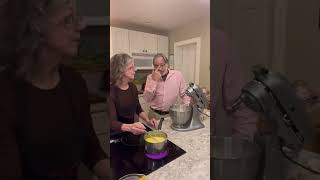
Arthur and Suzanna Cincotti make lemon meringue pie using Mighty Fine filling mix, half the usual water, and an extra egg yolk. Suzanna separates fresh eggs and whips a stabilized meringue with cream of tartar and commercial powder. They share tips like venting the crust, baking at 350°F for 11-15 minutes, and wetting your knife for clean slices.
Chapters
Hello again everyone and welcome to my humble kitchen, uh, from another angle this time. Uh, today we're going to make a lemon meringue pie, or at least we're going to make the filling. Uh, I'm introducing my lovely wife Susanna here. Uh, 34 years of marriage we're going to celebrate in a few weeks. We've made a crust, it's an 8-inch pie crust, and we've done that, we bake that separately. Because this pie filling goes into an already baked pie crust. And Suzanne has really been the expert on the lemon meringue filling. I've showed you how to make pie crusts in two other videos, our apple pie video and the pumpkin pie video. So I'm going to let her, uh, take the helm for the filling and the meringue. And this is a real— this is a winner. This one's a winner, it really is. Okay, go ahead, sweetheart.
Oh, the thing is, when I first met and married Arthur Don't go out of the camera, get over here. His mother told me that his favorite pie was lemon meringue, and she made it for him. Still is. And then of course the other one was the strawberry shortcake. We'll have to do that another time. Yeah, but the lemon meringue— and so I made a couple of lemon meringues, and in the past I've made them and they seem to be thin and watery, so I've changed a little bit of the recipe. Now you need to get yourself a good brand of cooking the pie filling, not, not the instant one, but the cooking one. Okay, and so the one that we use is called Mighty Fine. I hope that's okay with us copyright-wise, but anyway, it is the best one and it has the directions on both sides. Now what I do is I use 2 of these of the package mix, but I only use one of the directions for the water. So that's going to be important. So the first thing we're going to do is going to put 2 packages in a saucepan. It's one, yes, and two. Then it calls for a cup of sugar, um, a half a cup of water But before we put the water in, we're going to put in 5 egg yolks. It only calls for 4 with the 2 packages, but I always put in a fifth one because it makes it that much more wonderful. Then you put the whites in the meringue bowl. Okay, this is the way I do it because I've been— I was showing you how to do this with a lady who made icons, who painted icons using natural ingredients and using eggs that were fresh, fresh eggs. You just use your hand to scoop the egg, the white off of it, and then put the yolk right back in there. All you have to do. Take this off for you. Yeah, give me a little bit more.
Thanks.
Yeah, you do. So you're just catching the egg, letting the white fall into the dish, and then the yolk stays in your hand. Just drop that right in the pan. Right in your hand.
Wow, that's a like a nuclear egg.
Yeah, well, these eggs come from our friend Kathy. Yes. And Rick, they have their own chicken, so these are farm-raised eggs. Chickens are natural, they're free-range, they're not— there's no, um, cages or any of that kind of stuff going on for these chickens. They're pretty spoiled if you were to ask me. Pretty much a spoiled chicken if you ask me.
You don't have to use free-range eggs, okay? We just happen to be fortunate enough up here in Upstate New York to have a bunch of farmers around us, and, uh, or wannabe gentleman farmers. And the latest thing recently is a lot of people have been raising chickens.
Our neighbors next door have got chickens, and we might get to use some of them because they keep coming in our yard. Now I'm going to wash my hands. Arthur, you start stirring that mixture and add the half a cup of water for you.
Today I am the stirrer. I am the official stirrer. The sous chef.
The sous chef. Okay, I can be the chef and you can be the sous chef.
I don't know if they do that in baking, if they have sous chefs or—
but anyway, we have to ask our daughter Sarah because she's the one that was the baker at CIA. Adam was our, our chef chef, our savory chef, which Sarah was our— is our baker. You got those all good together, I see, hon?
Yeah, it looks great.
Okay, so now we're gonna—
yeah, top.
Okay, we're gonna use this one here. And now you're gonna start stirring and stirring and stirring and stirring and stirring and stirring and stirring and stirring. Now guess what, sous chef? You're gonna get to stir. Keep stirring.
Okay, so you stir this for 4 hours and 73 minutes.
No, I'm just kidding. No, it takes probably about 9 to 10 minutes for this to— what you're going to do is you need to bring it to a full bubble boil, and what is going to happen is going to thicken up while you're stirring. You're going to feel it thickening up. Okay, so that's what I do. I— when I use 2 packages, I use the 4 eggs with plus the flour, and I use 1/2 cup of water, and then for the rest of it, I only use 2 cups of water, not 4 cups of water. And that's going to keep the lemon part of it from being watery. Now for the meringue, while he's stirring all that, we're going to get this going too. Okay, so for the meringue, now you find the meringue on the side of the package too, and again, we're doing it— we're doubling it. So we're going to need— I use the cream of tartar. How much was that?
A quarter teaspoon?
Half a teaspoon.
Half a teaspoon.
And then I also use what's called a meringue powder, and this one I use half a tablespoon. And this is what this is going to do, it's going to stabilize the egg whites, and so that when you're— wait, you keep it in the refrigerator It's going to start, um, it can break down if you're not careful. You don't want your meringue to break down. Now I'm going to start the mixer. It's going to get a little noisy, I'm sorry. There we go. You want to let it start getting frothy. It starts getting frothy, you don't have to stir quite so strenuously here.
I'm exhausted.
Like a racehorse or something. Okay, when it starts getting a little frothy, you're going to gradually add a half a cup of sugar. Continue to get frothy. Like I said, this is one of the things that Arthur's mom taught me. But she said that Arthur liked it best, and then she and I talked about changing the recipe just a little bit. I think sometimes you can do that kind of thing if you see that there's something you need to change. And I was talking to my friend Kathy, who gave us the eggs, and she was saying that, yeah, that sometimes her lemon meringue gets watery after a while. I said, well, don't use the full amount of water, use half the amount of water.
Oh, you can use more eggs if you'd like the meringue to be higher.
That's what I do. The package only calls for 2 egg whites, but I use 4 or 5 egg whites. Yeah. And then that gets it a nice height to the meringue. You don't want a wimpy meringue. You want a nice solid meringue.
We have not transferred much heat yet, but, uh—
Yep, it's gonna happen.
That's what they all say.
A watched pot never boils.
Well, I can't stir it and not watch it at the same time.
Oh, you want me to stir it for a while? No, I'm good. This is kind of the waiting game part, but, uh, it's been a lot of fun with these videos getting bigger.
It has been, and we're bringing back holiday memories. We're coming up very quickly on Thanksgiving. Today is already the 17th, and We're hoping that these are instructional for folks out there to make their holidays special and festive. We've got any menu of folks that could be watching, new housewives or people just starting out in their baking adventure, want to make, want to make an impression, you bring these on your Parties, as you go into different people's houses as guests.
Oh, that makes me think of a story. My Aunt Hilda used to make a wonderful pumpkin pie. No, no, no, excuse me, pecan pie.
Pecan, that's very Southern.
Very Southern. We all joined my mother's and her sisters would join up in Arkansas at my grandmother's house in Marianna, Arkansas. She, my Aunt Hilda, would bake these pies and then put them in her trunk of her car. She and my Uncle Bill and the cousins would drive from wherever they were in Mississippi, where we were living, over to Arkansas. And they would— and we would— I remember always when they drive up onto the driveway at grandmother's house, we'd all get excited because we'd run to the trunk to make sure that the pies had made it all the way from the house to grandmother's house. And it was my brother Taylor, the Pumpkin pie is my brother's absolute favorite.
Well, fortunately, I'm sure it wasn't a bumpy road.
I hope not. Mississippi and Arkansas can be kind of bumpy.
We took a pumpkin pie, the one that we made earlier in the week. We took the pumpkin pie to church this morning. Oh yeah, with some fresh whipped cream. Uh, nice touch to add fresh whipped cream if you have one of these. It's not a big deal to make. I add about a teaspoon of powdered sugar to a small half a quart of whipped cream and a few drops of vanilla extract. Adds a little bit of flavor to that as well. And the pumpkin pie was a big hit in church.
Okay, so our meringue—
all we have is is an empty plate that we took home with us, and I was lucky to get a piece for myself.
Yes, you were. The meringue is now to a point where it's making those little peaks, so we know that it's ready to go. We can turn off that noise machine.
Is that enough?
Okay, it's gonna be fine, trust me.
Okay, I'm quality control here, you know. I have to, uh, this is Arthur's Humble Kitchen, so I get my name on the, uh, I think it's called My Humble Kitchen, so it can be either one of us. Okay.
Oh well, you don't need to claim it all for yourself.
This is getting warm and it's getting delicious. When I was a kid, my mom would have all she could do like that. I just didn't eat the lemon as pudding before she put it in the pot.
Yes.
Oh yes, this was my favorite part. Which you can do, you know. You— this— you could put this in cups and make a really good pudding.
Oh yes, absolutely. Any of these baked— any of these cooking puddings, I love these. We don't like the instant ones because they just don't taste the same. Yeah, a nice cooked pudding always tastes so much better.
Well, it does. We cook the chocolate ones, natural ingredients in here.
And, um, so let me take over for a while.
All right, we got some steam coming up.
Yeah, it's gonna start. You can see it's—
come on, lemon, come on!
Oh my stars and bars. As you can see, though, it is a nice color yellow, and it's gonna— it's gonna get— start getting thicker, thicker, thicker, thicker, thicker, thicker, or thicker, or thicker, or— I don't know, I think we'll have to have some of our English teaching French friends, let us know which is the right way to say it.
I think it's thicker.
Thickerer? The thickerer it is? I can start feeling it, starting to feel that thickening portion to it. I can feel it.
These videos that we're doing are also sort of a tribute to my mom, who was an excellent baker in her own right, self-taught, of course. Although my dad—
my dad, rest in peace—
my dad was a professional. He had a bakery in the North End of Boston on 39 Cooper Street through the '30s and '40s, Sincotti's Bakery. And it's not a bakery anymore, it's been turned into an apartment. But he worked a brick oven, a coal-fired brick oven with those long peels.
Wow.
And he baked bread through the night, he had to stoke that oven. And my dad, I'm told, was one of the first bakers in the area to use fortified flour. Oh really? And that was quite a time for him. He was a great guy. I was not yet born in 1940 anything. I was born in '58, and my dad had moved on since then he became a pipefitter with Local 537 in Boston. So I give a shout out to the 537 pipefitters in Boston. Um, my dad was an excellent pipefitter. He had a spirit of excellence. And my brother Carl is also a pipefitter with Local 537. But they were excellent parents. They genuinely were good to me. I unfortunately definitely was the rebel and the stinker.
You were the youngest.
In the mix. I was the youngest of 4 boys.
4 boys, can you imagine?
Yeah, and so I at times was not very nice to my parents.
You repent of that. You're forgiven.
Well, you know, that's the truth, and there is redemption in Christ and in Christ alone. I'm not doing this to try to make up for anything. Thing. That's bad theology. That's very bad theology. But in retrospect, I do want to give a shout out to my parents because they were very good people, Nicholas and Vincenza. And, um, you know, I'm blessed to have had that, had a healthy home and, and good parents.
Okay, our pudding is now coming into a boil.
I see that.
And it's starting— you can see where it starts to gel. You see See that it's starting to have those little glimmeries of glassy looking ice kind of stuff in there, right? That's what we're looking for. Okay, it's gotten thick. It's getting nice and thick. Okay, I'm just gonna get one more stir because there it goes for its boil. Oh boy. All right, there you go.
Good job.
Okay, good job.
Magical pie crust appears.
There's that pie crust that he baked for us. Exactly. And the thing that he told me about the pie crust though is in baking it, you have to make sure that you, um, vent the bottom of the pan.
Yes, perforate the bottom of the pan. All right, otherwise— and we lined it, uh, inside the crust with aluminum foil so that it doesn't collapse in on itself and it doesn't puff up from the bottom. So we—
and I know I can't— went off screen because I tend to do clean while I go Okay. All right, so anyway, so now what we're going to do is we're going to pour this into the pie crust.
Nice. Oh, that looks amazing.
And then the thing about doubling the, the recipe by using 2 packages, you don't get this teeny tiny skinny lemon meringue part— lemon part. Yep. I just can't stand that tiny, tiny lemon meringue stuff.
Okay, I'll take it.
Why don't you take that for me? Okay, thank you. You let this cool for a little while, and I'm going to go ahead and put on the meringue.
I'll clean this for you.
Hey, I know you will, darling. Was he licking the spoon? He was, wasn't he? Behind my back.
There you go.
Wow, now you're not gonna eat one.
Bend down here. I washed it at the— in the dishwasher.
He's such a liar.
Okay, what's next?
Next, we're just waiting for just couple minutes for this to cool. But if you'll come and help me— yeah, you can do this. If you'll hold the— no, stay where you are.
Okay, so in a perfect world, you know, we're, uh, we're not editing, we're very real novices at this, but in a perfect world we would want to let this cool, let them, uh— and but we're going to, um, go ahead, we're going to take a chance and see what happens here.
So it's just like pouring marshmallow on top of something.
That looks great.
Yeah. Okay, let go. Now the thing about this meringue is you need to make sure it goes all the way to the edge of the crust and cover the lemon part, because if you don't, it's going to pull away from the crust and the lemon part is going to be exposed. Now here's a little trick: you can make these little peaks with your back of your, your thing, paddle or your spoon or whatever you're using. And then in the oven, those little peaks are going to brown up and be very nice. You can stick that right in the oven, honey.
All right, so we got a 350 oven.
350 oven.
Okay, and how long is this going to go in for?
For 11 to 15 minutes.
11 to 15 minutes.
The top of it is nice and brown. Okay.
Wow, magic! Look at that, 11 minutes is up and this is what we've come up with. That is a beautiful lemon meringue pie, and let me tell you, it's delicious too. It genuinely is. I highly recommend this for your Thanksgiving feast. Uh, it's, uh, it's not because— because sometimes folks are intimidated by the meringue, you know, it's not commonly made anymore, but you don't have to run out and buy one. You can make this very easily. We've done this in about 15 minutes. It takes about 15 minutes for the crust as well, uh, and add baking time, maybe 45 minutes total. Let that cool, let the whole thing cool. You want to serve it, uh, nice and chilled.
And when you're waiting, just put it in the refrigerator and let it cool completely.
And, um, my mom gave a little tip, is when you go to cut the pie, wet the knife Wet the knife.
Yes, and that keeps it from sticking to the meringue. Yeah, mostly wet this and just wet the knife again. There you go. She always did that. Yep.
I'm gonna go off screen for just a minute and get me a dish, right? So that I can have a slice, right?
You grab your dish. Yeah, he's always trying to get me out of the screen, I think. All right, see how it looks.
Oh, look at that! That is a beautiful—
you got a lot of lemon and you got a nice height on your meringue.
Do we have a spork?
A fork? Yep. Boy, you're demanding.
Oh boy, this is what I've been waiting for. Okay, this is a fork, this is a pie, and this is me.
This is Arthur. Let's see how it tastes.
Here you go, sweetheart.
You sure?
Yeah.
All right.
Well, oh, that's great. There's a nice firmness in the lemon, and, uh, my crust is a good, good height, 3/16 of an inch thick or so. So I'm tasting the crust, you know, the meringue. It's all coming together. That's an excellent pie.
Okay, well, thank you very much.
Thank you very much. Suzanne is going to sign us out. God bless and enjoy your Thanksgiving. Remember one thing: Thanksgiving requires an object.
More from M.t.




Making Too Many Mistakes and The Mercy of God’s Grace and Favor - Purity 1811






